China's three-week open-weight sprint: Kimi K3, Qwen3.8-Max, and the twist that could end it
In three weeks China's biggest AI labs shipped or teased frontier open-weight models — Kimi K3, Qwen3.8-Max, and DeepSeek V4 at general availability. A plain-language guide to what each one is, what actually shipped versus what is still a promise, and why Beijing may now restrict the wave it enabled.
Between July 16 and July 26, three of China's biggest AI labs put frontier-class open models on the table. Moonshot AI announced Kimi K3 on July 16 and shipped the weights on July 26. Alibaba unveiled Qwen3.8-Max at WAIC in Shanghai on July 19. DeepSeek's V4 line reached general availability around July 20. Three labs, roughly three weeks.
The pattern is hard to miss, and it is not the one the Chinese open-model scene built its reputation on. These labs were known for small, fast, cheap models that punched above their weight. This wave is the opposite bet: trillion-parameter systems released, or promised, as open weights.
This is an honest read of that wave — what actually shipped, what is still a preview or a promise, and the twist that arrived with it: the same government that enabled these releases is now weighing whether to restrict them. We will keep the jargon to a minimum and explain the rest as we go, so you can follow the story even if "open weights" and "mixture-of-experts" are new to you. If you read our July roundup, this is the sequel, and one of its cliffhangers has resolved.
Image: OLCF at ORNL, Wikimedia Commons, CC BY 2.0.
First, the five ideas that make this make sense
If you are new to this corner of AI, five terms carry most of the story, and they are worth a plain-language minute before we get to the models.
"Open weights" is the whole reason this wave matters. A model's weights are the giant grid of numbers it learned during training — effectively the finished brain. When a lab releases the weights, you can download that file, run the model on your own hardware, adapt it, and build products on it without asking anyone's permission or paying per request. The alternative is a closed model, like most commercial chatbots, where the weights stay locked on the vendor's servers and you rent access through a paid API. Open weights turn a model from a service you rent into a thing you own a copy of, and that difference is why an entire industry pays attention when a good one ships.
"Parameters" are those learned numbers, and their count is the rough proxy for how much a model can hold. A "2.8-trillion-parameter" model has 2.8 trillion of them. Bigger is not automatically better, but at the frontier it usually means more room to reason — and, just as importantly, more hardware needed to run it. That is where "mixture-of-experts," or MoE, comes in. Instead of firing every parameter for every word, an MoE model is split into many specialist sub-networks called experts, and a router picks only a handful for each token. So when you see "2.8 trillion total, 104 billion active," it means the model is enormous but only about 104 billion parameters do work at any given moment — like a hospital with thousands of specialists on staff where only the few relevant ones see each patient. The total hints at how capable it can be; the active count tells you how expensive it is to serve. That gap is the single most useful number for judging cost.
A "context window" is how much text the model can hold in mind at once, counted in tokens — and a token is roughly three-quarters of a word. A one-million-token window is not an abstract spec: it is several long novels, or dozens of hour-long meeting transcripts, in a single pass. It is the difference between summarizing one email and reasoning over an entire quarter of them.
Finally, the license — and this is the part practitioners should read first, before the benchmarks. The license is the legal fine print that says what you may do with the weights. MIT is the gold standard: use it, modify it, ship it inside a commercial product, owe nothing. A custom license can look open while carving out exactly the use you had in mind — for instance, charging you once the business you built on it grows large. Two models can both be "open weights" and be worlds apart on what you are legally allowed to do, so it pays to read this line before you fall for a score. With those five ideas in hand, the wave reads clearly.
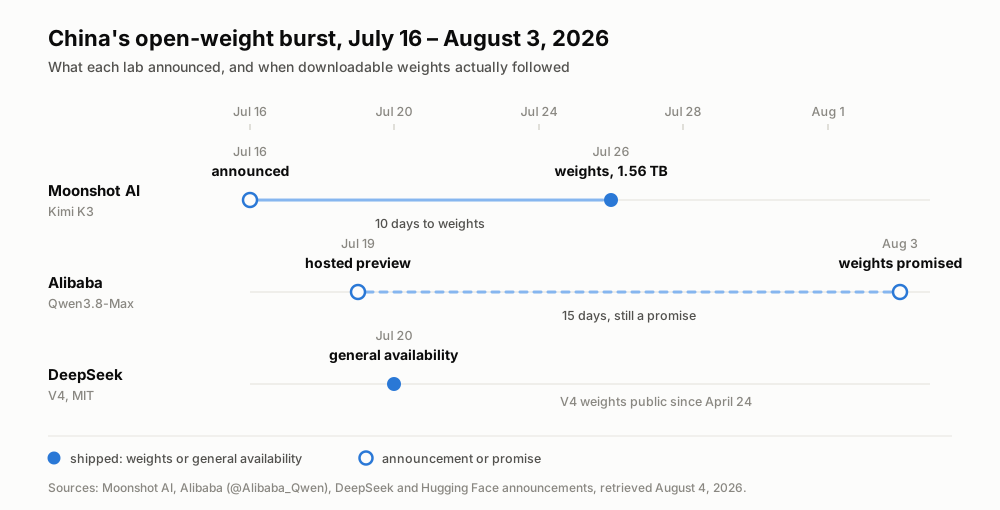
Three labs, three weeks — and only two of these five moments actually put weights in anyone's hands. Dates from each lab's own announcements, retrieved August 4, 2026.
Kimi K3 is the one that actually shipped
Start with Moonshot AI, the Beijing lab behind the Kimi assistant, which spent the past year building a reputation for large, capable open models. When we wrote about Kimi K3 in July, its weights were still a promise — Moonshot had said "by July 27." They arrived on July 26: 1.56 terabytes across 96 shards on Hugging Face under moonshotai/Kimi-K3. That is the news. An announcement is a press release; downloadable weights are a fact you can build on.
In plain terms, K3 is one of the largest open models ever released — a mixture-of-experts system with 2.8 trillion total parameters and about 104 billion active per token, routing roughly 16 of 896 experts through a mechanism Moonshot calls Kimi Delta Attention, with a one-million-token context window and a reported 2.5x scaling-efficiency gain over its predecessor, K2. Translated out of the spec sheet: it is very big, relatively economical to run for its size because only a slice fires per token, and able to swallow book-length inputs whole.
Those numbers also tell you who will actually run it. 1.56 terabytes in 96 shards is not a laptop download; it is a datacenter-class artifact that needs a cluster of high-end accelerators just to load. In practice almost no individual will host K3 themselves — they will reach it through providers who already own the hardware, and that market arrived on day one: Together AI and Modal both stood up hosted Kimi K3 endpoints the moment the weights landed. That is also how a curious reader tries it today — not by downloading 1.56 TB, but by calling one of those hosted endpoints or using the Kimi app. "Open" here means the weights are public and anyone with the hardware can serve them, which is exactly what keeps prices competitive; it does not mean you will personally run it on your desk.
Is it any good? By the one independent number we trust this round, yes. On Artificial Analysis's ranking it placed 4th out of 189 models — behind Claude Fable 5 and two GPT-5.6 "Sol" configurations, ahead of Opus 4.8 and GPT-5.5. For an open model you can download, being in that company at all is the story.
Then read the license, because this is where "open" gets an asterisk. Kimi K3 is not MIT. It ships under a custom "Kimi K3 License" that is not OSI-approved and carries a revenue-threshold clause: run K3 as the engine of a large Model-as-a-Service business and you need a separate agreement with Moonshot. For a solo developer, or a normal company using it internally, that changes nothing. But for anyone building a hosted product at scale, "open weights" and "open license" turn out to be two different questions — and here only the first is an unambiguous yes.
Qwen3.8-Max is a preview, not a download
Qwen is Alibaba's model family, and its team has been among the most prolific open-model shippers in the world — which is exactly why the newest one is confusing. Qwen3.8-Max, unveiled at WAIC in Shanghai on July 19, is the wave's biggest headline and its softest. It is a 2.4-trillion-parameter sparse MoE — active parameters undisclosed — and the first Qwen above a trillion parameters to be multimodal, meaning it takes not just text but images, video, and documents as input.
Here is the catch a newcomer needs spelled out: despite the fanfare, you cannot download it. Right now it exists only as a "hosted preview" — qwen3.8-max-preview, reachable through Alibaba's own service (its Token Plan and the Qoder tool) at roughly 10% of standard pricing. A hosted preview means Alibaba runs the model on its servers and lets you call it; it is the rented-API model, not the own-a-copy model. Calling it an open-weight release today is premature.
That framing changed on August 3. The official Qwen account on X, @Alibaba_Qwen, posted that the open weights of Qwen3.8-Max were coming "next week" — and that a smaller Qwen3.8-27B would go open-weights alongside it. So the 27B is not a rumor, whatever earlier chatter suggested: it is an on-the-record commitment from Alibaba's own account. And the size is the point. Where the 2.4-trillion-parameter Max, like K3, is something only a datacenter will run, a 27B is small enough to serve on a single high-end machine — the tier an individual or a small team can actually self-host. That genuinely softens the "promised with no specifics" picture: now there is a size and a rough timeframe.
The honest caveats still stand, though. "Next week" is a direction, not a shipping date, and as of this writing on August 4 nothing has landed on the Qwen organization on Hugging Face — its newest models there are from June. The open-weight license has not been published either, and early readers of the preview terms flagged possible regional restrictions, unconfirmed until the real license appears — exactly the license-first lesson from the primer. Alibaba's claim that the model is "second only to Fable 5" is still a self-report with no third-party numbers behind it, so treat it as a vendor's marketing line until someone outside Alibaba measures it. If you want to try the model today, the hosted preview is the only door — but for the first time, the wait for downloadable weights is measured in "next week," not "someday."
DeepSeek V4 quietly reached general availability
DeepSeek is the lab whose R1 model helped kick off the current open-model race in early 2025, and true to form it did the least announcing here while shipping the most usable thing. Its V4 line, released back on April 24, is the one you can most straightforwardly adopt, because it comes under the license the primer flagged as the gold standard.
V4 arrives in two sizes, both MIT-licensed. V4-Pro is the flagship at 1.6 trillion total and 49 billion active parameters; V4-Flash is the lightweight at 284 billion total and 13 billion active. Recall what the active number means: V4-Flash fires only 13 billion parameters per token, which makes it cheap and fast to serve, and that is what makes it the budget pick for high-volume work — the kind of transcribe-and-summarize load where cost per token decides everything. Both carry a one-million-token context window and can produce up to 384K tokens of output in a single response, enough to draft a long report rather than just a paragraph. Around July 20, V4 reached general availability with time-based pricing, which is what pulled a spring release into the same three-week frame as K3 and Qwen.
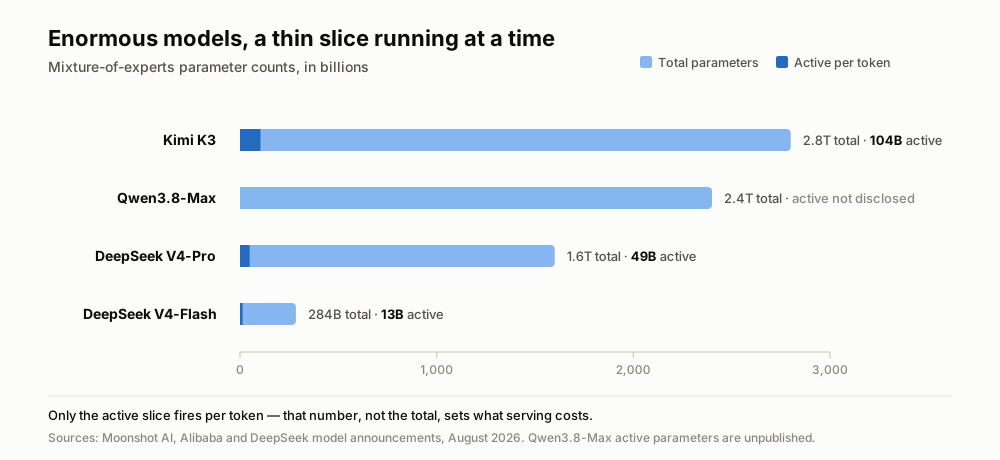
The pale bar is how big each model is; the dark stub is how much of it fires per token. Alibaba has not disclosed the active count for Qwen3.8-Max.
Because it is MIT, V4 is the one an adopter can build on with the fewest lawyers involved: get the weights (or use a hosted provider), run it, ship it commercially, owe nothing and ask no one. And to be clear about the version numbers, since the rumor mill loves them — there is no R2, no V5, no V4.1. There is just the V4 family maturing into something teams can depend on.
The gap is closing faster than the leaderboards admit
Step back and the individual releases matter less than the slope. Nathan Lambert's read is that the distance between the best open and best closed models has compressed from roughly six-to-nine months to three-to-five — "the closest open models have been to the frontier since DeepSeek R1." Put plainly: the free-to-download models are now only a few months behind the best models money can rent, where a year ago they were a comfortable lap back.
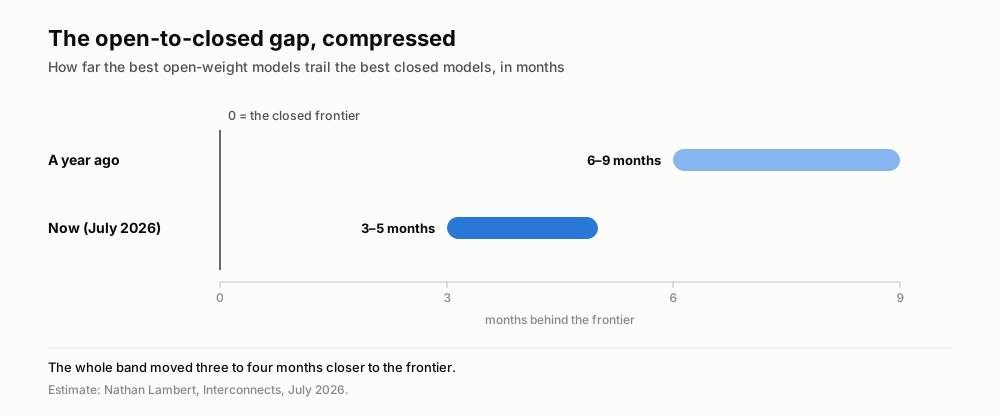
Lambert's estimate drawn to scale: the open tier did not just move closer, the whole band tightened.
The usage data points the same way. On OpenRouter, a marketplace that routes requests across many models, US-origin models' share of tokens fell from about 70% in June 2025 to about 30% a year later, while Chinese-origin models now regularly clear 30%. Price is a big part of why: Chinese open models tend to run 60% to 90% cheaper per token, and the hosting showed up immediately, as those day-zero K3 endpoints made plain.
The quieter shift is about scale. The Chinese open-model brand was small, fast, and cheap. K3 at 2.8 trillion parameters and Qwen3.8-Max at 2.4 trillion are the exact opposite — a bet that going big in the open is now worth it. GLM-5.2 from Z.ai, released June 16 under MIT and sitting atop the open-weight tier of the Artificial Analysis Index at 51, is the same message from a fourth lab.
The twist: the government that enabled this may restrict it
Then came the turn. Around July 22-25, the Financial Times and Reuters reported that China's Ministry of Commerce is weighing export controls on AI models — including open-weight LLMs — with Alibaba, ByteDance, and Z.ai reportedly in the conversation. The framework being floated is tiered: a filing requirement for weaker models, a security review for stronger ones, and a possible ban on publicly releasing the most capable. Nothing is law yet. But the direction is striking: the wave may be cresting at the exact moment its own government starts treating these models as strategic exports rather than open contributions.
The bottom line
The tidy story is "China caught up." The more accurate one is that open weights became a strategic asset fast enough that a government now wants a hand on the tap. In three weeks, open models went from trailing the frontier by two or three quarters to trailing by one — and from being small and cheap to being some of the largest models anyone has released in any form. The open frontier did not just move. It moved somewhere its makers may not be free to keep shipping from.
For teams building on top of these models, the practical takeaway is unchanged and slightly sharper. Telli.sh already runs an open model, Qwen3, in its summarization layer, so every gain in open-model quality and price flows straight into meeting transcription, translation, and summaries. The one new line item is supply: if China's export rules land the way the reporting suggests, which open models stay freely downloadable is worth watching rather than assuming. Better models feeding the layer is the trend; where those models are allowed to come from is the thing to keep an eye on.
Sources
- Simon Willison on Kimi K3 weights (July 27, 2026)
- Nathan Lambert, "Kimi K3: the open-weights escalation" (Interconnects, July 20, 2026)
- Kimi K3 announcement (Moonshot AI)
- Kimi K3 weights on Hugging Face
- Artificial Analysis on Kimi K3
- Qwen (@Alibaba_Qwen), Qwen3.8-Max & Qwen3.8-27B open-weights announcement on X (Aug 3, 2026)
- Latent Space / AINews, "Qwen 3.8 Max (2.4T) and 27B, new open weights models" (Aug 4, 2026)
- WinBuzzer on DeepSeek V4 (April 27, 2026)
- The Decoder on Chinese open-model adoption
- Tom's Hardware on China's proposed AI export controls (July 2026)
- Wikimedia Commons image page
