An anonymous model burned 26 trillion tokens in four days. Its price list arrived later: 24 cents.
On August 20, 2026 a model with no lab, no card and no price appeared on OpenRouter as stealth/ox-alpha. Four days later OpenCode users had pushed 26 trillion tokens through it. Six days later Z.AI put its name on it: GLM-5.3-Flash, 320B total parameters, MIT weights, $0.15 per million in. Why labs now ship models without their own name attached, what the traffic numbers really measure, and what a 24-cent blended price does to the economics of speech pipelines.
On August 20, 2026 a model appeared on OpenRouter under the slug stealth/ox-alpha. There was no lab attached to it. No model card, no benchmark sheet, no announcement thread. The price field said $0 in, $0 out. What it did have was a 1,048,576-token context window, text, image and video input, and a one-line description about long-horizon software engineering.
Four days later, OpenCode said its users had pushed 26 trillion tokens through it.
Six days later, Z.AI told Bloomberg the model was theirs, released the weights under an MIT licence, and attached a price list: fifteen cents per million input tokens, fifty cents per million output. The name was GLM-5.3-Flash. The word "Flash" is doing an enormous amount of work in that sentence, and it is the reason we are writing this post.
This is a commentary piece, not release coverage. What follows is the six-day timeline with the traffic figures and their asterisks, an argument about why labs are increasingly shipping models with nobody's name on them, the specs and independent scores now that the reveal has happened, an explicit list of the claims we could not verify, and a worked calculation of what a 24-cent blended price does to the cost of running speech through a pipeline. It is the direct sequel to our before-and-after on the local-model comeback, and it lands in the same direction: the price of competent machine intelligence is still falling, faster than most product roadmaps assume.
TL;DR:
- The traffic was real and record-breaking. 26 trillion tokens on OpenCode in four days across 327,000 unique users, and 11.6 trillion on OpenRouter in three days — the largest model launch in OpenRouter's history, against a previous best of 4.4 trillion.
- The identity is confirmed, first-party. Z.AI told Bloomberg on August 26, 2026 that Ox Alpha was a GLM-series model; OpenRouter's own page now says the stealth listing "was developed and operated by ZAI, revealed to be ZAI GLM-5.3-Flash."
- The price is the story. 320B total / 18B active parameters, MIT licence, $0.15 in and $0.50 out per million tokens — a blended $0.24, against $10.00 for the closed flagship of six months ago that it beats by 12.1 points on Artificial Analysis's Intelligence Index.
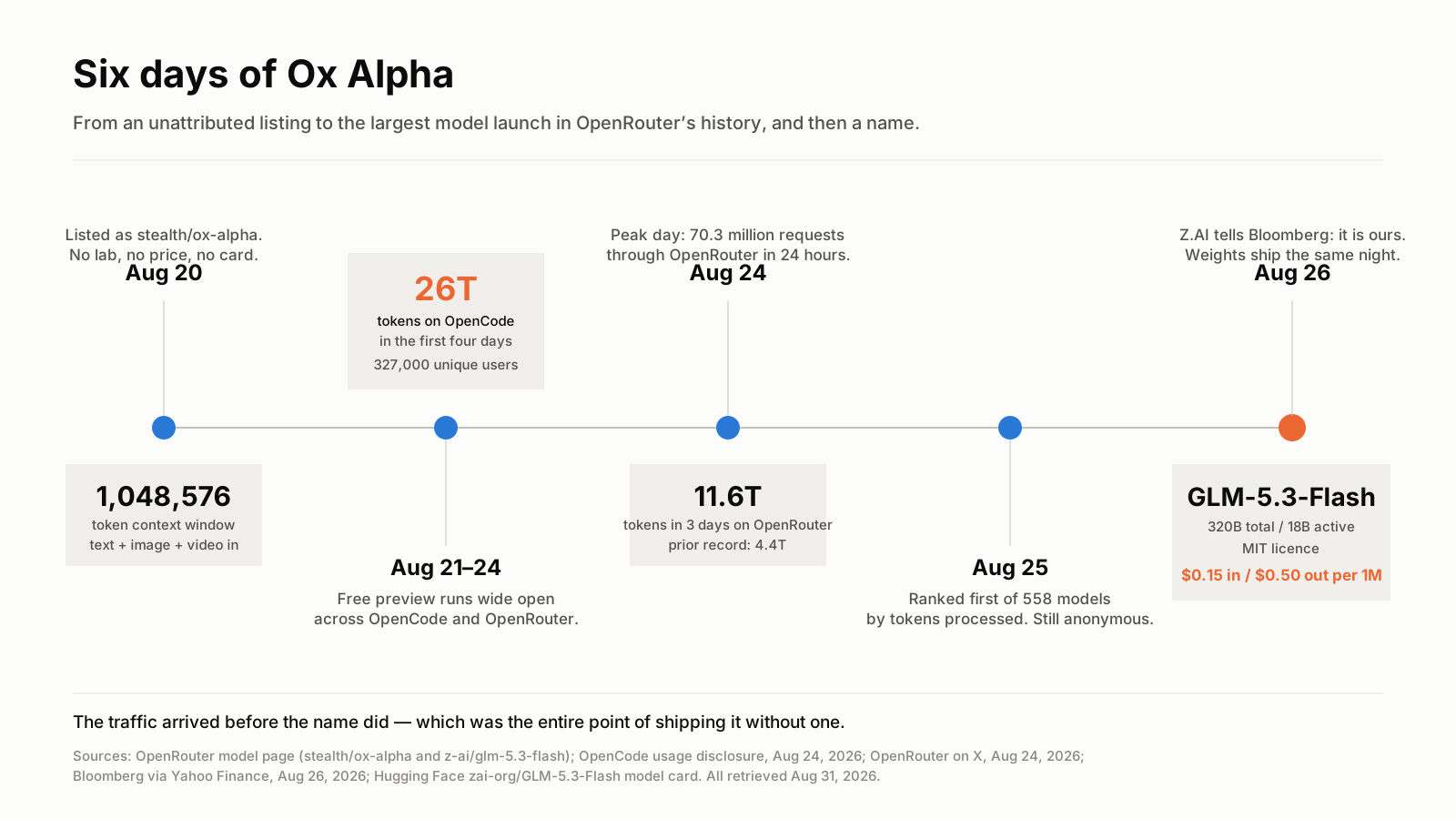
The whole event, end to end, took less than a week. Sources listed at the end.
Six days, in the order they happened
August 20: the listing goes live on OpenRouter and simultaneously inside OpenCode, the open-source terminal coding agent built by Dax Raad. OpenCode advertises it as free, effectively uncapped, with zero data retention through its own route, and says it has secured capacity for as much as 100 trillion tokens per day.
August 21 through 24: usage climbs every single day. OpenRouter's model-activity endpoint recorded 27.0 million requests on August 21, 54.4 million on August 22 (up 101.2%), 63.9 million on August 23, and 70.3 million on August 24.
August 24: OpenCode publishes the numbers. 26 trillion tokens processed in the first four days, across 327,000 unique users and 8,328,244 completed sessions — an average of 3.2 million tokens per session and roughly 25 sessions per user. That put Ox Alpha second among models OpenCode tracks, behind DeepSeek V4 Flash at 33 trillion and ahead of Xiaomi's MiMo-V2.5 at 12 trillion. OpenRouter separately reported 11.6 trillion tokens in the model's first three full days, calling it the largest model launch in the platform's history; the previous record-holder generated 4.4 trillion over the same opening window.
August 25: OpenRouter's models API, sorted by tokens processed in the trailing week, places Ox Alpha first among 558 returned models. Nobody outside the lab knows who built it.
August 26: Z.AI confirms to Bloomberg that Ox Alpha is a new model in its GLM series. The weights go up the same night. The company's own launch post says it tested GLM-5.3-Flash anonymously as ox-alpha on OpenCode and OpenRouter "to gather user feedback," and OpenRouter's stealth page is amended to read that the model "was developed and operated by ZAI, revealed to be ZAI GLM-5.3-Flash."
The traffic number is real. It is also not a quality verdict.
Here is where most of the coverage went wrong, so let us be precise about what 26 trillion tokens measures.
It measures throughput on a free endpoint with a million-token window, consumed mostly by coding agents. OpenCode's own dashboard says 93% of input tokens were served from cache — the same repository context, re-read across a long session. A ranking that sorts by tokens processed hands an enormous mechanical advantage to any model that is free and has a huge window, because agent harnesses re-ingest context, retry failed tool calls, and stream tool output back into the prompt. Long sessions inflate the number by design.
The 100-trillion-tokens-per-day figure needs the same treatment. That was OpenCode describing aggregate service capacity, not usage delivered and not a per-user allowance. Actual usage averaged about 6.5 trillion tokens per day over the first four days — 6.5% of the advertised ceiling. The analyst Teortaxes noted that generating 100 trillion output tokens a day at 80 tokens per second would require roughly 580,000 GPU equivalents, which is exactly the kind of number that should make you ask what is being counted before you repeat it.
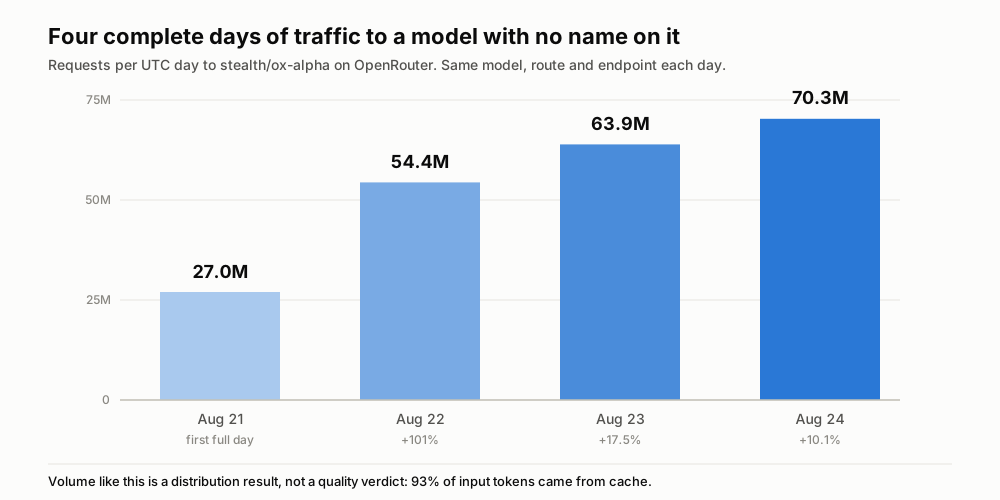
Daily request counts from OpenRouter's model-activity endpoint, snapshot cached August 25, 2026. Counts can be revised by the platform.
So what does the traffic actually prove? That a free frontier-shaped model with a million-token window, dropped into the two places where coding agents already live, will saturate demand within 24 hours. That is a distribution result, and distribution results are worth studying on their own terms. It tells you nothing about whether the model is good on your repository.
Why a lab now ships a model with nobody's name on it
Here is the point, and we will mark the pivot clearly: everything above is measurement, and what follows is our read of it.
Shipping anonymously buys a lab three things it cannot buy any other way. Call the combination the anonymity dividend.
The first is a clean evaluation. Every named release arrives inside a prior. A model from a Chinese lab gets graded against "surprisingly good for an open model"; a model from a US frontier lab gets graded against "is this worth the price hike." Strip the name off and the only thing left for a developer to react to is the output. The evaluations that came back during Ox Alpha's stealth week were run by people who had no idea whose model they were praising — which is the single most expensive thing to manufacture in AI marketing and the cheapest thing to obtain by simply not saying.
The second is the flywheel. The mystery is the campaign. Nobody writes a forensic blog post about a routine version bump, but a week of tokenizer fingerprinting, serving-layer analysis and speculation produces an enormous volume of coverage that the lab did not have to buy. The reveal then lands on an audience that is already invested in the answer. Z.AI got a week of free attention and then a launch day with a built-in punchline.
The third is telemetry at a scale money cannot easily buy. 8.3 million completed agent sessions of real, messy, production-shaped work is a dataset. Ox Alpha's OpenRouter page said prompts and completions were retained by the provider and explicitly not used for training — more on that in a moment — but retention alone still yields failure modes, latency distributions, tool-call error rates and long-context degradation curves across hundreds of thousands of real repositories. You cannot get that from an internal eval suite.
That data-terms line deserves its own note, because it is the one genuinely unusual thing in this story. Of the fourteen stealth listings OpenRouter has run since April 2025, thirteen carried some version of "prompts and completions are logged by the provider and may be used to improve the model." Ox Alpha is the only one whose page instead read: retained, not used for training. Whether you find that reassuring depends on how much weight you put on a line of text on a routing platform's model page. It is, at minimum, a deliberate choice, and it is the first time a stealth listing has made it.
The codename has become a genre
This is not a novel manoeuvre. It is a pattern with a five-listing verified track record, and knowing the track record is what lets you calibrate the next one.
| Codename | Turned out to be | Confirmed by | Date | Evidence |
|---|---|---|---|---|
| Quasar Alpha | GPT-4.1, OpenAI pre-release snapshot | OpenRouter's own blog | Apr 14, 2025 | First-party |
| Optimus Alpha | GPT-4.1, nearer-final snapshot | OpenRouter's own blog | Apr 14, 2025 | First-party |
| Horizon Alpha / Horizon Beta | Early GPT-5 checkpoints | OpenRouter, "GPT-5 is now live" | Aug 7, 2025 | First-party |
| Sonoma Dusk Alpha / Sonoma Sky Alpha | xAI Grok 4 Fast, non-reasoning and reasoning | Community inference only | — | Reported, unconfirmed |
| Hunter Alpha / Healer Alpha | Xiaomi MiMo | Xiaomi's own MiMo team | Mar 18, 2026 | First-party |
| Owl Alpha | Meituan LongCat-2.0-Preview | Meituan blog and @Meituan_LongCat | Jun 30, 2026 | First-party |
| Cypher Alpha / Aurora Alpha | Never resolved | — | — | None |
| Ox Alpha | Z.AI GLM-5.3-Flash | Z.AI to Bloomberg; OpenRouter page amended | Aug 26, 2026 | First-party |
Two things fall out of that table. Seven of the thirteen historical listings were eventually confirmed by a first-party statement, which is a much better resolution rate than the folklore suggests — and three of those confirmations came from the lab, not from OpenRouter, which is why compilations that only watch OpenRouter's blog keep undercounting. And the genre has migrated. The 2025 rows are OpenAI and xAI. The 2026 rows are Xiaomi, Meituan and Z.AI. Chinese labs did not invent the stealth drop; they industrialised it.
The reveal: 320B total, 18B active, MIT
Now the specs, from Z.AI's own model card rather than from anyone's summary of it.
GLM-5.3-Flash is described by its authors as "the first natively multimodal model in the GLM-5 series," with 320 billion total parameters and 18 billion active in a mixture-of-experts configuration, trained on a 30-trillion-token multimodal corpus. The architecture combines sparse and linear attention for the first time in the series, plus a technique the paper calls Manifold-Constrained Hyper-Connections. The context window is 1,048,576 tokens with a 131,072-token maximum single response. Reasoning depth is exposed as a reasoning_effort parameter with low, high and max settings, defaulting to max. The licence is MIT — not a bespoke community licence with a user-count trigger, but MIT.
Z.AI's own capability claim is worth quoting exactly, because it is more modest than the coverage around it: the model "outperforms GLM-5.2 across benchmarks and real-world workloads at one-tenth the price, while approaching Claude Opus 4.8 on coding and agentic benchmarks." Approaching. Not beating.
For an independent read, Artificial Analysis has now run it. GLM-5.3-Flash scores 57 on the Artificial Analysis Intelligence Index, against a median of 29 for comparable open-weight models. Running that full evaluation suite cost $138.02 in API spend — a figure we quote because it is the most honest single number in this entire post about what frontier-adjacent intelligence now costs to use. The same evaluation flags two real weaknesses: at 45 output tokens per second the model is slow, and it generated 150 million tokens completing the index against a 110-million median, which makes it verbose. Verbosity is a bill even when the per-token price is small.
A Flash-tier model at 57 is the actual news
Put the numbers side by side, using the same blended 3:1 input-to-output convention Epoch AI uses for price comparisons.
| Claude Opus 4.6 Max | Qwen3.8-27B | GLM-5.3-Flash | |
|---|---|---|---|
| Released | Feb 5, 2026 | Aug 14, 2026 | Aug 26, 2026 |
| Weights | Closed | Apache 2.0 | MIT |
| Intelligence Index | 44.9 | 52.0 | 57 |
| Price per 1M input | $5.00 | $0.45 | $0.15 |
| Price per 1M output | $25.00 | $3.20 | $0.50 |
| Blended (3:1) | $10.00 | $1.09 | $0.24 |
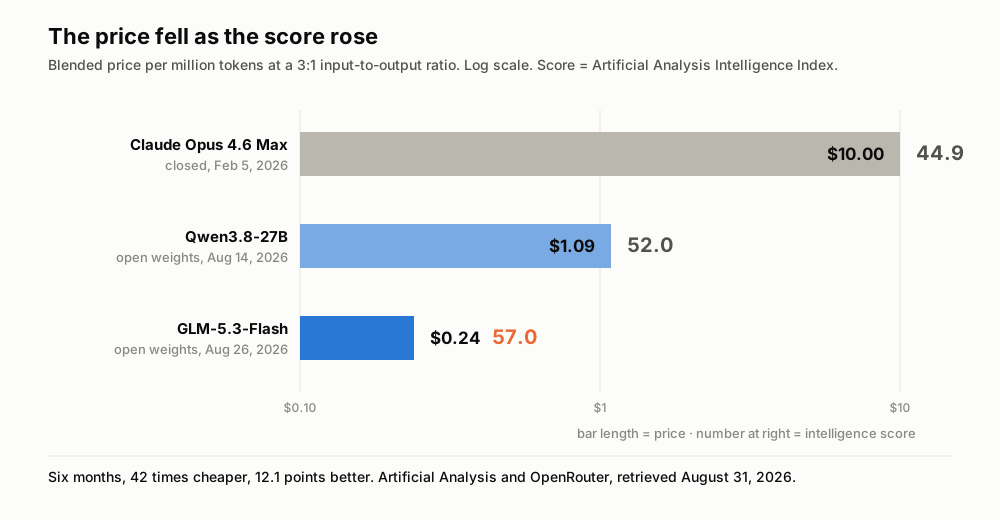
Bar length is price; the number at the right of each bar is the intelligence score. Artificial Analysis and OpenRouter, retrieved August 31, 2026.
GLM-5.3-Flash costs 42 times less than February's closed flagship and scores 12.1 points higher on the same independent index. Against the open 27B we wrote about ten days ago, it is 4.6 times cheaper and 5 points better. Both of those gaps opened inside six months.
That is the same curve our Qwen3.8 post measured from the other end: Epoch AI's fixed-threshold series, which holds a benchmark score constant and tracks the cheapest model that reaches it, found GPT-4-level performance falling from $37.50 per million tokens in March 2023 to $0.18 by February 2025 — 208 times cheaper in 23 months. GLM-5.3-Flash is what that curve looks like when it reaches the current frontier rather than a three-year-old one.
And notice the tier. This is not the flagship. "Flash" in every lab's naming convention means the cheap, fast, high-volume sibling of the model they actually want you to be impressed by. The interesting fact is not that a Chinese lab shipped a strong model. It is that the budget SKU is now close enough to the frontier that a week of anonymous head-to-head testing did not immediately give the game away.
Four things we could not verify, marked as such
The enthusiasm around this release runs ahead of the evidence in specific places, so here they are.
The claim that Ox Alpha "surpasses GPT-5.6" on million-token context tests comes from third-party write-ups, not from any published methodology we could inspect, and Z.AI's own comparison target is Claude Opus 4.8, not GPT-5.6. Treat the GPT-5.6 comparison as an unverified community claim.
The widely repeated 80% DeepSWE pass@1 score is not comparable to the 96%-plus SWE-bench Verified numbers you will see next to it in the same tables. Different harness, different task set, different difficulty. Any table that puts them in adjacent rows is producing a ranking that does not exist.
Z.AI's claim that the entire stealth week was served on domestic Chinese accelerators, with a 3x end-to-end serving improvement and per-token cost comparable to NVIDIA hardware, is vendor-stated and has not been independently audited. If it holds up it is the most consequential detail in the story; right now it is a press claim.
And the free preview was a subsidy, not a tier. It ended. The current pricing is $0.15 and $0.50, with a 50% promotional discount running through September 9, 2026 at 16:00 UTC — which means the honest steady-state number is the undiscounted one, and you should plan your budget against $0.15/$0.50 rather than against what the model costs this week.
What 24 cents does to a pipeline that listens, translates and summarises
Speech products are unusually exposed to token prices, because they generate transcripts and then read them repeatedly. Every downstream step — refinement, translation, summarisation, question answering — re-ingests the same text. Here is the arithmetic, with every assumption on the table.
- Start with a real unit of work. A 60-minute two-person meeting at roughly 130 words per minute produces about 7,800 words. With speaker labels and timestamps, call it 12,000 tokens of transcript.
- Add the summarisation pass. Feed the full transcript in, get structured notes out: 12,000 input tokens, roughly 800 output.
- Add live translation into three target languages. Each pass reads the transcript and writes a comparable volume: 12,000 in and 12,000 out, three times over.
- Total the meeting. 48,000 input tokens and 36,800 output tokens.
- Price it twice. At GLM-5.3-Flash's $0.15/$0.50, that meeting costs 2.6 cents. At Claude Opus 4.6's $5.00/$25.00, the same meeting costs $1.16.
A 45x difference on a single hour of audio is not a line-item optimisation. It is the difference between a feature you meter carefully and a feature you leave switched on by default. At $1.16 per meeting, translating into three languages for every user is a decision someone in finance has to approve. At 2.6 cents, it is a checkbox.
That is the part of this story that outlives the codename. The stealth drop was a marketing manoeuvre and a good one. The durable fact is that the cheap tier of a mid-sized lab's lineup now delivers 57 index points at 24 cents blended, with an MIT licence attached so you can run it yourself if the price ever moves in the wrong direction.
The bottom line: the frontier is no longer where the interesting prices are
For three years the question about model selection was "how close to the frontier can you afford to be." Ox Alpha's six days answered a different one: how much capability is now sitting below the flagship tier, priced as a commodity, and shipped by labs confident enough to test it with their name removed.
The anonymity dividend only pays if the model is good enough to survive an unbranded week. Z.AI collected. The next codename that shows up on a routing platform deserves the same treatment Ox Alpha got — run it on your own tasks before anyone tells you whose it is, because for one week that is the only honest evaluation anybody gets.
Where Telli.sh fits: this curve is why we build our speech pipeline on an engine-provider layer rather than around one vendor's API. Telli.sh routes transcription, translation and summarisation through swappable engines, so a step down the price curve like this one arrives as better notes at the same price rather than as a pricing announcement. The part no model release gives you is the rest of the job: capturing an hour of audio without dropping it, keeping speakers apart, translating live across 15 languages, and leaving you with notes you can still search next quarter.
Sources
- OpenRouter model page for
stealth/ox-alpha— listing date August 20, 2026, 1M context, and the amended line confirming ZAI GLM-5.3-Flash; retrieved August 31, 2026 - OpenRouter model page for
z-ai/glm-5.3-flash— current pricing and the promotional discount window through September 9, 2026; retrieved August 31, 2026 - Hugging Face model card, zai-org/GLM-5.3-Flash — 320B total / 18B active parameters, 30T-token multimodal corpus, MIT licence,
reasoning_effortsettings, and the "approaching Claude Opus 4.8" claim - Anonymous Ox Alpha processes 26T tokens on OpenCode, breaks OpenRouter launch record — RuntimeWire, August 26, 2026 — 26 trillion tokens, 327,000 users, 8,328,244 sessions, the 93% cache figure, and OpenRouter's 11.6-trillion-token record
- Ox Alpha usage, specs and mystery model evidence — LLM Rumors, August 25, 2026 — daily request counts and the first-of-558-models ranking
- Stealth frontier-level AI model Ox Alpha appears on OpenRouter and OpenCode free of charge — WinBuzzer, August 24, 2026 — the 100-trillion-tokens-per-day capacity claim and the Teortaxes GPU estimate
- China's Z.AI made Ox Alpha stealth model that rivals DeepSeek — Bloomberg via Yahoo Finance, August 26, 2026 — the first-party identity confirmation
- The stealth model that beat DeepSeek belongs to Zhipu — The Next Web — reveal reporting and open-weights commitment
- OpenRouter stealth models: who they turned out to be — Digital Applied, August 22, 2026 — the fourteen-listing census, reveal dates, evidence tiers and the data-terms comparison
- Artificial Analysis: GLM-5.3-Flash intelligence, performance and price analysis — Intelligence Index 57, $138.02 evaluation cost, 45 tokens per second, 150M tokens generated; retrieved August 31, 2026
- Epoch AI, "LLM inference prices have fallen rapidly but unequally across tasks," March 12, 2025 — the fixed-threshold price ladder behind the 208x figure
- Our before-and-after on the local-model comeback — the Qwen3.8-27B figures, the price curve and the catch-up lag