Speech recognition quietly went open-weight — and it fits in 1.56 GB
Alibaba's Qwen3-ASR models are Apache-2.0, cover 52 languages and dialects, and download in under two gigabytes. A plain-language guide to the open-weight transcription layer: what exists, what running a model on your own laptop actually buys you, and where the closed APIs still win.
Alibaba's Qwen team has three speech recognition models sitting on Hugging Face that almost nobody wrote about. Qwen3-ASR-0.6B, Qwen3-ASR-1.7B, and a companion called Qwen3-ForcedAligner-0.6B, all under the Apache 2.0 license. The smallest is a 1.56 GB download, it handles 52 languages and dialects, and as of June 26 it runs in three lines of standard Python. You can put it on a machine you already own, and no one gets to send you a bill for it.
The pattern is hard to miss, because we have watched it play out once already. Large language models spent 2023 and 2024 as things you rented through an API, and then the open-weight tier arrived and became the default for anyone who cared about cost, privacy, or being able to run the thing offline. Transcription is now doing the same, roughly two years behind.
This post is a map of that shift for people who do not follow model releases for a living: what an open-weight speech model is, which ones exist right now and under what license, what "0.6B on your laptop" gets you in practice, and — the part most coverage skips — where the closed hosted APIs still comfortably win.
TL;DR:
- Open-weight transcription is real and usable today: Qwen3-ASR (Apache 2.0, 52 languages/dialects), Whisper (MIT), NVIDIA's Parakeet and Canary (CC BY 4.0), Mistral's Voxtral (Apache 2.0).
- Self-hosting buys privacy, offline operation, and cost control. On the independent Artificial Analysis board, hosting an open model runs $1.50 per 1,000 minutes against $6.00 for Microsoft's MAI-Transcribe-1.5 and $18.15 for Gemini 3.1 Pro Preview.
- The number one accuracy spot is still a closed preview endpoint — but an open Apache-2.0 model, Voxtral Small, now sits fifth, about one point of word error rate behind it.
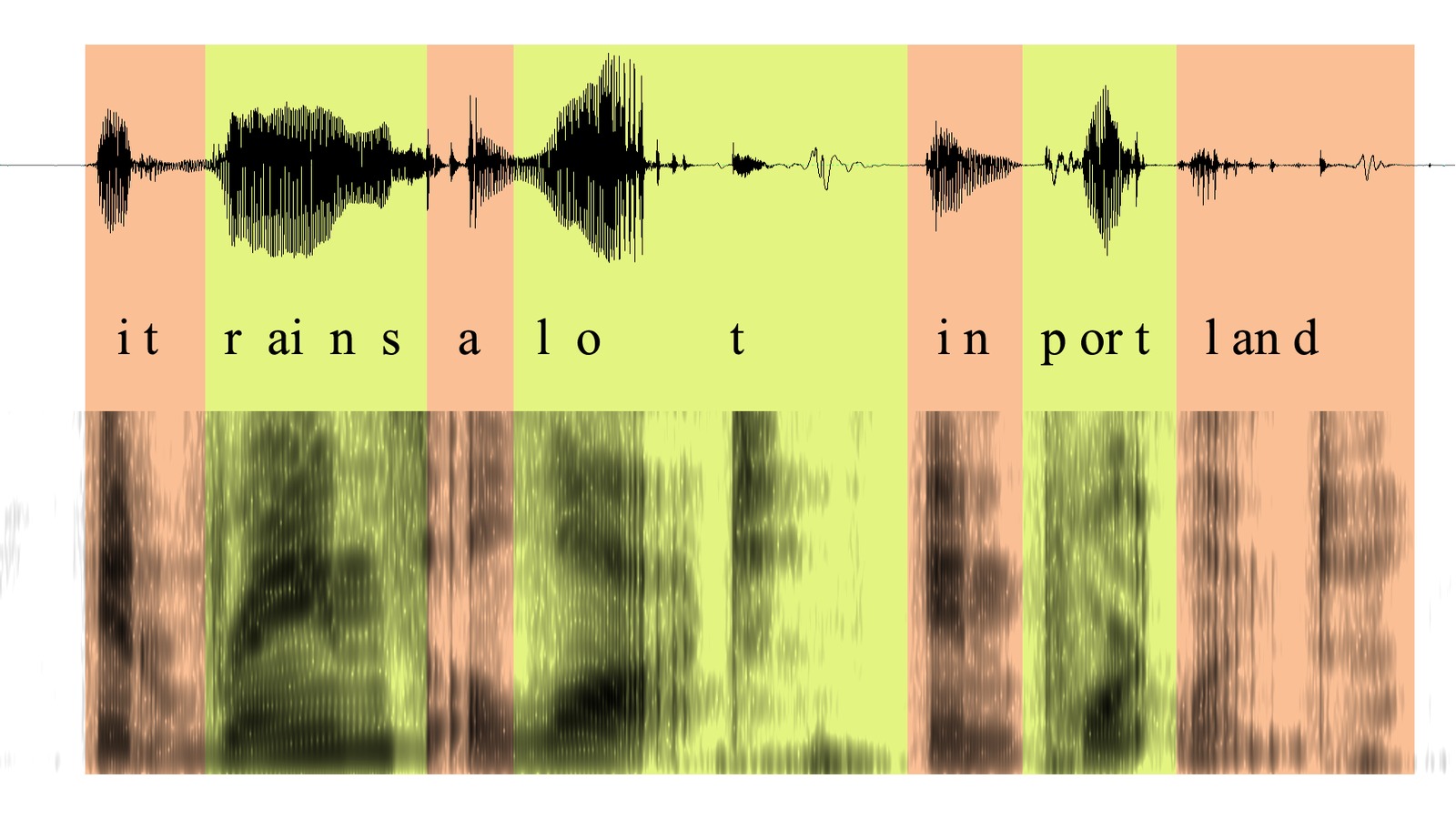
Image: Aaron Parecki, Wikimedia Commons, CC BY 2.0. The waveform and spectrogram of the phrase "it rains a lot in Portland," with the letters positioned over the audio they correspond to — this is the raw material every speech recognition model works from.
What you are actually downloading when you download a transcriber
An ASR model — automatic speech recognition, used interchangeably with STT, speech-to-text — is a program that takes audio in and produces text out. That is the whole job. It does not decide who spoke, does not summarize, does not know what your meeting was about. It hears words and writes them down.
"Open weights" means the lab published the finished model file itself. A model's weights are the enormous grid of numbers it learned during training, and publishing them means you download that file, run it on your own hardware, and build on it without asking permission or paying per request. The alternative is a closed model, where the weights stay on the vendor's servers and you rent access through an API — audio goes up, text comes back, and you are billed by the minute.
The number in the name is the parameter count, and for speech models it is unusually meaningful. "0.6B" means roughly 600 million parameters, which in practice makes Qwen3-ASR-0.6B a 1.56 GB file and Qwen3-ASR-1.7B a 4.08 GB one — both small enough to sit on a laptop SSD without anyone noticing. Compare that to the open language models we covered in our China roundup, where the headline release was 1.56 terabytes across 96 shards and needed a cluster just to load. Speech models are a thousand times smaller than frontier text models, and that single fact is why this shift lands harder here than it did there.
Here is the term we will use for the rest of this post: the laptop tier. It is the class of models where the hardware question simply disappears — where "can I run this?" stops being a budget conversation and becomes a download. Text models mostly are not in it. Speech models almost all are.
One last line to read before any benchmark: the license. Apache 2.0 and MIT are the permissive end — use it, modify it, ship it commercially, owe nothing. CC BY 4.0, which NVIDIA uses, is also commercially usable but asks for attribution.
Qwen shipped the family in January; June is when it got easy
Now the release that prompted this post, with one correction to how it has been described. The Qwen3-ASR family did not appear in June. The original repositories went up on January 28, 2026, and the technical report landed on arXiv the following day. What happened on June 26 is that Qwen published -hf versions of all three models — checkpoints that work natively in Hugging Face Transformers from v5.13.0 onward.
That sounds like a footnote and is not. Before, running the model meant installing Qwen's own qwen-asr package or a vLLM backend and learning a toolchain. After, it is three lines of standard Python that any developer who has touched Transformers already knows. The barrier that keeps most open models unused is rarely the model. It is the forty minutes of environment wrangling before the first transcript appears, and that is what June 26 deleted.
The specs, taken from the model cards themselves. Both sizes handle language identification and recognition across 30 languages — English, Chinese, Korean, Japanese, Spanish, Arabic, Hindi, Thai, Vietnamese, Polish and twenty more — plus 22 Chinese dialects, which is how the "52 languages and dialects" figure is reached. Both run streaming and offline inference from a single model, which is rarer than it sounds: many transcription models do one or the other. Both accept long audio, and the card lists singing and songs with background music as supported audio types.
The third model is the one worth pausing on. Qwen3-ForcedAligner-0.6B does forced alignment — given audio and a transcript, it marks where each word starts and stops, down to the millisecond, across 11 languages for up to five minutes of speech at a time. That is the machinery behind clickable transcripts, subtitle timing, and jumping to the moment someone said a thing; it is exactly what the image at the top of this post shows. Publishing an aligner alongside the recognizer is a signal about who the release is for: not people running a demo, but people building products.
On quality, be careful about what is claimed by whom. Qwen's own card reports figures from the Hugging Face Open ASR Leaderboard dated June 26, 2026: a mean word error rate of 5.59% for the 1.7B model and 6.31% for the 0.6B, with the AMI meeting-audio subset at 9.26% and 10.57%. Word error rate is the share of words the model gets wrong, so lower is better, and AMI is the hardest number there because real meetings are messy. Qwen also calls the 1.7B version "state-of-the-art among open-source ASR models" and competitive with commercial APIs — a vendor claim until someone outside Alibaba measures it. Note too that this is a different benchmark from the independent board below, on different audio, so the two sets of numbers cannot be compared against each other.
Whisper started this, and it is still the model everyone runs
None of this would exist in its current shape without OpenAI's Whisper. The repository went public on September 16, 2022, under the MIT license — code and weights both — at a moment when serious speech recognition meant a contract with a cloud vendor. It has since collected 106,679 GitHub stars.
What made Whisper matter was less the model than what the community built on it within months. whisper.cpp reimplemented it in plain C and C++, MIT-licensed, 52,591 stars, and made it run on laptops and phones with no Python and no GPU. faster-whisper rebuilt it on CTranslate2 for a large speed and memory win, MIT again, 24,750 stars. The model was the seed; the ecosystem was the tree.
Four years on it is still the most-used speech model in the world. Over the past 30 days, whisper-large-v3-turbo was downloaded 8.72 million times from Hugging Face and whisper-large-v3 5.50 million — figures we pulled on August 5, 2026. Qwen3-ASR-0.6B, at 4.29 million, is climbing fast for a six-month-old model, but Whisper remains the default the industry reaches for without thinking. Its accuracy has aged, though: on the Artificial Analysis board, Whisper Large v3 posts 4.07% AA-WER against 1.73% for the current leader, and a great many shipping products still run it.
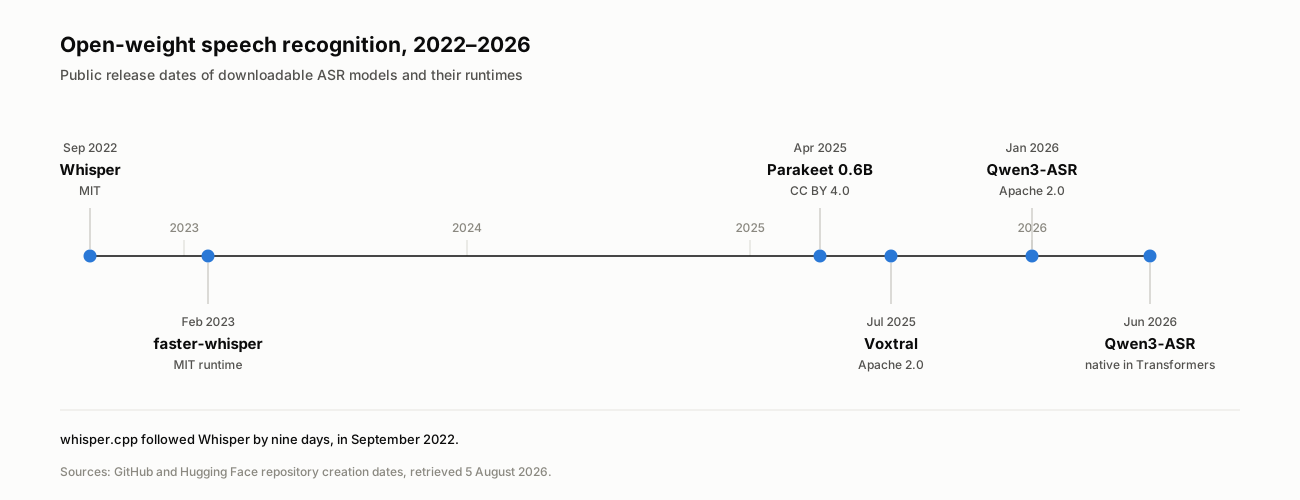
The open speech tier arrived in two bursts three years apart, with almost nothing in between. Release dates from GitHub and Hugging Face, retrieved August 5, 2026.
The open tier is wider than one lab
Qwen is not alone, and the others differ sharply in what they are good at.
NVIDIA's Parakeet line is the speed play. parakeet-tdt-0.6b-v3, released August 2025 under CC BY 4.0, is a 600-million-parameter model covering 25 European languages with automatic language detection, punctuation, capitalization and word-level timestamps built in, and it takes audio up to 24 minutes long in a single pass. NVIDIA's Canary family — canary-1b-v2 and canary-qwen-2.5b, also CC BY 4.0 — covers similar ground with different architectural bets. Mistral's Voxtral models arrived in July 2025 under Apache 2.0, and matter for a reason we come to in a moment.
Here is the open tier side by side, with a hosted API on the last row for contrast.
| Model | Download | License | Languages | Runs on | Strongest at |
|---|---|---|---|---|---|
| Whisper Large v3 | 3.09 GB | MIT | 99 | Laptop or one GPU | Being the default everything already supports |
| Qwen3-ASR-0.6B | 1.56 GB | Apache 2.0 | 52 with dialects | Laptop | Multilingual work at the smallest size |
| Qwen3-ASR-1.7B | 4.08 GB | Apache 2.0 | 52 with dialects | Laptop or one GPU | Best accuracy in the Qwen family |
| Parakeet TDT 0.6B v3 | 2.51 GB | CC BY 4.0 | 25 European | Laptop or one GPU | Speed and word-level timestamps |
| Voxtral Small | — | Apache 2.0 | — | Server GPU, 24B parameters | Highest open score on the independent board |
| Hosted API | Not downloadable | Proprietary | Varies | The vendor's cloud | Diarization, streaming, uptime |
Download size is the default checkpoint in each Hugging Face repository; "—" marks a value we could not confirm from a primary source. Retrieved August 5, 2026.
Then there is the packaging work that gets these models onto actual devices, which is where the laptop tier stops being theoretical. whisperkit-coreml — Whisper compiled for Apple hardware — was downloaded 8.31 million times in the last 30 days. An MLX build of Parakeet for Apple Silicon took 1.87 million, and two GGUF conversions, the quantized format that runs models on ordinary CPUs, pulled 2.04 million and 1.87 million between them. Millions of people a month are downloading speech recognition packaged specifically to run on their own machine. That is not a research curiosity. That is a distribution channel.
The number one spot is still a preview endpoint you cannot download
Here is where the honest accounting starts, and it cuts both ways.
We pulled the Artificial Analysis speech-to-text board on August 5, 2026 — an independent benchmark that measures open and closed models on the same audio, unlike the Hugging Face leaderboard, which is an open-model affair. The AA-WER index at the top:
| Rank | Model | AA-WER | Downloadable? |
|---|---|---|---|
| 1 | Fun-Realtime-ASR-preview | 1.73% | No — preview endpoint |
| 2 | Scribe v2 (ElevenLabs) | 2.18% | No — hosted API |
| 3 | MAI-Transcribe-1.5 (Microsoft) | 2.38% | No — hosted API |
| 4 | Smallest AI Pulse Pro | 2.43% | No — hosted API |
| 5 | Voxtral Small (Mistral) | 2.77% | Yes — Apache 2.0 |
| 6 | Gemini 3.1 Pro Preview (High) | 2.82% | No — hosted API |
| 11 | Whisper Large v3 | 4.07% | Yes — MIT |
Source: Artificial Analysis speech-to-text leaderboard, AA-WER v2, retrieved August 5, 2026. Download status assessed from each model's published license.
Read the top four rows first, because they are the correction to any story that says open has won. The best-scoring speech models in the world are things you rent, and the leader is not even generally available — it is a preview endpoint.
Now read row five, because it is the correction to the correction. Voxtral Small is Apache 2.0. You can download it, run it on your own hardware, ship it commercially — and it sits fifth on an independent board at 2.77%, roughly one point of word error rate behind a closed preview model. Against a 6,300-word hour-long meeting, that gap is about 66 words. Real, but not the chasm the framing implies.
Our take: the accurate summary is not "open STT is far behind." Open speech models cleared the good-enough threshold for most work some time ago, and the remaining closed advantage is a point of WER plus the product wrapped around it. Which brings us to the trade-off that actually decides things.
What running it yourself buys you, and what it costs
Three things push teams toward self-hosting, and none of them are accuracy.
Privacy is the first and usually the decisive one. If you transcribe medical consultations, legal interviews, or HR conversations, "the audio never leaves our hardware" is not a preference, it is a procurement requirement, and a model you host yourself is the only architecture that satisfies it cleanly. Offline operation is the second: a model on the device works on a plane, in a basement, on a factory floor, at a field site with no signal. That is exactly why whisper.cpp and the GGUF builds have the download numbers they do.
Cost is the third, and here the numbers are stark. From the same Artificial Analysis snapshot, price per 1,000 minutes of audio: Whisper Large v3 hosted on fal.ai runs $0.50, NVIDIA's Canary Qwen 2.5B on Replicate $0.74, Parakeet TDT 0.6B V3 on Together AI $1.50. On the closed side, Deepgram's Nova-3 is $4.30, MAI-Transcribe-1.5 is $6.00, and Gemini 3.1 Pro Preview runs $18.15. That is a 4x gap against Microsoft and a 12x gap against Google for hosting an open model on someone else's servers — before you consider running it on your own, where the marginal cost of the thousandth hour is electricity.
Speed cuts the same way, and this is the detail that surprised us most. The fastest model on the entire board is Parakeet TDT 0.6B V3 served on Together AI, at 885 times realtime — an hour of audio back in about four seconds. Deepgram's Nova-3 manages 512x, Whisper Large v3 on Together 478x, MAI-Transcribe-1.5 189x. The single fastest transcription option available is a 600-million-parameter open-weight model anyone can download.
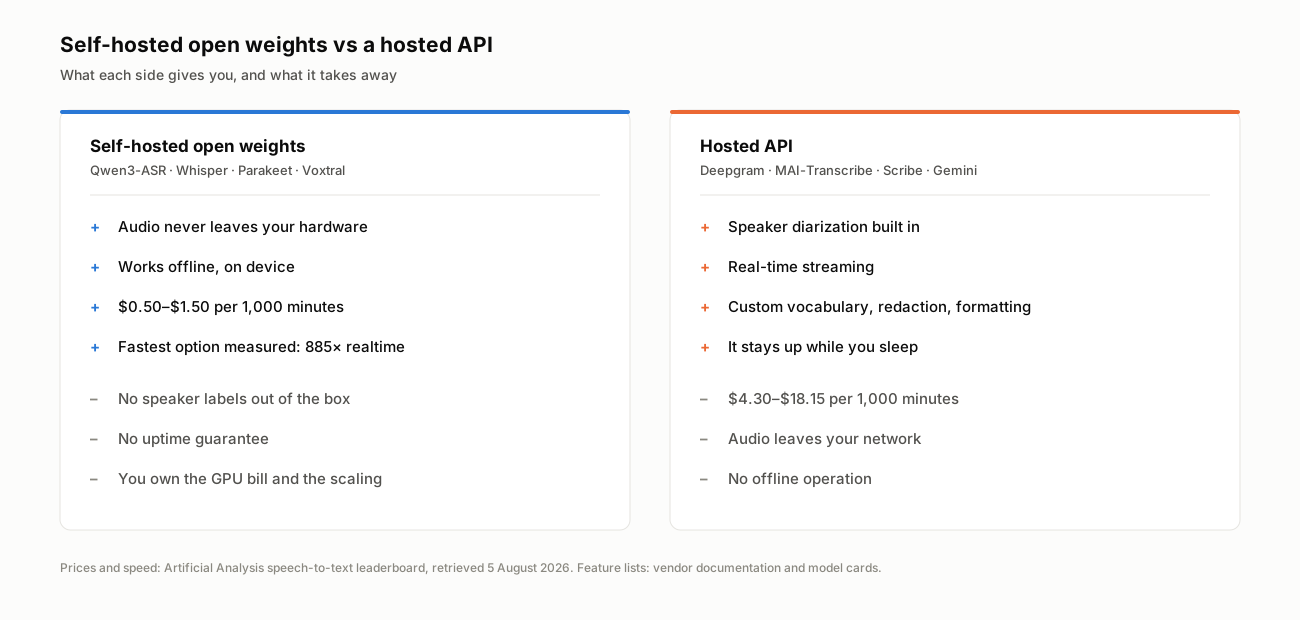
The trade was never accuracy against accuracy. It is control and cost against the features wrapped around recognition.
So what do the hosted APIs still sell? Everything that is not recognition. Deepgram's documentation is a fair inventory: speaker diarization, real-time streaming, formatting, custom vocabulary, entity redaction, language detection, and the guarantee that it stays up while you sleep. Download Qwen3-ASR and you get words and timestamps. No speaker labels, no SLA, and you own the GPU bill, the scaling, and the 3 a.m. page.
The most-downloaded model in the category is not a transcriber
One statistic ties this together, and we did not expect it.
When you sort Hugging Face's entire automatic-speech-recognition category by downloads, the model at the top is not Whisper, not Qwen, not Parakeet. It is pyannote/speaker-diarization-3.1, with 8.91 million downloads in the last 30 days, and a second pyannote diarization model takes fifth place at 5.26 million. Diarization is the machinery that works out who spoke when — the layer directly above transcription.
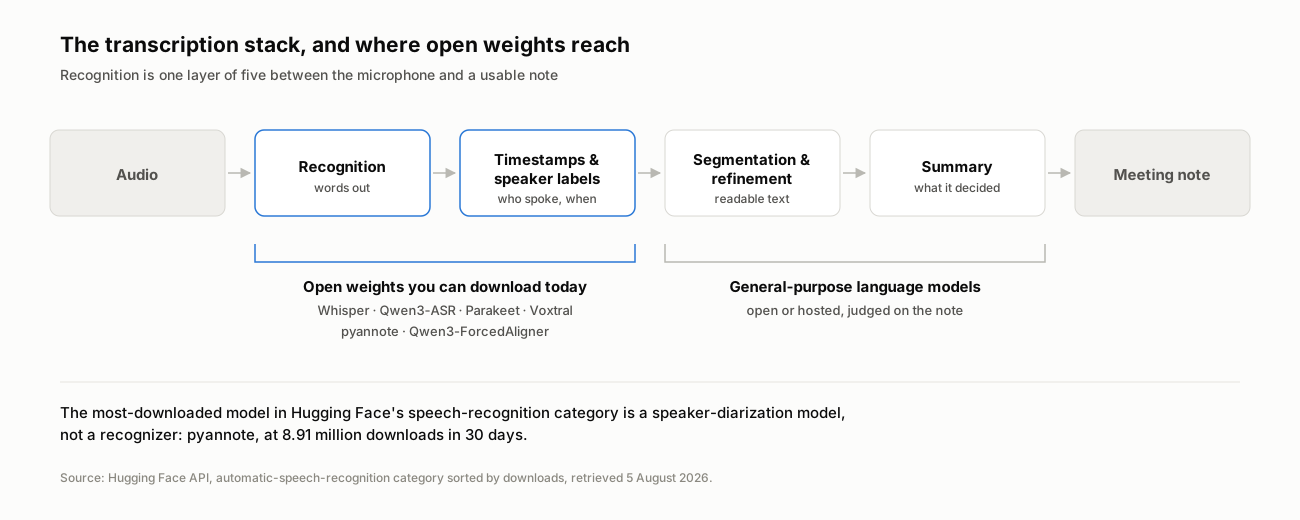
Open weights now cover the first two layers of the stack. The layers that decide whether a note is useful sit above them.
The most-wanted model in the speech-recognition category does not recognize speech. It answers a question the recognizers leave unanswered, which is the same conclusion we reached from the closed side of the market when the highest-scoring model in the world shipped without speaker labels. Two entirely different vantage points, the same finding: hearing the words is the solved part.
The bottom line
The interesting question about open-weight speech recognition was never "is it as good as the closed models." It is within about a point of word error rate, it is faster, it is between four and twelve times cheaper, and it fits on a laptop. The interesting question is what you build in the space that opens up when transcription stops being a line item you rent — because a 1.56 GB file that hears 52 languages is not a product. It is a component that just became free.
For a team choosing a meeting-notes tool rather than a model, the practical read is short. Whether a product runs an open model or a closed API is now largely an implementation detail, and increasingly it will be both — open weights for the bulk work, hosted APIs where diarization and streaming and scale earn their price. Telli.sh already runs an open model in its summarization layer, so improvements in the open tier flow straight through to transcription, translation, and meeting notes without a price change. Judge the tool by what comes out at the end: whether the note tells you who committed to what.
Sources
- Qwen3-ASR-0.6B-hf model card (Hugging Face) — license, language list, leaderboard figures dated June 26, 2026
- Qwen3-ASR-1.7B-hf model card (Hugging Face)
- Qwen3-ForcedAligner-0.6B (Hugging Face)
- Qwen3-ASR Technical Report, arXiv:2601.21337 (submitted January 29, 2026)
- OpenAI Whisper repository (MIT, published September 16, 2022)
- whisper.cpp and faster-whisper
- NVIDIA parakeet-tdt-0.6b-v3 model card (CC BY 4.0)
- Mistral Voxtral-Small-24B-2507 (Apache 2.0)
- Artificial Analysis speech-to-text leaderboard — AA-WER v2, speed and price figures retrieved August 5, 2026
- Hugging Face Open ASR Leaderboard
- Deepgram speaker diarization documentation
- Wikimedia Commons image page
