NVIDIA didn't buy a model hub for $12.93 billion. It bought the default
On September 3, 2026, NVIDIA agreed to acquire Hugging Face for $12,930,300,000 — its second-biggest deal ever, after $20 billion for Groq's assets. Hugging Face began in 2016 as a chatbot app for teenagers and ended up hosting 3 million models for 18 million developers. A close read of how it got there, why NVIDIA's two previous platform bets ended in opposite ways, and where the neutrality promise will actually be decided: not in a blog post, but in kernels, quantization formats and default deploy targets.
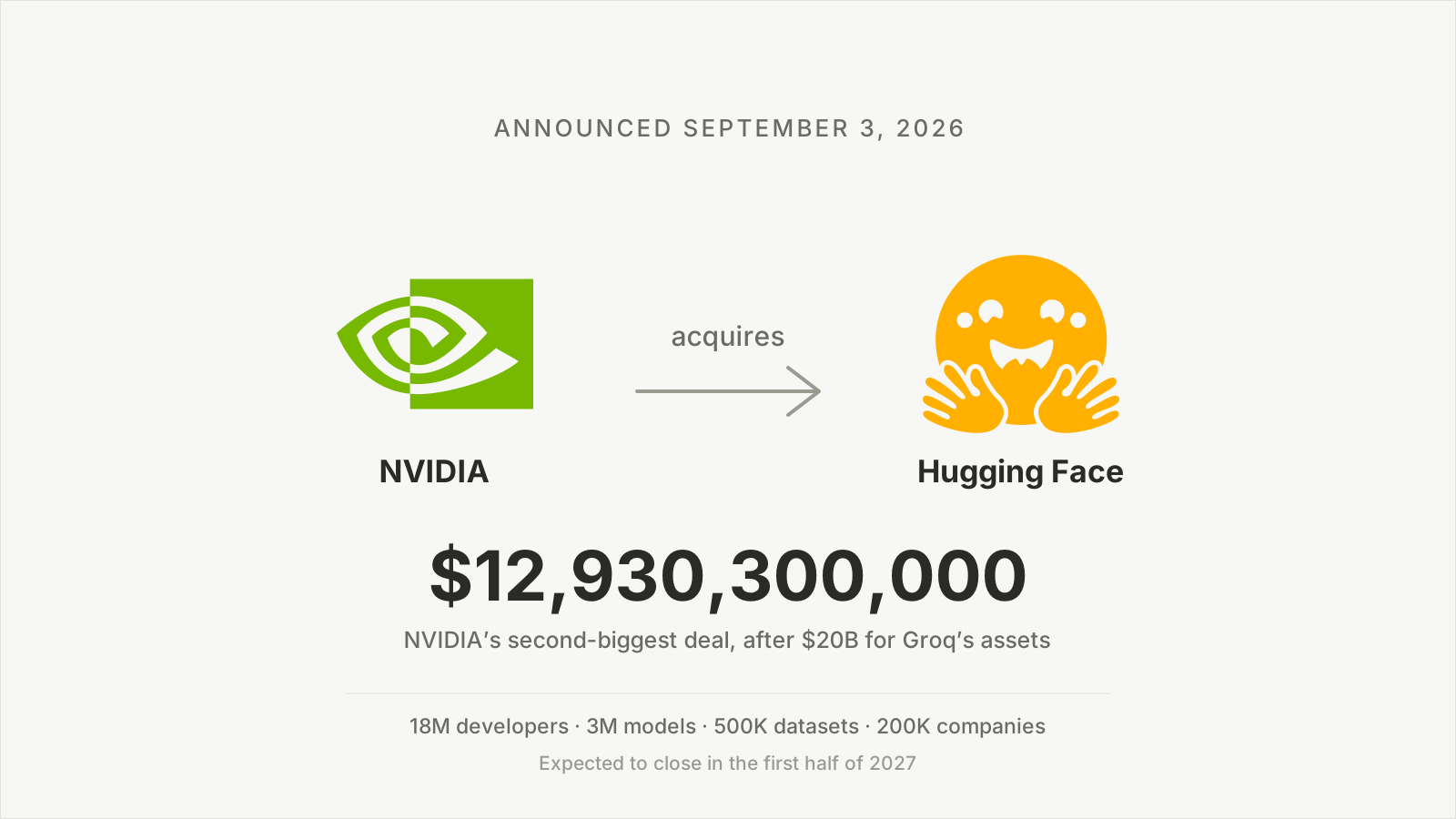
Brand marks from Simple Icons (CC0). Figures from NVIDIA's announcement, September 3, 2026.
On September 3, 2026, Jensen Huang published a short blog post announcing that NVIDIA had agreed to acquire Hugging Face for $12,930,300,000. Not "approximately $13 billion" — the exact figure, down to the last hundred dollars.
Most of the coverage that followed asked whether the "GitHub of AI" could stay neutral under a chip company. That is the right question. It is almost always asked in the wrong place.
Neutrality on Hugging Face is not going to be decided by a promise in a blog post. It will be decided by which kernels are on the fast path, which quantization formats get first-class support, and what the Deploy button does by default. Those are engineering decisions, they get made every week, and none of them will be announced.
TL;DR:
- The price is the story. $12.93 billion for a company that raised $395 million total and was worth $4.5 billion three years ago. NVIDIA's second-biggest deal ever, behind $20 billion for Groq's assets at the end of 2025.
- NVIDIA has bought a neutral platform twice before, with opposite outcomes. Mellanox closed and worked. Arm collapsed under regulators who called it the "Switzerland of hardware." Hugging Face is closer to Arm than to Mellanox.
- The technical risk isn't a walled garden. Nobody is going to block AMD. The risk is defaults — and defaults are how ecosystems tilt without anyone deciding to tilt them.
From a chatbot for teenagers to the layer everything imports
Hugging Face was founded in 2016 in New York by three French engineers — Clément Delangue, Julien Chaumond and Thomas Wolf — to build a chatbot app for teenagers. That product is not why anyone knows the name.
The company's actual founding moment came two years later, and it was a weekend. When Google released BERT in late 2018, Hugging Face's team shipped a PyTorch port within a week. The library they open-sourced to support their own chatbot — first pytorch-pretrained-bert, then pytorch-transformers, then simply transformers — became a hit among academic developers who had no interest whatsoever in a chatbot for teenagers.
By 2019 the company had done the thing most startups cannot bring themselves to do: it killed the product and kept the tool.
What followed is a textbook case of a distribution business disguised as an open-source project. transformers standardised how you load a model. The Hub standardised where the weights live. safetensors standardised the file format, after the industry spent years shipping neural networks as pickled Python objects that could execute arbitrary code on load. Each of these looks like community infrastructure. Each of them is also a position.
The valuation followed the position, not the revenue. Hugging Face reached $2 billion in May 2022, then raised a $235 million Series D in August 2023 at a $4.5 billion post-money valuation, led by Salesforce Ventures. The investor list on that round is worth reading twice: Google, Amazon, NVIDIA, Intel, AMD, Qualcomm, IBM and Salesforce. Direct competitors, all buying a stake in the same neutral ground.
Total capital raised across the company's life was roughly $395 million, against a headcount of about 300. Whatever else this deal is, it is one of the most capital-efficient outcomes in the history of AI infrastructure.
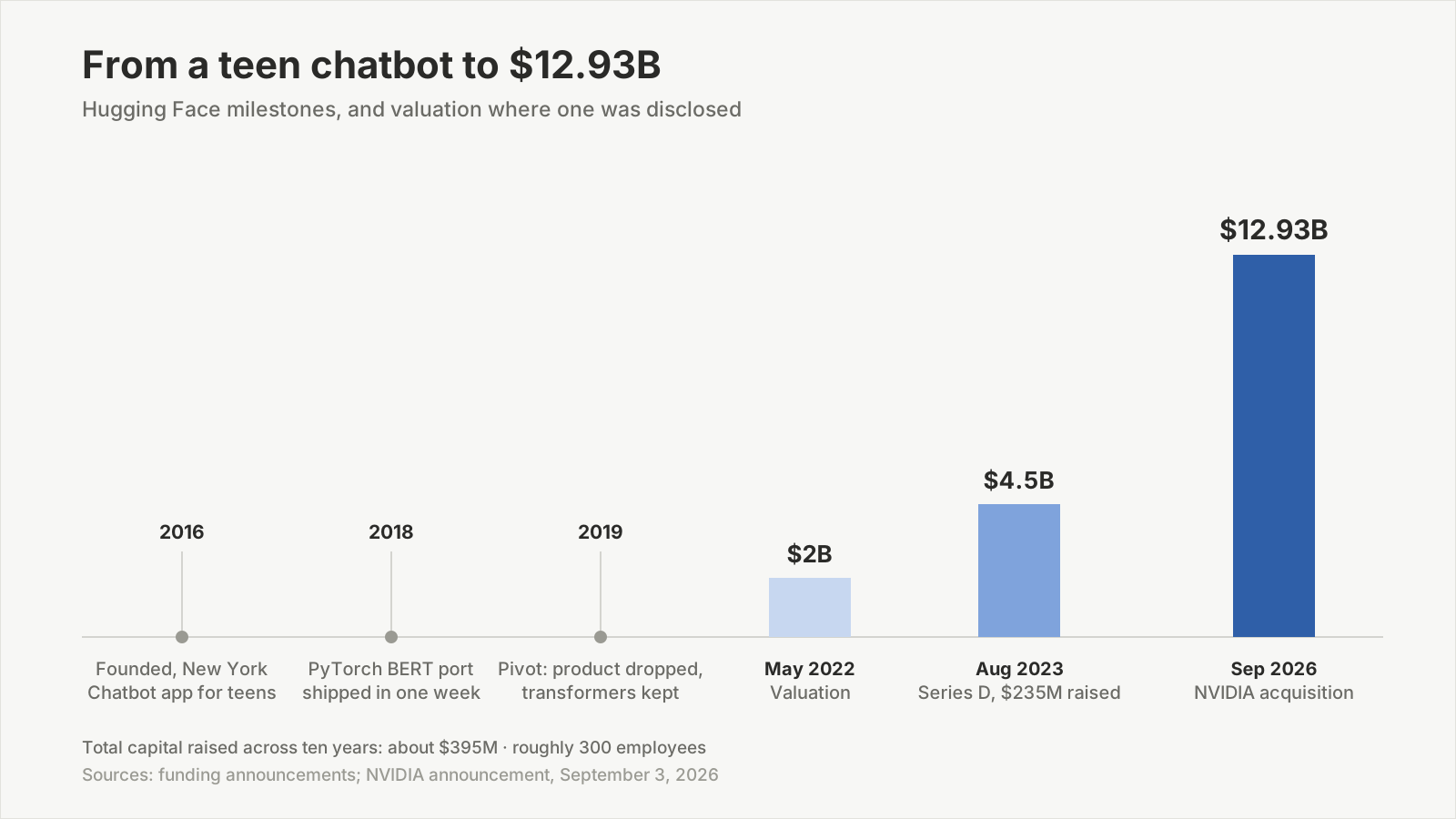
Ten years from a teen chatbot to a $12.93 billion acquisition. Valuations from company funding announcements; deal figure from NVIDIA's September 3, 2026 announcement.
What $12.93 billion actually buys
NVIDIA's own announcement gives the scale it paid for: more than 18 million developers, researchers and creators; more than 3 million models; 500,000 datasets; 1 million applications; and more than 200,000 companies using the platform to discover, evaluate, customise and deploy AI.
Note what is missing from that list. No revenue figure. No ARR, no growth rate, no margin. For a $12.93 billion transaction announced by a public company, the absence is conspicuous, and it tells you what was purchased. NVIDIA did not buy a SaaS business with a good multiple. It bought a position in the supply chain.
Here is the mechanism, and it is one line of code:
from transformers import AutoModel
model = AutoModel.from_pretrained("org/model-name")
That call is where the AI supply chain narrows to a single point. It resolves a name to a repository, downloads weights, picks a format, selects a backend, and hands you an object. Every one of those steps has a default. Most developers never change any of them, because the entire value proposition of the library is that you do not have to.
NVIDIA did not buy a model hub. It bought the default. For a company whose moat has always been that CUDA is what everything already targets, buying the layer where "what everything already targets" gets decided is not a diversification play. It is the same play, moved one level up the stack.
Delangue's own framing supports this reading. He told CNBC on September 3 that he approached Huang over the summer, "and a few weeks later, here we are," because Hugging Face and open-source AI were "at a turning point" and needed "more resources, more scale, more visibility." That is a distribution company concluding it could not fund distribution at the scale the moment required.
NVIDIA has bought a neutral platform twice. The results were opposite
This is where history is more useful than speculation, because NVIDIA has run this exact experiment before — twice, with the two possible outcomes.
| Deal | Announced | Price | What it was | Outcome |
|---|---|---|---|---|
| Mellanox | March 2019 | $6.9B | Interconnect vendor, complementary to NVIDIA's business | Closed April 2020; became NVIDIA's networking arm |
| Arm | September 2020 | $40B | Neutral CPU IP licensed to every NVIDIA competitor | Abandoned February 2022 under regulatory opposition |
| Run:ai | 2024 | ~$700M | GPU orchestration software | Closed after EU approval; open-sourced afterwards |
| Groq (assets) | End of 2025 | $20B | Inference silicon | NVIDIA's largest purchase to date |
| Hugging Face | September 2026 | $12.93B | Neutral model distribution used by every competitor | Pending; HSR filing required |
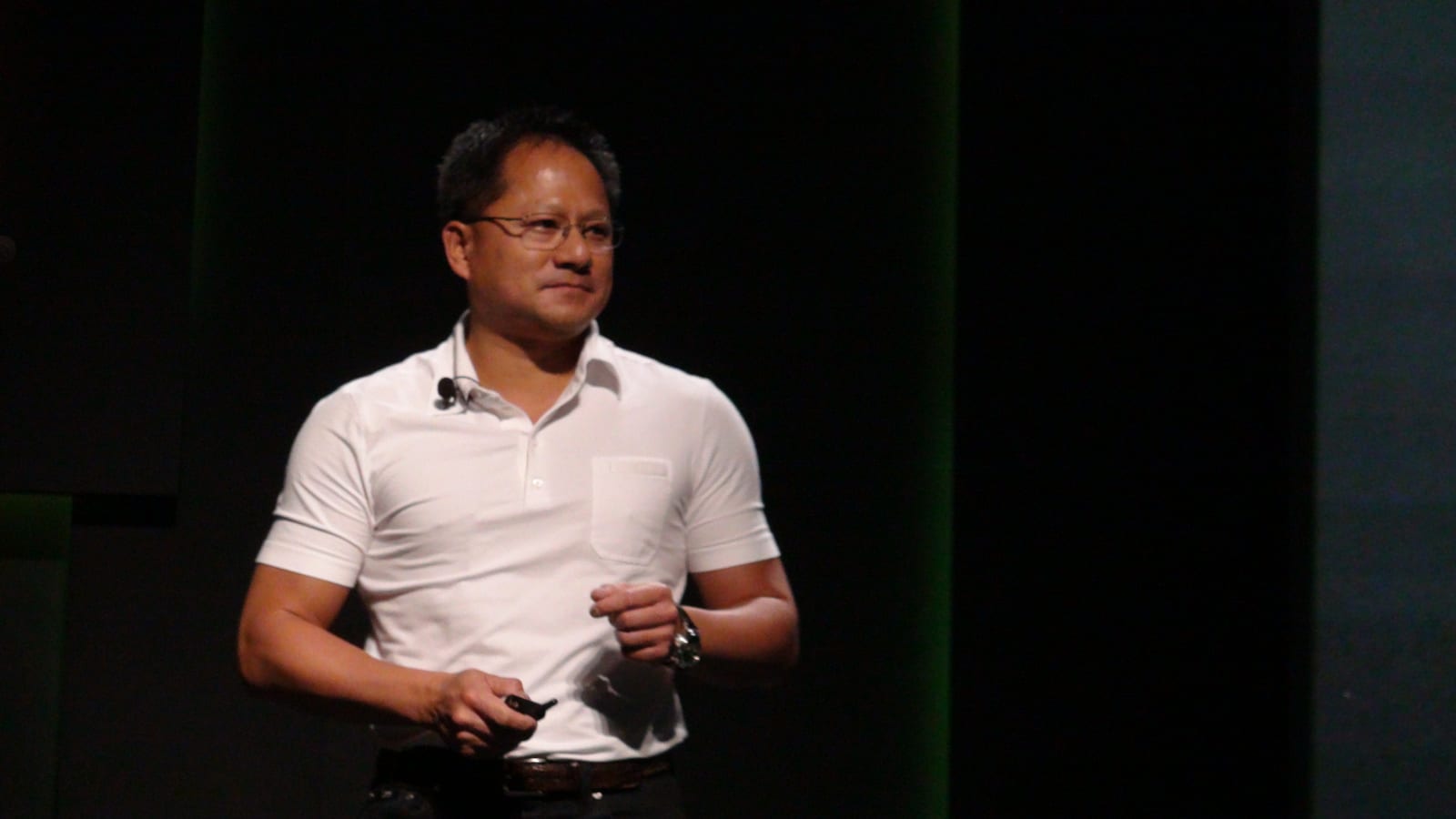
The same CEO, sixteen years earlier: Huang at Computex Taipei on May 31, 2010, when NVIDIA was a graphics-card company at a PC trade show and Hugging Face did not exist. Photo by Masaru Kamikura, CC BY 2.0 via Wikimedia Commons.

The Mellanox deal worked because Mellanox sold something NVIDIA's customers also wanted, and NVIDIA's competitors did not depend on it existing neutrally.
Arm failed for the opposite reason. Arm's entire value was that everyone could license it on equal terms — regulators and competitors described it as the "Switzerland of hardware," and the argument that killed the deal was not that NVIDIA would definitely abuse ownership. It was that customers would have to trust a competitor with their roadmaps, and that the option to abuse it was itself the harm.
Hugging Face is structurally much closer to Arm. It is the Switzerland of AI software, and its neutrality is load-bearing for AMD, Intel, Qualcomm and every cloud that competes with NVIDIA — several of which, remember, are on its cap table.
There is one difference that matters, and NVIDIA is leaning on it hard. A vice president has argued publicly that regulators should view Hugging Face as a "deconcentration platform" — that a hub distributing open-weight models from thousands of builders spreads AI capability outward, against the concentration of a handful of closed frontier labs. Huang made the same argument in the announcement, pointing to an open letter on open weights he co-authored, and to NVIDIA's record as the largest single contributor to the Hub: more than 500 models and more than 250 open datasets.
It is a genuinely strong argument. It is also, conveniently, an argument that the thing NVIDIA is buying is too good for the ecosystem to be taken away from it.
The regulatory path is real either way. At $12.93 billion this requires an HSR filing, which means the FTC and DOJ get formal notice and a waiting period — the first true antitrust test of NVIDIA's current acquisition run, after a series of asset purchases and investments structured to avoid exactly that. The FTC and DOJ opened a joint inquiry into competitive collaborations in AI in February 2026. The deal is expected to close in the first half of 2027, which is a long time for competitors to write letters.
The neutrality promise is technical, and it is checkable
NVIDIA's commitments in the announcement are unusually specific for a document of this kind. Hugging Face remains open to the entire ecosystem. Developers pick their own models, frameworks, clouds and inference providers. Multi-cloud and multi-accelerator development stay supported. And the sentence competitors will hold them to: "NVIDIA compute will not be required to build on or deploy through Hugging Face."
Take that at face value. It is almost certainly sincere, and it is also almost certainly not the mechanism anyone should be watching, because nobody tilts a platform by blocking a competitor. That is visible, actionable and stupid. Platforms tilt through defaults, and defaults look like engineering.
Here is where it actually gets decided:
Kernels and the fast path. When transformers picks an attention implementation, one path is optimised and tested, and the others are correct but slower. Which hardware gets the maintained fast path is a resourcing decision made in pull requests, not in press releases.
Quantization formats. GGUF, AWQ, GPTQ, FP8, NVFP4 — each maps to what particular silicon does well. Which formats get first-class Hub tooling, which get an upload widget, which get automatic conversion, and which are left to community scripts, determines what most people actually run.
Serving defaults. Hugging Face maintains its own inference stack and routes to inference providers from the Hub. What the Deploy button offers first, and in what order, is a UI decision with an economic result.
Discovery ranking. Search, trending and recommendation on a hub with 3 million models decides which of them exist in practice. Model cards carrying hardware-compatibility signals affect what gets picked long before anyone benchmarks anything.
None of these require bad faith. A team that is genuinely trying to be neutral, resourced by a company whose engineers know one architecture best, will produce better support for that architecture — not because anyone chose to, but because that is where the expertise is. Call it the gravity of the maintainer: platforms drift toward whoever fixes the bugs.
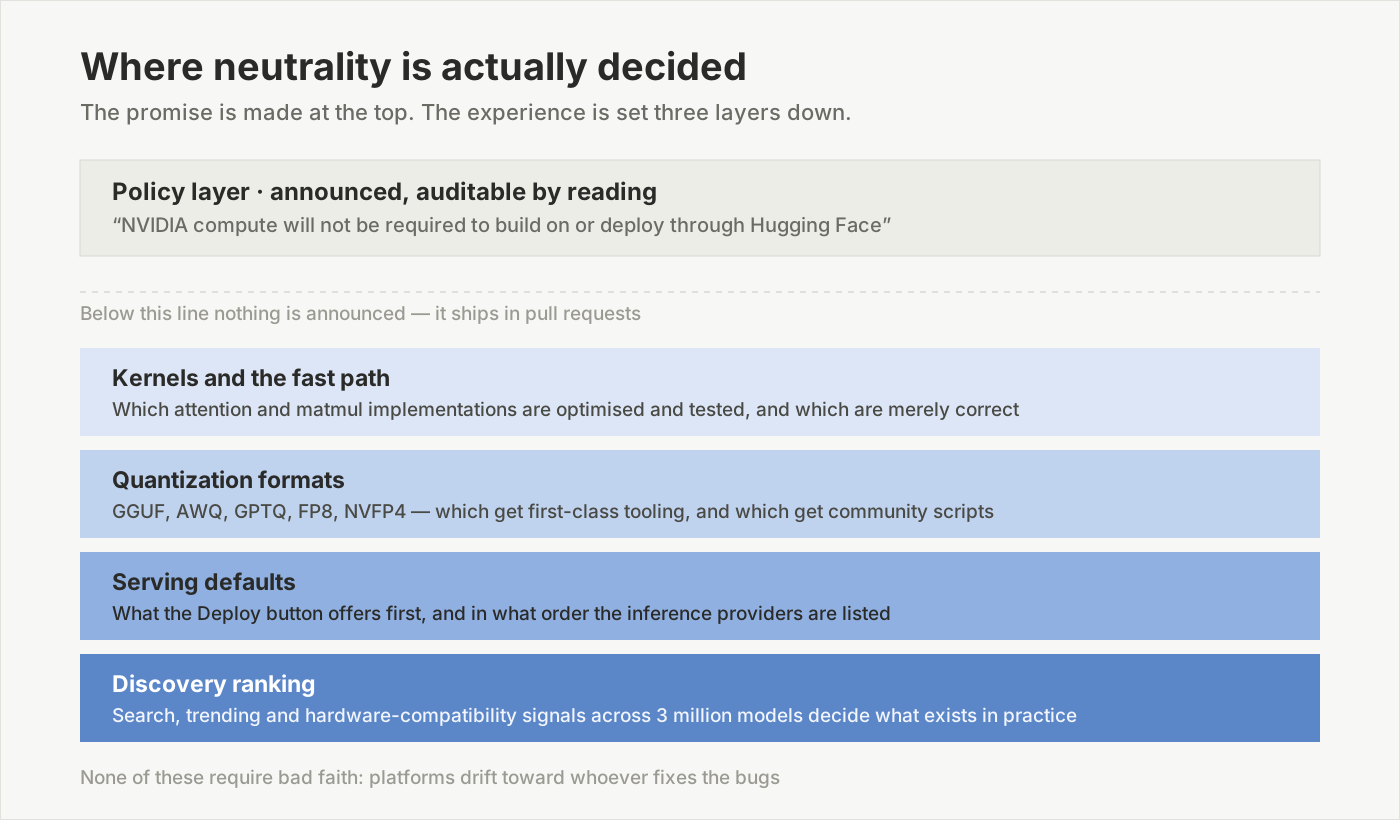
The commitments in NVIDIA's announcement operate at the policy layer. The behaviour developers experience is set three layers down.
What to watch, concretely
If you want to know whether this stayed neutral, do not read the next announcement. Check these, on a calendar:
- The Deploy button's default target, before and after close. One screenshot every quarter is a complete audit.
- Time-to-support for non-NVIDIA formats. When a new AMD or Apple Silicon quantization lands, how many weeks until the Hub handles it as well as it handles NVFP4?
- Who merges the kernels. The maintainer mix on
transformersattention and quantization backends is public. Watch the ratio, not the rhetoric. - Whether competitors keep shipping there. Meta, Alibaba, Mistral and AI2 publishing weights to the Hub as their primary channel is the real neutrality metric. If any of them start leading with their own distribution, that is the tell.
- The remedies, if any. If the FTC or DOJ extracts governance commitments — an independent board seat, a published neutrality policy, a complaints process — those are worth more than any voluntary statement.
The bottom line: open weights just got an owner
The AI industry has spent three years arguing about open versus closed models as if it were a licensing question. It was always partly a distribution question, and distribution has now been consolidated into a single owner with the largest possible stake in one answer.
That does not make the deal wrong. Hugging Face genuinely needed capital that its ~$395 million lifetime raise was never going to provide, the open-weight ecosystem genuinely benefits from a funded hub, and NVIDIA's contribution record to the Hub is genuinely the largest of anyone's. All three things can be true at once, and they are.
But something did change on September 3, and it is worth naming precisely. The place where open models are found, evaluated and loaded is no longer owned by a company whose only interest is that it remains the place. It is owned by a company with a much larger interest sitting one layer below it.
Neutrality is now a thing NVIDIA must actively maintain rather than a thing the structure produced for free. That is a harder problem than it sounds, and the people who will find out first are not regulators. They are developers who notice, quarter by quarter, which path is the fast one.
Where Telli.sh fits: we sit on the consuming end of exactly this ecosystem. Telli.sh records meetings, separates speakers, translates across 15 languages live, and generates summaries — and the models behind that come from the open ecosystem this deal reshapes. Our browser extension ships nine translation engines including a fully on-device option, precisely so the choice of model and the choice of vendor stay separate. That principle is why this acquisition is worth watching closely rather than casually.
Record your next meeting and keep the original
Sources
- NVIDIA Blog, Jensen Huang, "NVIDIA to Acquire Hugging Face," September 3, 2026 — the exact price of $12,930,300,000; the platform scale figures (18M+ developers, 3M+ models, 500,000 datasets, 1M applications, 200,000+ companies); the neutrality commitments including "NVIDIA compute will not be required to build on or deploy through Hugging Face"; multi-cloud and multi-accelerator support; NVIDIA's contribution record of 500+ models and 250+ open datasets; and the open letter on open weights; retrieved September 8, 2026
- CNBC, "Nvidia agrees to buy Hugging Face for almost $13 billion," September 3, 2026 — Delangue's account of approaching Huang over the summer, the "turning point" and "more resources, more scale, more visibility" quotes, the confirmation that this is NVIDIA's second-biggest purchase after $20 billion for Groq assets at the end of last year, and Huang's "asymmetric advantage" argument about open models and security; retrieved September 8, 2026
- Tom's Hardware, "Nvidia acquires Hugging Face for $12.93 billion," 2026 — the model-distribution framing and expected close in the first half of 2027
- TechCrunch, "Hugging Face raises $235M from investors including Salesforce and Nvidia," August 24, 2023 — the Series D at a $4.5 billion post-money valuation and the investor list including Google, Amazon, NVIDIA, Intel, AMD, Qualcomm, IBM and Salesforce
- Contrary Research, "Hugging Face Business Breakdown & Founding Story" — the 2016 founding in New York by Delangue, Chaumond and Wolf, the chatbot origin, and the 2018–2019 pivot to open-source tooling
- TechTimes, "Nvidia's $12.9B Hugging Face Deal Must Pass Antitrust Review Its Quasi-Mergers Dodged," August 28, 2026 — the HSR filing requirement, the February 2026 FTC/DOJ joint inquiry into AI collaborations, and the Arm "Switzerland of hardware" parallel
- Wccftech, "NVIDIA Insists Its $12.93 Billion Acquisition Of Hugging Face Will Escape Antitrust Scrutiny, Calling It A 'Deconcentration Platform,'" 2026 — NVIDIA's "deconcentration platform" defence
- Photo: Jensen Huang at Computex Taipei, May 31, 2010, by Masaru Kamikura — CC BY 2.0 via Wikimedia Commons
- Simple Icons — the NVIDIA and Hugging Face brand marks used in the header graphic, released under CC0
- Our read of Google's UCP and what it standardises — the same theme from the protocol side: infrastructure decisions that look procedural are where the leverage actually sits