40 minutes instead of 75: what GPT-6 Astra is genuinely good at
OpenAI shipped GPT-6 Astra on September 3, 2026 and called it the world's most intelligent model. Its own announcement tables tell a sharper story: enormous jumps on narrow tasks — Terminal-Bench Science 22.4% to 64.6%, SRE-Bench 55.9% to 88.0%, OSWorld at 47% less time per task — sitting on top of a neutral aggregate that moved three tenths of a point. Where the gains are real, where the asterisks are, and what a 1M-token text model still cannot do.
On September 3, 2026, OpenAI released GPT-6 Astra and called it "the world's most intelligent and aligned model."
Four rows down its own benchmark table sits the Artificial Analysis Intelligence Index v4.1.1: Astra 61.2, GPT-5.6 Sol 60.9, Claude Fable 5.1 65.7. OpenAI published the number where its new flagship gains three tenths of a point on its own predecessor and trails a competitor by 4.5.
Both facts are true, and the tension between them is the whole story. This is not a model that got generally smarter. It is a model that got dramatically better at a specific list of things, and the list is worth knowing precisely, because it does not match the marketing summary in either direction.
TL;DR:
- The specialist gains are enormous and first-party verifiable. Terminal-Bench Science 22.4% to 64.6%, SRE-Bench 55.9% to 88.0% in one attempt, ScreenSpot-Pro 76.9% to 92.7%, MRCR 8-needle retrieval at 512K–1M tokens 73.8% to 96.3% — all against GPT-5.6 Sol, all from OpenAI's published tables.
- The speed gain may matter more than any score. On OSWorld 2.0 Astra scores 72.6% in roughly 40 minutes per task, against Sol's 65.7% in roughly 75 — about 47% less time.
- The general aggregate barely moved. On the one cross-vendor index OpenAI itself printed, Astra is +0.3 over Sol and −4.5 against Claude Fable 5.1. It also loses the only academic row it reports against all three Claudes: Humanity's Last Exam with tools, 57.2% vs 65.0%.
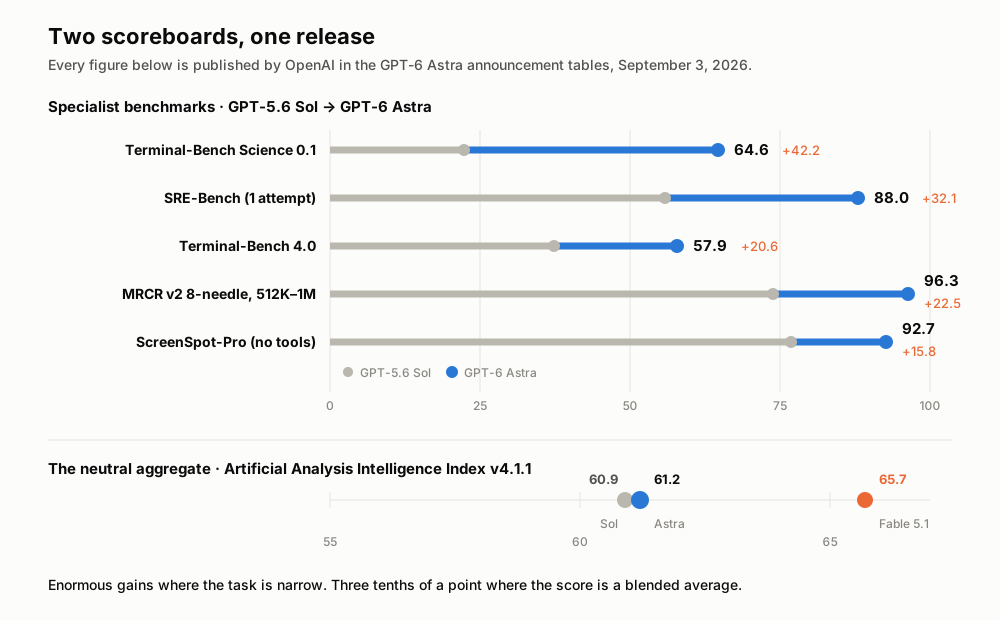
Every figure is from OpenAI's own announcement tables. Sources listed at the end.
The spec sheet, without the adjectives
Before the argument, the facts you can look up. These come from OpenAI's developer model page for gpt-6-astra, retrieved September 5, 2026.
| GPT-6 Astra | |
|---|---|
| API model ID | gpt-6-astra |
| Released | September 3, 2026 |
| Context window | 1,050,000 tokens |
| Max output | 128,000 tokens |
| Knowledge cutoff | April 30, 2026 |
| Input modalities | Text, image |
| Output modalities | Text |
| Reasoning effort | low, medium, high, xhigh, max |
| Price per 1M input | $10.00 |
| Price per 1M cached input | $1.00 |
| Price per 1M output | $50.00 |
| Availability | ChatGPT Plus, Pro, Business, Enterprise; OpenAI API; Microsoft Azure; AWS Bedrock |
Three details in that table get skipped in most coverage and shouldn't be.
Prompts above 272,000 input tokens are billed at 2x the input and cache rates and 1.5x output for the entire request — so the million-token window has a cliff in the middle of it, not a flat rate. Batch and Flex processing run at 50% of standard; Fast mode runs at 2x for up to double the speed, with no latency SLA attached.
Tool calling requires the Responses API. Chat Completions still works for plain generation, but temperature, top_p and top_logprobs are gone entirely — if you are migrating a pipeline that tunes sampling, that tuning no longer exists.
And Astra takes text and images in, and emits text. It does not hear. We will come back to that.
Computer use is the actual headline, and the clock is the actual number
OpenAI's framing is that Astra "sets a new frontier on computer and browser use." Here the evidence supports the adjective.
On OSWorld 2.0 — desktop tasks like navigating applications, moving files, filling forms — Astra scores 72.6% against Sol's 65.7%. That is a respectable 6.9 points. The interesting figure is next to it: in OpenAI's latency simulation, Astra finished the average task in about 40 minutes where Sol took about 75, a reduction of roughly 47%.
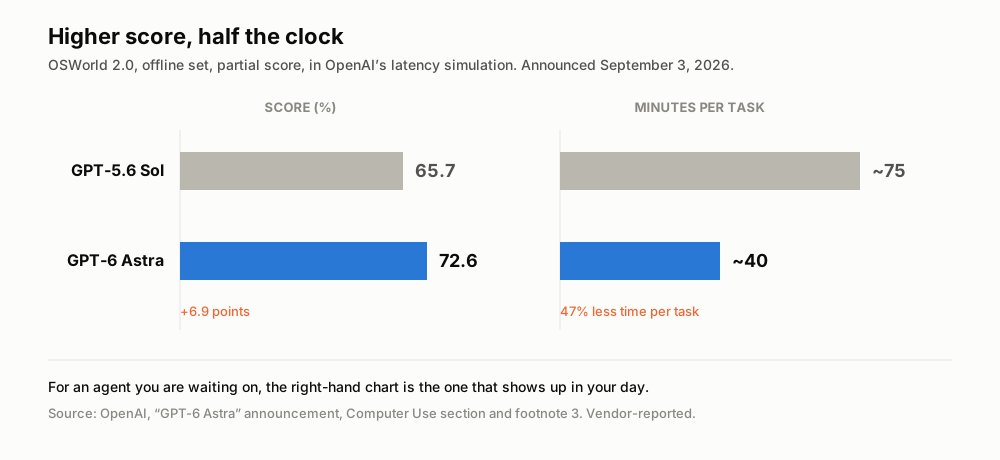
Score on the left, wall clock on the right. Source: OpenAI's GPT-6 Astra announcement, Computer Use section.
Here's the point: for a model you delegate work to and then wait on, time-per-task is the metric that shows up in your day and on your invoice. A seven-point accuracy gain is an evaluation result. Halving the wait is a different product.
The rest of the computer-use block is consistent. ScreenSpot-Pro, which tests whether a model can find and click the correct pixel in a dense interface, goes from 76.9% to 92.7% with no tools. Agents' Last Exam — complex professional tasks in real software, from financial modeling to media production — lands at 59.3%, against 55.5% for Claude Opus 5 and 53.6% for Sol, and OpenAI notes Astra used roughly 65% fewer output tokens than Opus 5 to get there. On the Mind2Web browser benchmark, with an updated Codex harness, OpenAI reports 1.9x faster task completion than the current Sol setup.
Read carefully, that last number is a system claim, not a model claim: harness plus model. It is still the number a user experiences, which is why it is worth quoting and worth labelling.
What the demos actually show
OpenAI published a set of screen recordings alongside the announcement rather than still images, and they are the clearest evidence in the release of what "computer use" now means. We have not re-hosted them; they play on OpenAI's announcement page, and OpenAI's own footnote 4 states that the displayed clips are edited excerpts with reported elapsed times, which is the right caveat to carry into watching them.
The four worth your time:
- PCB layout in KiCad — a 15-second condensed playback of Astra turning an electronic schematic into a manufacturable board, placing components and routing copper. Layout is normally manual work and a standard bottleneck in electronics design.
- Blender to Unreal Engine 5 — modelling a house, then converting it into a walkable scene, the kind of hand-off that usually costs a designer a day.
- A slide deck built from a template — Astra given a few slides of OpenAI's presentation template and asked to produce a deck about a fictional model, matching tone and layout. This is the demo most relevant to office work, and the least cinematic.
- Genomics software navigation — inspecting sequencing quality and visualising genetic variation inside specialised scientific tooling.
OpenAI also published a static side-by-side of Sol and Astra building a personal career website, illustrating a behavioural change rather than a score: when instructions leave room for interpretation, Astra asks a focused question instead of guessing.
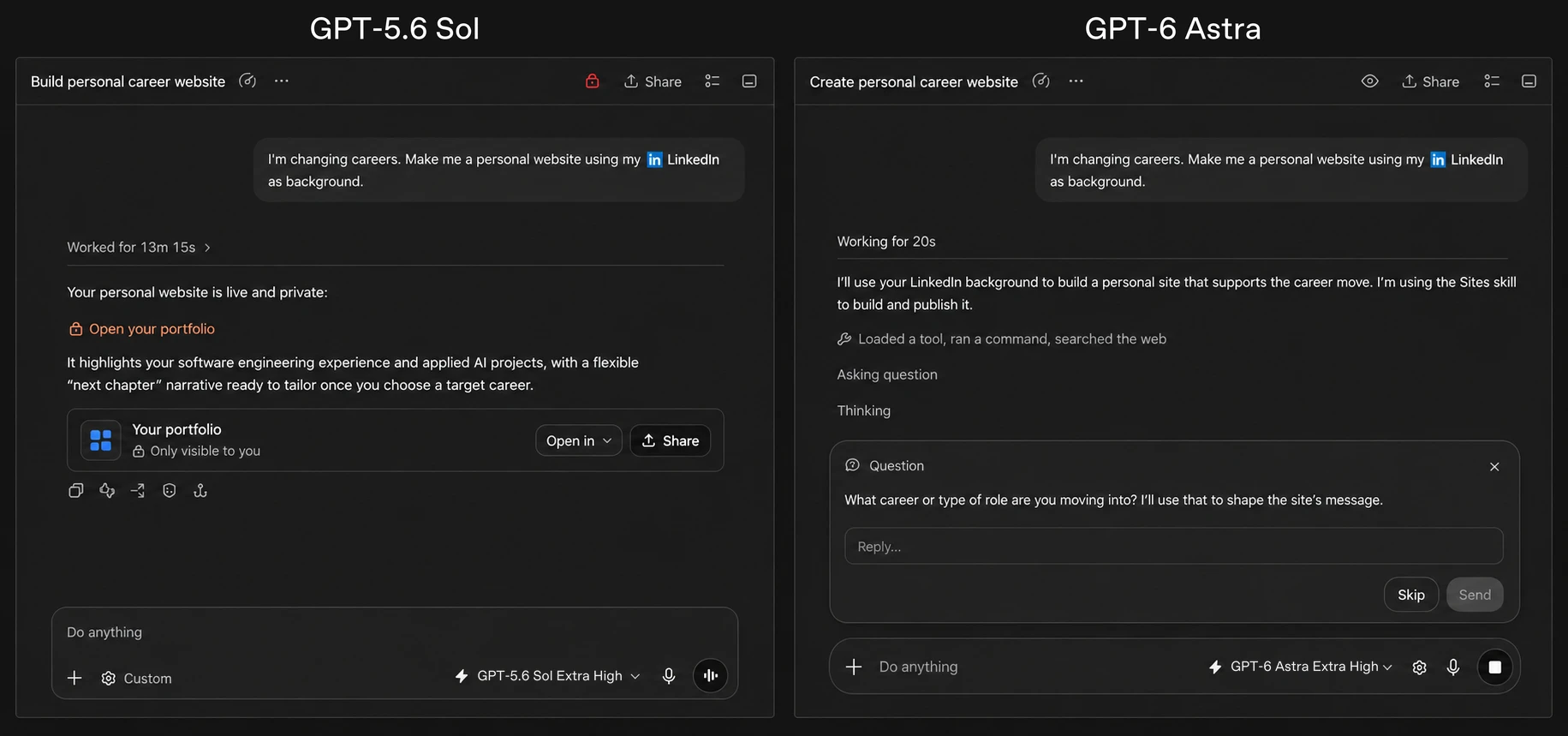
Image credit: OpenAI, "GPT-6 Astra: A new generation of intelligence", September 3, 2026. The behaviour it demonstrates — asking when the answer would change the outcome, proceeding when it wouldn't — is vendor-demonstrated, not independently benchmarked.
The far end of the context window stopped collapsing
This is the least discussed result in the release and, for anyone building on long documents, probably the most consequential.
Long-context marketing has been unreliable for three years because the advertised window and the usable window were different numbers. Models accepted a million tokens and then retrieved badly past a few hundred thousand. Astra did not widen the window at all — GPT-5.6 Sol's context is also 1,050,000 tokens. What changed is what happens at the far end of it.
On OpenAI's MRCR v2 8-needle test, Astra scores 100.0% in the 256K–512K band against 91.5% for Sol, and holds 96.3% in the 512K–1M band where Sol drops to 73.8%. A 22.5-point gap at the top of the window is the difference between a spec and a feature.
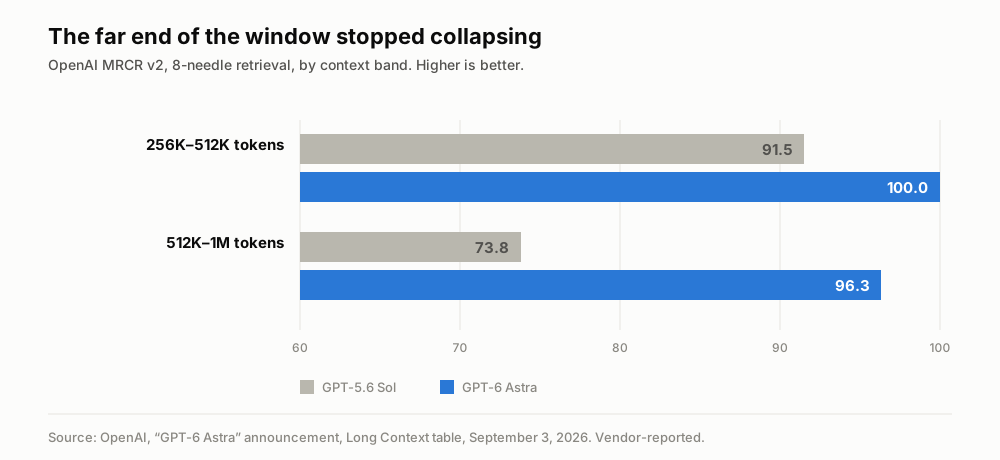
Vendor-reported, from OpenAI's Long Context table. MRCR is OpenAI's own benchmark, which is the caveat.
Paired with this, Codex gains an experimental mechanism where Astra keeps notes across context windows instead of compacting a long session into a single lossy summary, with earlier windows left searchable. OpenAI says it becomes the default for Astra within weeks. Compaction loss — forgetting why a fix failed three hours ago — is the most common failure mode in long agent sessions, so this is a targeted fix for a real problem.
Terminal and science work produced the biggest deltas in the release
If you rank every published comparison against GPT-5.6 Sol by size of jump, the top of the list is not math and not coding-in-general. It is agents operating a terminal.
| Benchmark | GPT-5.6 Sol | GPT-6 Astra | Claude Fable 5.1 |
|---|---|---|---|
| Terminal-Bench Science 0.1 | 22.4% | 64.6% | 52.6% |
| SRE-Bench (1 attempt) | 55.9% | 88.0% | – |
| Terminal-Bench 4.0 | 37.3% | 57.9% | 55.8% |
| AutomationBench | 18.1% | 41.4% | 31.4% |
| Internal Database Migration Tasks | 42.7% | 63.9% | 57.8% |
| FrontierMath Tier 4 (v2) | 83.0% | 97.6% | 87.8% |
| GPQA Diamond | 94.6% | 96.0% | 93.7% |
| Humanity's Last Exam (w/ tools) | – | 57.2% | 65.0% |
Terminal-Bench Science nearly tripled. SRE-Bench — reverse-engineering compiled binaries without source — went from 55.9% to 88.0% on the first attempt, and 99.2% within four. AutomationBench more than doubled. These are not rounding-error improvements, and they cluster tightly around one description: an agent that operates tools over many steps without losing the thread.
On mathematics, OpenAI reports two new results on prime gaps, with proofs published as PDFs. Astra helped establish that infinitely many pairs of primes occur within 186 of each other, improving on a bound of 240 set recently by Julia Stadlmann, itself an improvement on 246 that had stood for more than a decade. A second result improved a term in a bound on large prime gaps that had been unchanged for over 80 years. Those are checkable artifacts, not benchmark rows, which makes them the most durable claims in the entire announcement.
Where the marketing outruns the evidence
Now the pivot from measurement to judgment. Our take: this is a major release that has been described using the wrong vocabulary, and OpenAI supplied the evidence against its own framing.
The neutral aggregate is flat. Artificial Analysis Intelligence Index v4.1.1, printed in OpenAI's own Professional table: Astra 61.2, Sol 60.9, Fable 5.1 65.7, Opus 5 63.1. On the Coding Agent Index v1.4, also in OpenAI's table, Astra scores 67.0 against Opus 5's 68.1 and Fable 5's 67.2. A model that ties its predecessor on the composite is not a generational jump in general capability, whatever the blog post says. On Artificial Analysis's own current v4.2 methodology, retrieved September 5, 2026, the ranking is unchanged in shape: Fable 5.1 at 56.8, Astra at 54.7, Opus 5 at 54.1.
"Saturates" is doing heavy lifting. ARC-AGI-3 at 99.9% is real, and OpenAI's footnote 1 says it was run with a Responses API harness "which changes two settings to better match real-world performance." A plain stateless API call is not that harness. Treat 99.9% as a ceiling under a tuned configuration, not the behaviour of your integration.
FrontierMath is not a neutral referee. Epoch AI, which runs it, has disclosed that OpenAI funded its development and holds exclusive access to part of it. The 97.6% is impressive; it is not independent.
ExploitBench at 100% has a footnote too. OpenAI's own note on the refreshed June–August 2026 port says some included vulnerabilities may not permit arbitrary code execution under the evaluation's constraints — the sentence quietly complicates what a perfect score on the original means.
Every headline score is a best-case setting. OpenAI states plainly that evaluation scores are the maximum at any effort level. At max effort, Artificial Analysis measures time to first token at 463.7 seconds — nearly eight minutes before the first word — against a 3.86-second median for reasoning models in the same price tier. Output then runs at 87.5 tokens per second, which is above that peer median. The headline numbers and a responsive application are not the same configuration.
The price is 2.5x. GPT-5.6 Sol's model page lists $4.00 per million input and $20.00 per million output; Astra lists $10.00 and $50.00. That is exactly 2.5x on both sides — and Sol's rate is itself promotional, published as available at least through November 21, 2026. The honest counterweight is token efficiency: Artificial Analysis measures cost to run its full Intelligence Index at $2.57 for Astra against $6.12 for Fable 5.1 and $4.21 for Opus 5. Astra costs more per token and less per finished task than the Claudes — a distinction worth making before anyone quotes the sticker price as a verdict.
And OpenAI is more monitorable in some ways, less in others. The system card reports Astra makes substantially fewer factual errors than Sol, never attempted to circumvent a Codex Auto-Review denial in internal testing, and went beyond an authorised target in 0% of cases on a scope-creep evaluation where Sol did so 48% of the time without safeguards. The same document reports Astra's written reasoning is harder to monitor than Sol's, which OpenAI attributes to shorter chains of thought and says it takes seriously. Both belong in the same paragraph.
Four things we could not verify, marked as such
The reporting around this release runs ahead of the evidence in specific places.
Secondary coverage has claimed Astra regressed on GDPval, on banking tool-use, on long-document reasoning and on presentation quality in long-horizon agentic tests. We checked: GDPval does not appear anywhere in OpenAI's announcement, and we could not find a published Astra GDPval figure from OpenAI or a completed independent run to check the claim against. The absence is itself notable — GDPval is the benchmark built around economically valuable work across occupations — but "missing" and "regressed" are different findings, and only the first is established.
The claim that Astra discovered two previously unknown zero-day vulnerabilities during internal evaluation is stated in OpenAI's announcement, with disclosure to maintainers promised. It has not been independently confirmed and the vulnerabilities are not identified.
"GPT-6 Astra Pro" is referenced for Pro, Business and Enterprise plans with no separate pricing, benchmarks or model card published as of September 5, 2026. Nobody outside OpenAI knows what it is.
The internal hallucination benchmark showing 4.2% for Astra against 12.2% for Sol is an internal benchmark. OpenAI describes its construction — de-identified ChatGPT conversations users flagged as containing factual errors — and states outright that absolute rates are inflated by design and should not be read as production hallucination rates. The direction is credible; the number is not portable.
The frontier model still cannot hear
Here is the detail that reframes the release for anyone whose work arrives as speech rather than text.
GPT-6 Astra's input modalities are text and image. Its output modality is text. The most capable model OpenAI has ever shipped — a million-token window, 47% faster at driving a desktop, 96.3% retrieval at the top of its context — has no ears.
That is not an oversight, it is architecture. Frontier reasoning models and speech models are separate product lines, and audio work still runs through a transcription stage before a reasoning model sees anything. Which means the quality of everything Astra can do with a conversation is capped upstream, by whatever turned that conversation into tokens. If the transcript merged two speakers, or lost the Thai segment in a bilingual meeting, or dropped ninety seconds when the connection wobbled, then a 1M-token context window is a very large container for a flawed input.
This is the part of the stack that model releases never fix and that gets less attention every time a new flagship ships. The reasoning layer keeps getting better at a rate you can chart. The capture layer — recording an hour without dropping it, keeping speakers apart, handling a meeting that switches languages mid-sentence — improves on a completely different and much slower curve, and no amount of frontier intelligence downstream compensates for a bad transcript upstream.
The bottom line: the frontier grew an arm, not a head
GPT-6 Astra is a long-arm release. It reaches much further into specific kinds of work — operating a terminal, driving a desktop, retrieving from the far end of a million tokens, reverse-engineering a binary — while the thing we usually call intelligence sat almost still on every neutral measure available, including the one OpenAI printed itself.
That is not a disappointment. It is a more useful shape than the alternative, because narrow capability arrives in production faster than general capability does. But it means the buying question has changed. "Is it smarter?" now has a nearly meaningless answer. "Is it better at the specific loop I run forty times a day, and how long does that loop take now?" has a very good one.
Check the benchmark that resembles your work. Ignore the composite. And check the clock, not just the score.
Where Telli.sh fits: the gap this release makes visible — brilliant reasoning sitting on top of whatever the capture layer handed it — is the gap we build in. Telli.sh records the meeting, keeps speakers apart, translates live across 15 languages, and turns the result into notes you can still search next quarter. It routes transcription, translation and summarisation through a swappable engine layer, so a release like Astra arrives as better notes rather than as a migration project. No frontier model release changes the part where someone has to capture the hour in the first place.
Sources
- OpenAI, "GPT-6 Astra: A new generation of intelligence," September 3, 2026 — all benchmark tables (Computer Use, Professional, Coding, Academic, Science and Health, Cybersecurity, Alignment, Long Context, Abstract reasoning), the OSWorld latency simulation, the Mind2Web 1.9x figure, footnotes 1, 3, 4, 8, 9, 10, 11 and 12, availability, and the prime-gap results; retrieved September 5, 2026
- OpenAI developer docs,
gpt-6-astramodel page — context window, max output, knowledge cutoff, modalities,reasoning.effortlevels, and standard/cached/cache-write pricing; retrieved September 5, 2026 - OpenAI developer docs, "Using GPT-6 Astra" migration and prompting guide — Responses API requirement for tool calling, removed sampling parameters, Fast mode caveats; retrieved September 5, 2026
- GPT-6 Astra System Card, OpenAI Deployment Safety Hub — Critical cybersecurity threshold under the Preparedness Framework, High in Biological and Chemical, below High in AI Self-Improvement, jailbreak robustness, the factuality evaluation and its stated limits, and the chain-of-thought monitorability decline; retrieved September 5, 2026
- Artificial Analysis, GPT-6 Astra intelligence, performance and price analysis — Intelligence Index v4.2 scores, cost per Intelligence Index task, output speed of 87.5 tokens per second and time to first token of 463.7 seconds; retrieved September 5, 2026
- Vellum, "GPT-6 Astra Benchmarks Explained" — cross-checking of the computer use, academic and long-context tables, and the Humanity's Last Exam asterisk
- Emergent, "GPT-6 Astra Benchmarks: What the Numbers Actually Show" — the ARC-AGI-3 harness caveat and the Intelligence Index comparison
- MindStudio, "GPT-6 Astra Benchmarks: Is It Really Better Than Fable 5.1?" — the reported GDPval, banking tool-use, long-context and presentation-quality regressions that we were unable to verify against a primary source
- Al Jazeera, "OpenAI unveils GPT-6 Astra amid rising scrutiny and safety concerns," September 4, 2026 — release timing and the staged rollout
- 9to5Mac, "OpenAI releasing major upgrade to ChatGPT and Codex with GPT-6 Astra," September 4, 2026 — the plan-by-plan rollout sequence after launch day
- Our commentary on the GLM-5.3-Flash stealth release — the other end of the same curve, where capability arrives cheaply rather than expensively