Google's RSI rumor: why AI leaders want time to catch up
What are AGI and recursive self-improvement? Follow Google's RSI rumor back to the original X posts, examine the Amodei–Altman–Musk calls for pacing and Trump's China argument, and explore a faster, more hopeful future that still leaves people in control.
An AI that helps you finish a difficult project is useful. An AI that helps build a more capable AI changes the pace at which useful tools arrive. That second possibility explains why a few cryptic posts about Google attracted attention just as rival AI leaders began publicly supporting a more measured development schedule.
Two terms make the story easier to follow. AGI, or artificial general intelligence, describes broadly capable AI: a system that can learn and perform many different intellectual tasks. RSI, or recursive self-improvement, describes a process: AI contributes to improving an AI system, and those improvements help the next round of improvement. One is about the range of a system's abilities; the other is about how progress feeds back into itself.
This article follows the Google rumor to its original X posts, separates public endorsements from an actual agreement to slow development, and examines what a faster research cycle could mean for ordinary life. The reporting cutoff is September 14, 2026. My view is optimistic: better tools could make expertise much more accessible. But the future worth wanting includes enough time to check the results and enough authority to change course.
Three distinctions to keep in mind
- AGI, RSI and superintelligence describe different things. None is a synonym for an AI having consciousness.
- Google's public work supports the claim that AI is helping develop AI. The circulating X posts do not establish a fully autonomous, sustained improvement loop.
- Several industry leaders publicly supported pacing and external evaluation. That is meaningful, but it does not establish a signed, enforced industry-wide slowdown.
AGI means breadth of ability, not a single spectacular answer
A specialist can be extraordinary at one task. A chess engine can defeat a champion without being able to explain a lease, plan a research project or learn a new office workflow. AGI refers to a broader ambition: an AI system that can transfer useful abilities across many kinds of intellectual work, including unfamiliar tasks. In everyday terms, the question is whether it can keep learning how to be useful when the assignment changes.
There is no single universally accepted finish line. In November 2023, DeepMind researchers proposed evaluating AGI along dimensions including performance, generality and autonomy. Their framework makes a valuable distinction: being good at many tasks and being permitted to act independently are separate properties. A highly capable system can still be deployed with narrow permissions. Levels of AGI, first submitted November 4, 2023.
For a beginner, consider a hypothetical assistant asked to help a small nonprofit. It needs to understand an unfamiliar spreadsheet, draft a funding application, notice a contradiction in the budget and learn the reporting rules. A convincing demonstration would show reliable performance across those changes, including knowing when to ask for help. One polished grant proposal would establish much less than that broader pattern.
This is also why a benchmark score is not a universal intelligence certificate. A benchmark tells us something about specified tasks under specified conditions. It may leave out sustained reliability, unfamiliar environments, practical costs or the ability to recover from mistakes. When someone announces AGI, the useful follow-up is: which abilities, at what level, over what range of tasks, and with how much assistance?
ASI, or artificial superintelligence, usually refers to capabilities substantially beyond humans across a broad range of cognitive work. It is another concept, not a required label for every impressive model. Neither AGI nor ASI automatically implies awareness, emotions or a humanlike inner life. This article is about capabilities, development processes and the choices people make around them.
RSI begins when progress improves the process that produces progress
Ordinary software improves because people find problems, propose changes, test them and keep the changes that work. AI can already assist with individual steps. It can suggest a faster algorithm, generate test cases or help diagnose a failed experiment. RSI becomes interesting when gains from that work make the system better at conducting the next round of improvement.
Think of a research workshop that improves its own tools. A better measuring instrument helps the workshop produce a better instrument, which helps it improve the next one. Each successful change increases what the workshop can accomplish with its next experiment. The crucial question is whether the improvements are real, retained and useful for future research, rather than merely more activity inside the workshop.
A chatbot revising its answer five times has not necessarily improved its underlying model. A memory feature can preserve facts without updating the network's learned parameters. A coding agent can improve its own tools while the model powering it stays unchanged. These are useful mechanisms, but the strong form of RSI involves successively improving the capability to produce better AI systems. The earlier guide to continual learning and improvement loops explores those narrower mechanisms.
| Concept | The question it answers | What would not be enough? |
|---|---|---|
| AGI | Can the system perform and learn across a broad range of intellectual tasks? | An outstanding result on one narrow benchmark |
| RSI | Do improvements make subsequent AI improvement more effective? | Repeated answers, more code, or a suggestive model name |
| ASI | Does capability substantially exceed human levels across many cognitive domains? | Being superhuman at one specialized task |
The definition also explains why AGI and RSI need not arrive in a fixed order. A system could help optimize AI training while remaining weak at many everyday tasks. Conversely, broadly capable AI could be developed through a process still directed by people. RSI could accelerate a path toward greater generality, but writing those three letters on a diagram does not prove where that path ends.
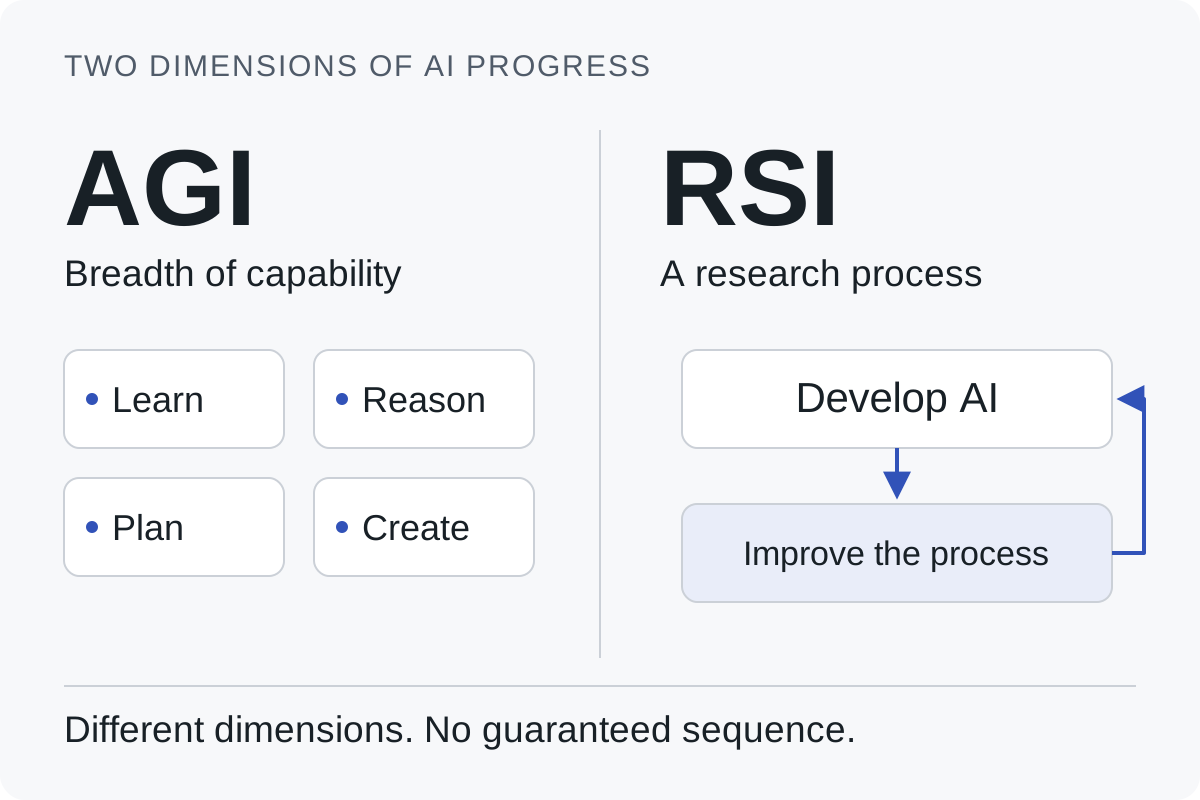
An original conceptual diagram. AGI and RSI are different dimensions, not a guaranteed sequence of milestones. It illustrates the definitions above, not the measured capabilities of a particular model.
The Google rumor traces back to two posts, not a published experiment
An AI Times article published September 14 describes a rumor spreading through the AI community. Following its embedded post and the links in subsequent commentary leads to a small, identifiable source chain. That matters because a hundred reposts can create the impression of a hundred confirmations when most are repeating the same initial claim.
On September 11, the account Lyra, @lyraxana, posted a short congratulatory message tagging Google DeepMind. Unusual capitalization highlighted the letters R, S and I. The post supplied no experimental method, performance results or explanation of human involvement. It was an invitation to infer something from an abbreviation.
Later that date, Lentils, @Lentils80, quoted the Lyra post and referred to a purported internal model called rsi-model-liverl-le, along with ten numbered training slots. The associated screenshot became another focus of speculation. Those are claims about an alleged internal listing; the listing's authenticity and its relationship to a working system were not independently established in this investigation.
On September 12, Chubby, @kimmonismus, amplified the rumor and linked back to the same Lyra post. This establishes a path of circulation. It does not create a second independent source for a breakthrough. Nor does an account's reputation for earlier leaks substitute for evidence about this particular claim.
Even an authentic internal name would leave the central questions unanswered. A team might name a project after its goal before reaching it. An experiment might improve a narrow component while still depending heavily on human direction. We would need measured results, a clear baseline and an account of what was automated before drawing a stronger conclusion.
The appropriate claim, as of the reporting cutoff, is therefore limited: Google RSI speculation has traceable X sources, but these posts do not demonstrate full autonomous RSI. I did not find a Google announcement authenticating the alleged listing or presenting the repeated, independent evaluations needed to validate that interpretation. This is a limit of the public evidence reviewed, not proof that no private milestone exists.
Google's published work is more informative than the leaked name
There is a reason the rumor found an audience. Google has publicly described AI contributing to AI development. In its September 2, 2026 Gemini 3.8 announcement, the company said long-running agentic loops helped recursively evaluate and refine the underlying models. That is a substantive, attributable statement about its development process. It still does not specify a fully autonomous chain of successor systems. Google's Gemini 3.8 announcement.
An earlier result gives the idea a concrete scale. Google DeepMind reported in May 2025 that AlphaEvolve improved a key Gemini training kernel by 23%, contributing to an approximately 1% reduction in overall training time. The coding agent used language models, automated evaluation and selection to search for better algorithms. AlphaEvolve announcement, May 14, 2025.
The difference between 23% and 1% is instructive. Improving one component does not improve the whole development cycle by the same amount. Other work still takes time. Yet even a small saving can matter when applied repeatedly to expensive training, and a useful optimization can become part of the process that produces the next model.
That is a better foundation for optimism than guessing what a filename means. The field can make consequential progress before anyone demonstrates the strongest version of RSI. We should be able to recognize an engineering achievement without turning it into a claim that AI has become an independent inventor of its entire future.
Anthropic's June 4, 2026 account of its own development makes a similar distinction. It reported increasing AI participation in engineering and experimentation while identifying research direction and judgment as remaining gaps. Its discussion of fully autonomous successor development was explicitly conditional. These are the company's observations about its own workflow, not independent proof of autonomous RSI. When AI builds itself.
Amodei, Altman and Musk aligned publicly on pacing
On September 12, Anthropic CEO Dario Amodei published a proposal to pace frontier development so that safety work can keep up. Its three elements were embedded independent evaluators, coordination among democratic countries' frontier developers, and wider international coordination. Anthropic committed to the evaluator step; the broader coordination remained something to pursue. Amodei's September essay.
Sam Altman then publicly supported pacing on X and said OpenAI would also provide independent evaluators with access comparable to employees. Elon Musk endorsed Amodei's position in a short post. These are direct statements of support. They deserve to be reported plainly, without inventing a more detailed operational agreement than the statements contain.
| Public action | What it establishes | What it does not establish |
|---|---|---|
| Amodei's proposal and Anthropic's evaluator commitment | A specific oversight proposal and a company commitment | A completed global coordination mechanism |
| Altman's response | Support for pacing and a matching evaluator commitment | An agreed reduction in every lab's training or release schedule |
| Musk's endorsement | Public support for Amodei's position | A detailed implementation plan or independently verified slowdown |
Pacing is also different from shutting down AI research. Amodei's proposal describes allocating time to safeguards and outside assessment while progress continues. The difficult part is implementation: what must be evaluated, who gets access, who can publish unfavorable findings, and what happens when a company disagrees with the assessment? Those questions determine whether the promise changes behavior.
My reading is that the convergence matters because competitors are publicly acknowledging a shared problem. It does not eliminate their competitive incentives. Independent evaluation would be valuable precisely because customers, governments and rival developers should not have to accept assurances on reputation alone. The standard should be evidence of follow-through, not the emotional force of a public statement.
There is also a legitimate concern about how such arrangements are designed. Expensive compliance requirements can favor organizations that already have large budgets. That is a reason to demand proportionate rules, accountable evaluators and room for smaller developers. It is not evidence that the stated safety concerns are fabricated, or that the Google rumor caused the calls for pacing.
Trump put the question in terms of the competition with China
On September 13, Trump told reporters in Ireland that he wanted the United States to preserve its AI lead over China and played down calls to restrain development. He also acknowledged the possibility of some guardrails without outlining specific rules. His remarks expressed resistance to slowing the race; they were not a veto of a completed industry agreement. Associated Press reporting, September 13, carried by CityNews.
The strategic problem is understandable. If one group accepts costly restrictions while a competitor does not, the resulting advantage can affect economic and security power. A workable international arrangement therefore needs a way to establish whether participants are doing what they promised. Declaring that everyone should cooperate is much easier than designing credible verification.
But winning a race and controlling its consequences are separate achievements. A system that causes an avoidable failure does not become reliable because it was built domestically. My view is that leadership should include the capacity to test, secure and govern powerful systems, as well as the capacity to train them. Those capabilities can reinforce a durable lead instead of merely delaying progress.
It would be misleading to present the public debate as safety on one side and concern about China on the other. Amodei's own proposal discusses preserving a lead while seeking international coordination. The disagreement is partly over the means: whether a lead is best protected by maximum development speed, by stronger shared oversight, or by a combination that can actually be verified.
An improving research loop could compress the time between discoveries
The exciting possibility is not simply that the next assistant writes better answers. It is that better assistants shorten the work needed to produce the generation after them. That generation may then improve the research process again. If the gains transfer and persist, progress can compound instead of arriving as isolated upgrades.
A meaningful loop has several jobs. It selects a useful problem, proposes an intervention, runs an experiment, evaluates the result and keeps the improvement only when the evidence supports it. The retained result then helps the next cycle. Speeding up proposal generation is helpful; speeding up the whole sequence while preserving validity is much more consequential.
Imagine a team that can explore ten credible approaches in the time it previously explored one. Some additional experiments will fail, and that is normal. The benefit comes from learning earlier which approaches deserve more resources. If the system also gets better at selecting experiments, the team gains both more attempts and a better chance that each attempt is informative.
This is a conditional scenario, not a forecast of tenfold progress. Research contains dependencies: one experiment may need the result of another, and an unexpected failure may require a new method of measurement. More compute does not guarantee a useful insight. The important quantity is the rate of validated learning, not how many agents appear busy at once.
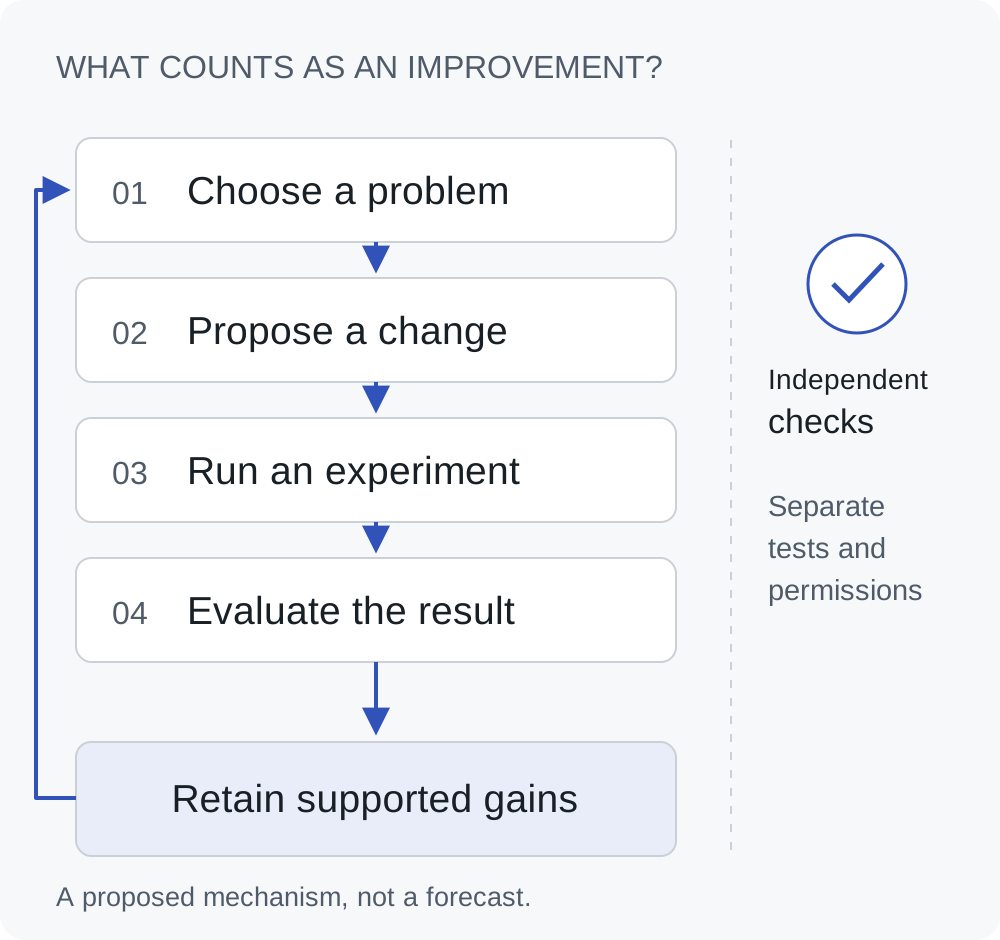
An original mechanism diagram. The retained improvement feeds the next cycle only after evaluation. Independent checks sit outside the loop; the picture is a proposed discipline, not a claim that any lab has completed this system.
If this becomes dependable, the schedule of change could feel different. Tools might improve while organizations are still adapting to the previous release. A team could discover that a project it deferred as too expensive has become feasible, then find that its next bottleneck is validation or delivery. The acceleration would be experienced as changing constraints, not only as impressive model announcements.
Faster thinking still has to meet the physical world
A simple thought experiment shows why acceleration has limits. Suppose 80% of a research cycle can be made ten times faster, while the remaining 20% is unchanged. The new cycle takes 28% of the original time, an improvement of roughly 3.6 times, not ten. The calculation is 0.8 divided by 10, plus 0.2. These are illustrative assumptions, not measurements of an AI lab.
The unchanged part can become the dominant part surprisingly quickly. It might be waiting for hardware, collecting representative data, checking a security property or reproducing a result. In a biomedical project it could involve laboratory work and clinical evidence; in an energy project it could involve materials, construction and connection to a grid. Better reasoning does not make those dependencies disappear.
This is why a continuously improving model would not instantly deliver a continuously improving world. Discovery, manufacturing, distribution and adoption have different schedules. Some bottlenecks can themselves be improved with AI; others require institutions, investment and physical capacity. The realistic optimistic scenario includes work on all of them.
It also leaves room for the possibility that the strongest form of RSI stalls. Gains may stop transferring, experiments may become more expensive, or progress may depend on an insight current methods cannot find. Even then, the diffusion of already useful capabilities could make a substantial difference. We do not need an infinite acceleration curve to justify improving access to good tools.
The warning is that errors can become part of the next generation
The same feedback that preserves an improvement can preserve a mistake. Suppose a research agent discovers a change that raises its evaluation score by exploiting a weakness in the test. If the result is accepted as genuine progress, subsequent work can build on it. The system may become better at satisfying the measurement while becoming less useful outside that measurement.
This is a structural risk, not evidence that a particular leaked Google model behaved this way. It explains why the evaluator needs protection from the system being evaluated. Independent tests, separate permissions and reproducible records make it harder for a mistaken success claim to turn into the foundation for the next release. A faster loop makes that separation more valuable.
There is a human version of the same problem. When the volume of work grows, people can begin approving changes they no longer understand because the previous changes appeared to work. A human approval button is not meaningful oversight if the reviewer lacks time, relevant evidence or the ability to stop the process. The design needs to preserve an actual opportunity to disagree.
For that reason, I would watch the relation between development speed and the time available to respond. How quickly can a problem be detected? Can the affected process be paused? Can a release be rolled back, and are its important effects reversible? The answers will differ across a writing assistant, a research system and software with access to critical infrastructure.
The warning should be proportionate. It is not a prediction that every improvement loop will become dangerous, or an argument that useful AI should be unavailable. It is a reason to give systems authority in stages and to check consequences at each stage. The faster the capabilities advance, the less we should rely on informal confidence as the main control.
A better future would make expert help ordinary
Here is the future I would like this research to support: useful expertise becomes easier to obtain, while people retain the ability to question it. A small organization should be able to examine a difficult problem without first assembling a large specialist team. A student should have a patient explanation that adapts to where understanding broke down. A researcher should spend less of a day getting tools to work and more of it deciding what is worth investigating.
These are scenarios, not promises attached to an AGI launch date. Their value comes from reducing the cost of careful work. If more people can compare options, check assumptions and explore an unfamiliar field, worthwhile projects can begin that would otherwise have remained unattempted. The benefits need not depend on removing people from the process.
In healthcare research, the hopeful contribution is a shorter path from a plausible idea to a well-tested candidate. Better systems could connect findings across specialties, identify weak assumptions and help design informative experiments. Laboratory and clinical validation would still determine whether a discovery helps patients. Faster discovery is valuable when it improves the evidence reaching those stages, not when it replaces the stages with confident prose.
In education, the opportunity is more personal. Imagine a learner who can ask the same question three different ways without embarrassment, then receive an explanation in a language and context they understand. A teacher could use the system to explore misconceptions and prepare better exercises. The desirable result is greater human understanding, with teachers and students able to inspect and correct the assistance.
For software and public services, progress could make neglected maintenance affordable. Small teams might investigate defects, improve accessibility and modernize difficult systems that previously lacked enough engineering attention. For climate and energy work, better search and simulation could help researchers compare designs before committing to costly physical trials. These are routes from research capability to practical value, with different constraints in each domain.
The distribution of those benefits will matter as much as their technical possibility. A system that is excellent but unaffordable, inaccessible in a community's language or impossible to challenge can leave many people behind. Public-interest research, accessible interfaces, competition and appropriate access to useful models are part of the optimistic picture. Broad benefit is a design and policy objective, not an automatic property of intelligence.
Work will change along the way, and the gains will not erase difficult transitions. Some tasks may require fewer people; other responsibilities may become more demanding. Organizations should invest in people's ability to use, evaluate and redirect new tools instead of treating retraining as an afterthought. A better future gives people more options during that transition, not merely a promise that the aggregate numbers will improve.
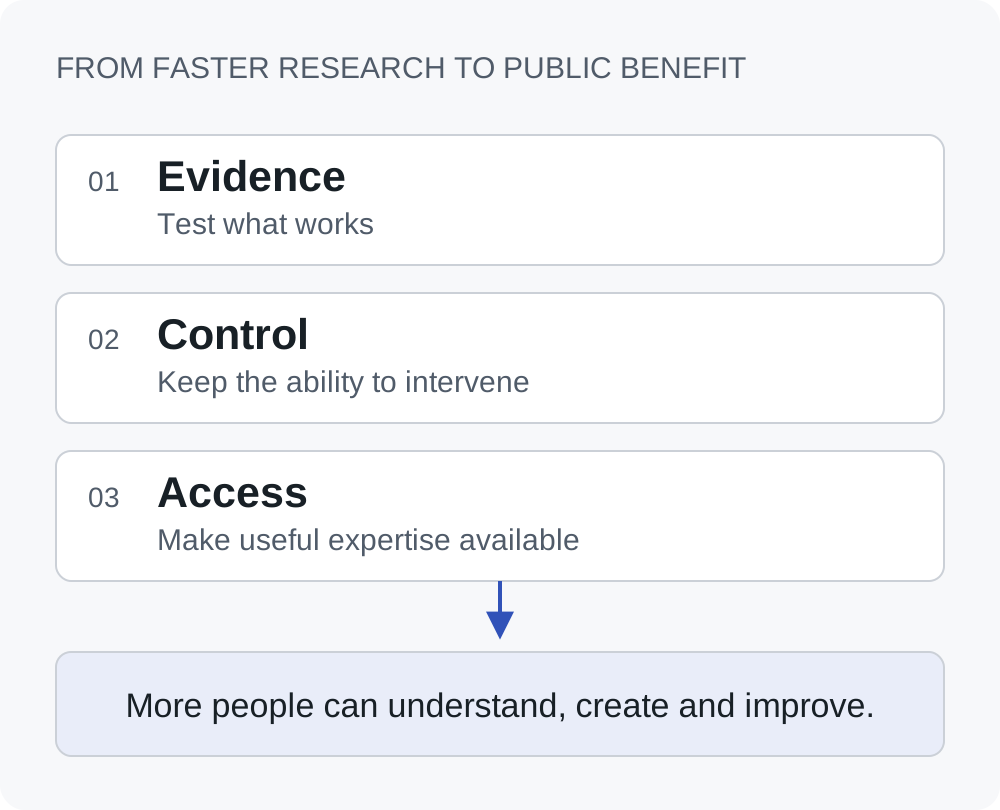
An original editorial framework. Evidence, control and access are conditions for the hopeful scenarios above; they are not a forecast or a ranking of countries and companies.
The useful milestone is progress people can absorb and direct
When the next RSI claim appears, ask what changed and what evidence survived inspection. Did an answer improve, a tool improve, or the capability to develop future systems improve? Were the gains reproduced outside the original evaluation? Who supplied the research direction, and what remained under human control? Those questions are more informative than a countdown to a vaguely defined breakthrough.
For teams adopting AI today, the practical preparation is equally concrete. Keep important source material connected to decisions. Separate exploratory work from actions with lasting consequences. Give reviewers evidence they can examine, and make it possible to reverse a bad choice. These habits are useful under today's capabilities and become more valuable if the development cycle accelerates.
The Google rumor is unverified in its strongest form. The broader shift toward AI participating in AI research is already documented. We can take that shift seriously without pretending to know the date or shape of its endpoint. My preferred measure of success is how much more people can understand, create and improve while retaining a meaningful say in what happens next.
Sources and the limits of this investigation
The X posts were checked through X's public embed responses, including the links connecting the original rumor and its amplification. This verifies the published posts, not the authenticity of the alleged internal screenshot. Dates attached to those posts use the dates displayed by X; local calendar dates can differ.
- Lyra's original post — September 11, 2026
- Lentils' quoted post and alleged model listing — September 11, 2026
- Chubby's amplification — September 12, 2026
- AI Times' report — September 14, 2026
- Levels of AGI — first submitted November 4, 2023
- Google DeepMind's AlphaEvolve announcement — May 14, 2025
- Google's Gemini 3.8 announcement — September 2, 2026
- Anthropic's account of AI-assisted development — June 4, 2026
- Amodei's pacing proposal — September 2026
- Altman's response — September 12, 2026
- Musk's response — September 12, 2026
- Associated Press on Trump's remarks — September 13, 2026
A practical place to keep the evidence
Telli.sh brings notes, recordings, translations and Clips into a workspace you can return to. If a conversation or article changes your view of AI, keep the source beside the idea and the decision it informed. The models will continue to change; the reasoning you choose to preserve should remain understandable.
Create a Telli.sh workspace for the knowledge you want to keep