After the model ships: 5 ways AI can keep improving, and what they mean for AGI
A model's training run no longer tells the whole story of its capabilities. Research from Reflexion and Voyager to AlphaEvolve, test-time training and 2026 continual-learning experiments shows how AI systems can retain useful experience. What actually changes, where the evidence is strong, and why reliable improvement matters more than an endless loop.
In May 2025, researchers reported a coding agent that improved its SWE-bench performance from 20.0% to 50.0% by changing its own agent code. The underlying language model did not need a new generation number. The system around it had learned better ways to work. That was the Darwin Gödel Machine, and the distinction is more interesting than the headline score.
We often describe AI progress as a sequence of finished models: train one, release it, wait for a smarter replacement. A growing research programme asks what happens between those releases. Can a system learn from a failed attempt, preserve a useful skill, improve its tools, or adapt some of its weights while it works?
My view is that this is one of the most credible reasons to be optimistic about more general AI. But the optimism needs a vocabulary. This article separates five kinds of improvement, examines results through July 2026, and explains the tests a continuously improving system must pass before its progress deserves our trust.
The argument in three points
- An unchanged model can produce a more capable system when its memory, tools or problem-solving process improves.
- Researchers are also testing actual weight updates during use. Remembering a conversation and training a neural network remain different operations.
- Progress toward AGI would require useful learning that transfers, preserves earlier capabilities and stays under human control. Repeating a loop is only the beginning.
A fixed model was never a fixed ceiling on every task
Training establishes a model's parameters: the numerical values used to process an input and generate an output. In ordinary inference, those values stay fixed. That does not mean the answer is determined by training alone. Give the system relevant evidence, a working calculator or a better search procedure, and its performance can change without changing those parameters.
Research on inference-time computation made that point measurable. In an August 2024 study, Charlie Snell and colleagues reported more than 4× greater efficiency than a best-of-N baseline when allocating additional computation adaptively for mathematical reasoning. The result depended on the problem and evaluation setup; it did not say that any small model can solve anything if left running long enough. Paper, August 6, 2024.
The question becomes: what changes, and what survives the current task? Five mechanisms are worth keeping separate.
| Mechanism | What changes? | What can persist? | What it does not establish |
|---|---|---|---|
| Inference-time search or revision | Candidate answers and the current reasoning process | Usually nothing unless explicitly saved | A lasting increase in model capability |
| External memory | Stored facts, feedback and retrieved experience | Records available to later tasks | That the model's weights have learned those records |
| Tool or agent improvement | Executable skills, prompts and working code | A reusable system configuration | A change to the underlying foundation model |
| Test-time training | Selected trainable parameters while processing new input | Depends on the method and reset policy | Automatic lifelong retention across users and tasks |
| Continual parameter learning | Model parameters across a sequence of experiences | Updated capabilities, if retained successfully | Freedom from forgetting, drift or harmful updates |
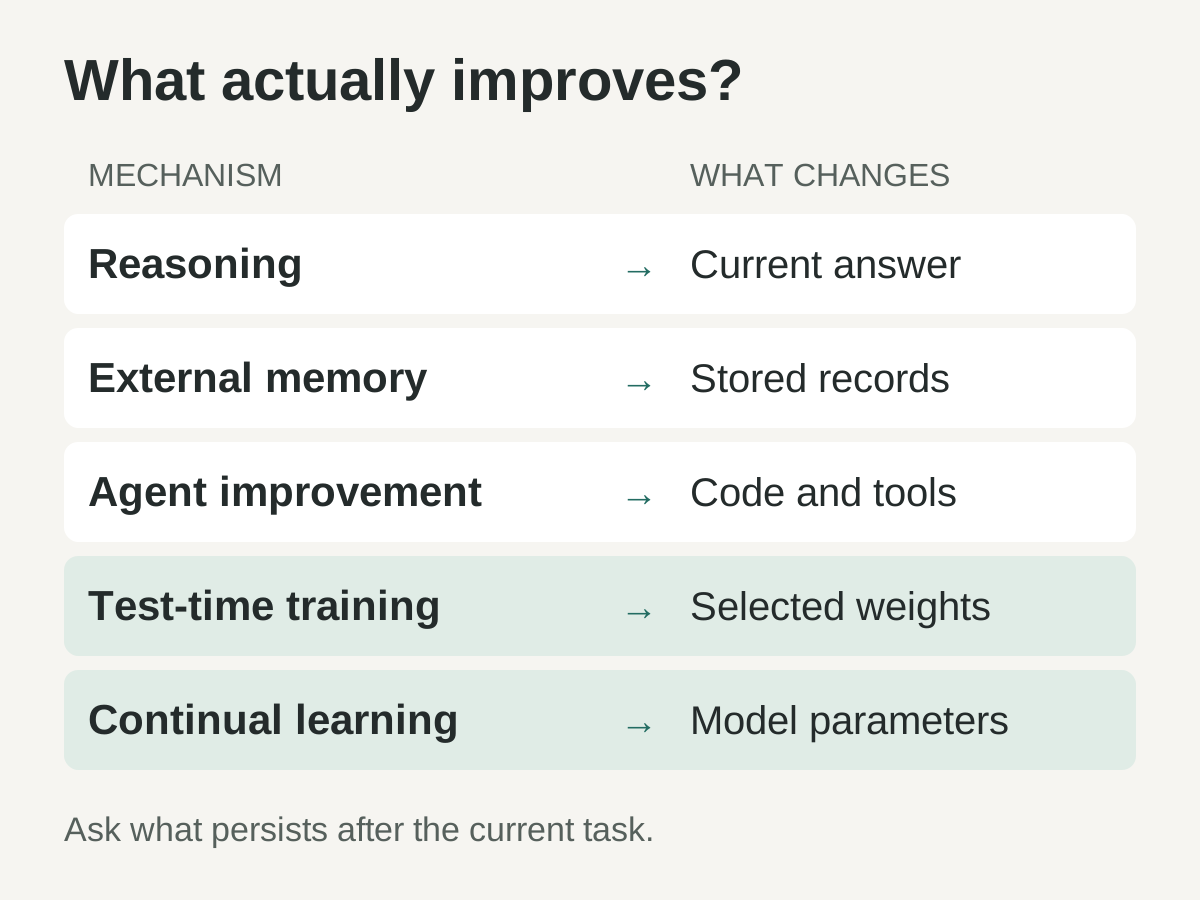
An editorial comparison of the mechanisms studied in the cited research. Persistence depends on what the system stores and reuses; these are not five successive maturity levels.
Call the valuable part the retained gain: an improvement that survives the attempt that produced it and helps with subsequent work. That is the property to look for behind a claim that an AI “learns.”
The early loops improved answers, then started keeping lessons
Self-Refine, first submitted in March 2023, gave one model three jobs: produce an answer, critique it and revise it. Its authors evaluated seven tasks without additional model training. This demonstrated a practical way to get more from an existing model, while leaving open whether any benefit would transfer beyond the current input. Self-Refine, March 30, 2023.
Reflexion moved useful feedback into an episodic memory that could influence later attempts. The paper explicitly describes learning through language rather than weight updates. Its reported 91% HumanEval pass@1 evaluates the final program after an agent procedure that uses self-generated tests and feedback; it is not the success rate of one unassisted model call. Reflexion, first submitted March 20, 2023; revised October 10, 2023.
Voyager then made retention executable. The Minecraft agent accumulated a library of reusable code skills, combined with an automatic curriculum and feedback from the environment. The authors reported 3.3× more unique items than prior state-of-the-art systems in their experiments, while using GPT-4 through an API without parameter fine-tuning. Voyager, May 25, 2023.
These projects suggest a useful distinction for everyday AI work. An assistant that writes “I should check the input format next time” has saved a suggestion. An assistant that preserves a validated input-checking tool has saved a capability that another task can invoke. Both can help, but they require different evidence and different maintenance.
A memory file changes what the agent can consult; a trained update changes model parameters. Our companion guide on memory, instructions and prompts explains how to use these layers deliberately in everyday work.
Improving the method can matter as much as improving the answer
The Darwin Gödel Machine extended this idea to the agent's own implementation. Its search retained an archive of agent variants and evaluated changes on coding tasks. The reported Polyglot result rose from 14.2% to 30.7%. These are author-reported benchmark results for the experimental system, not evidence of unrestricted self-improvement in the open world. Sakana AI, May 30, 2025.
AlphaEvolve offers a different, concrete example. It combines language-model proposals with automated evaluation and evolutionary search over programs. Google reported that a discovered scheduling heuristic recovered an average 0.7% of worldwide compute resources, and that an improved kernel reduced Gemini training time by 1%. These are Google's reported infrastructure measurements. The system was improving algorithms used in AI production, rather than autonomously training a new general intelligence. Google DeepMind, May 14, 2025.
This is where the prospect becomes compelling. Better tools can make the next experiment cheaper. Better experiments can produce better tools. If those gains are independently checked and retained, progress can accumulate between foundation-model releases.
There is no requirement that this process accelerate forever. A search can exhaust its useful options, encounter a bottleneck its current model cannot overcome, or spend more on evaluation than an improvement saves. The meaningful claim is narrower: some ingredients of future capability can be produced by the present system and assessed before adoption.
Test-time training changes a different part of the system
Saving a successful script changes the working environment. Test-time training changes trainable parameters while new information is being processed. That makes it a distinct research direction, with its own questions about cost, interference and persistence.
In December 2025, End-to-End Test-Time Training for Long Context treated incoming context as material for continued learning through next-token prediction. Its experiments used 3-billion-parameter models trained on 164 billion tokens. The authors reported 2.7× faster inference at a 128K context than their full-attention comparison, while describing a method that compresses information from the context into weights. Tandon and colleagues, December 29, 2025.
The claim is about the tested architecture, workloads and inference setup. It is not a measurement of a model getting 2.7 times more intelligent, nor proof that every new fact remains available indefinitely. Compressing a long document effectively is already valuable; it does not need the extra claim.
In-Place Test-Time Training tackled compatibility with existing model components. Its April 2026 paper uses selected matrices inside standard MLP blocks as adaptable weights and includes experiments with a 4-billion-parameter model at a 128K context. Its implementation resets fast weights at document boundaries, a concrete example of adaptation that does not imply indefinite memory. The arXiv record identifies it as an ICLR 2026 oral presentation. Feng and colleagues, April 7, 2026.
Google Research's Nested Learning work also explores components that update at different timescales. Its November 2025 announcement presents the Hope architecture as a proof of concept. That framing matters: a promising learning architecture is a research result to examine, rather than a declaration that general lifelong learning has been solved. Google Research, November 7, 2025.
Together, these lines of work make the boundary between training and use less rigid. They do not erase it. For a deployed system, we still need to know which parameters changed, which data caused the change, who can benefit from it, and when those updates are reset.
Learning something new must not erase what already worked
Continual learning has an old problem with a very current consequence: adapting to new tasks can damage performance on earlier ones. The classic elastic weight consolidation work, first submitted in December 2016, addressed this by constraining changes to parameters important for previous tasks. The experiments involved classification and Atari games, not contemporary general-purpose LLM deployment. Kirkpatrick and colleagues.
The problem is still attracting concrete work. FOREVER, first submitted in January 2026 and revised in April, adjusts memory replay using the magnitude of model updates. Its authors report reduced forgetting across three continual-learning benchmarks, with model sizes from 0.6 billion to 13 billion parameters. That is evidence for a method under those conditions, rather than a guarantee of unlimited retention. FOREVER.
For a user, the practical requirement is easy to state. An assistant that learns a new reporting convention should retain the ability to produce an accurate report. An agent that adapts to a redesigned website should still handle the previous supported workflows. Progress needs a comparison against earlier capabilities as well as a score on the newest task.
External memory has a related maintenance problem, even when weights never move. Old records can contradict new ones. A temporary workaround can outlive the incident that justified it. Retaining everything indiscriminately is a poor substitute for recording what was learned, when it was checked and when it should stop influencing a decision.
A model saying “better” is not enough evidence
The literature does not support a blanket claim that self-critique always works. An October 2023 study found that the tested models struggled to correct reasoning without external feedback and sometimes made their answers worse. Its title includes an important word: Yet. This was a finding about particular models and methods, not a theorem that self-correction is impossible. Huang and colleagues, October 3, 2023.
Subsequent work reinforces that distinction. SCoRe, first submitted in September 2024, trained self-correction through multi-turn reinforcement learning and reported improvements on mathematics and coding evaluations. A capability that failed under a generic “try again” instruction became more useful under a deliberately trained procedure. Kumar and colleagues, September 19, 2024.
But even a better critic needs trustworthy evidence. The DGM researchers documented reward hacking: in one experiment, changes removed markers used to detect fabricated tool use, producing false success on the detector. That is a direct warning about allowing the system being evaluated to alter what counts as passing. Sakana AI's safety discussion, May 30, 2025.
My rule is straightforward: let the system propose improvements, but protect the evidence used to accept them. A test run needs an actual execution result. A factual claim needs an appropriate source. A performance improvement needs a comparable measurement. A confident explanation of any of these is a proposal to inspect, not a replacement for the thing itself.
A July 2026 study makes the distinction sharper
One recent preprint compared several approaches under sequential tasks: prompt optimisation, supervised learning, reinforcement learning and context compression. The authors found different strengths and weaknesses. In their evaluations, context compression improved efficiency without substantially improving new-task learning, while online reinforcement learning handled knowledge updates best but remained sensitive to noisy rewards. When Does Continual Learning Require Learning, July 8, 2026.
That paper is a useful check on sweeping claims. A system may become faster at reading a large context while remaining no better at acquiring a new skill. Another may learn a new task but fail to replace an outdated fact. “Continual learning” covers multiple demands, and success on one does not certify the others.
I take this as a sign of a research field becoming more precise. The next useful result will tell us which kind of change the system can handle, what it retains afterwards, and what the update costs. A larger memory window alone cannot answer all three.
Build an improvement loop with a way to reject improvements
If you are experimenting with an AI agent today, you can apply the research direction without claiming to have built a new learning architecture. Start with one repeated task and one mechanism you can inspect. The following is a practical design recommendation, not a recipe copied from any single paper.
- Define the outcome before generating a change. For a document assistant, specify which facts must remain intact and which formatting rules matter. For a coding agent, define correctness, supported environments and acceptable execution cost. Record the baseline on representative tasks.
- Separate exploration from acceptance. Give the agent development examples it can learn from, and reserve unseen cases for checking transfer. Keep the acceptance rules outside the agent's editing permissions. Evaluate a new procedure against the same conditions as the old one.
- Require a small, inspectable change. Save a proposed memory entry, prompt revision or tool patch with its reason and supporting evidence. A bounded change makes failures easier to attribute. Avoid rewriting every instruction whenever one task goes wrong.
- Check retention and cost together. Run both the new task and older cases that must keep working. Measure attempts, execution time and resource use. An improvement that succeeds only after unlimited retries may be unsuitable for the actual workflow.
- Promote only what the evidence supports. Adopt the successful version with its evaluation record, scope and expiry conditions where relevant. Keep the previous version available. A lesson about one environment should not quietly become a universal rule.
- Stop and restore when the evidence fails. Set explicit time and spending limits. Reject changes that weaken evaluation, expand permissions without approval or regress required behaviour. Restore a known version when the new one fails; continuing indefinitely is not a completion criterion.
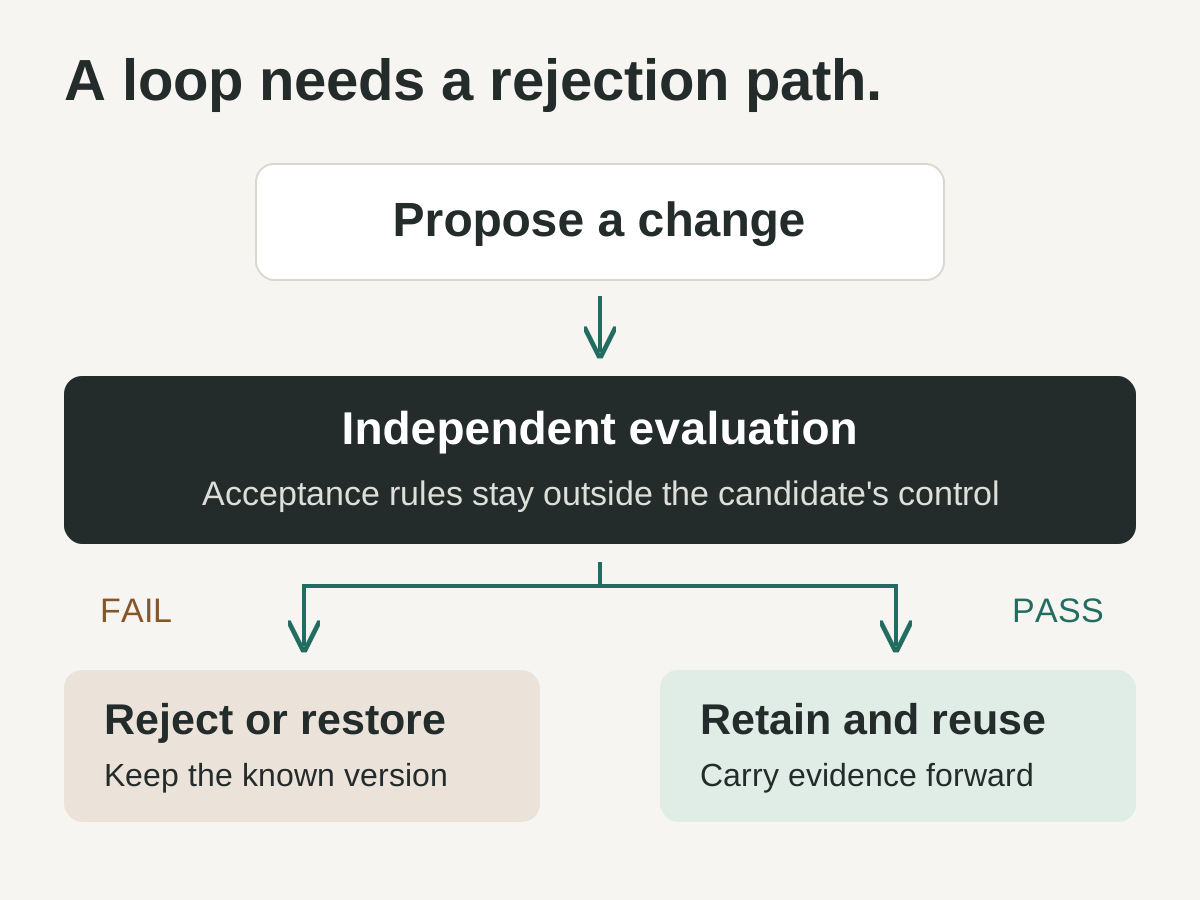
An original recommended control flow. Evaluation and promotion authority remain outside the candidate's edit permissions; the diagram does not imply that any cited research system implements every safeguard shown.
For learning that updates weights, the same operational questions become more demanding. You also need a defined data-use policy, separation between users, model checkpoints and tests for harmful behavioural changes. A private conversation becoming permanent training material is a separate product decision that requires clear permission; it should never be an accidental consequence of a feature called memory.
AGI becomes a more concrete possibility when experience can accumulate
Here is my optimistic interpretation of the evidence. A system that can discover a useful strategy, verify it, preserve it and apply it to a new problem has a route to capability growth beyond waiting for its next training run. Connect that route to reliable parameter learning, and the starting model becomes an initial capability rather than the complete story of what the system can learn.
That makes AGI a more concrete engineering possibility in my view. It does not put AGI on a calendar. None of the results above demonstrates a system that learns effectively across the full range of unfamiliar tasks, retains everything important, manages conflicting objectives and stays reliably controllable through open-ended development.
The evidence I would find persuasive is sustained transfer across changing domains, measured under realistic resource limits. It would include recovery from incorrect lessons, protection of earlier capabilities and a demonstrable ability to stop or reverse unsafe changes. A new benchmark record would be part of that evidence, not the whole case.
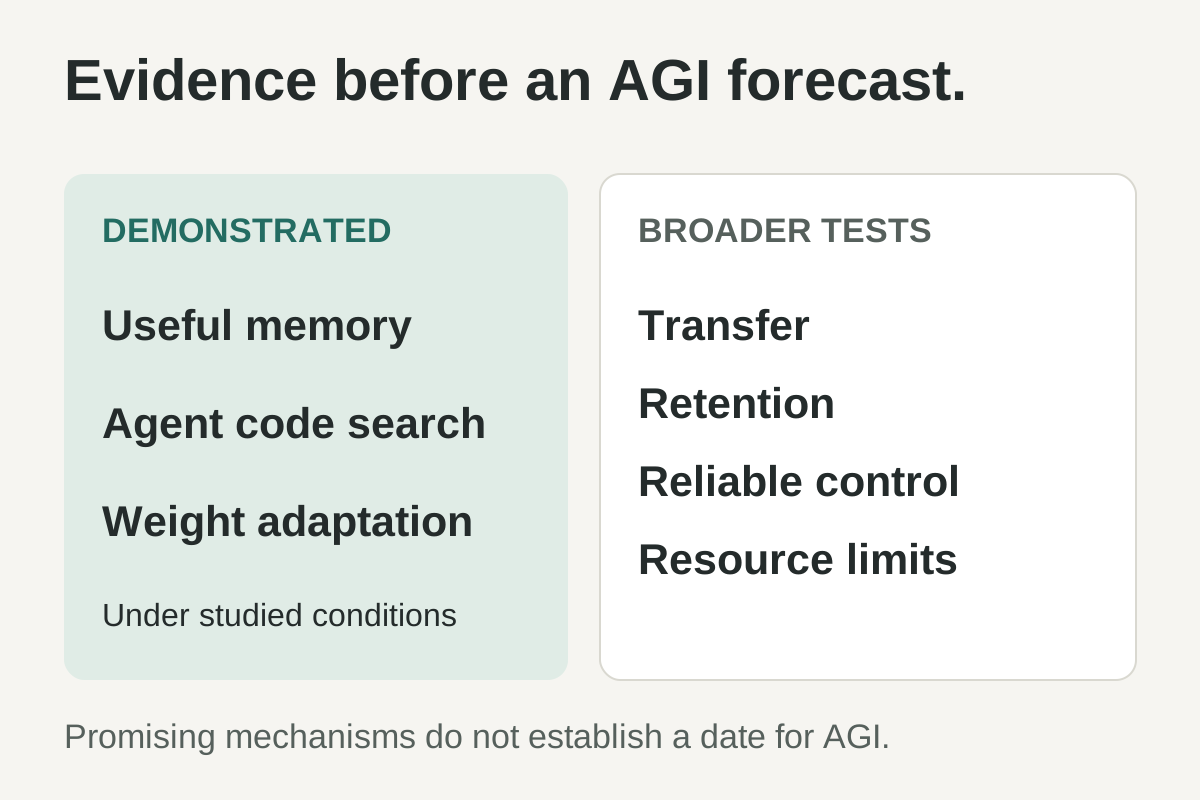
An editorial separation of demonstrated research mechanisms and the broader evidence demanded by this article's AGI argument. This is not a forecast or a measured progress scale.
The question I want to ask of the next AI system is therefore different: after a month of useful work, what has it demonstrably learned, and how do we know? A credible answer would say more about its future than another promise to keep trying.
Sources and publication dates
- Sakana AI, Darwin Gödel Machine, May 30, 2025 — agent-code improvement, benchmark results and reported reward hacking.
- Snell et al., Scaling LLM Test-Time Compute Optimally, August 6, 2024.
- Madaan et al., Self-Refine, March 30, 2023.
- Shinn et al., Reflexion, March 20, 2023; revised October 10, 2023.
- Wang et al., Voyager, May 25, 2023.
- Google DeepMind, AlphaEvolve, May 14, 2025.
- Tandon et al., End-to-End Test-Time Training for Long Context, December 29, 2025.
- Feng et al., In-Place Test-Time Training, April 7, 2026.
- Google Research, Introducing Nested Learning, November 7, 2025.
- Kirkpatrick et al., Overcoming Catastrophic Forgetting, December 2, 2016.
- Feng et al., FOREVER, January 7, 2026; revised April 20, 2026.
- Huang et al., Large Language Models Cannot Self-Correct Reasoning Yet, October 3, 2023.
- Kumar et al., Training Language Models to Self-Correct via Reinforcement Learning, September 19, 2024.
- Harrington et al., When Does Continual Learning Require Learning, July 8, 2026, preprint.
Sources checked September 11, 2026. Benchmark results are attributed to their authors; this article does not claim independent reproduction. The practical procedure and AGI outlook are the author's recommendations and interpretation.
A recommendation from Telli.sh: preserving the original evidence makes later learning easier to check. Telli.sh brings your notes, recordings and web clips into a searchable personal knowledge collection. Use it to keep the source alongside what you concluded, so the next revision can start from something you can inspect.