AI writes the transcript now — a good meeting note still needs these six things
Granola put an AI notepad on your wrist, VOMO passed 400,000 users, and open-source clones arrived in weeks. None of it changed what makes a meeting note useful. Here are the six things that still have to be in one, and a 60-second test for your last note.
On July 28, Granola shipped a version of its meeting notepad built for the Apple Watch. Tap your wrist, the screen turns bright green, and the note starts — no laptop open, no bot joining the call. Three weeks earlier, VOMO announced it had passed 400,000 users. In between, NextBigWhat ran a guide to open-source Granola replacements — five of them, four under an MIT license — for people who want the same bot-free flow on hardware they control. And when G2 published its 2026 note-taking roundup on July 9, seven of the eight apps it recommended were pitched on capturing a conversation automatically.
The pattern is hard to miss. Recording a meeting and getting structured text back has become close to free, and it now runs on every device you already carry.
Here is what none of it changed: whether the note is any good.
A meeting note earns its keep by doing three things — letting you get back to the source, telling you what was decided and who owns it, and being readable by someone who wasn't in the room. Those requirements are older than the software and completely indifferent to it. AI raised the floor on capture; it did not shorten the list. This post is the list: six things that still have to be in a meeting note, why each one breaks a team when it goes missing, and a 60-second test you can run on your own last note before you finish reading.
TL;DR:
- AI made what was said nearly free, which means the human job has collapsed entirely onto what was done — and that half is still unautomated.
- Six things have to survive: a retrievable source record, the question the meeting was called to answer, every decision with an owner and a date, what was ruled out and why, who was in the room and when recording started and stopped, and enough context for someone who wasn't there.
- The 2026 failure mode is not a thin note. It is a 4,000-word note in which the one line that matters looks exactly like the two hundred that don't.

Image: Web Summit, photo by Eóin Noonan / Sportsfile, Wikimedia Commons, CC BY 2.0.
The oldest rulebook on meeting records says the opposite of what your AI does
Robert's Rules of Order — the parliamentary manual that boards, clubs, and city councils have run on since 1876 — is blunt about this. "Minutes are a record of what was done at a meeting, not a record of what was said," says the 12th edition. It goes further than a preference: summarizing the discussion in the minutes, it says, is not merely unnecessary but improper.
That rule was written for rooms where a secretary wrote by hand and every word cost effort. Scarcity did the editing. So it is worth noticing what an AI notetaker produces by default, with no configuration at all: a complete record of what was said. Precisely the artifact Robert's Rules tells you not to file.
Here's the point. That doesn't make the old rule wrong — it splits the job cleanly in two. The machine now handles "what was said" for free, and does it better than any human stenographer ever did. Everything the rule actually cared about, which is what was decided and by whom and what happens next, sits on the other side of that line, and no tool fills it in for you. The six items below are the other side of the line.
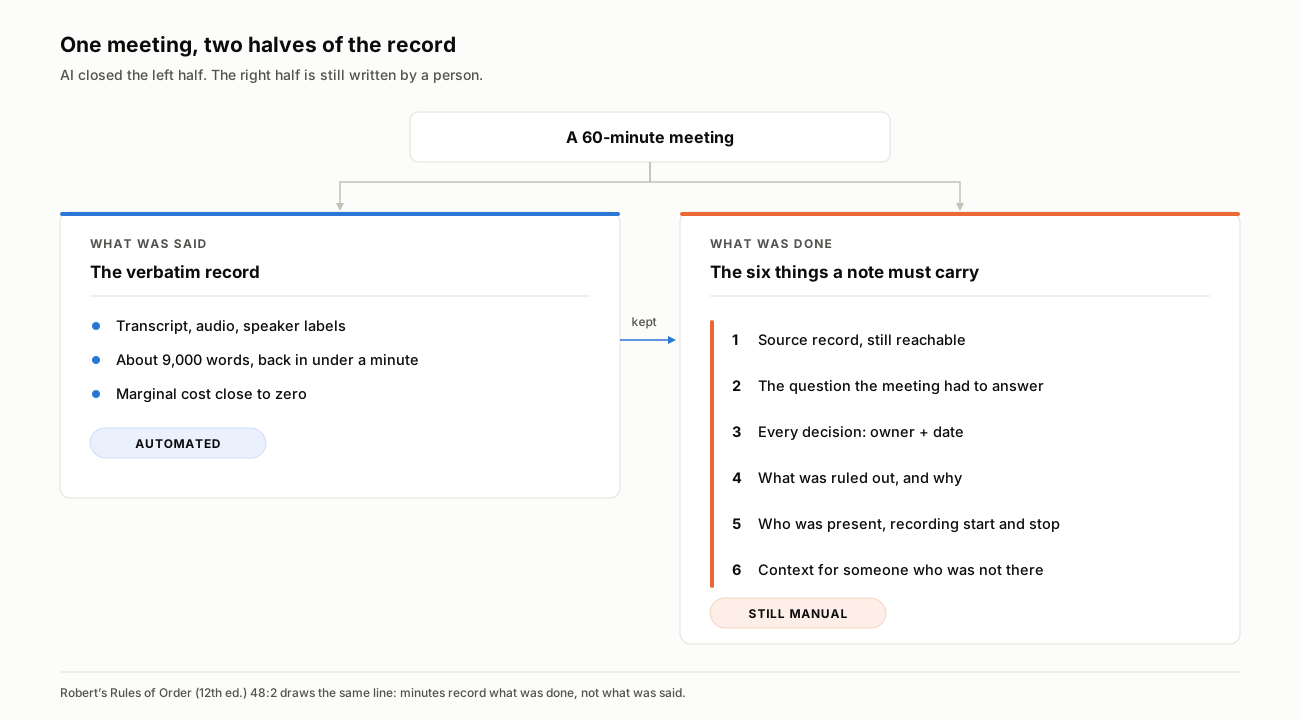
The split AI created: the left lane is finished work, the right lane is the job. Robert's Rules drew the same line in 1876.
Keep the record, not just the readout
A generated summary is a compression, and every compression has a loss rate. That is fine — as long as the note keeps the thing it was compressed from.
Think of it as a flight recorder and a logbook. The transcript and the audio are the flight recorder: dense, boring, and the only thing worth having on the day two people remember the same decision differently. The summary is the logbook: short, readable, the thing anyone actually opens. A note that has only the logbook is unfalsifiable. When a colleague says "that's not what we agreed," a summary is just one more opinion in the argument.
So the first requirement is mechanical rather than editorial. The source has to survive, it has to be retrievable by whoever reads the note, and the summary has to be traceable back to it — speaker attribution and time positions, so that "we agreed to cut the scope" can be checked in eleven seconds instead of re-litigated in a thirty-minute call.
This matters more in 2026, not less. When notes were typed by a person in the room, readers knew a human had filtered them and read with appropriate suspicion. A machine-written summary reads with more authority than it has earned, in clean prose, with confident headings. Keeping the source is what converts that borrowed authority back into something a reader can check.
An orphan decision isn't a decision
Now the part where most notes fail, and where no model release is coming to save you.
Call it the orphan decision: a conclusion recorded in the passive voice with nobody attached to it. "It was agreed we'd revisit pricing." "The team will follow up with legal." Read either one back three weeks later and you cannot tell who owes what to whom. In the room, both of those were real commitments made by a specific person who nodded. The note dropped the name.
A decision line needs three parts to survive contact with next week: what was decided, who owns the next move, and by when. Drop the date and it degrades into a memory aid. Drop the owner and it degrades into nothing at all.
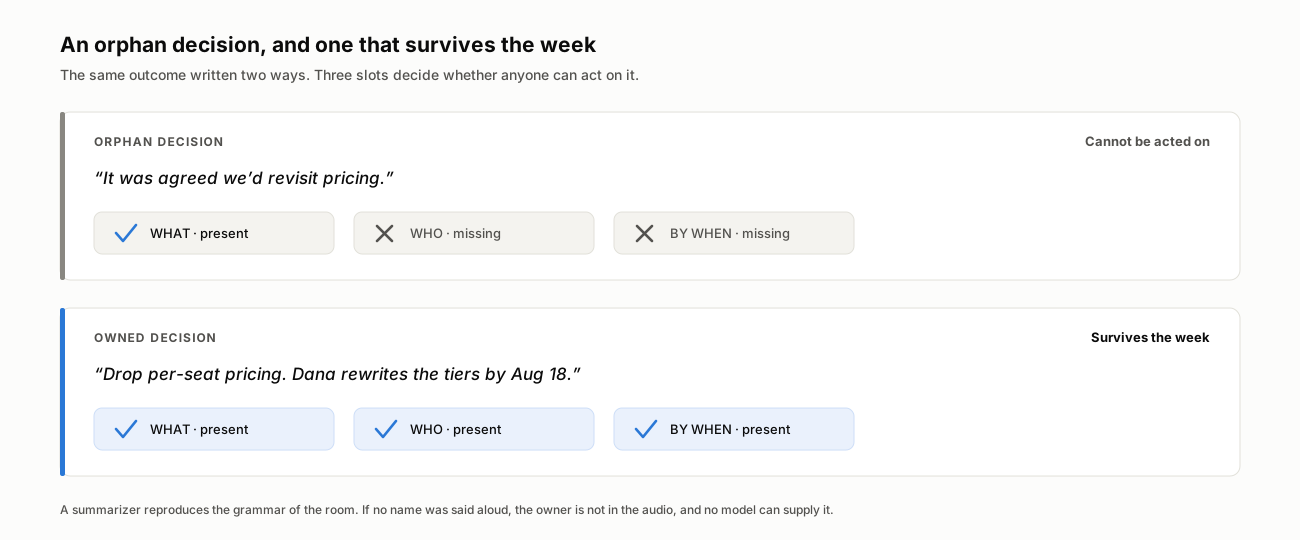
The same outcome, written two ways. Only the second can be acted on — and the missing parts were never in the audio to begin with.
Here is the uncomfortable structural fact. An AI summarizer cannot fix this, and better models will not change that. Summarizers faithfully reproduce the grammar of the room, and if nobody said a name out loud — if the meeting ended on "okay, great, let's do that" — then the owner is not in the audio, and no amount of model quality recovers information that was never recorded in the first place. This is not a transcription problem. It is a meeting problem that the note merely exposes.
Which is why the last sixty seconds of a meeting are worth more than the fifty-nine minutes before them. Say the decisions out loud, with names and dates, before anyone leaves the call. You are not being pedantic; you are dictating to the record. Every notetaker on the market will capture that perfectly. Not one of them will invent it.
Action items are the visible tip of this — a decision with an owner and a date already is one, structurally. But the requirement underneath is the decision itself, whether or not it generates work this week.
And then the half that almost every note omits: what was not decided.
Record the roads not taken. If the room considered per-seat pricing and rejected it because two enterprise buyers pushed back on it last quarter, that sentence will be worth more in six months than the decision it supports. Notes that record only conclusions guarantee the same debate reopens — usually raised by someone new, entirely in good faith, with no way of knowing it has already been had. One line — we considered X, rejected it because Y — is the cheapest insurance a team can buy against re-litigating its own history.
The same goes for open questions. A question the meeting couldn't resolve should be parked in the note with an owner attached. Without one, it isn't parked. It's dropped.
Who was in the room is now part of the record
Attendance used to be the most boring line in the minutes. It isn't anymore.
In February 2026, Fortune reported a pattern that HR teams had started to dread: AI notetakers that don't know when to stop listening. Employees drop off a video call, the assistant stays behind and quietly documents the side conversation — gossip, complaints about colleagues — and then emails the transcript to everyone on the invite.
The boundary of the record has become a fact in its own right, and it belongs in the note. Who was present, who was absent, and when the recording started and stopped. In a world where the capture device joins on its own and outlasts the humans, a line like "this note covers 14:00 to 14:52, and everyone in it knew they were being recorded" is not bureaucratic throat-clearing. It is the sentence that makes the record usable later — as something you can share, and if it ever comes to that, defend.
Write for the person who wasn't there
Two of the six are really one idea seen from opposite ends.
At the front: the question the meeting was called to answer, written down before it starts. Not a list of topics — a question. "Do we ship the pricing change before the conference or after?" A note that opens with a question is legible in a way that a note opening with "Attendees:" never manages, because every line after it is either an answer or a detour, and the reader can tell which.
At the back: the newcomer test. Someone who joins your team in six months should be able to read the note and understand the decision without asking a single person a single question. That is a high bar, and it is the right one. It means acronyms get expanded the first time they appear, the document everyone was staring at gets linked instead of referred to as "the doc," and the constraint that made option B win gets written down even though every person in the room already knew it.
That last one is where AI notes quietly fail. Models are genuinely good with context — better than most human note-takers, and faster — but only with context that was actually spoken. The shared assumption nobody says out loud is exactly what doesn't survive the room, and it is usually the thing that made the decision make sense at all. If your meeting turns on a premise everyone already accepts, someone has to say it aloud or write it in afterward. That is a five-second job, and it is the whole difference between a note that ages well and one that becomes unreadable by autumn.
What AI actually changed, and the failure mode it created
Two years ago the complaint about meeting notes was that they were too thin. Someone half-listened, typed four bullets, and the meeting evaporated.
That problem is solved. The new one is its mirror image, and it is sneakier.
A 60-minute meeting is roughly 9,000 spoken words. Modern tools will hand you all 9,000, plus a structured summary, plus a topic breakdown, plus extracted action items — several thousand words of output inside a minute of the call ending. The useful note buried in that is maybe 200 words. When a tool produces everything, nothing is marked as mattering more than anything else, and the one line that changes what somebody does on Monday sits at exactly the same visual weight as a tangent about the offsite.
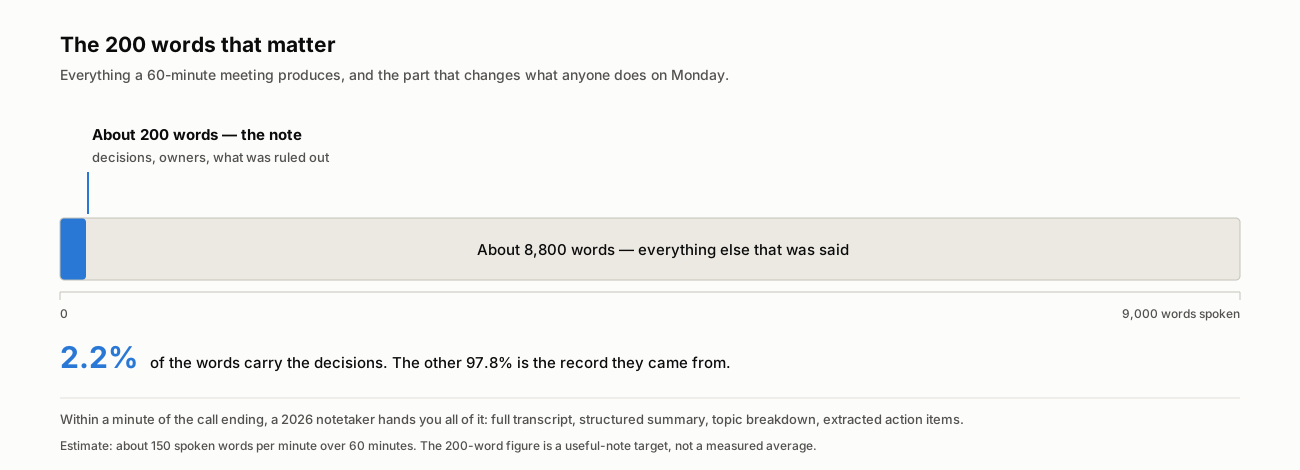
Estimated at about 150 spoken words per minute. Compressing 9,000 down to 200 is the judgment no tool makes for you.
That is the trade we actually made. The floor went up: no meeting has to vanish anymore, and the raw capture is better than what a human could type in real time. The ceiling didn't move, because the ceiling was never about capture. That compression from everything-that-was-said down to what-was-done is a judgment call, and judgment is the part nobody automated.
If your meeting notes feel worse since you adopted a notetaker, this is almost certainly why. You didn't get a worse note. You got a much better record and no note.
A 60-second test for your last meeting note
Open the most recent one and answer six questions honestly.
- Can I get from this note to the source — transcript or audio — in one click?
- Does it say what question the meeting was called to answer?
- Does every decision have a person's name and a date attached to it?
- Does it say what was ruled out, and why?
- Does it say who was present, and when recording started and stopped?
- Could someone who wasn't there act on it without asking me anything?
If you answered no more than twice, a different app is not the fix.
The bottom line
A meeting note is not a record of a meeting. It is the smallest artifact that lets a decision outlive the people who made it — including the version of you who has completely forgotten the meeting.
AI made the recording free. It did not make the record. Your notetaker will follow you to your wrist, your watch face, and whatever gets clipped to a lapel next, and every one of those devices will capture what was said with a fidelity no secretary in 1876 could have imagined. What was done still has to be said out loud by someone in the room, and then written down on purpose.
If you want both halves in one place, that is the shape Telli.sh is built around: the full transcript with speaker attribution sits next to an AI summary you can edit, so the source record and the readout live in the same note instead of two systems — with real-time translation when the room isn't all speaking one language. The summary arrives as a draft you correct, not an output you accept.
Sources
- Granola, "Granola for Apple Watch" (July 28, 2026)
- TechCrunch, "Granola launches an Apple Watch app" (July 28, 2026)
- PR Newswire, "VOMO Surpasses 400,000 Users as Demand for AI Meeting Notes Grows" (July 6, 2026) — figure self-reported by EverGrow Tech Inc.
- NextBigWhat, "The best open source alternatives to Granola for AI meeting notes" (July 22, 2026)
- G2 Learning Hub, "8 Best Note Taking Apps I Recommend for 2026" (July 9, 2026)
- Fortune, "The dark side of AI meeting notes and AI notetakers" (February 9, 2026)
- Robert's Rules of Order Newly Revised (12th ed.) 48:2, via the official Robert's Rules FAQ
- Wikimedia Commons image page
.jpg)