One link, one meeting, one decision: build a knowledge chain you can audit
A practical method for carrying web research into a meeting, preserving the evidence behind the discussion, and producing a decision record that a teammate can verify months later. Includes a six-field evidence packet, a four-lane meeting note, and a 20-minute retrieval drill.
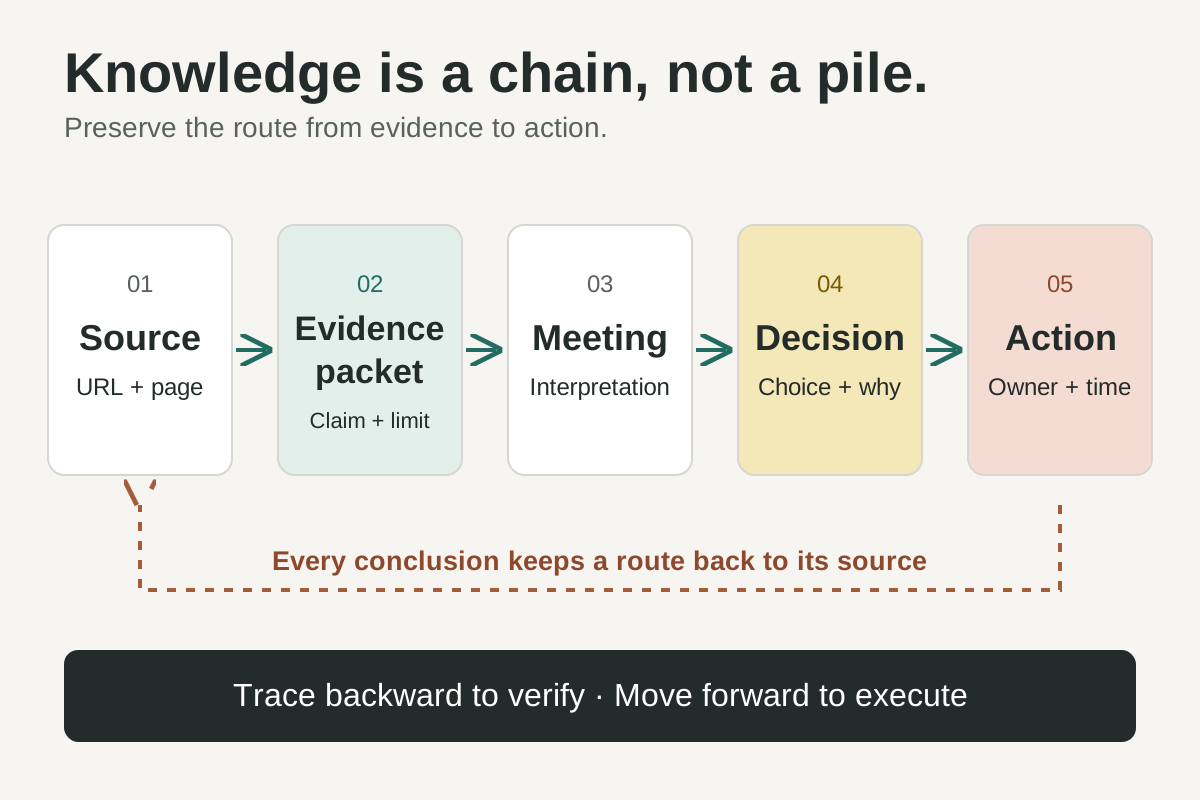
An original workflow diagram. The arrows are the point: every conclusion keeps a route back to the evidence that shaped it.
At 10:12 on Monday, someone drops a market report into a team chat. At 14:00, three people discuss it in a planning call. By Thursday, the team has changed the onboarding roadmap. Six weeks later, a new colleague asks the reasonable question: “Why did we make this change?”
The report is still somewhere. The meeting recording may still exist. The decision probably appears in a task tracker. Yet the chain between the three has vanished, so the team cannot tell which claim mattered, whether anyone challenged it, or what tradeoff the decision accepted.
This guide shows how to keep that chain intact. The method is deliberately small: capture each useful web source as a six-field evidence packet, use four lanes during the meeting, write one decision record, and test the result with a 20-minute retrieval drill. It works in a document system, a notes app, or plain Markdown because the important design is the links, not the software.
TL;DR:
- Saving a URL preserves an address, not the reason it mattered. Add the claim, a short excerpt, the author or publisher, the publication date, and the date you retrieved it.
- During discussion, keep facts, interpretations, decisions, and actions in separate lanes. A sentence can move from one lane to another, but it should never quietly change category.
- The finished decision record needs links in both directions: from the decision back to its evidence and from the evidence forward to the decision that used it.
A bookmark remembers a place, not a purpose
The problem is older than today's tabs, chat threads, and AI summaries. In November 2002, William Jones, Susan Dumais, and Harry Bruce published an observational study of how people kept web information for later use. The participants did not rely on one method: they bookmarked, emailed URLs to themselves and others, printed pages, saved files, and pasted addresses into documents. The researchers' point was functional: people choose different keeping methods because they need the information to do different jobs. Microsoft Research's publication record preserves the study and its abstract.
More than two decades later, the same behavior appears in more interfaces. A URL goes into chat because a colleague must see it now. It goes into bookmarks because you may need it later. It goes into a meeting agenda because the team must discuss it. It goes into a task because somebody must act on it. Those copies look like duplication, but they are attempts to preserve four different purposes.
The failure begins when the purpose stays only in the sender's head. Consider a link titled “2026 Customer Support Benchmark.” Is it evidence that response time affects retention, a competitor comparison, a source for a chart, or merely background reading? The title cannot answer. The page cannot know why your team cared.
Call this missing layer decision provenance: the route from a source, through the team's interpretation, to the choice it justified. Provenance is not a synonym for citation. A citation says where a claim came from. Decision provenance also records what the team did with that claim.
The World Wide Web Consortium's PROV model gives useful vocabulary without requiring anyone to implement the full standard. Its 2013 primer distinguishes entities such as a web page or document, activities that use or generate entities, and agents responsible for those activities. It also models derivation, revision, and time. A source page, a research note, a meeting, and a decision are therefore not four versions of the same item. They are distinct entities connected by activities and responsibility. W3C PROV Primer.
That distinction fixes a common mistake. Teams often paste a source into meeting notes and then overwrite the note with the meeting's conclusion. The evidence and the interpretation collapse into one paragraph. Months later, the conclusion reads as though the source stated it directly.
Six fields turn a link into an evidence packet
A useful evidence note does not need to reproduce the page. It needs enough information to identify the source, recover the relevant passage, and understand why somebody brought it into the work.
Use six fields:
- Source identity: page title and canonical URL.
- Responsibility: named author when available; otherwise the publishing organization.
- Time: publication or last-updated date, plus the date you retrieved it.
- Evidence: a short exact excerpt or a precise paraphrase, clearly labeled.
- Relevance: one sentence explaining the question this source helps answer.
- Limits: what the source does not establish, including sample, geography, sponsorship, or missing methodology.
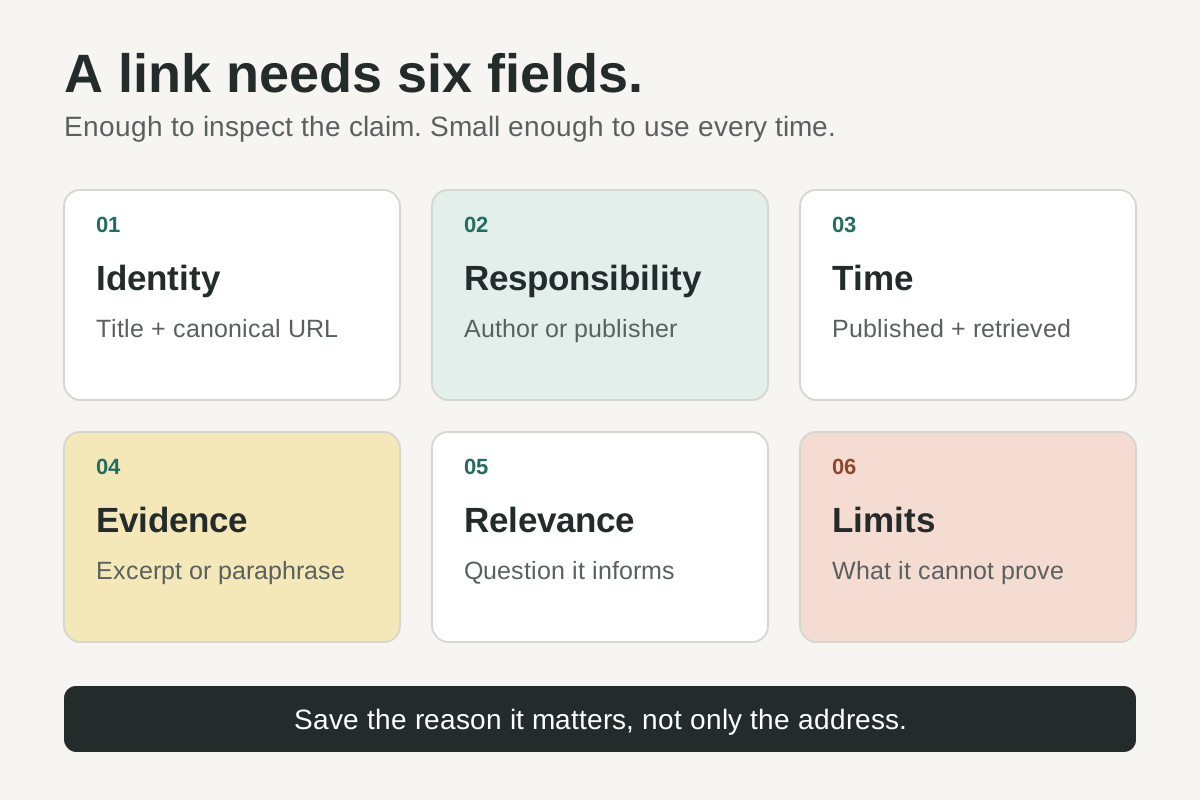
Figure 1: The packet is intentionally smaller than a summary. It preserves the evidence required for a later reader to inspect the source and its limits.
Here is a compact example:
SOURCE
Title: The FAIR Guiding Principles for scientific data management
URL: https://doi.org/10.1038/sdata.2016.18
Author/publisher: Wilkinson et al., Scientific Data
Published: 2016-03-15 · Retrieved: 2026-09-24

EVIDENCE
The principles require reusable data to carry detailed provenance (R1.2).

RELEVANCE
Supports keeping the source and derivation beside a team's decision record.

LIMIT
FAIR addresses scholarly data stewardship, not meeting operations;
the workflow proposed in this article is an adaptation.
The dates matter for two different reasons. The publication date positions the claim in time. The retrieval date records when you observed the page, while the excerpt preserves the part you relied on when a live page changes without publishing a visible history. Neither field creates an archival copy or proves that the source is correct; together they make the evidence easier to inspect.
The limit field is equally important. On March 15, 2016, the FAIR principles were published as guidance for making scholarly data Findable, Accessible, Interoperable, and Reusable. Principle R1.2 says reusable data should be associated with detailed provenance. The authors also state that FAIR precedes implementation choices and is not itself a technical standard. The open-access paper in Scientific Data supports the principle, but it does not prove that a particular meeting template improves business performance.
That last sentence is what an honest evidence packet preserves. A source may inspire a practice without validating every consequence of that practice.
The meeting needs four lanes, not one running summary
Once the evidence enters a meeting, most notes turn into chronology: Alice said this, then Ben asked that, then the team discussed a third thing. Chronology is useful in a transcript, but it is a poor decision interface. Readers must replay the conversation to discover which statements were facts, which were opinions, and which became commitments.
Separate the meeting note into four lanes instead:
| Lane | What belongs there | Test before writing |
|---|---|---|
| Evidence | A source-backed fact or direct observation | Can another reader inspect where this came from? |
| Interpretation | What the team thinks the evidence means | Could a reasonable reader disagree while accepting the same evidence? |
| Decision | The option the authorized group selected | Is this settled, and who had authority to settle it? |
| Action | Work created by the decision | Is one person responsible, with a visible checkpoint? |
The separation is not bureaucracy. It prevents grammar from silently upgrading confidence. “The report sampled 312 respondents” belongs in evidence. “The segment is underserved” is an interpretation. “Prioritize the segment in Q4” is a decision. “Mina will test the new onboarding copy by October 9” is an action.
All four statements may be reasonable, but they do not have the same source. Only the first came from the report. The second came from the team's reading of it. The third came from authority. The fourth came from assignment.
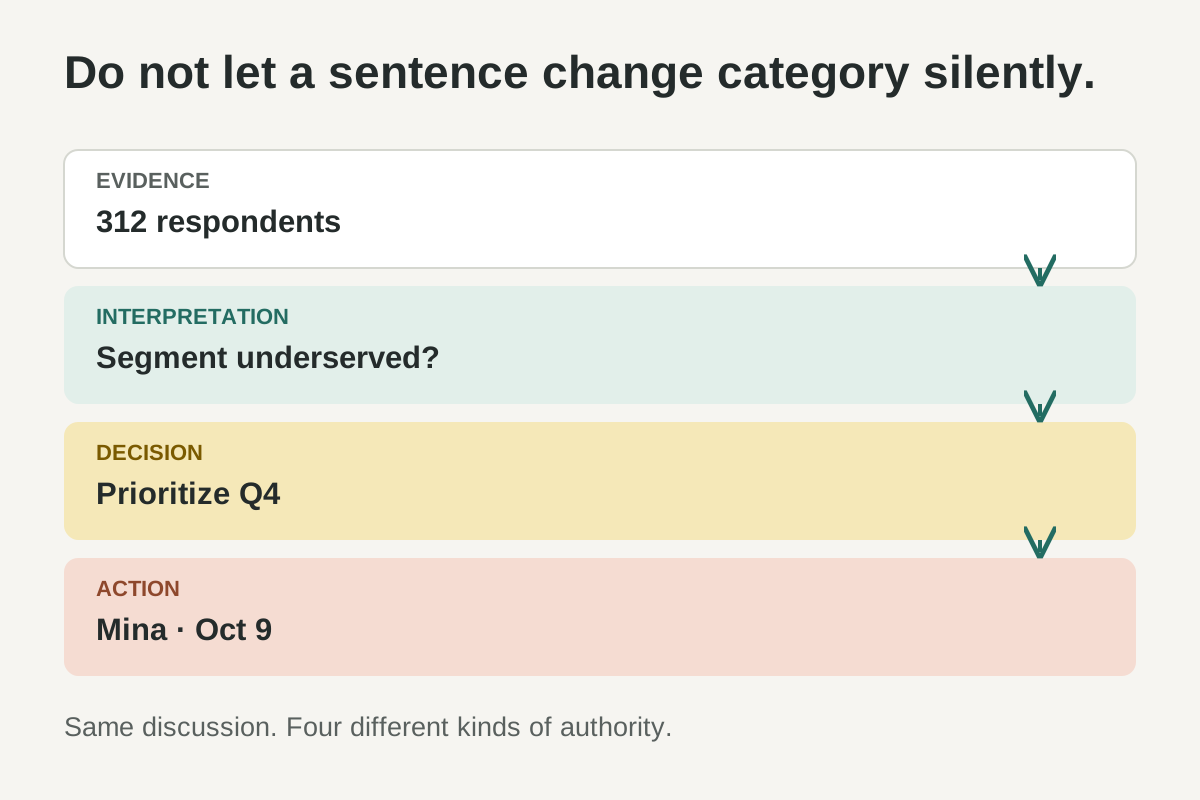
Figure 2: The lanes preserve category. Links can cross them, but labels should not disappear.
This is especially important when an AI produces the first draft. A fluent summary tends to smooth the transitions that matter most. “The report found weak retention, so the team decided to simplify onboarding” reads cleanly, but it may hide three unresolved questions: which cohort had weak retention, whether onboarding caused it, and who actually authorized the change.
Use AI to locate passages, group repeated points, and draft a structure. Then require the four labels. The model does not gain authority by writing a confident sentence, and a meeting participant does not become a published source because the transcript captured their words accurately.
One decision record should survive without the meeting
After the call, do not send the full notes as the only outcome. Create a small decision record that can stand on its own while linking back to the larger record.
Architecture teams have used this idea for years. Michael Nygard's 2011 Architecture Decision Record format uses a title, status, context, decision, and consequences. Later ADR formats add considered options, decision makers, and confirmation. The ADR community's template index documents the lineage and the common fields.
The same shape works outside software architecture:
DECISION: Shorten the first-run onboarding from five steps to three
STATUS: Accepted on 2026-09-24
OWNER: Mina Patel

CONTEXT
Completion falls most sharply at identity verification. Two external
benchmarks describe similar friction, and our own funnel shows the same
step as the largest drop. Links: E-14, E-19, dashboard snapshot F-08.

DECISION
Remove the profile-photo and preference screens from first run.
Keep identity verification. Run the change for 14 days.

CONSEQUENCES
Profile completion moves to the home screen. The experiment cannot tell
us whether verification copy or verification itself causes the drop.

NEXT CHECKPOINT
Mina reports completion and week-one activation on 2026-10-09.

MEETING
2026-09-24 onboarding review, transcript 18:42-31:08.
Notice what this record leaves out: the whole discussion. It does not need every objection or every sentence. It needs enough context to understand the choice, the links necessary to inspect its basis, the consequence the team accepted, and the moment the decision will be reviewed.
The status prevents a draft from pretending to be policy. Use a small vocabulary: proposed, accepted, superseded, rejected. When a decision changes, do not rewrite history. Mark the old record superseded and link to the new one. The old decision was still real; erasing it removes the explanation for work completed under it.
Links must work forward as well as backward
Most teams stop after adding source links to the decision. That supports audit, but it does not support discovery.
Suppose you find the original benchmark six months later. You can see the page and perhaps your evidence note, but can you see which decision used it? If the answer is no, the source has no forward history. You may repeat the research, reopen a settled argument, or apply an old source after the decision it supported has been superseded.
Make the relationship bidirectional:
- The evidence packet links to every meeting or decision that used it.
- The meeting links to the evidence packets on its agenda and to the decision records it produced.
- The decision links backward to evidence and discussion, then forward to actions and later replacements.
- The action links back to the decision that authorized it.
This is a graph in concept, but it does not require graph software. Stable identifiers such as E-14, M-31, D-22, and A-57 are enough when each system supports links or search. Human-readable titles should accompany the identifiers; nobody should have to remember that D-22 means onboarding.
The discipline creates a useful answer to four different questions:
| Question | First record to open | Next link |
|---|---|---|
| “Where did this claim come from?” | Evidence packet | Original source and relevant passage |
| “How did the team interpret it?” | Meeting note | Evidence and transcript segment |
| “What did we decide?” | Decision record | Context, consequences, owner |
| “What happened afterward?” | Action or replacement decision | Original authorization and outcome |
No single document needs to answer everything. The chain does.
Build the chain in six steps
The workflow can be introduced without migrating every old note or designing a universal taxonomy. The 30-day interval, 20-minute drill, and five-point score below are starting heuristics proposed for this guide, not published performance thresholds; adjust them to the stakes and complexity of your work.
- Choose one live decision. Use a decision scheduled for the next two weeks. A real deadline exposes missing fields faster than an archive cleanup exercise.
- Create evidence packets before the meeting. Give each source the six fields and a stable identifier. Add only sources that could change the choice; “useful background” belongs in a separate reading list.
- Put the evidence identifiers on the agenda. Participants should know which claims are being used and have a chance to inspect them before the call.
- Take notes in four lanes. Mark evidence, interpretation, decision, and action explicitly. If the group has not decided, write
OPEN, not a polished sentence that implies closure. - Publish the decision record within the same working day. Link it backward to sources and the relevant transcript span, then forward to one owner and one checkpoint.
- Run a retrieval drill 30 days later. Give a teammate who missed the meeting 20 minutes to answer: what was decided, why, from which evidence, with what limitation, and what replaced it if anything changed.
The final drill is the only honest test. A tidy folder structure proves that the author can navigate the author's system. Retrieval by an absent colleague proves that knowledge survived the handoff.
Score the drill with five yes-or-no checks. Could the reader find the decision? Could they identify the original sources? Could they separate source claims from team interpretation? Could they name the owner and checkpoint? Could they see whether the decision was still active? A score of four out of five tells you exactly which link to repair.
Avoid measuring the number of pages saved or notes created. Volume is an input, not an outcome. A thousand unconnected clips are a larger inbox.
Keep the original even when the summary is excellent
AI makes this workflow faster and also increases the need for provenance. A summary can compress a 6,000-word report into six paragraphs, combine five sources into a comparison, or turn a 60-minute transcript into a decision list. Each transformation creates a new entity. It does not replace the source entities.
Preserve three boundaries:
Original versus derived. Keep the URL, selected passage, recording, or transcript available beside the summary. Label generated text as a summary or interpretation.
Observation versus conclusion. “Eight of twelve interviewees mentioned setup time” is an observation if the interviews support it. “Setup time is the main reason customers churn” is a conclusion that requires different evidence.
Current versus superseded. A source may update, a decision may change, and an action may close. Preserve the timeline instead of editing every record into the latest answer.
Keep only material you are permitted to retain. For private, paywalled, confidential, or licensed sources, a URL, source metadata, and a limited user-selected excerpt may be appropriate where copying the full page is not. Provenance does not override access rights or retention policy.
The cost of these boundaries is a few fields and links. The benefit is correction. When someone finds a transcription error, an outdated number, or a stronger source, they can repair the affected conclusion without distrusting the entire archive.
The bottom line: knowledge is the path, not the pile
A folder full of reports is not research. A transcript is not a decision. A task is not an explanation.
Useful organizational knowledge is the navigable path between them: this is what we read, this is what we thought it meant, this is what we chose, this is who acted, and this is what changed next. The path lets a colleague disagree intelligently because they can inspect the same evidence instead of reconstructing your memory.
Build one complete chain before collecting more material. The best knowledge system is not the one that remembers the most. It is the one that can answer “why?” without calling the original meeting back into existence.
A practical place to build the chain: Telli.sh keeps saved web material, recordings, transcripts, translations, and notes in one workspace. Save the source, record the discussion, and keep the original beside the summary so the final decision still has evidence behind it.
Create a Telli.sh workspace and record the next decision
Sources
- Jones, Dumais, and Bruce, “Once Found, What Next? A Study of ‘Keeping’ Behaviors in the Personal Use of Web Information,” Microsoft Research / ASIST — November 2002; observational account of the varied methods people used to keep web information for reuse.
- W3C, PROV Model Primer — W3C Working Group Note, April 30, 2013; entities, activities, agents, derivation, revision, and time in provenance records.
- Wilkinson et al., “The FAIR Guiding Principles for scientific data management and stewardship,” Scientific Data — published March 15, 2016; findability, accessibility, interoperability, reusability, and detailed provenance under R1.2.
- Architectural Decision Records, ADR Templates — retrieved September 24, 2026; documents the 2011 Nygard format and later variants. The application beyond architecture in this article is the author's recommendation.