Why Vertiv is testing the AI factory before the GPUs arrive
Vertiv's ATLAS Lab brings power, cooling, controls, and emulated AI loads into one test environment. What that changes for the team buying its next AI installation.
The expensive moment in an AI installation is discovering that equipment which passed its own tests does not behave as expected when connected. The power system has its specifications, the cooling plant has its capacity, and the servers have their operating limits. The unanswered question sits between them: what happens when the whole installation changes load together?
On November 16, 2026, Vertiv introduced its ATLAS Lab as a system-level testing capability for that question. The power and cooling infrastructure company is combining digital modeling, workload emulation, and physical equipment tests with NVIDIA. Their aim is to evaluate the infrastructure required by current and future accelerated computing systems before those production systems reach customers. Vertiv says the companies held the lab's opening and technical sessions on November 6. Vertiv's November 16 announcement
For a team planning AI capacity, the interesting development is an earlier opportunity to test the joins. ATLAS connects power, thermal management, controls, and IT infrastructure in a representative AI factory pod. It makes the integration work more visible—and gives buyers a better question than whether each box has enough capacity on its label.
A cooling unit can pass while the installation still has a problem
Consider a company moving an inference service from a pilot into dedicated hardware. Its facilities team is responsible for power and heat removal, its integrator supplies the servers and cooling connections, and its application team measures response times. Each team can produce a reasonable acceptance document. Unless those documents describe the same operating conditions, they leave room for different assumptions about the system being delivered.
The infrastructure version of this problem is an interface tax: time and money spent discovering, explaining, and correcting mismatches between otherwise capable products. A server-side requirement must become something the power and cooling systems can supply. Their status and alarms must become something the control system can interpret. The people operating the service need to know what happens when one of those conditions changes.
Vertiv identifies five pressures behind ATLAS: density, speed, scale, complexity, and dynamic load profiles. Its announcement argues that these pressures interact, so improving one part can move the constraint somewhere else. The lab's response is to test the connected architecture in engineering rather than wait until the customer's equipment is assembled on site. Vertiv announcement
That changes the purpose of a facilities discussion. A larger cooling rating may be useful, but it does not answer how power, cooling, and controls respond to the same changing workload. A useful design review asks for the conditions under which the combined system was tested, the measurements recorded, and the behavior the operator should expect when those conditions change.
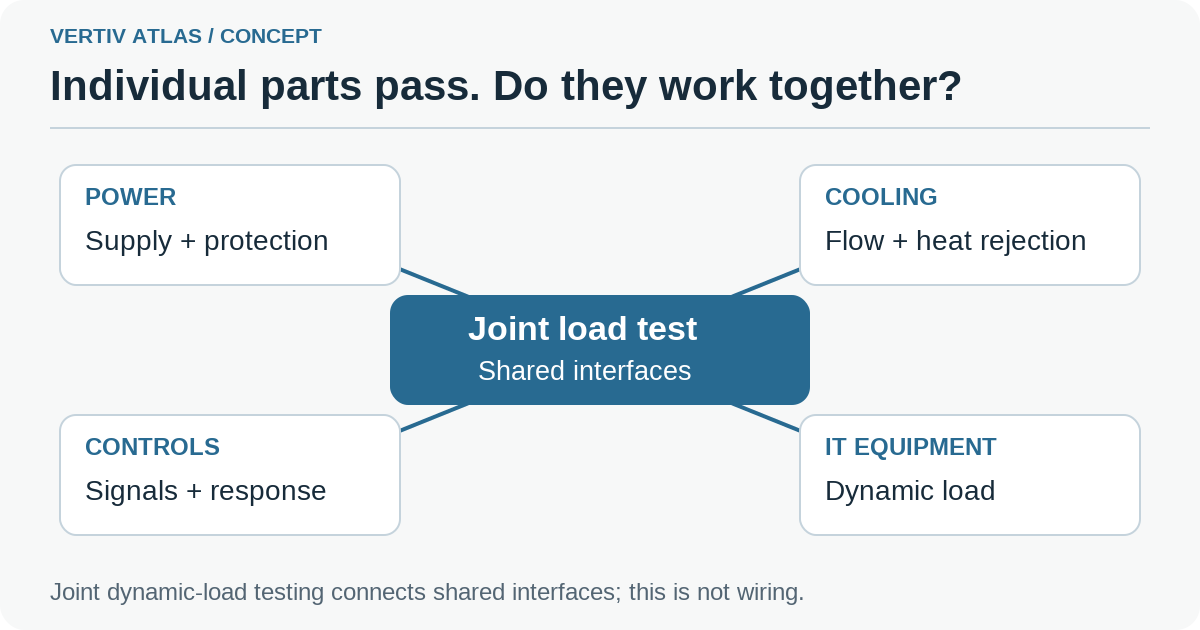
Illustration by Telli.sh. ATLAS's central idea is to evaluate interacting systems together; this diagram explains that idea rather than reproducing a measured lab result.
Testing ahead of the silicon means reproducing its demands
ATLAS stands for Advanced Test Lab for Architecture and Systems. According to Vertiv, it uses workload emulation to reproduce the power and thermal behavior of current and future NVIDIA accelerated computing architectures. Physical infrastructure can then be evaluated against those demands before the corresponding production compute systems are commercially available. That is a useful distinction for anyone reading the announcement as a hardware launch. Vertiv announcement
An emulated load represents demands on infrastructure. It does not establish how fast an unreleased GPU runs a model, what accuracy an application achieves, or how many useful requests a future server will complete. The valuable result is evidence about infrastructure response under specified conditions. The quality of that evidence depends on the represented load and on how closely the test arrangement matches the architecture a customer intends to build.
The digital side uses NVIDIA's DSX AI Factory Platform, including Omniverse libraries, DSX Sim, and SimReady assets. Vertiv says its power and cooling assets are incorporated into those workflows before physical deployment. NVIDIA describes DSX as a collection of reference designs, APIs, and software technologies for designing, simulating, building, and operating AI factories. Vertiv announcement · NVIDIA DSX documentation
The combination is more interesting than a digital twin viewed in isolation. A model lets engineers explore an arrangement before building it; physical testing offers a way to examine the connected equipment. The operator should ask how the findings from one change the other. If a physical test exposes an integration limit, does that limit become part of the reference design and the customer's eventual acceptance conditions?
One pod is a useful starting point, not a universal site certificate
Vertiv describes ATLAS as a representative pod of an AI factory: a test environment joining power, thermal management, controls, and IT infrastructure. The company wants validated pod-scale reference designs to be reusable as customers build at campus scale. This is an engineering and deployment proposition, rather than an independently demonstrated guarantee that every site will behave alike. Vertiv announcement
A buyer can use a reference design to reduce the number of decisions that start from a blank page. The remaining decisions still matter. The electricity supply, physical layout, heat rejection arrangement, maintenance practices, and permitted operating conditions belong to the actual installation. An acceptance plan should identify which parts reproduce the tested reference and which introduce a new condition requiring further evaluation.
This is especially helpful when a project has several suppliers. A shared reference gives the server integrator and facilities team a common starting point, but someone still needs to own the differences. If a connection, control setting, or equipment revision changes, the project needs a clear decision about which evidence remains applicable. Otherwise, the final configuration can gradually drift away from the one that justified the purchase.
The practical expectation is therefore a more useful evidence package. It should connect the tested configuration to the proposed configuration and show where site commissioning takes over. That is more valuable than treating the existence of a test lab as a replacement for checks at the place where the hardware will actually operate.
Three deployment situations make the idea concrete
The following situations illustrate how a buyer could apply system-level validation. They are planning examples, not reported ATLAS customer deployments or results from our own tests.
Expanding an existing inference room. A business has a working pilot and wants to install a denser block of AI servers without replacing everything around it. The useful question is which parts of its existing power and heat-removal arrangement remain suitable for the proposed operating envelope. A relevant combined test would help the team examine the transition from its current setup to the connected architecture, with clear limits on which existing equipment the evidence covers.
Preparing a site while compute hardware is still on order. A project has made a hardware decision but cannot yet commission the final machines. Emulation offers a way to move some infrastructure evaluation earlier. The team can request the load assumptions and acceptance criteria used during that work, then plan a final comparison when production equipment arrives. Earlier tests make the schedule more informative; they do not remove the need to reconcile the delivered hardware with the original assumptions.
Repeating a deployment across several locations. An operator wants to use a common architecture rather than redesign every installation. A validated reference can provide a repeatable baseline and a standard set of handover questions. The operator still needs a record of local deviations, because a change in the facility-side conditions may matter even when the server racks look identical. The benefit comes from reusing applicable evidence while identifying the exceptions quickly.
In each case, the buyer's decision is more specific than choosing a cooling product. It is deciding which operating conditions the complete installation must support and what evidence will demonstrate that it does. This also separates ATLAS's news from a new pump, a larger heat exchanger, or a grid-connection rule: the subject is the test across the interfaces.
Ask for measurements that belong to the same test
The November announcement describes ATLAS's methods and intended benefits. It does not publish an independent percentage reduction in project cost, a measured improvement in customer uptime, or a universal time saving. Those outcomes need an agreed baseline and a deployment context. An infrastructure team should carry the idea into procurement as a request for evidence rather than insert an assumed saving into its budget. Vertiv announcement
Start with the workload description. Ask what electrical and thermal demands were represented, how those demands changed, and which operating states were included. Then ask which configuration of equipment and controls was connected during the test. A result is easier to interpret when the relevant measurements share a timeline and the report explains what the system was doing at that moment.
The next question is what counts as success. A quiet run with no alarms is different from evidence that the system stays within agreed limits throughout a planned load transition. A graph is also more useful when the report includes sensor locations, measurement intervals, equipment revisions, and the thresholds used for acceptance. These are recommended questions for a buyer; the public announcement does not describe a standard ATLAS reporting package containing all of them.
| Evidence to request | What it helps the buyer decide | What it cannot establish on its own |
|---|---|---|
| Tested equipment, topology, and control versions | Whether the proposed installation resembles the tested one | That an altered configuration has identical behavior |
| Load assumptions and synchronized measurements | How the connected systems responded under the stated conditions | Future GPU model throughput or application accuracy |
| Operating limits and acceptance criteria | Which conditions the supplier is prepared to support | Performance outside that envelope |
| Differences and site-commissioning plan | Which remaining checks belong to the customer's facility | That a reference design replaces local verification |
This approach also makes a disappointing result useful. If the limiting condition is known before equipment arrives, the team has a specific design decision to revisit. Without the context, a successful laboratory demonstration can be difficult to turn into a purchasing or operational commitment.
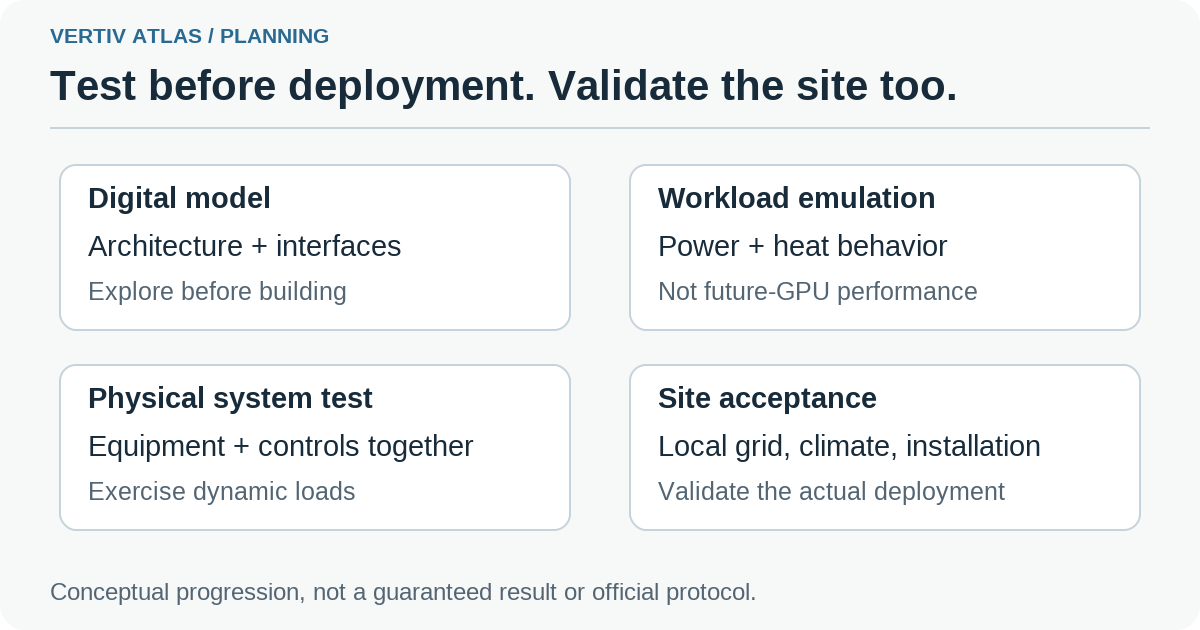
Illustration by Telli.sh. The stages describe a sensible validation sequence. They are an explanatory framework, not a published ATLAS certification procedure or a report of tests conducted by Telli.sh.
How to bring the new approach into a procurement review
You do not need to commission an entire facility to make the next supplier conversation more precise. Bring the proposed configuration and the service's operating requirements into one review. Ask the suppliers to connect their claims to that configuration, especially where responsibility changes between organizations.
- Define the installation being purchased. Record the intended compute equipment, power path, cooling arrangement, control interfaces, and site-side conditions. Identify the revisions and options that are still undecided.
- Request the relevant system-level evidence. Ask which reference design and combined tests apply, what loads were represented, and which parts of the proposed installation differ. Keep simulations, emulation results, and measurements from production hardware clearly labeled.
- Agree the acceptance envelope before ordering. Specify the conditions and transitions that matter to the service, together with the measurements and limits required to assess them. Assign an owner to every interface and unresolved dependency.
- Plan the final site checks. Decide what must be repeated or reconciled after delivery, who attends the handover, and what would trigger a design change or further testing.
- Retain the configuration behind the approval. Connect the accepted report to the installed equipment and operating settings. Revisit the evidence when a later expansion changes the architecture.
These steps are a procurement framework, not instructions for operating electrical or cooling equipment. The supplier and qualified site teams should define and conduct the actual tests. Their value for the buyer is a clearer chain of responsibility: a result, a configuration it applies to, and a named owner for the next decision.
Cost control belongs in that discussion. The right comparison includes the expense of validation, integration, site commissioning, and later changes alongside hardware acquisition. A team should ask which work is genuinely reusable and which is site-specific. Repeating every test without a reason wastes money, while assuming an old result covers a changed system leaves the original integration question unanswered.
The useful promise is fewer surprises at the handover
ATLAS is an operating laboratory and engineering capability described by Vertiv, rather than a consumer product with a published checkout price. Its November release does not establish general customer access terms, a standard service fee, or availability in every region. A prospective customer should ask Vertiv and its integrator which validation work is included in a particular project and which deliverables it will receive. Vertiv announcement
The strongest idea is straightforward: the AI factory should be evaluated as a connected system before the customer is committed to resolving every interface problem on site. Emulating future compute demands can move useful work earlier, while physical tests can expose interactions that separate product documents leave unclear. The result to ask for is a traceable operating envelope, rather than another impressive photograph of infrastructure.
When the next shipment of AI servers arrives, the question is whether the facility is ready for the service those servers are meant to provide. Better evidence about power, cooling, and controls gives that question an answer before the handover becomes the experiment.
Sources
- Vertiv, “ATLAS Proves AI Infrastructure Ahead of Silicon,” November 16, 2026; includes the November 6 opening and technical sessions
- Vertiv's corporate announcement
- NVIDIA DSX documentation, checked November 18, 2026
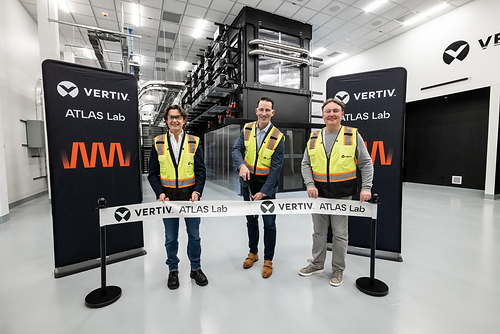
- Official ATLAS opening photograph and caption, distributed by Vertiv
To keep architecture diagrams, supplier reports, and deployment decisions in one searchable place, create a Telli.sh account.