What if your video game teammate remembered what you told them?
Ubisoft has set up Motherbrain to work on AI gameplay. Its Teammates experiment gives a concrete starting point for judging memory, pacing and accessibility.
A teammate in a game offers to find a missing character. You tell them that you already checked the storage room and would rather look somewhere else. If the next conversation starts with another suggestion to check the same room, the companion feels like a menu with a voice. If it remembers the exchange and offers a sensible next place to look, speaking to it starts to feel worthwhile.
On November 19, Ubisoft said it had established Motherbrain, a subsidiary dedicated to developing AI tools for gameplay. The team behind the playable Teammates experiment is working on directions that include non-player characters with memory and AI that coordinates elements of the game world. The announcement sets a development direction. It gives no release date or supported platforms for a follow-up commercial game. Ubisoft first-half 2026–27 results
What Teammates actually let players do
Ubisoft introduced Teammates in November 2025 as a playable research experiment. In a short first-person game level, participants look for five missing allies. A voice-controlled assistant named Jaspar can highlight objects, share background about the game world or respond to a request to pause. Sofia and Pablo are companions in the scene who can respond to voice directions. That setup let the team explore how conversation fits into moment-to-moment play. Ubisoft says a few hundred people tried it in a closed playtest. Ubisoft's Teammates experiment
The 2025 project followed a different kind of experiment. In March 2024, Ubisoft's Paris research team discussed NEO NPC, a prototype made with NVIDIA's Audio2Face and an Inworld language model. The work explored conversational characters whose personalities, backgrounds and speaking styles were defined by writers. That project focused on how characters could improvise without losing the situation or voice set by their creators. Teammates put voice interaction inside a playable level and let companions respond with game actions. The difference matters when judging evidence about memory. A character that remains consistent over a conversation has passed one test. A character that acts on what the player said after the world has changed has a larger job. Ubisoft's NEO NPC prototype · Ubisoft's playable Teammates experiment
There is a difference between asking a character to explain a room and expecting it to remember why you chose a route. The next step would be to decide what information the character can carry into another scene, what it learns from the world and what it can act on. A useful companion might remember that the player chose to search the library first, while the game still checks whether the library is reachable and how far the current quest has progressed.
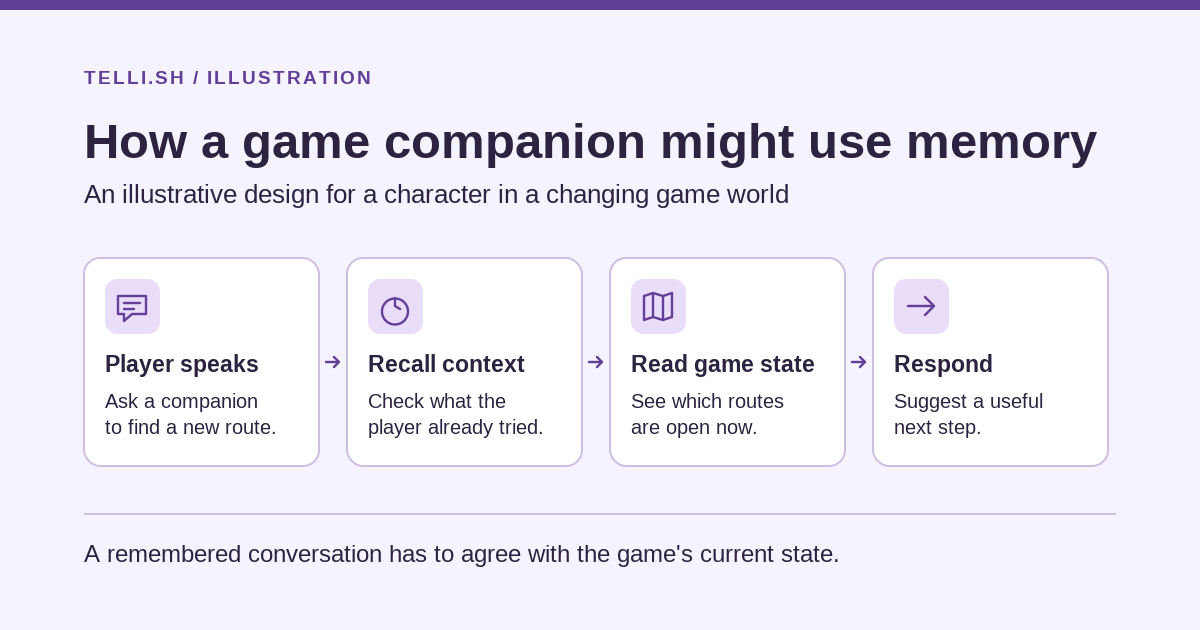
Illustrative design. The pipeline shows one way a companion might combine conversation with the state of a game.
Separate a character's recollection from the game's record
A game already knows which quest step is complete, what the player carries and which doors can open. A companion can use those facts to give relevant help. Its own recollection adds a different kind of context. It could remember that the player wanted to explore a room without hints, or that they asked the companion to warn them before revealing a solution. The design question is how much of that context should survive a scene change and which system should correct it when it conflicts with the game.
Suppose a player says, “We can skip the map, I know the way,” then returns to the same room ten minutes later after two failed attempts. A companion might offer a small clue, wait for a renewed request or leave the original preference in place. That is a design choice about assistance and consent. If the player instead says they already collected an objective that the game shows is still in the room, the character may acknowledge what it heard. The game can check the actual quest state before allowing any action that depends on that objective.
The useful memory may be more compact than a transcript of every exchange. A game team could try storing a few explicit decisions with the quest or scene they refer to. It could also decide which notes belong to a character. A teammate who was present in the library can refer to that visit. Another character may plausibly hear about it later in the story. Giving every character the same memories makes it easy to answer a question and difficult to preserve the player's sense of who knows what.
The best memory has clear boundaries
Context can reduce repeated instructions and make a character's help feel specific to the player. It can also create continuity problems. Imagine reloading a checkpoint from before the library search. A companion that remembers finding a clue in the abandoned attempt might give away information the player has yet to discover. A game team has to decide which memories reset with the checkpoint and whether a new playthrough starts fresh.
A narrative team also needs to decide how much the character can improvise. Ubisoft's narrative director described authors creating the story, personalities and rules that govern how characters can respond. That would let a companion remember that a player searched a room without suddenly speaking as if it knew the entire plot. Ubisoft's Teammates experiment
Testing helps reveal which boundary matters to players. Ask for the same kind of help before and after a scene changes, then reload and try again. Check whether the companion has a coherent reason for giving different advice. A voice feature also needs a path for people who cannot use a microphone or would rather keep it off. Text input or a controller menu could provide the same essential actions if the game supports them.
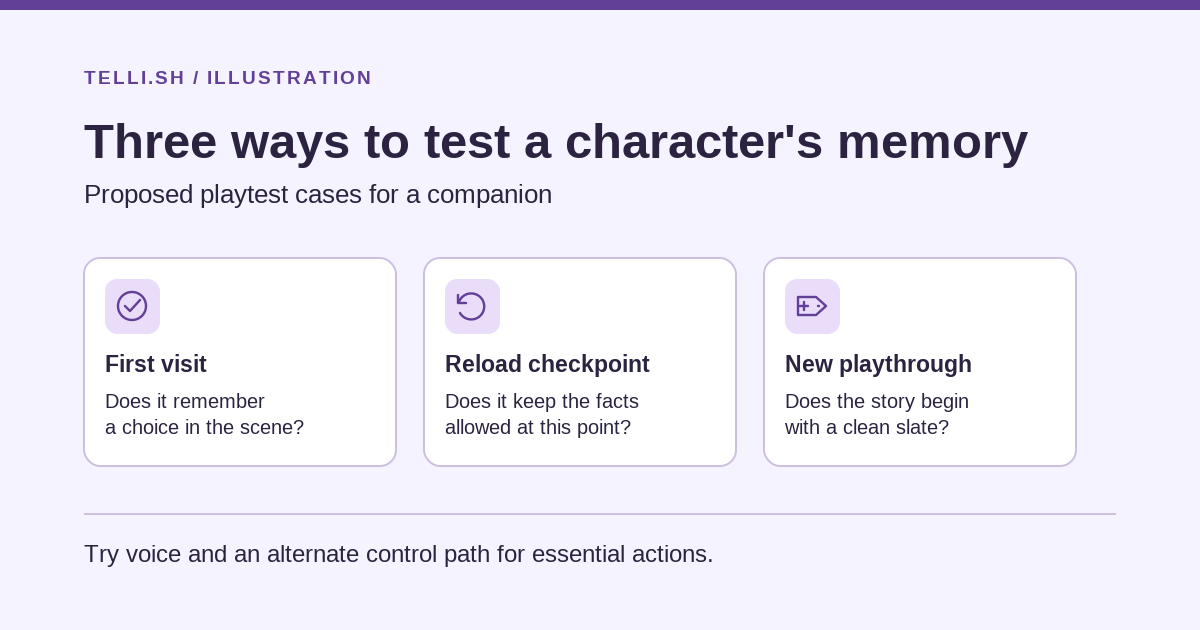
Proposed playtest cases for a game with companion memory.
One boundary is the save slot. A player may start a second campaign to explore a different path. The game can preserve accessibility choices across playthroughs and reset the story knowledge associated with the first run. Another boundary is the party. If a player joins a friend's session or changes characters, any persistent preferences and recollections need to follow the right player and story. A useful test is to switch saves and talk to the same companion in each. The companion should be able to give current advice without exposing clues or choices from an unrelated run.
Players should also have a way to recover from a misunderstanding. A short acknowledgement can confirm that a companion is about to help search a room. A player who said “Let's skip the study” may hear the character repeat “I'll check the study,” giving them a chance to correct the command. The longer the action takes to undo, the more valuable that correction path becomes. Finding the right words for the system can be part of a role-playing experience. It becomes tedious if the player has to guess at a phrase to perform a basic action.
A world that responds creates a different design problem
The earnings announcement describes a second focus for Motherbrain alongside NPC memory. Ubisoft says it is working on game masters that can coordinate large game worlds. A character remembering a remark can change one conversation. A system that controls how locations, events and characters respond can change what the player encounters next. The announcement gives a broad description of the work. It does not specify how an upcoming game would make these decisions. Ubisoft first-half 2026–27 results
Consider a fictional exploration game with a secondary task to deliver supplies. If the player stops to check a nearby ruin, a game master might select a different optional encounter or move a hint to a route the player will reach later. The central objective still needs a valid way to finish. If two systems can change the same world, they also need to agree on what already happened. A companion that recommends a shop that the game master just closed can break the player's sense of continuity even if both responses looked plausible separately.
That is a reason to test a few coordinated changes in a controlled build. Give world events a record of why they were chosen and when they took effect. In a playtest, ask players what they believed changed as a result of their decisions. Compare that answer with the event log. A system that silently swaps minor encounters can make repeat runs more varied. Players may become frustrated if a significant development feels arbitrary or takes away a choice they counted on. The difference is in the promise the game makes about consequences.
Questions a playtest can answer
Start by watching how players express a request before telling them which phrases the character understands. Then try the same request with room noise, a strong accent, multiple people speaking or a microphone turned off. A response log can show whether voice recognition, the character's interpretation or the game action produced a mistake. A comparison with the game's text or controller path can show whether some actions are accessible only to people who can use voice reliably.
Check the timing inside a scene. A two-second delay may feel quite different while choosing a dialogue topic at camp and while trying to coordinate a moving companion. Give players feedback that the game heard the request, and test what happens when they issue another instruction before the first finishes. A clear response to an interruption can feel more natural than a polished sentence that arrives after the player has already moved on.
Plot continuity deserves its own cases. A companion should give the amount of information a player requested without revealing the ending. Test a character that hears an incorrect claim, a quest skipped in a previous save and two companions given conflicting instructions. Ask whether the next explanation is coherent using only what each character knew in that scene. A game team can learn more from a replay that exposes one broken assumption than from several successful demonstrations of the same line.
Voice and long-lived context also raise questions a prospective player can bring to a demo. Where does the spoken input go? How long can a character remember it, and does deleting or reloading a save affect that record? Will there be text or controller equivalents for essential requests? The corporate announcement outlines design areas rather than an implementation for a released title. These are practical questions to check when Ubisoft shows the next version. Ubisoft's corporate announcement
What to watch in the next playable demo
A scripted demo can show how expressive a companion sounds in a single exchange. A longer playtest can show whether it stays in character, responds quickly enough to keep a scene moving and lets the player correct a misunderstood command. Motherbrain gives Ubisoft a team dedicated to that work. The first evidence to look for will be what happens when players change their minds, repeat an instruction or return to a scene after making a different choice. Ubisoft results and development direction · Ubisoft's playable research example
Telli.sh is a place to upload your first note and keep your playtest observations together.