Therabody's Jason turns the product shelf into a conversation
Therabody's new AWS-powered shopping assistant connects needs, product explanations and checkout. Its promise is a clearer purchase decision; the harder test is keeping evidence, sales incentives and personal health questions distinct.
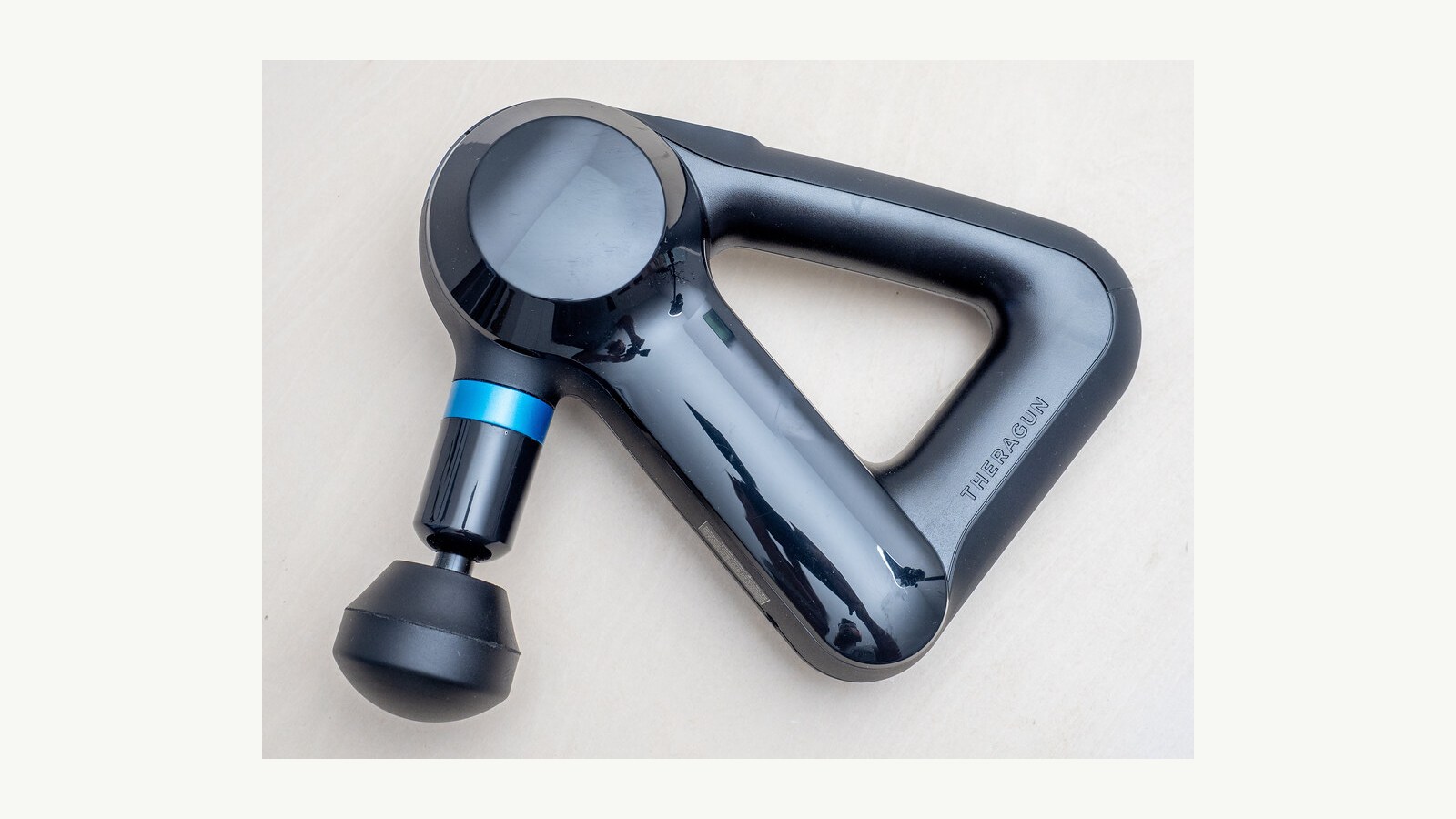
Theragun photograph by Ajay Suresh / ajay_suresh, January 8, 2022, CC BY 2.0, via Wikimedia Commons. Resized with neutral padding. This older device illustrates Therabody's product category; it does not show Jason's interface or the current catalog.

A shopper knows their budget and where a device needs to fit in their day. They may not know whether that means a small massage gun, a larger device or a different category altogether. A product grid asks them to translate the problem into a product name before the shopping has really begun.
On October 21, 2026, Therabody launched Jason, an AI shopping assistant built with AWS. The company says it asks about needs, budget and lifestyle, explains recommendations with research links, and connects to Shopify shopping actions. The entry point is Chat to Shop on Therabody.com. Therabody announcement.
Our take: the useful change is a shorter path from an everyday question to a purchase the buyer can explain. That path needs more than fluent answers. A sales assistant must keep product facts, evidence and a person's circumstances separate, especially when the conversation touches health. Jason is an interesting example of that challenge becoming an actual retail product.
A recovery brand has more to explain than a specification sheet
Therabody is the company behind Theragun massage devices and a broader range of recovery and wellness products. Its public store organizes equipment around activities such as fitness and recovery, everyday comfort, sleep and skincare. For a reader unfamiliar with the brand, the practical point is the variety: choosing within this catalog involves different device types, forms of use and routines. Therabody store.
A familiar product name does not settle the purchase. A portable device may suit someone who travels, while another buyer prioritizes easy handling at home. A gift buyer may understand the recipient's habits without knowing the preferred device. These are questions about fit, and they do not always map neatly onto filter menus or feature counts.
Conversational shopping can help when the buyer has useful constraints but lacks the vocabulary of the category. Asking a follow-up question can be more efficient than showing another page of results. The assistant's answer should also reveal which constraint changed the recommendation. Otherwise, a longer conversation can leave the customer with the same uncertainty as an ordinary product list.
Jason puts explanations next to the buying action
Therabody describes research citations inside the chat and Shopify integration for add-to-bag and checkout. It also says the assistant was built in under 90 days. That is the company's deployment account, rather than a measure of customer benefit. The important product combination is explanation plus action: a recommendation can lead directly toward a transaction. October 21 launch details.
That combination creates what we would call a decision receipt. A useful receipt would retain the shopper's main constraint, the reason an option fits and the qualification attached to the evidence. It should remain understandable after the excitement of the conversation has faded. The customer can then compare the answer with the actual product page and decide whether to proceed.
The purchasing boundary deserves equal attention. Discussing an item, adding it to a bag and paying for it are different decisions. The closer the interface brings them together, the more clearly it should show which action comes next. A helpful conversation should leave the buyer in control of the item, quantity and final total.
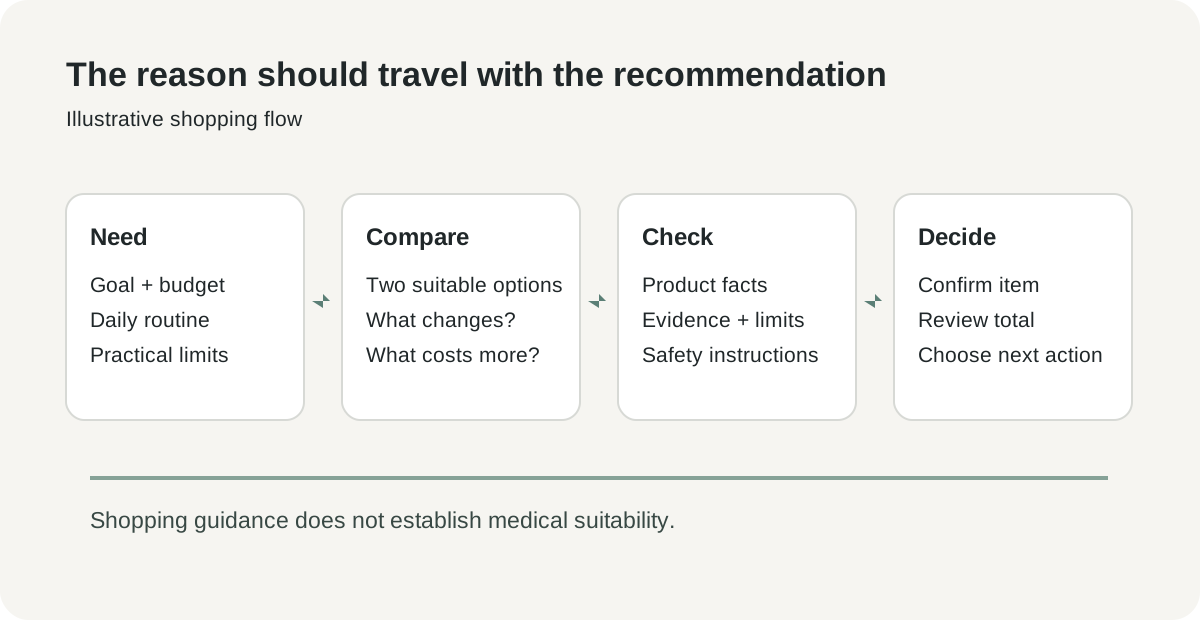
Original editorial infographic. This is an illustrative buying process, not a reproduction of Jason's interface or an assertion that every listed check is implemented.
Three ordinary shopping questions make the opportunity concrete
Consider an illustrative customer who wants something easy to pack for regular work trips. Their useful starting information is the available space, the routine they expect to follow and the maximum spend. The assistant could help narrow the category and identify what changes between two suitable options. The buyer can then check current dimensions, included accessories and instructions on the product pages before deciding.
A second scenario is a gift for someone who already owns a massage device. The problem is avoiding duplication rather than finding the highest specification. A good conversation would ask what the recipient already uses and which preferences are actually known. It would make uncertainty visible instead of filling the gaps with confident assumptions about another person's body or habits.
A third scenario is replacing an older device. The buyer wants to know whether a newer model adds something they will use, or merely rearranges a familiar feature set. Here, a comparison tied to a concrete routine is more valuable than a broad declaration that the latest device is better. A useful outcome could be a smaller purchase, a different option or a decision to keep the existing equipment.
These are proposed use cases, rather than results from a trial of Jason. They show the product's potential without requiring a claim that a shopping model understands every customer. They also suggest a practical test: after the conversation, can the buyer explain why an option fits and what remains uncertain?
A citation should answer a specific question
The distinction between a specification and research matters. A specification can tell you how a device is designed or operated. A study can describe what happened under particular conditions. Neither automatically establishes that a given person should buy that device. The conversation becomes clearer when the assistant says which kind of answer it is giving.
For a linked study, a reader can ask three basic questions: who participated, what was compared and which outcome was measured? The answer should connect to the claim in the chat. A source about one activity or device should not quietly become support for every product in a category. This is a general reading method, not a judgment about a particular study in Therabody's library.
Even a relevant source needs context. A small change in a measured outcome can have a different practical meaning from the claim a shopper first imagines. A study summary should therefore help the reader understand the result and its limits, rather than use the existence of a paper as a badge. The benefit of putting sources in a chat is the opportunity to make that explanation easier to follow.
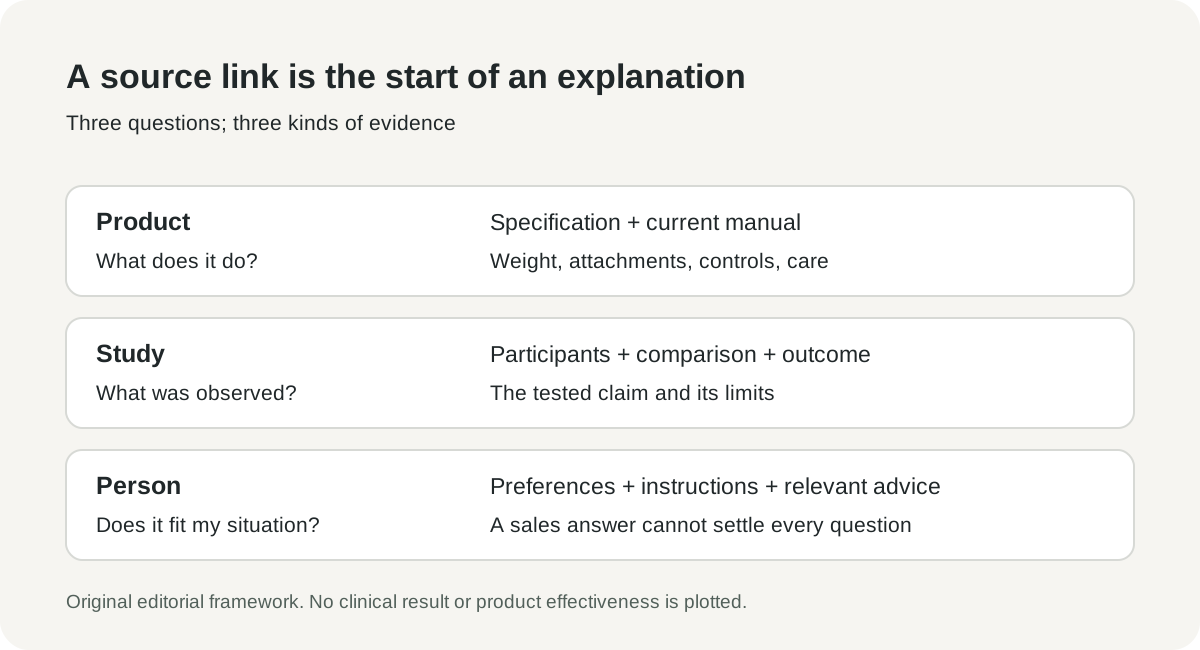
Original editorial framework. It distinguishes kinds of evidence without plotting a clinical result or asserting the effectiveness of a device.
The health boundary belongs in the conversation
Jason's public interface states that the AI can make mistakes and is not for medical advice. Therabody also publishes device precautions and directs readers with relevant concerns to a medical professional. These are useful boundaries for a customer: a shopping answer cannot establish a diagnosis or settle individual medical suitability. Public shopping entry and product precautions, checked October 23.
The practical implication is to separate a purchasing preference from a health question. Wanting a device that fits a travel bag is a shopping constraint. Asking whether a device is appropriate for a particular medical situation requires a different kind of judgment. A conversational interface should make it easy to pause the purchase and consult the relevant instructions or professional advice when that distinction matters.
This boundary can improve the experience. An assistant that acknowledges the limit of a recommendation gives the customer a usable next step. An answer that sounds certain because it is smoothly written can leave the buyer with misplaced confidence. The best sales interaction should be able to end without a sale when the remaining question belongs elsewhere.
A retailer-owned assistant has a useful bias to make visible
Jason recommends within Therabody's commercial environment. That makes it a specialist shopping assistant with access to the brand's product context. It also means the shopper should treat it as help navigating this seller's offerings. A brand expert and an independent comparison service have different jobs, even when both use conversational language.
The constructive version of that role is easy to describe. Explain the catalog accurately, honor the budget and show a cheaper suitable option when the customer's priorities support it. Identify a genuine reason to choose a more expensive device without making that the automatic destination. The recommendation becomes more credible when the customer can see the tradeoff.
For the retailer, this sets a richer goal than increasing the number of items in a bag. Did the assistant preserve the customer's stated limit? Did the explanation match the product page? Did a buyer later return an item because the conversation created the wrong expectation? These are proposed evaluation questions, and they would help distinguish useful guidance from an effective sales script.
Privacy can change how much detail a shopper should share
Therabody's privacy policy says chat conversations may be retained for training and customer-service purposes. The policy also describes several categories of information collected through its services. A reader should review the applicable notice before treating a retail conversation as a private place for sensitive personal detail. Therabody privacy policy, checked October 23.
There is often enough information to start with less. A budget, a portability preference and the intended everyday routine may be sufficient for an initial product comparison. If a question requires sensitive medical context, the more appropriate next step may be outside the shopping interface. For a gift, avoid sharing another person's private information simply because the assistant asks a natural-sounding follow-up.
Retailers also have a product-design choice here. The assistant can explain why it needs a detail, let the customer skip optional questions and keep a route to ordinary product browsing. A conversation that demands more information than the purchase needs can turn convenience into an unnecessary exchange of personal context. Clear, limited questions would make the product easier to trust.
AWS is selling a foundation that brands still have to shape
AWS describes its Agentic Shopping Assistant as architecture guidance, starter code and expert support that retailers adapt to their own catalog, business rules and voice. Its public account also names Kate Spade's gift-shopping experience as an implementation. This is a platform and customization story, rather than a single identical bot installed on every store. AWS retail explanation.
That distinction matters when evaluating the category. A broad technical foundation may reduce repeated engineering work, but a retailer still needs to decide what its assistant knows, when it asks questions and how it handles an unsuitable request. The behavior that matters to a shopper depends on those choices. A successful deployment at one brand does not settle how another brand's catalog or customer needs should work.
Therabody's case is interesting because explanations are part of the sale. The product has to connect understandable language with precise product information while keeping the purchasing experience coherent. The expected benefit is less effort moving between pages. The expectation worth watching is whether the resulting decision is better informed, including when the customer chooses to wait.
Start with one comparison and keep the decision visible
For a reader who wants to explore Jason, a bounded first conversation is more informative than a vague request for the best product:
- Open the appropriate regional Therabody store and look for Chat to Shop. Confirm that the catalog and delivery region match your purchase.
- State a budget and one or two practical constraints, such as storage space, portability or an existing device. Share only what the comparison needs.
- Ask for two suitable options and the concrete difference that matters to your stated routine. Request the corresponding product links.
- Follow any research links relevant to the explanation. Read the selected device's precautions and current instructions separately.
- Review the exact item, price, delivery and return terms before confirming a shopping action. Save the explanation if you want to compare it later.
For a retailer planning a similar product, begin with a small set of questions customers already ask. Include awkward cases: a firm budget, a request outside the catalog, a concern that needs human help and an item the shopper does not need to replace. Review the answer and resulting action together. A polished recommendation followed by the wrong item is still a poor shopping experience.
Judge the answer by the tradeoff it explains
A customer can compare conversational help with ordinary browsing using a few observable questions. The comparison should reward clarity rather than the amount of text the assistant produces. If a response merely repeats a product description, the chat has added another reading task. If it connects a specific feature to an actual constraint, it has done useful work.
| Customer question | A useful explanation | A weak answer to challenge |
|---|---|---|
| Why this option within my budget? | Connects a stated priority with a current specification | Repeats that the product is premium or popular |
| What do I give up by spending less? | Names a difference that affects the intended routine | Lists every feature without explaining relevance |
| Should I replace what I own? | Identifies a specific missing function or acknowledges overlap | Assumes a newer product is automatically worthwhile |
The same approach helps a retailer review failed conversations. An answer can contain accurate details and still fail to resolve the customer's question. Reviewers should ask whether the recommendation honored the budget, explained the decisive tradeoff and left the next action understandable. That gives the assistant a service-quality target a customer can recognize, rather than a conversational style that merely sounds helpful.
The purchase should be easier to explain afterward
Conversational commerce is most useful when it removes translation work between a person's goal and a product catalog. Jason makes that idea tangible: a brand can bring explanations and shopping actions into the same exchange. The resulting experience will earn trust through the quality of the reasons it gives and the control it leaves with the customer.
The meaningful success is a buyer who understands the choice, the cost and the limits of the explanation. A fluent answer is a useful beginning. An understandable decision is the stronger product.
Sources
- Therabody launches Jason with AWS, October 21, 2026.
- AWS explains its Agentic Shopping Assistant foundation, checked October 23, 2026.
- Therabody public store and Chat to Shop entry, checked October 23, 2026.
- Therabody product precautions and privacy policy, checked October 23, 2026.
- Theragun photograph by Ajay Suresh, January 8, 2022, CC BY 2.0.
Keep the recommendation and its sources together
For readers who want a separate workspace for product links and their own comparison notes, Telli.sh is one option. Open your notes workspace.