Why Tencent Hy4’s 49B active parameters still leave an infrastructure decision
Tencent Hy4 opens a 770B multimodal language backbone for self-hosting. See what 49B active parameters tell you, how to estimate memory, and where an internal trial makes sense.
If a team wants to run image and document analysis inside its own network, Tencent Hy4 gives it a downloadable model to evaluate. Hy4 exposes text, image and video understanding through the model family Tencent’s Hunyuan team announced on November 4, 2026. The engineering decision starts with two numbers in the official specification. The language backbone has 770 billion parameters, and it activates 49 billion for each text token.
The 49 billion figure helps explain how the model limits computation per token. A team planning to host the model also has to decide where the weights will reside, how requests will move between devices and how much memory is left when the server is busy. Hosting inside the organization offers control over where inputs are processed. It also makes the organization responsible for capacity, access and reliability. Tencent’s Hy4 announcement · Hy4 architecture and downloads
The weights a token uses and the weights a server holds
Hy4’s language backbone uses a mixture-of-experts architecture. Tencent describes 77 mixture-of-experts layers, following one dense layer. Each of the 77 layers has 256 routed experts and one shared expert. The router chooses eight of the routed experts per token, and the shared expert also participates. Each token uses selected experts, while subsequent tokens can take different routes. Hy4 architecture
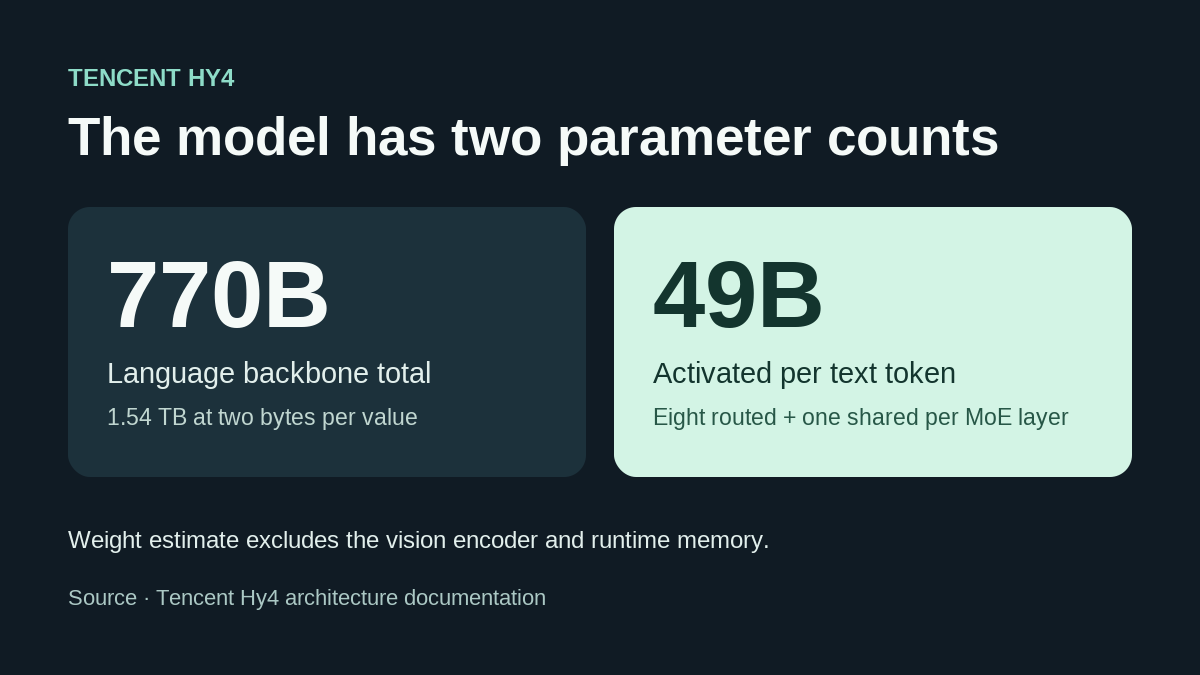
One way to sanity-check the storage scale is to multiply the 770 billion parameters by bytes per value. At two bytes each, a uniformly stored language backbone would occupy about 1.54 TB in decimal units. At one byte each, that arithmetic gives about 770 GB. These are illustrative backbone-only calculations. They exclude the separate vision encoder and other components, additional runtime memory and any overhead or exceptions introduced by a particular checkpoint format.
Tencent’s published downloads include Hy4, Hy4-FP8 and Hy4-Base. To budget a deployment, use the shard inventory of the specific checkpoint and measure the peak memory on the proposed serving system. How the runtime places weights, whether it offloads them and how many requests run concurrently all affect the result. A precise capacity estimate comes from the configuration the team will operate. Hy4-FP8 checkpoint · Hy4 release repository
That capacity estimate has at least three parts. The model artifacts occupy disk and need a distribution path to each serving environment. Weight memory covers the portions resident on GPUs or in host memory while the service is ready. Request-time memory covers state and temporary buffers used while work is in flight. A system that can load a checkpoint is at the starting line. Its reserve for long documents and overlapping requests determines what it can serve without delaying or turning away work. On a shared cluster, a useful capacity record includes the GPUs, host RAM, checkpoint revision, serving runtime, model placement and concurrent request limit.
The two-byte calculation is worth doing even when the team plans to run FP8. It shows why the artifact choice and the serving layout belong in the initial decision. Compare two configurations by the amount of hardware they reserve when idle and by what happens while a request is running. A configuration that splits experts across accelerators may require moving intermediate results between devices. A configuration that places some weights in host memory may spend time transferring them. A short quality trial and a request trace can show whether those delays are acceptable for a support desk that expects an answer while a ticket is still open.
Long context gives teams a choice about which pages to send
Tencent lists a context length of 1,048,576 tokens. It also documents a separate vision encoder with dynamic image resolutions and an adapter that turns image and video-frame features into tokens the language backbone can use. These capabilities give a team several ways to represent the same incident. It could include the text from a report, add the original screenshot, or select frames from a recording that show a changing alarm indicator. Each representation presents different evidence and carries a different processing cost. Hy4 model specifications
A maintenance team could compare full-report input with selecting relevant pages first. Full-report input keeps references such as “see the prior inspection” in reach, which can help when a report’s meaning depends on an appendix. A page-selection step can filter receipts, routing covers and duplicates before sending the useful pages to the model. It also introduces a new place for the workflow to miss a clue. Save the selected page list with each answer. If a model omits the calibration date, the team can then tell whether the source page was absent or whether the model saw it and failed to extract the date.
Test image detail explicitly. Text extracted from a clean PDF may retain every relevant digit and heading. The same procedure on a screenshot with a small serial number can lose the one character that distinguishes two devices. Hold the task and answer format constant, and compare text-only, image input, and text plus image. For video, annotate which frame contains the evidence and test what happens if the configured sampling interval skips it. Faster responses make little difference when a request path drops the moment the team needs to inspect.
Tencent publishes a four-shot pretraining evaluation table covering multimodal benchmarks such as TextVQA and MMMU-Pro. For Hy4 Base, it reports 78.2 on TextVQA and 59.6 on the listed standard MMMU-Pro setup with ten answer options. The figures describe Tencent’s evaluation of that base model. They give readers examples of the visual reasoning Tencent measured, while a service report pilot requires a different test with the serving checkpoint, inputs and response format the team would use. Tencent’s pretraining evaluations
An internal trial starts with known answers
Consider a support team that receives screenshots and scanned service reports. It could ask Hy4 to extract the stated error, affected product and timestamp, with the source page attached to each answer. A pilot could use documents the team has permission to process and include clean reports, blurry scans and examples where the requested field is missing. This is a suggested evaluation, with quality and operating cost still to be measured.
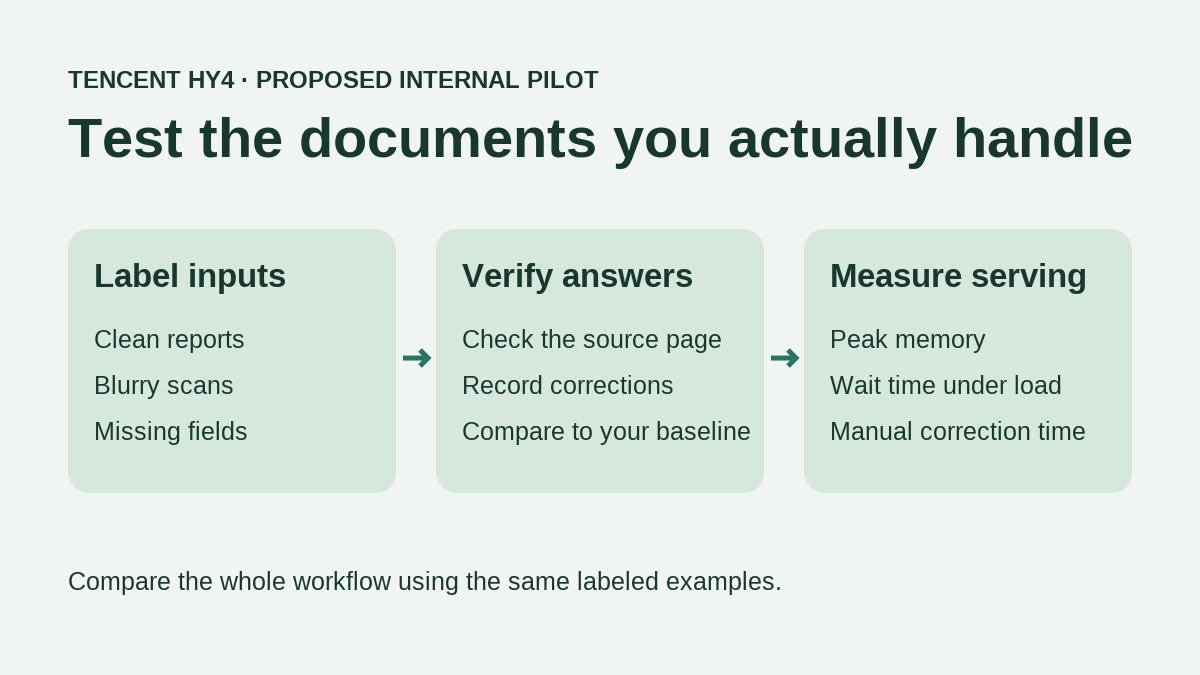
A small labeled set lets the team see whether adding a screenshot helps and whether the model invents plausible answers when a field is absent. Measure the share of outputs that pass a manual check, the time someone spends fixing the others, and the time a user waits when several jobs arrive together. A comparison with the team’s existing extraction method makes the tradeoff visible. A more accurate model may justify the hardware on difficult scans, while a simpler option may already cover the routine forms.
The comparison can be run in three steps. First, use a text-extraction pipeline with the team's current field rules on the same sample. Second, add a smaller vision-language model the team can already run and include the original page images. As an example of the scale difference, the Qwen team published Qwen3-VL-30B-A3B variants in October 2025. That release establishes that smaller downloadable multimodal models exist. Comparing one with Hy4 requires running both with equivalent evidence and scoring rules. Third, test Hy4 with the same ground truth, and break the results down by field and document type. Official Qwen3-VL release history
Define what counts as complete before reviewing any answers. An error message can be scored against the literal text. A product name might accept a known alias. A timestamp has to make clear which time zone it uses, or preserve the original value if the source leaves the time zone unspecified. When two pages disagree, record the conflict and accept an answer that points to both. A model that handles those cases reliably may save more review time than one that gets a slightly larger share of clean forms right.
Treat a reply with a valid shape and the right value as two separate checks. A service can enforce a format such as fields for the proposed value, evidence page and a missing-value marker. A human reviewer can still see where a valid-looking field points to the wrong page. Reviewing evidence and values together also helps when someone prepares a corrected record. A later audit should be able to tell which version came from the source, which came from the model and which a person changed.
Measure useful output while the service is busy
For an internal pilot, define a light, typical and burst workload using the mix of tasks the team expects. Begin with one small request to check that the service loads and produces a usable response. Then include several jobs with images or long reports. Time from submission to first response helps diagnose slow startup or input processing. Time to a completed, reviewable extraction is closer to the number a support lead needs. Track the slower end of that distribution as well as the median, and record request failures and retries with the same test run.
Compare costs in terms of reviewed documents. Consider an illustrative run of 100 reports. If 80 outputs pass review, the serving and reviewer time spent on all 100 belongs in the cost calculation. If a smaller model handles 70 on the first pass and a larger one helps rescue a portion of the remaining 30, a tiered workflow is another candidate. Start by checking whether missed or uncertain cases can be reliably identified, since a mistaken pass in the first tier can keep the higher-capacity model from seeing the very example it could fix.
A live internal service also needs an answer when accelerators are busy or temporarily unavailable. A team processing a nightly archive may prefer a queue. A help desk may prefer to return to its existing workflow when a request exceeds a wait limit. Note how long it takes to start the serving process after a restart and whether rerunning a request duplicates a record. Loading a large checkpoint is part of the time to recovery, so the pilot can distinguish a working one-off run from a service a team can run every day.
The license is part of that evaluation. Section 10 of the Tencent Hy License describes when qualifying model-as-a-service businesses need a separate written license. It also defines an exception for solely internal use when the work, derivatives and outputs stay inside the organization. Verify where your planned workflow fits, especially if a pilot may later become a service available to customers. Tencent Hy License, section 10
What makes Hy4 worth the additional capacity
Hy4 is a strong candidate for evaluation when a team needs to keep multimodal processing in a controlled environment and routinely handles evidence conventional extraction misses. The same team should keep a narrower workflow in the comparison. Hy4’s technical value is easier to judge when the test names the exact cases it should improve and measures the extra infrastructure and operating effort against the time saved. If the improvement concentrates on rare, difficult cases, those cases can justify a focused trial before the model becomes the default for every document.
This is also a way to evaluate the role of a large model without assuming future documents will resemble the original sample. Keep a second set of return visits, missing attachments and changed templates that nobody uses to tune prompts. If the result holds on that set, the team has evidence that the advantage covers the variation it actually sees. Pair that result with the recorded memory and wait times so reviewers can decide whether a gain in quality translates into a workable service.
Sources and dates
- Tencent announced Hy4 on November 4, 2026 and said the weights would follow. The official repository now links the checkpoints. Its specifications and license describe the released artifacts. Announcement and launch visual · Official repository
Keep the test documents, accepted answers and corrections together while comparing models. Start your first note with Telli.sh.