Mischief 1: what a 2.5-cent video attempt changes for creators
TBC's neuron-derived Mischief 1 runs as software on ordinary AI hardware. Its image-to-video pricing makes iteration interesting, while usable output remains the real test.
The first video idea is rarely the final one. A camera move needs changing, a hand drifts out of shape, or the opening frame looks right while the ending loses the subject. Creative work depends on having enough attempts to find the version worth keeping.
The Biological Computing Co., or TBC, launched Mischief 1 on October 30, 2026 through fal and OpenRouter. Its unusual technical story begins with experiments on living neurons, but the customer-facing product is familiar: image-to-video software running on standard AI hardware. The neurons remain in the laboratory. TBC launch announcement
The immediate reason for creators to look is the price of experimentation. fal lists $0.005 per generated second at 480p and $0.01 at 720p, making a five-second attempt $0.025 or $0.05 respectively. This article explains the biological research claim, the economics of repeated attempts, and a practical way to decide whether the resulting footage is useful for your work. fal model listing, checked November 2, 2026
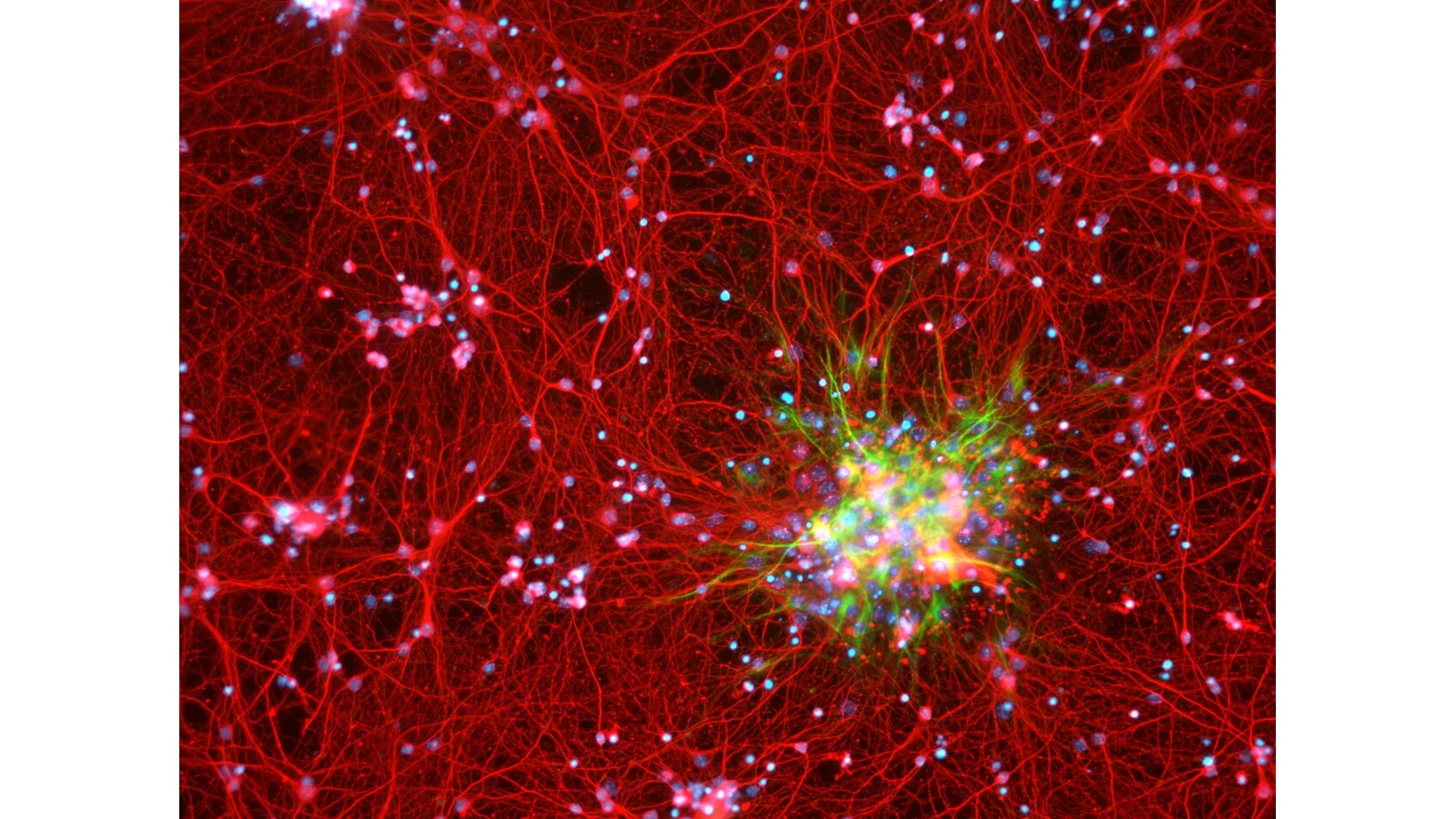 Cultured mouse cortical neurons and astrocytes in 2009: neurons red, astrocytes green. Illustrative microscopy, not TBC cells, apparatus or output. Image: Dchordpdx, CC BY 4.0; resized with margins. Image source · License and image notes. Official product reference.

Biology supplies a discovery method, not the serving hardware
TBC describes a research process that measures how laboratory-grown neurons handle information and translates useful principles into software. Its technical explanation places a lightweight layer around diffusion-transformer blocks after training. The company says that layer adds less than 0.1% to the underlying model's parameter count. TBC technical explanation, checked November 2, 2026
That distinction answers a practical infrastructure question. A developer using the API is not commissioning a biological experiment for each video. The delivered artifact is software, so the relevant operating questions remain latency, reliability, price, output quality, and the provider's handling of inputs and outputs. The unusual research origin does not remove any of those ordinary requirements.
It also changes how the claim should be evaluated. “Inspired by the brain” can describe a metaphor. TBC is making a more specific statement about measurements informing a commercial optimization. Understanding that statement does not require believing that customers now have a general-purpose biological computer at the other end of the API.
Our take: the interesting possibility is a new source of optimization ideas. If biological experiments produce transferable improvements, they could complement established engineering techniques. The commercial test is whether those improvements remain valuable on the workloads people actually submit, across more than a selected demonstration.
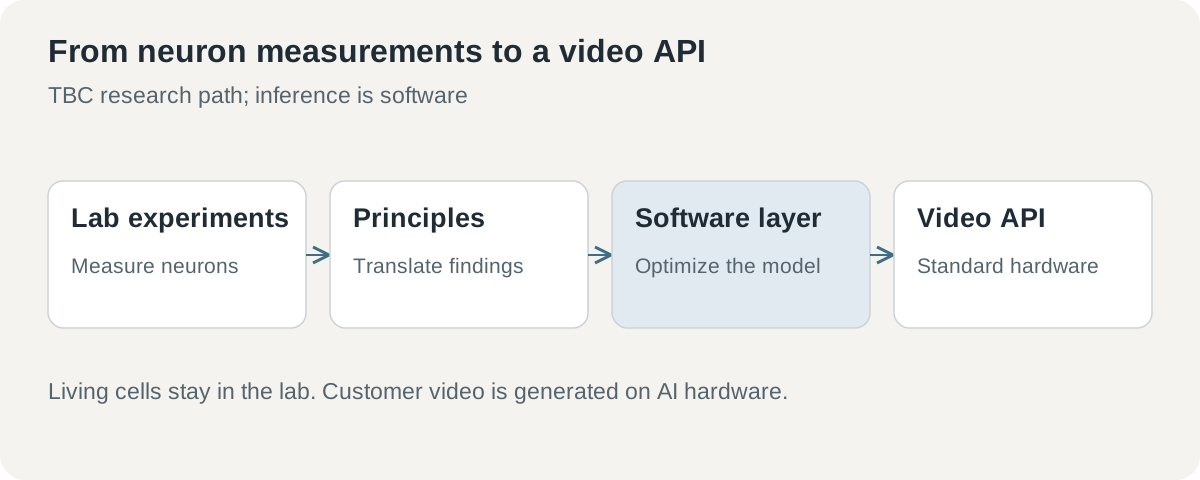 TBC's stated path runs from laboratory discovery to software optimization. Customer video inference runs on standard AI hardware, rather than living cells.
The 5× comparison is against the stated base model
Mischief 1 is built on Wan 2.2. TBC's October 30 announcement claims a fivefold generation-speed improvement while matching that base model's quality. This is the company's comparison, rather than a universal ranking against every current video system. A newer competitor, different hardware, or a different generation configuration can change the relevant result. TBC release announcement
Speed also has several meanings in a creative workflow. Model computation is one part; upload, queueing, download, review, and reruns are others. A creator waiting for a usable clip experiences all of them. A developer should therefore measure elapsed time from submitting a request to having an accepted asset, in addition to any provider-reported inference timing.
Quality parity needs an explicit job too. A five-second camera move over a landscape and an expressive close-up ask different things of a video model. A model can be suitable for one and frustrating for the other without either observation establishing a global quality ranking. Choose prompts and source images that resemble the intended work.
The base model's open-weight status is another separate issue. It explains lineage; it does not by itself make the optimized derivative's weights available for download or self-hosting. A team that requires local execution should establish the available artifact and license directly, rather than treating an API launch as a self-hosting release.
A cheap attempt and a cheap accepted clip are different numbers
The published fal rate is based on generated video seconds. At 480p, 100 five-second clips cost $2.50 in generation charges; at 720p, the same volume is $5.00. These are calculations from the listed rates, not a report of a paid run. They exclude any other services, editing labor, or downstream processing. fal pricing
| Illustrative batch | 480p at $0.005/second | 720p at $0.01/second |
|---|---|---|
| One 5-second clip | $0.025 | $0.05 |
| Twenty 5-second clips | $0.50 | $1.00 |
| One hundred 5-second clips | $2.50 | $5.00 |
Now suppose a team accepts four clips from twenty attempts. At 480p, the generation charge per accepted clip is $0.50 divided by four, or $0.125. If it accepts only one, the generation charge per accepted clip is $0.50. The model's unit price did not change; the usefulness of the output did.
Review time can dominate that difference. Watching, naming, comparing, and rejecting a hundred clips takes attention even if generation is inexpensive. A low attempt cost should support deliberate exploration, rather than an unmanageable pile of unlabeled files. The workflow needs a way to remember why one take worked and the next did not.
Think of the budget as a contact sheet. A photographer does not judge a shoot by the price of one exposure alone; the value comes from the frames that can carry the story. Video generation deserves the same distinction between producing candidates and producing an accepted result.
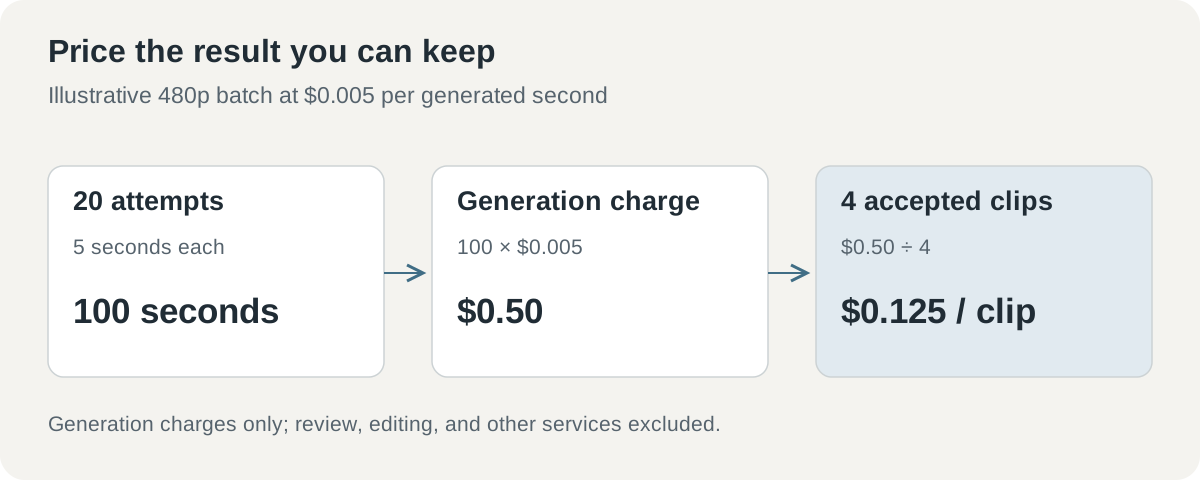 The illustrative 480p batch costs $0.50 for twenty five-second attempts. Four accepted results make the generation cost $0.125 per accepted clip, before review and editing.
Storyboards can spend the savings on better choices
Consider an illustrative creative team preparing a short product film. It has an approved source image and wants to compare three camera approaches: a restrained push-in, a lateral reveal, and a nearly static shot with environmental motion. Mischief 1 can be evaluated as a way to produce candidate motion quickly enough for that discussion. No generated take needs to become the final advertisement for the experiment to be useful.
The team should hold the source image and core subject description steady while changing one motion instruction. Otherwise, it may confuse a different composition with a better camera move. A simple review sheet can record subject stability, intended motion, unwanted changes, and whether the result communicates the planned beat.
A second illustrative use is a small agency testing directions before presenting a client with expensive production choices. It can show a limited set of labeled concepts and explain that they are motion studies. Client approval should focus on the intended direction, with final branding, text, and visual accuracy checked separately.
A third is an application that helps users animate their own images. Here, lower generation prices can make repeated use easier to offer, but the developer must account for errors, abandoned jobs, repeated clicks, and output storage. A plausible per-request margin can disappear if the interface encourages several accidental submissions or keeps every generated file indefinitely.
All three uses benefit from a bounded brief. “Make it cinematic” leaves reviewers arguing about taste after the fact. “Keep the product shape unchanged while the camera moves slightly closer” creates a condition they can inspect, even when their final judgment is still subjective.
Compare Mischief 1 with Wan 2.2 under the same brief
Wan 2.2 is the most natural named baseline because TBC explicitly identifies it as the base. A comparison with another production candidate can also be useful, but it should be matched to the same delivery need. The goal is a decision about your workflow, rather than a sweeping leaderboard assembled from incompatible settings.
| Comparison dimension | What to hold steady | What to record |
|---|---|---|
| Visual task | Source image, requested action, framing | Subject changes and motion fidelity |
| Delivery format | Resolution, duration, intended use | Whether the asset fits the edit |
| Time | Comparable submission conditions | Full elapsed time and failed attempts |
| Economics | Same acceptance standard | Spend and review effort per accepted clip |
OpenRouter's listing identifies image-to-video support and short clips, with 480p and 720p options; its current description includes three- and five-second lengths. Check the actual selected provider's schema before coding around those options. Model names and provider interfaces are related, but the integration still needs its own validation. OpenRouter model listing, checked November 2, 2026
For a small pilot, write the acceptance rules before generating. You might reject subject deformation, unreadable essential text, or a camera move that reverses the brief. Keep the rejected results in the record so a later price comparison does not quietly count only the successful examples. That record will be more valuable than a single spectacular sample.
Begin with a small, labeled image-to-video batch
The public marketplace routes make a limited trial more practical than arranging a special research collaboration. Start with a source image you have permission to use, and keep the brief modest enough to judge. A budget cap and a naming convention are useful creative tools because they force the team to make its choices explicit.
- Choose a public integration route. Open the fal or OpenRouter Mischief 1 listing, inspect the active provider and schema, and review applicable terms before uploading material.
- Prepare one authorized source image. Avoid a complicated starting point for the first test. Write down the subject features that must remain unchanged.
- Set duration and resolution deliberately. For a five-second test, use the listed 480p or 720p rate to calculate the intended batch budget before running it.
- Write three bounded prompts. Change the requested motion or atmosphere while retaining the same subject requirements. Give each variation a clear name.
- Generate a limited batch and label every result. Record the settings, actual charge, elapsed time, failures, and rejection reasons. Keep the source image with the batch.
- Review against the intended use. Compare the best candidates with the baseline, then calculate cost per accepted result. Decide whether better prompts, a different model, or conventional editing is the next useful move.
A developer can then turn that process into an application contract. Jobs need visible states, repeat submissions need handling, and a result should not be reported as ready before the video is available. Those ordinary details determine whether an inexpensive model becomes a dependable feature.
The next milestone is transfer, not a louder metaphor
TBC says it is extending its research toward newer video models and exploring language and physical AI. Those are development directions, while Mischief 1's public image-to-video endpoints are the current commercial offering. A useful expectation is evidence that the optimization continues to help as the underlying models and tasks change. TBC October 30 announcement
The research origin also raises reasonable questions about reproducibility. Customers buying an API do not need every laboratory detail to make a narrow creative decision. Researchers evaluating the claimed mechanism need more than output clips and price tables. Those are different audiences, and the same launch material will not answer both sets of questions fully.
For creators, the near-term opportunity is concrete: spend less on each attempt while preserving a demanding acceptance standard. For developers, the question is whether the provider delivers enough dependable, usable output to justify integration. Neither depends on pretending that every inexpensive clip is a finished asset.
The useful unit is an idea you can keep
Mischief 1 makes an interesting argument that AI efficiency can come from a different research direction. Its practical offer is easier to assess: short image-to-video generation at published per-second prices, with a vendor-reported speed improvement against Wan 2.2.
The creative breakthrough, if a team finds one, will happen when those economics buy a better choice. Ask how many accepted ideas emerge from the same budget and attention. That is the result worth carrying into the next project.
Sources
- TBC Mischief 1 launch announcement, October 30, 2026.
- TBC technology and product explanation, checked November 2, 2026.
- Mischief 1 on fal, checked November 2, 2026.
- Mischief 1 on OpenRouter, checked November 2, 2026. Speed and quality parity are vendor claims; cost examples are arithmetic, and scenarios are illustrative rather than hands-on results.
Keep the brief beside the chosen take
Telli.sh is one option for retaining authorized source material, creative notes, and the decisions behind a project. Create a note workspace.