Nova-3 added its 58th language this month. Only 10 of them work in the same sentence.
On August 4, 2026 Deepgram added Punjabi and Nepali to Nova-3; on August 7 it added Armenian and improved Tamil, Indonesian, and Belarusian. Nine months ago the model covered 31 languages — today the docs list 58. But code-switching still works in exactly 10, and August's own changelog shows Indonesian improving in batch while Belarusian improved only in streaming. A look at the pace of speech-recognition language coverage, and at what the word 'supported' is actually hiding.
On August 4, 2026, Deepgram added Punjabi and Nepali to its Nova-3 speech recognition model. Three days later it added Armenian, along with improved monolingual models for Tamil, Indonesian, and Belarusian.
Two changelog entries, eleven lines of text between them, no press release. And yet for anyone who runs meetings in those languages, it is the most consequential thing that happened to speech recognition this month.
The pattern behind those entries is worth more than the entries themselves. In December 2025, Deepgram's own release notes put Nova-3 at 31 total languages. Counting the distinct base language codes in Deepgram's Models & Languages Overview today, August 31, 2026, gives 58. That is the pace the whole industry is moving at, and it has quietly changed what you should expect from a transcript.
This post does three things. It puts numbers and dates on that expansion using primary sources. It explains why a headline language count is close to useless on its own — and what three questions you have to ask instead. And it works through what the August additions concretely change for a meeting with Punjabi, Nepali, Armenian, Tamil, or Indonesian speakers in the room.
TL;DR:
- 58 vs 31. Nova-3's documentation listed 31 total languages on December 10, 2025 and 58 distinct base language codes on August 31, 2026 — 39 languages added across nine dated changelog entries.
- Coverage is not one number. Deepgram's
language=multicode-switching mode covers exactly 10 languages (English, Spanish, French, German, Hindi, Russian, Portuguese, Japanese, Italian, Dutch). The other 48 are one-language-at-a-time only.- Batch and streaming are separate products. August 7's release improved Tamil in both, Indonesian in batch only, and Belarusian in streaming only. Same changelog entry, three different outcomes.
- Monolingual still wins. For 48 of Nova-3's 58 languages, a dedicated model is not just better than the multilingual mode — it is the only option that exists.
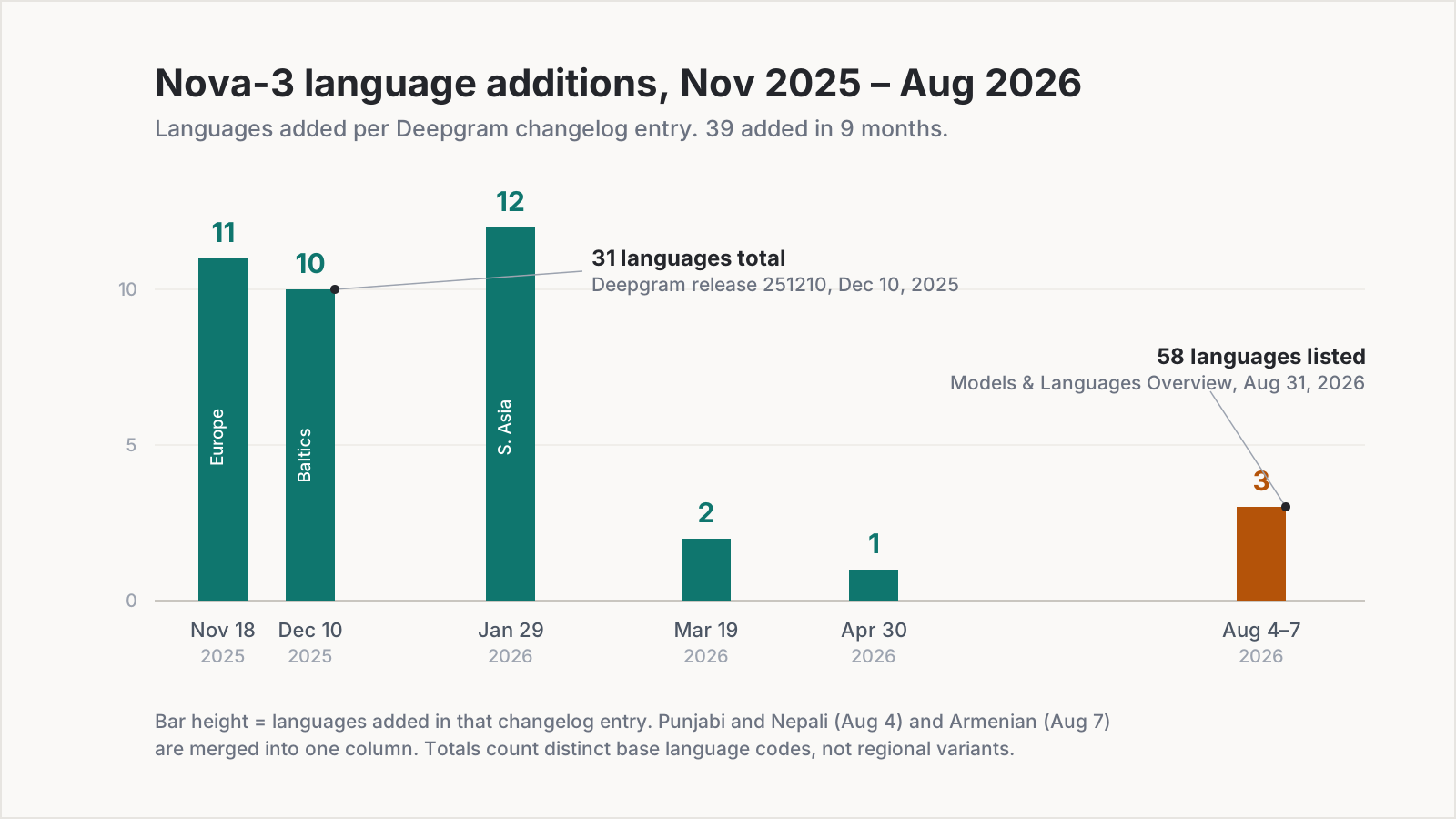
Chart: Telli.sh, built from Deepgram changelog entries dated November 18, 2025 through August 10, 2026, and the Models & Languages Overview retrieved August 31, 2026.
Thirty-one languages in December, fifty-eight in August
Speech recognition vendors rarely announce language coverage the way they announce accuracy. It arrives in release notes, a handful at a time, and the cumulative effect is easy to miss unless you go back and add it up. So we did.
Deepgram's release 251118, dated November 18, 2025, expanded Nova-3 monolingual support with 11 new languages — Bulgarian, Czech, Finnish, Hindi, Hungarian, Japanese, Korean, Polish, Russian, Ukrainian, and Vietnamese. Release 251210, three weeks later on December 10, 2025, added 10 more across Southern Europe, the Baltics, and Southeast Asia: Greek, Romanian, Slovak, Catalan, Lithuanian, Latvian, Estonian, Flemish, Swiss German, and Malay. That release note contains the single most useful sentence in this whole story: "Nova-3 now supports 31 total languages."
From there the additions kept coming. Release 260129 on January 29, 2026 added 12 more, including Belarusian, Bengali, Bosnian, and Croatian. Release 260319 on March 19, 2026 brought Thai and Cantonese. Release 260430 on April 30, 2026 added Gujarati. Then August: Punjabi and Nepali on the 4th, Armenian on the 7th.
Add the documented additions from November 18, 2025 to August 10, 2026 and you get 39 languages in a little under nine months. That is roughly one new language every seven days, sustained, from a single vendor.
Here is a detail worth noticing, because it tells you something about how these releases actually reach you. The cloud changelog dates the Punjabi and Nepali addition to August 4, 2026. The self-hosted release that bundles the same models, 260812, is dated August 12. Eight days of lag between the hosted API and the container image. If you run Deepgram on your own hardware, "supported" arrived more than a week later than it did for everyone else.
"Supported" is not one thing — it is three questions
Now the part that the headline numbers hide. When a vendor says a language is supported, that single word is doing at least three jobs, and they come apart constantly.
Can you use it in real time, or only after the fact? Batch transcription and streaming transcription run different models with different constraints. A streaming model has to commit to words before it has heard the end of the sentence; a batch model gets the whole recording. Vendors ship them separately, and they do not always ship them together.
How good is the model, really? "Supported" tells you a code will be accepted, not that the output is usable for a board meeting. A language that was added last month and a language that has had four rounds of improvement are both listed in the same table cell.
Can it be mixed with another language? This is the one almost nobody checks until it breaks. Transcribing a meeting where everyone speaks Nepali is a different technical problem from transcribing a meeting where people switch between Nepali and English mid-sentence, and the second problem is solved for far fewer languages.
August's own changelog is the cleanest illustration of the first question we have seen in a year. The August 7 entry improved four things, and it did not improve them uniformly.
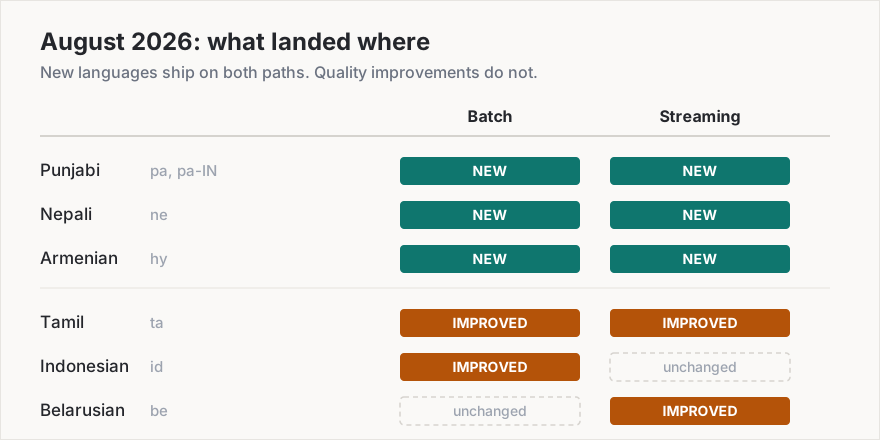
Chart: Telli.sh, from the Deepgram changelog entries of August 4 and August 7, 2026.
Punjabi, Nepali, and Armenian arrived on both paths — Deepgram states plainly that "batch and streaming models are both available for these languages." Tamil got an improved model in both batch and streaming. Indonesian got an improved batch model and nothing new for streaming. Belarusian got an improved streaming model and nothing new for batch.
If you are transcribing recorded Indonesian interviews, August 7 was a good day for you. If you are running live Indonesian meetings, August 7 changed nothing. Both facts live inside one bullet list in one changelog entry, and no summary of that entry will tell you which one applies to you.
That asymmetry is not sloppiness. It reflects the fact that these really are different models with different training and validation budgets, and it is the strongest single argument for reading vendor changelogs at the level of the individual language rather than the headline.
The coverage cliff: 58 languages, 10 conversations
Now the third question, which is where the interesting gap lives.
Deepgram's multilingual code-switching mode is enabled with a single parameter, language=multi, and it lets one request handle speakers moving between languages inside a sentence. It is genuinely useful, and it is available on Nova-2, Nova-3, and Flux Multilingual. It is also much narrower than the monolingual catalogue.
On Nova-3, language=multi covers exactly ten languages: English, Spanish, French, German, Hindi, Russian, Portuguese, Japanese, Italian, and Dutch. On Nova-2, the same parameter covers two — Spanish and English.
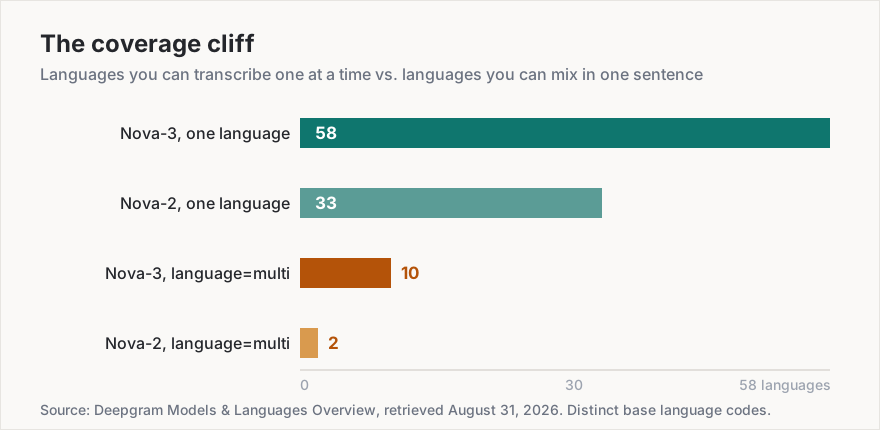
Chart: Telli.sh, from the Deepgram Models & Languages Overview, retrieved August 31, 2026. Counts are distinct base language codes, excluding regional and script variants.
Call it the coverage cliff: the drop between the language a vendor lists and the language your actual, messy, half-English meeting gets handled in. Fifty-eight languages sit on top of that cliff. Ten of them survive the fall.
For the 48 languages on the wrong side — Punjabi, Nepali, Armenian, Tamil, Bengali, Thai, Korean, Vietnamese, Malay, and the rest — the dedicated monolingual model is not merely the better choice. It is the only choice. There is no code-switching path to compare it against.
Here's the point, and it runs against the intuition that a multilingual mode is strictly more capable: for most of the world's languages, the monolingual model is the advanced option, not the fallback. A dedicated model is trained on one language's phonetics, one language's vocabulary distribution, one language's numbers and dates. The multilingual model has to hold ten of those in tension and decide, word by word, which one it is hearing. When you know the meeting is in Tamil, telling the engine so is not a limitation you are accepting — it is the highest-accuracy configuration available to you.
language=multi (code-switching) | Dedicated language model | |
|---|---|---|
| Nova-3 language coverage | 10 languages | 58 languages |
| Nova-2 language coverage | 2 languages (Spanish + English) | 33 languages |
| Handles mid-sentence switching | Yes | No — off-language speech degrades |
| Accuracy on a single known language | Lower; the model arbitrates between candidates | Higher; the model is specialised |
| Keyterm prompting | Yes on Nova-3 Multi, up to 500 tokens (~100 words), since Dec 10, 2025 | Yes |
| Recommended streaming setting | endpointing=100 per Deepgram's guide | Default endpointing |
| Available for Punjabi, Nepali, Armenian, Tamil | No | Yes |
The practical reading of that table: if your meeting genuinely mixes English and Spanish sentence by sentence, use multi and accept the accuracy trade. If your meeting is in Tamil with occasional English loanwords — which is what most "multilingual" meetings actually are — set language=ta and let the dedicated model do its job.
Who actually gets a better meeting this month
Enough architecture. Six languages changed state in August 2026, and behind each code is a population that has been transcribing meetings badly, or not at all.
| Language | Code | Speakers | What changed in August 2026 |
|---|---|---|---|
| Punjabi | pa, pa-IN | ~125 million | New on Nova-3, batch and streaming (Aug 4) |
| Nepali | ne | ~16 million | New on Nova-3, batch and streaming (Aug 4) |
| Armenian | hy | ~6.7 million | New on Nova-3, batch and streaming (Aug 7) |
| Tamil | ta | ~75 million native | Improved model, batch and streaming (Aug 7) |
| Indonesian | id | ~199 million incl. second-language | Improved batch model only (Aug 7) |
| Belarusian | be | ~7.6 million | Improved streaming model only (Aug 7) |
Speaker figures: Ethnologue counts as aggregated on Wikidata (property P1098), retrieved August 31, 2026. Rounded.
That is roughly 430 million people whose language got measurably better speech recognition in a single week, and about 148 million of them — the Punjabi, Nepali, and Armenian speakers — went from having no first-class Nova-3 option at all to having one on both batch and streaming.
Consider what that means in a room. A Chandigarh engineering team's standup, previously either conducted in a second language for the tooling's benefit or left untranscribed, now produces a real-time transcript. A Kathmandu NGO's field debrief becomes a searchable record instead of somebody's handwritten notes. An Armenian legal deposition can be transcribed live rather than sent out for manual transcription at a per-minute rate.
There is a second-order effect that matters more than the transcript itself. Once speech in a language becomes machine-readable in real time, everything downstream unlocks at once: live translation for remote participants, automatic summaries, extracted action items, search across a year of meetings. Speech recognition is the bottleneck stage. Every language that clears it inherits the entire pipeline that was built for English.
If you're on a team where someone habitually switches to English because "the tool doesn't do our language," this is the update that ends that particular compromise.
How to pick the language setting for a multilingual meeting
The engine improvements only help if you configure the session correctly, and the defaults are frequently wrong for multilingual teams. Five steps, in order:
- Establish whether the meeting has one dominant language or genuinely mixes. Occasional English loanwords in a Tamil meeting is one language. Alternating full sentences between Spanish and English is two. Only the second case needs code-switching.
- If it is one language, set that language explicitly. Use
model=nova-3with the specific code —language=pafor Punjabi,language=nefor Nepali,language=hyfor Armenian. Do not leave it on automatic detection; you know the answer, and telling the model costs nothing. - If it genuinely mixes, check the language against the list of ten. Set
language=multionly if every language in the room appears in English, Spanish, French, German, Hindi, Russian, Portuguese, Japanese, Italian, Dutch. If any does not,multiwill not help you, and the dominant-language model is your best available option. - For live sessions using
multi, setendpointing=100. Deepgram's own code-switching guide recommends 100 ms specifically for code-switching, against the higher default. Longer endpointing lets a switched-language phrase get absorbed into the wrong segment. - Verify batch and streaming separately before you promise anything. As August 7 demonstrated, an improvement to one is not an improvement to the other. Run the same 10-minute sample through both paths and compare, rather than assuming a changelog entry applies to your path.
We covered a different slice of this in June — Deepgram's mid-year update on adaptive live sessions and diarization, including the UpdateListen control that lets a running session change its language hints without reconnecting. Step 2 above and that capability compose well: set the language explicitly at the start, and adjust it mid-meeting if the room actually shifts.
The bottom line: coverage stopped being a number and became a matrix
The instinct when comparing speech engines is to look for the biggest number. OpenAI's Whisper tokenizer has declared 100 language tokens since 2022 — nearly double Nova-3's 58 — and that comparison tells you almost nothing, because Whisper has no native streaming path and a declared token is not a validated production model. Nova-3 lists fewer languages and ships them, per language, per mode, with dated evidence.
The number that describes an engine's real coverage is not a count. It is a matrix: language × mode × quality tier. Fifty-eight languages one at a time. Ten of them mixable. One language improved in batch and not in streaming, another in streaming and not in batch, in the same release, on the same day.
So the question to bring to your next vendor evaluation is not "how many languages do you support." It is: for my language, on my path, as of what date?
Where Telli.sh fits: all of the above is engine-layer detail, and we think most teams should not have to know any of it. Telli.sh sits on top of that layer and makes the choices in the numbered list above on your behalf — picking the dedicated model when the meeting has one language, keeping batch uploads and live sessions on their correct paths, and inheriting engine improvements like August's the week they ship rather than at your next migration. On top of the transcript we run live translation into 44 target languages and a 15-language interface, so the person who joins your Punjabi standup from Warsaw reads it in Polish while it happens.
Start a live translated meeting note
Sources
- Deepgram changelog, August 4, 2026 — Nova-3 Model Update — Punjabi (
pa,pa-IN) and Nepali (ne), batch and streaming both available - Deepgram changelog, August 7, 2026 — Nova-3 Adds Armenian, Plus Improved Models for Tamil, Indonesian, and Belarusian — Armenian (
hy) new; improved batch models for Tamil and Indonesian; improved streaming models for Tamil and Belarusian - Deepgram Models & Languages Overview — full Nova-3 and Nova-2 language tables and the
multilanguage list, retrieved August 31, 2026 - Deepgram Multilingual Codeswitching guide —
language=multiusage and theendpointing=100recommendation, retrieved August 31, 2026 - Deepgram Self-Hosted release 251210, December 10, 2025 — "Nova-3 now supports 31 total languages"; multilingual keyterm prompting up to 500 tokens
- Deepgram Self-Hosted release 251118, November 18, 2025 — 11 new languages, plus the 36-language detection model
- Deepgram Self-Hosted release 260129, January 29, 2026 — 12 new Nova-3 languages including Belarusian, Bengali, Bosnian, Croatian
- Deepgram Self-Hosted release 260319, March 19, 2026 — Thai and Cantonese
- Deepgram Self-Hosted release 260430, April 30, 2026 — Gujarati
- Deepgram Self-Hosted release 260812, August 12, 2026 — the self-hosted bundle of Nepali and Punjabi, eight days after the cloud entry
- OpenAI Whisper tokenizer language table — 100 declared language tokens, retrieved August 31, 2026
- Wikidata property P1098 (number of speakers) — Ethnologue-derived speaker counts for
pa,ne,hy,ta,id,be, retrieved August 31, 2026 - Our June 2026 coverage of Deepgram's live-session and diarization updates