What a delivery robot company can sell to a construction fleet
Serve Robotics launched tools for connecting robots, finding valuable field events and supplying sidewalk data. A construction customer shows which layer transfers first.
A sidewalk delivery robot pauses when a temporary ramp puts a curb outside the route it expected. A vehicle on a construction site pauses when fresh gravel changes the surface near a marked work area. The two machines have different jobs, and a safe response to one scene may be useless in the other. Their operators have a problem in common. They need to know what the machine saw, what it decided and whether this is one of the few moments worth sending back to the engineering team.
Serve Robotics, a company that operates sidewalk delivery robots, launched Physical AI Services on November 5, 2026. It describes three parts of the offering. Serve Link connects machines to off-board systems, Serve Data Curator helps teams identify useful events in fleet data, and a training-data catalog draws on Serve's sidewalk deployments. Its launch announcement names Bedrock Robotics, which develops autonomy for heavy construction equipment, as an early customer using Serve Link. That is evidence of a connection use case in construction. Whether sidewalk footage helps a construction model is a separate question that deserves its own test. Serve's launch announcement
The service offers a way to see where one fleet can borrow from another. The software that moves a record, the filters that make it findable and the record itself each have a different range of uses. Keeping those pieces separate makes the product easier to evaluate.
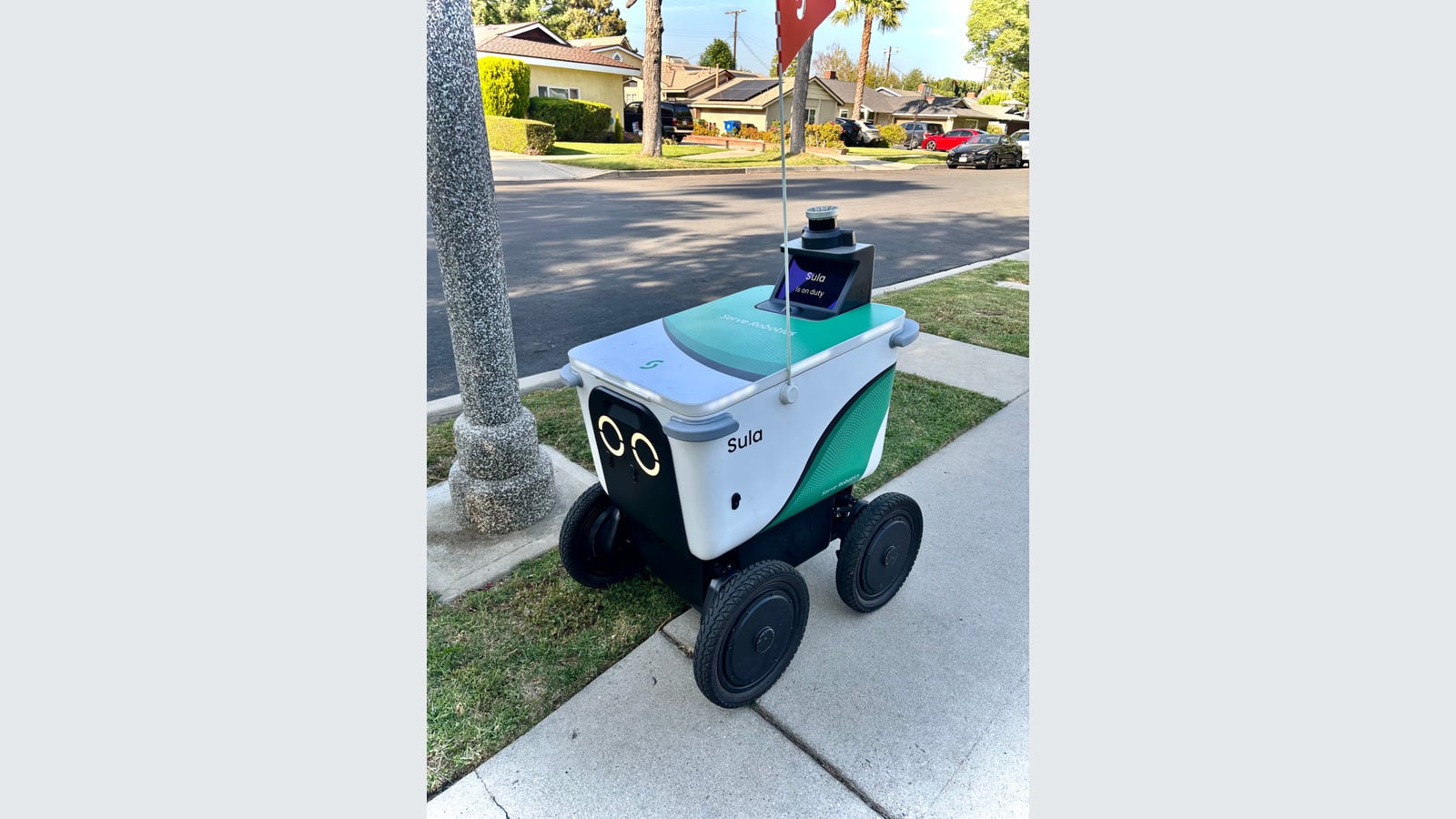
A Serve Robotics delivery robot in Los Angeles, May 2026. Photograph by The Squirrel Game, resized and fitted to a neutral canvas, CC BY 4.0. Image source · License.

The connection can transfer before the training data
Serve says Bedrock uses Serve Link to connect machines over Wi-Fi, LTE, 5G and satellite networks. Construction equipment may move between places with very different coverage during one shift. The network list tells a prospective buyer which kinds of links are part of the reported deployment. A site test still has to establish how a connection behaves at a known dead spot, what bandwidth is available when several machines upload at once, and how the application behaves during a change between networks. Serve's launch announcement
Start by separating three flows. A health check can be small and frequent. A short event clip can arrive later as long as it carries the original timestamp. A live operations feature can have a much tighter response deadline. Give each flow a priority, an expected delay and a clear failure behavior. Then test the transition between an intermittent link and a working one. A dashboard that says a machine is online provides little help if the events necessary to explain yesterday's stop never arrived.
The connection layer is also a good place to ask which decisions remain available to the machine itself. In a pilot, have the site team define how the machine should behave if the remote service drops out. Review the sequence with the responsible safety engineers and test it with a recorded replay or an isolated fixture first. A training upload can wait until the link returns. A motion constraint belongs in the appropriate safety design for the machine. Serve's commercial announcement establishes the service and a named customer, while each fleet has to establish the behavior of its own integration. Serve Physical AI Services
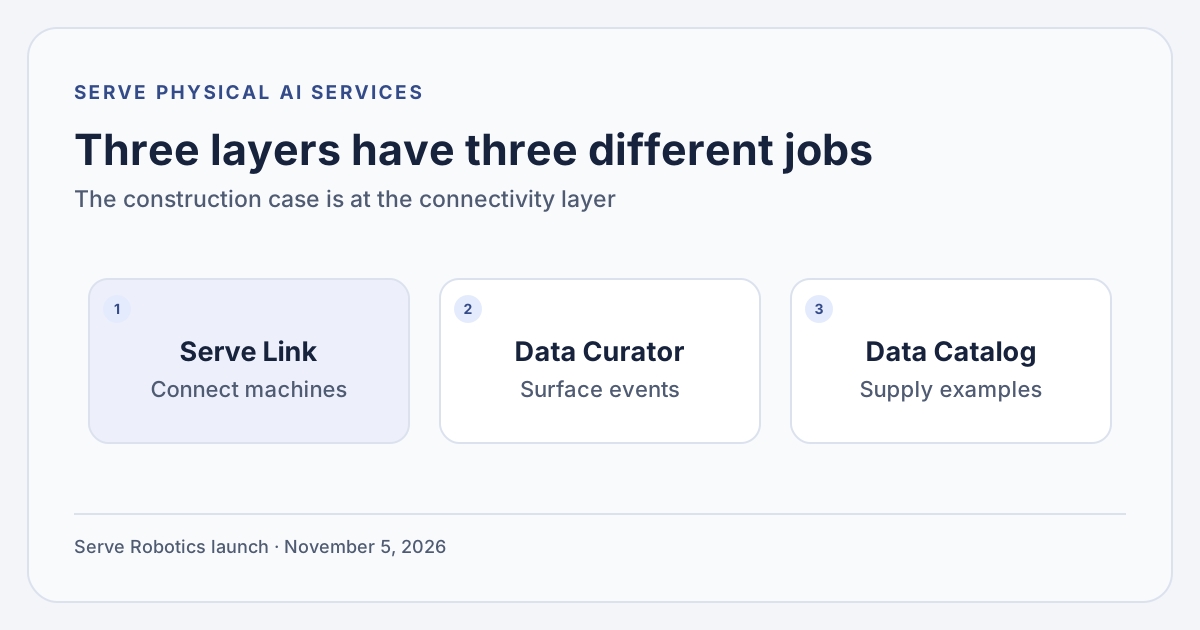
Serve groups connection, event selection and a data catalog into one offering. The named construction example is a Serve Link deployment. Original illustration by Telli.sh.
A rare event is useful when the team can find it again
Fleet data becomes expensive to review when each machine records several hours of routine work. Imagine 30 machines each collecting eight hours of footage in a day. That yields 240 camera-hours before any second camera or sensor stream is considered. A reviewer who needs to understand an unusual stop has to find the relevant seconds inside that pile. Serve describes Data Curator as a tool for surfacing useful training events from this kind of field volume. Serve's launch announcement
One reasonable first task is to find unexpected stops near a particular surface transition. An operator could use an event flag or a simple signal such as speed dropping to zero, then pair the marker with a short clip and the machine state before and after it. These are illustrative selection rules, independent of which filters a specific product implements. Keep enough context to distinguish a scheduled stop from a loss of traction, an obstruction or a protective pause.
A second task is to look for similar events that led to different decisions. An uneven surface could trigger a pause at one site and be traversed at another because the loads or boundaries differ. A reviewer will need more than two similar pictures. Keep the vehicle type, site conditions, policy version and any operator intervention with the event. That record helps someone determine whether to change a filter, add a training example or investigate a sensor problem.
A third task is to keep known easy examples for comparison. A queue made entirely of unusual stops is good for investigating failures. It can mislead a team that is trying to estimate how often those failures happen. Record how examples entered the queue, and keep a separately sampled reference set for tracking rates. If a candidate model improves on the curated queue and starts interrupting ordinary work, the reference set helps reveal the trade.
There is a practical test for a curation system. Give two reviewers the same definition of a relevant event and have them independently mark a small, representative replay set. Compare the selection tool's results with that reference. Count how many relevant events it finds, how many irrelevant events it asks a reviewer to open, and how often the evidence is too incomplete to classify. A tool can lower the time required to get a useful example even before an engineering team uses a single clip for training.
Sidewalk data has value when its limits are visible
The third product is a catalog drawn from Serve's sidewalk operations. The launch announcement specifically describes real-world terrain and infrastructure data. A buyer working on another sidewalk robot may care about variations in curb geometry or temporary barriers. A buyer working on construction equipment has different sensors, camera heights, speeds and operating constraints. A paved sidewalk can give a perception team examples of objects and lighting. It can tell them little about how a heavy vehicle handles a loose surface under load. Serve's launch announcement
Ask what a sample actually contains. A collection useful for one model may offer camera images with timestamps. Another project may need calibrated intrinsics, synchronized motion records or an indication of how labels were checked. These are questions for the buyer's trial. The launch establishes the origin and broad subject of the catalog, leaving each buyer to inspect a sample for the fields its task requires.
| What transfers | Example question | What a pilot should establish |
|---|---|---|
| Connectivity | Do event records make it off a machine during an ordinary shift? | Record completion, delay, recovery and duplicates across link changes |
| Curation workflow | Can reviewers find unusual stops with less footage to inspect? | Relevant events found, missed events and reviewer time |
| Data catalog | Does externally sourced terrain data improve a named perception task? | Performance on a held-out set from the buyer's real operating environment |
The field data also has an ownership boundary. Sidewalk footage or job-site footage can include faces, signs, license plates or details of facilities. A buyer needs to review the actual permitted uses, geographic terms, retention rules and deletion process for the product it buys. Data acquired to debug one system may be licensed differently from data acquired for model training. Keeping a record of the specific source, collection conditions and contractual rights makes a later deletion request or data quality issue much easier to handle.
Compare the same incident before connecting a whole fleet
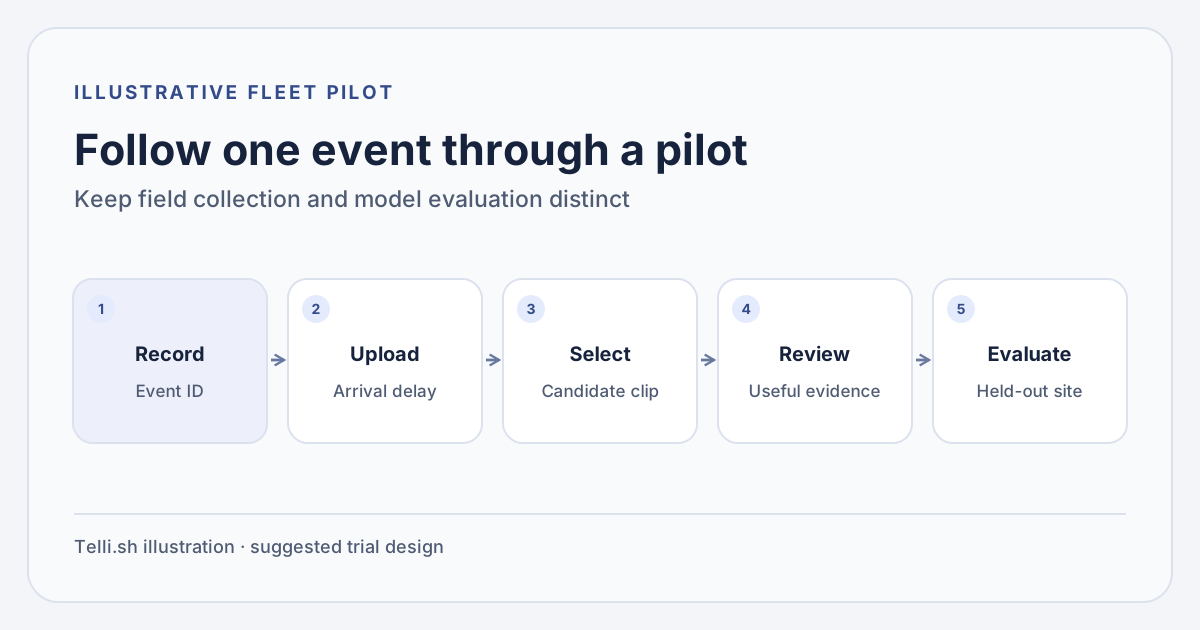
A pilot can measure retrieval, review and model evaluation separately on the same class of incident. Original illustration by Telli.sh.
- Name the decision the pilot should improve. Choose one vehicle type, one site and one event class. A review team might want a reliable record when a machine pauses near a surface transition. Define which evidence makes the record usable.
- Establish the baseline with known recordings. Record the number of usable events, the amount of footage reviewed and the time it takes to find each one. Separate an unavailable recording from a recording an operator could have found.
- Exercise the connection with a bounded replay. Use a test device or an isolated environment for connectivity checks. Record completion and delay under ordinary and interrupted links. Check repeated uploads and whether event identity and timestamps stay stable.
- Compare a curated queue with the reference sample. Give reviewers the same rules and note what each queue misses. Track time per useful event and whether a reviewer can trace it back to the relevant machine and software version.
- Treat model evaluation as a separate step. If external training data seems relevant, compare matched training runs with and without it. Evaluate against held-out scenarios from the buyer's intended operating environment. Keep the thresholds for regression fixed before seeing the result.
Consider the economics of the pilot as well as its accuracy. Keeping more footage creates network, storage and review costs, even when the machine sends data successfully. Compare those costs with the value of collecting the example. For one fleet, sending a short event record first and fetching the full clip on demand may make sense. For another, the unavailable footage will cost more than saving it. That decision depends on upload delay, contract terms and how often operators actually use longer clips.
A fleet rollout has an operational owner. Decide who handles a missing record, how the engineering team sees a persistent link problem, and what information support can retrieve without exposing more site data than necessary. Give the owner a replayable example with a known answer. If the new system changes, that example makes the next review far less dependent on whoever remembers the original pilot.
The same replay is useful when a fleet switches contractors, adds a camera or changes the retention period. Keep the test's expected event ID and the fields the operator needs to explain it. Compare them after the change, and record which parts of the process required vendor access. A team evaluating a service may discover that moving a clip between systems is easy while moving its labels and review history takes extra work. Ask for a sample export early enough to check whether those records can travel together. The answer will matter when a new tool needs to read a previous incident or when the business changes its storage policy.
Make the sample export something a second team can actually open. Have the fleet operator pick one event that includes a human correction, and have a separate engineer reconstruct it from the export alone. That engineer should be able to tell when the source was captured, when it arrived, which clock and units each stream uses, and whether the label describes the raw event or a later interpretation. If the export includes a link instead of a copy of a clip, check whether it still resolves when access changes. Add a missing-camera example as well. A schema that can mark a known gap lets a later replay stop visibly instead of treating absent evidence as a quiet run. This handoff also shows which operator notes belong with the replay and which must be restricted to a smaller audience.
The service proves itself in the events a team can explain
Serve's launch shows a practical way for a robot operator to sell some of the infrastructure it built for itself. A named construction customer provides a concrete example at the connectivity layer. The case for curation and training data needs additional evidence, and a small incident review can collect it. Look for the same event arriving with enough context to explain what happened, appearing in the right queue, and helping the people responsible decide what the fleet should do next.
Sources
- Serve Robotics Physical AI Services launch and Bedrock example, November 5, 2026
- Serve Robotics Physical AI Services product page
- Los Angeles sidewalk delivery robot photograph by The Squirrel Game
For a searchable record of the conversations and decisions behind your work, Create a Telli.sh account.