Sema4.ai 3.0: stop asking an agent to reinvent the same calculation
Sema4.ai 3.0 turns approved queries and business logic into shared team assets. Here is where reuse helps, what the token claims mean, and how to start safely.
An invoice arrives on Monday. Another arrives on Tuesday. Should an AI agent invent a new way to calculate the same tax difference every morning?
Sema4.ai's October 29, 2026 release makes a persuasive case for keeping the answer once a team has approved it. The enterprise agent company's 3.0 platform brings shared work and reusable execution units into the same operating environment. Its most interesting promise is less glamorous than a more eloquent chatbot: repeated business work should become easier to inspect and cheaper to run. Sema4.ai announcement
For finance, procurement, and operations teams, that changes the buying question. You need to know which parts of a process deserve model judgment, which should execute established logic, and who maintains the boundary. This article explains that division, puts the reported savings in context, and offers a practical pilot built around exceptions rather than an unattended leap into production.
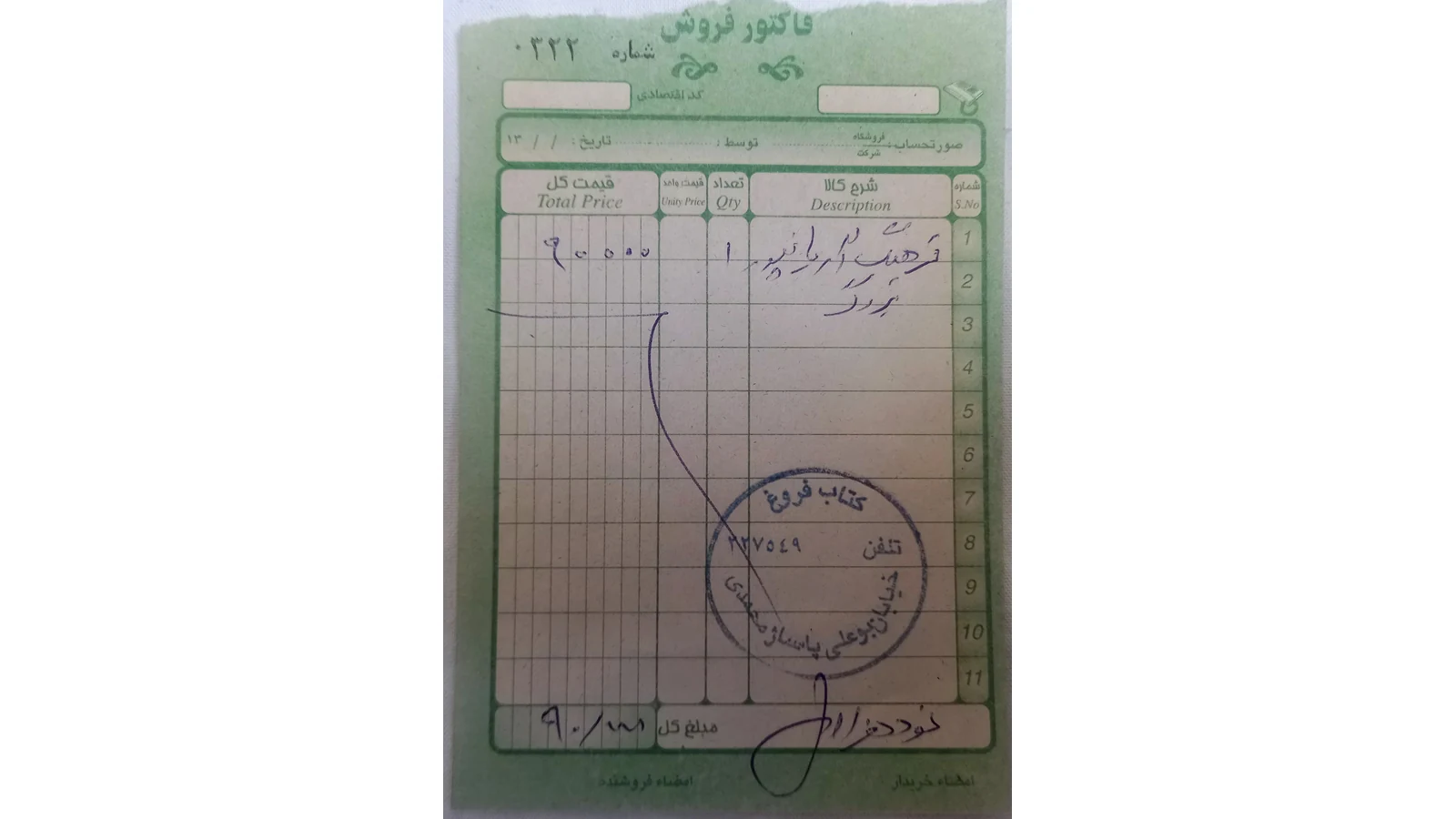 An invoice photographed in 2024, illustrating the document inputs that reconciliation work must verify. It is not a Sema4.ai screen or a customer result. Photo: Shams948, CC0; resized with margins. Image source · License and image notes. Official product reference.

The useful asset is the approved method
A good prompt can help one person answer a question. A shared business process needs an answer to a different question: what happens when another person asks tomorrow, using a slightly different description and a newly updated dataset? If every run rebuilds the query and calculation, the team has to keep reviewing the method as well as the result. That is an expensive place to put expert attention.
Sema4.ai distinguishes approved retrieval patterns, called Verified Queries, from approved calculations and transformations, called Verified Logic. Its October 29 feature explanation describes these as reviewed and versioned artifacts, connected to the work that uses them. The platform also offers structured DataFrames for processing datasets without putting every row into the model's context. Sema4.ai 3.0 feature explanation
Here's the point: the reusable asset is the method, with its assumptions attached. A model can interpret an ambiguous supplier email, but the organization's approved rounding convention should not depend on how that email was phrased. A human can investigate a disputed charge while the same established comparison runs across the ordinary entries. That division puts judgment where uncertainty actually lives.
Think of it as a recipe card for an operational decision. The card is valuable because a team can inspect the ingredients and revise the instructions; merely printing the same meal description again would not create that reliability. A version number matters only when someone knows why the recipe changed and which work used the earlier version.
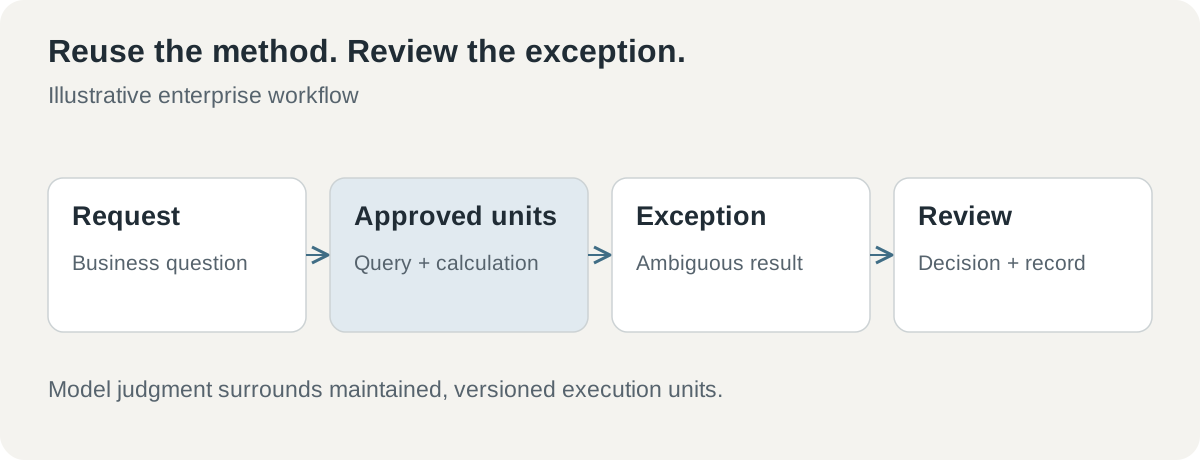 An illustrative division of responsibility: established retrieval and calculations execute as reviewed units, while ambiguous exceptions receive judgment and review.
The 80% claim belongs to one kind of work
Sema4.ai reports 80% fewer LLM tokens and 4× faster execution for Verified Queries, compared with regenerating queries through free-form AI. It separately reports 50% fewer tokens and 30% faster execution for Verified Logic, compared with generating code for repeat work. Those are the company's October 29 measurements for specific execution patterns. They are useful indicators of where reuse can help, rather than a forecast of an organization's complete technology bill. Sema4.ai release announcement
Consider an illustrative workload in which repeated query generation consumes 40% of model tokens. Reducing that component by 80%, while everything else stays equal, reduces total token consumption by 32%: 0.40 multiplied by 0.80. If repeated query generation accounts for only 10%, the same component improvement produces an 8% reduction overall. Neither example includes platform fees, maintenance, human review, or data access costs.
The timing claim needs the same discipline. If a five-minute process spends one minute generating a query, making that minute four times faster brings the process to four minutes and fifteen seconds, assuming the other stages do not change. That is a useful improvement, but it is not a fourfold acceleration of the entire workflow. Teams should time the complete journey from request to accepted result.
Token savings also have an operational meaning beyond price. Fewer regenerated methods can mean fewer opportunities for a subtly different join, filter, or rounding decision. Yet approved code can be consistently wrong if its assumptions become stale. Reuse concentrates both value and responsibility in the shared artifact.
An invoice pilot should make the exceptions visible
Imagine a distributor comparing supplier invoices with purchase orders and received quantities. This is an illustrative use case, not a claim about a newly measured deployment. A sensible pilot would retrieve approved records, apply the agreed quantity and price checks, and show a reviewer the remaining differences. The success criterion is a trustworthy exception queue, rather than the most impressive conversational answer.
The approved query should have an explicit business meaning. Does “open purchase order” exclude partially received items? Are returns included in received quantity? Does the invoice date or delivery date determine the relevant exchange rate? These questions belong in the maintained process because two syntactically correct queries can answer different accounting questions.
The logic should also declare the unit it is comparing. A box of twelve items and twelve individual items cannot be matched safely by comparing a raw quantity field. A tolerance of one currency unit means something different before and after tax. A reviewer needs enough source detail to understand why an entry was accepted or escalated.
For a starting evaluation, choose a small historical batch containing routine matches, partial deliveries, duplicate invoice references, and a disputed exception. Ask the subject expert to label the expected disposition before reviewing the agent's output. That creates a concrete benchmark for the team's own process. Measure missed exceptions as carefully as unnecessary escalations; a short queue is not automatically a good queue.
Procurement and logistics reveal different maintenance problems
A second illustrative use is procurement comparison. A team could reuse an approved supplier-data query and a standard total-cost calculation while asking an agent to explain differences in delivery commitments. The calculation might be stable, while interpreting whether a proposed substitution meets a buyer's needs requires judgment. The final recommendation should preserve that separation so a buyer can inspect both the numbers and the interpretation.
Here the maintenance risk is a policy change. A preferred-supplier list, payment term, or shipping assumption can change without the underlying database schema changing. An artifact can continue to run perfectly while applying last quarter's rule. Assigning an owner and an expiry review is as important as verifying the first output.
A third illustrative use is logistics exception triage. An established query can gather shipment status, a repeatable check can identify a missed milestone, and a model can turn the exception into an understandable handoff. The useful output is a case with supporting events, a responsible team, and a proposed next action. An autonomous message that promises a new delivery date would require a separate decision about authority.
These examples share a pattern but should not share every rule. A finance tolerance, a procurement preference, and a logistics escalation have different owners and consequences. Good reuse is selective. A common workspace should make those distinctions easier to find, rather than flattening all operational knowledge into one giant instruction document.
Compare the ownership model, not just the chat window
Sema4.ai's release positions shared agents, skills, files, business context, and memories as team assets. Its announcement also describes interoperability with Claude Cowork and Microsoft Copilot, plus an Agent Inbox for Microsoft 365, Google Workspace, and webhooks. The practical question is how a team keeps a single approved process as requests arrive through different surfaces. Sema4.ai announcement, October 29, 2026
The following comparison is a choice of operating approach, rather than a feature benchmark of competing products. Microsoft Copilot and Claude Cowork can be the familiar entry points named in the release; the evaluation still needs to identify where the operational assets live. A SQL script can already make a calculation repeatable, but connecting that script to interpretation, exceptions, and review remains someone's work.
| Approach | Good starting question | Responsibility that remains |
|---|---|---|
| An individual assistant in Microsoft Copilot or Claude Cowork | Can a person complete this request more easily? | Decide which results and methods become shared assets |
| A maintained SQL/Python workflow | Can a specified calculation run consistently? | Maintain inputs, business meaning, and exception handling |
| A Sema4.ai team workflow | Can shared agents reuse reviewed business methods? | Own artifacts, permissions, updates, and acceptance criteria |
This avoids a misleading contest between conversation and code. Many teams need both. The valuable comparison is how much duplicated work a proposed system removes and how clearly it exposes the work that still needs an owner.
Begin with one process and an explicit review boundary
The official release offers a demo route; feature activation and commercial terms need to be established for the organization's environment. Do not build a rollout plan around an assumption that every 3.0 feature appears in every tier at the same moment. A focused demo request is more useful than a broad request to “automate finance.” Sema4.ai release and demo route
- Choose a bounded outcome. Pick one repeated task, such as identifying invoice discrepancies in a historical batch. Write the accepted output and the decisions that remain with a person.
- Name the data owner. Identify the approved systems, permitted fields, refresh expectations, and meanings of business terms. Use the minimum access needed for the pilot.
- Prepare a comparison set. Include ordinary cases and deliberately awkward examples. Record expected results before tuning the workflow.
- Review the reusable units. Ask a domain owner to approve query meaning, calculation assumptions, and transformations. Record version, owner, and review date together.
- Run with review before consequential actions. Compare results with the labeled batch, inspect exceptions, and measure end-to-end time and complete operating cost.
- Test a change. Alter a policy assumption or input schema in a controlled copy. Verify that the team can identify affected assets and explain which version produced an earlier result.
That last step is especially revealing. An implementation that works once may still be hard to operate. Asking how a change propagates exposes the quality of ownership, documentation, and rollback much earlier than an enthusiastic demo does.
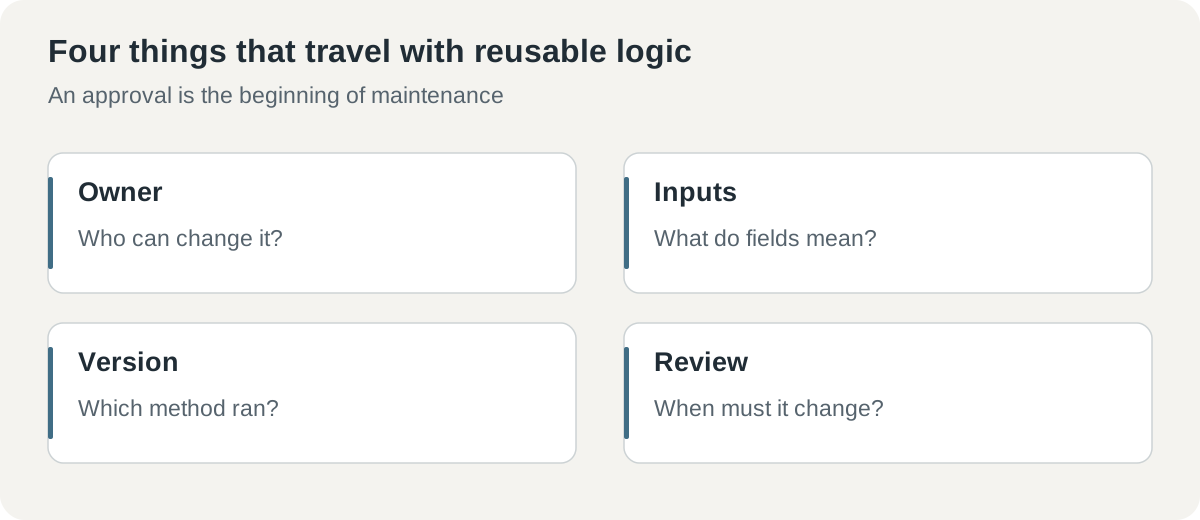 Reuse becomes a team asset when its owner, input meaning, version, and review boundary travel with it.
An audit trail needs a question it can answer
Sema4.ai describes enhanced audit records connecting work activity, documents, data, logic, and actions, with change investigation across the agent lifecycle. The company frames this as support for control reviews, including SOX-related review needs. A logging capability is not a blanket certification that a particular accounting workflow satisfies its obligations. Sema4.ai 3.0 feature explanation, October 29, 2026
A useful evaluation question is precise: can a reviewer reconstruct why invoice 1042 was escalated using the data and logic that were available at the time? The answer should survive a later correction to the supplier record. An attractive current-state dashboard is insufficient if it quietly substitutes today's source values for yesterday's decision context.
Access deserves equal attention. A shared skill may be broadly useful while the underlying documents remain restricted. Ask what happens when the person requesting an analysis can see the summary but is not allowed to view a sensitive source field. Permission inheritance, logging access, and retention policies need to agree with the team's actual responsibilities.
The most convincing future progress would be boring in the best way: a business owner updates an approved rule, affected work is identifiable, exceptions remain visible, and reviewers can explain the change. That is a more durable measure of maturity than how often an assistant says it is confident.
Reuse turns an answer into an obligation
Our take: Sema4.ai 3.0 matters because it treats a successful method as something a team can maintain. The immediate attraction is fewer repeated model calls. The larger opportunity is a working agreement about what should stay deterministic, what needs judgment, and who is responsible when either changes.
Before choosing a platform, ask a concrete question: if the person who wrote the original prompt leaves next month, can the team still understand, update, and defend the process? A good automation investment makes that answer easier.
Sources
- Sema4.ai 3.0 release announcement, October 29, 2026.
- Sema4.ai 3.0 feature explanation, checked November 2, 2026. Efficiency figures are vendor comparisons for the stated workloads; scenarios and arithmetic above are illustrative.
Keep the method beside the evidence
Telli.sh is one option for retaining authorized source material, review notes, and the reasoning behind a technical decision. Create a note workspace.