Your AI knows the policy. Does it know who may approve the order?
Sakana Aquarium connects organizational data, rules and agent workflows. Why the next enterprise AI question is how a decision reaches an authorized action, not just a convincing answer.
An employee asks whether the team can buy a replacement laptop. An AI assistant finds a purchasing policy and gives a sensible answer. The actual decision still depends on the budget, the supplier, the employee's department and the person allowed to approve that particular order.
On October 23, 2026, Sakana AI announced Sakana Aquarium, a platform for building, running and governing agents around an organization's data and rules. The Japanese AI company describes an ontology that connects the meaning and relationships of information, a managed agent runtime and governance over access, approvals and execution records. Official announcement.
The useful question is what happens between an answer and an authorized action. Aquarium's proposal is to give that gap a shared structure, so each new agent does not need to rediscover what the company means by a customer, a purchase or an approval.
 Sakana AI's earlier TinySwallow browser chat interface, shown as background on its model-to-product work. This is not Aquarium. Image: Sakana AI, Apache License 2.0. Resized without cropping.

The same word can mean different things in different systems
Most organizations already have the information an agent needs somewhere. A spreadsheet lists budgets, a document explains procurement rules and an application records the status of an order. The difficult part is knowing which pieces refer to the same thing and which one is authoritative at the moment of a decision.
For example, “approved” could mean a manager agreed by email, a purchase request passed a finance check or a supplier has accepted an order. Those states are related, but they are not interchangeable. An agent that treats them as synonyms can produce an answer that sounds right while taking the wrong next step.
An ontology is a structured account of such meanings and relationships. In Aquarium's description, it connects organizational knowledge, rules and data so an agent can use them in context. The product page also explains that connections and synchronization are designed for the target data sources. Platform explanation.
Our interpretation is that the hard work has moved into a more visible place. Someone must still decide what a state means, which source owns it and when it changes. Making those decisions explicit can be valuable because another workflow can reuse them instead of encoding a slightly different definition in another prompt.
This is less like handing a chatbot a larger filing cabinet and more like agreeing on a shared map. The map does not replace the territory. It makes it easier to recognize which record, rule and owner a question refers to.
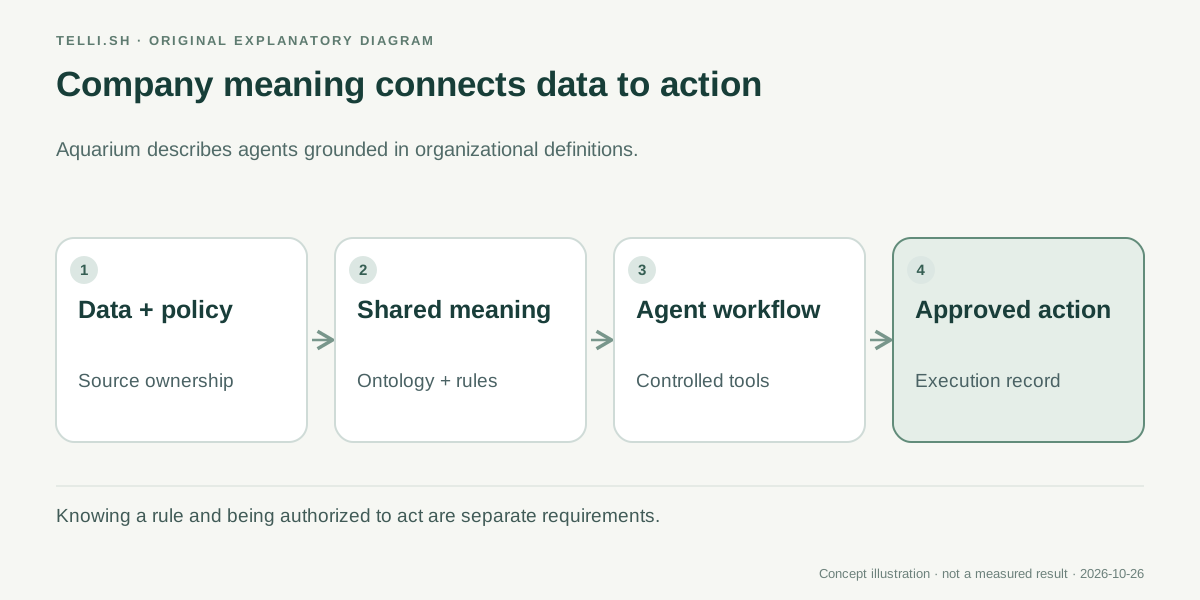 Original explanation of the product's stated direction: shared definitions connect information to a governed workflow.
A purchasing request reveals why retrieval alone is not enough
Consider an illustrative request for a replacement laptop. A useful workflow would identify the employee, the applicable budget, the approved supplier and the current purchase state. It would then determine the required approval path rather than treating a general policy paragraph as permission to buy.
If the budget record has changed since the request began, the workflow needs a policy for using the new value. If a manager is absent, it needs to know whether another person may approve the request. If the supplier quote expires, an earlier approval may no longer cover the current order.
These are not primarily language-generation problems. They concern ownership, time and authority. A model can help interpret a request, but the application must connect that interpretation to the right records and permitted operations.
Aquarium's announcement describes access control, approval before execution and records connecting the grounds for a judgment to its result. It also describes reusable data and ontology definitions across agents. Those are useful product commitments to evaluate in a pilot, not a reason to assume every organization's purchasing process is already covered. Governance and managed agents.
A small initial project should make one such decision path understandable from end to end. That is more revealing than connecting every document in the company and asking a broad question. The target is a specific task whose inputs, owner and result can be inspected.
A customer exception needs the rule and the reason
A second scenario is handling an exception for a business customer. Suppose a contract has a standard renewal date, but a salesperson has promised a different arrangement. An agent that reads only the latest email may miss the contract; one that reads only the contract may miss an authorized exception.
A useful system should distinguish a proposal from an approved change. It should also make the supporting information accessible to the person who must decide. The goal is not simply to select the newest text, but to connect the relevant records with their status and authority.
This is where a common definition can be reused. If one workflow understands a customer's contract state and another understands billing, they should not invent different meanings for the same renewal. A shared foundation can reduce inconsistencies when the organization adds more agents.
The benefit is conditional on the quality of that foundation. A wrong relationship can be reused just as efficiently as a correct one. Teams should therefore review the definition and its update path, not merely the answer an agent produces in a demonstration.
For readers considering a similar platform, the most useful question is specific: which decision would improve if the relevant meaning, status and authority were connected? If no one can name that decision, the project may be collecting information without a clear operational purpose.
A reusable workflow still needs an owner when the world changes
Aquarium's product page describes workflows expressed in YAML, including information reference, AI judgment, function execution and human approval. It also explains that connected information updates can be reflected in the ontology. Workflow and synchronization.
That is a useful direction because a process can be reviewed as a sequence of decisions and actions. A person can ask where an approval belongs, which function performs the operation and what happens when information is missing. The workflow should not be understood only by the model that generated it.
However, an update reaching a system is not the same as an organization agreeing on what that update means. A new policy may apply only to requests made after a certain date. A changed customer record may need review before it affects a sensitive action. The surrounding business rules determine the answer.
Ownership should therefore be explicit at two levels. Someone maintains the data connection and detects failures. Someone else, or the same person in a smaller team, owns the business definition and decides when the rule changes. Without those responsibilities, synchronization can make a stale assumption spread faster.
| Question | What needs a shared definition | What a pilot should show |
|---|---|---|
| Who is the request about? | Identity and record relationships | The correct records are connected without confusing similar names |
| Which rule applies? | Policy scope, state and effective time | A changed or exceptional case follows the intended policy |
| Who may act? | Access and approval authority | The proposed operation reaches an appropriate reviewer |
| What actually happened? | Result and evidence | The outcome can be traced back to the decision and its inputs |
These are evaluation questions rather than a claim about a specific customer deployment. Their purpose is to connect the platform's concepts with a task a business can recognize.
Begin with one operation whose mistakes are understandable
The official Aquarium site currently offers an introduction and a consultation route. It does not establish a public self-service price or a universal activation date for every customer. That makes it more useful to frame an initial discussion around a concrete operation than around a promise to switch the entire company to agents. Introduction and contact.
A practical preparation sequence would look like this:
- Choose one recurring operation, such as checking a purchase request before it reaches an approver.
- Identify the original records, the system that owns each value and the person who owns each business rule.
- Write down the states that matter, including missing information, exceptions and a request that must stop.
- Define the actions an agent may prepare, the actions it may execute and the approvals required between them.
- Evaluate ordinary and difficult examples with the people who handle the work today.
- Inspect the execution record and the update path before expanding to another operation.
This approach makes the pilot easier to judge. The team can compare the completeness of the assembled information, the correctness of the proposed route and the burden on the reviewer. It can also notice when the system confidently advances a request that should have waited.
The first useful result may be better preparation rather than automatic execution. Bringing the relevant information together and identifying the right reviewer can remove a real bottleneck. It also creates a clearer foundation for deciding whether more autonomy is appropriate later.
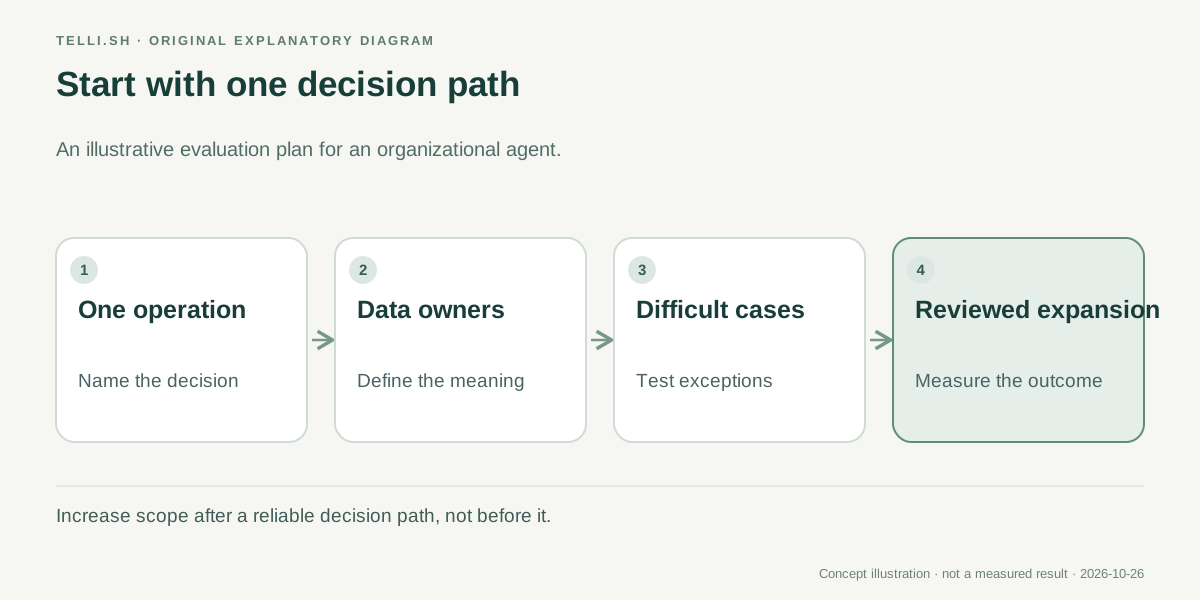 A proposed evaluation sequence. Expanding the number of agents should follow a working decision path, rather than substitute for one.
Sakana's enterprise experience explains the direction, not the outcome
Sakana AI's announcement connects Aquarium with the company's work implementing AI in areas that require accuracy and accountability, including financial services. It describes repeated effort spent connecting data and organizing terminology and judgment criteria. Aquarium is presented as a common foundation for work that would otherwise be rebuilt for each project. Product background.
That background is useful because it explains the problem the team chose to productize. It should not be confused with a published measure of Aquarium's results. A previous collaboration involving Sakana AI is not automatically an Aquarium customer case, and a successful narrow deployment is not evidence that every operation will transfer easily.
The next evidence to look for is operational. Which task was selected? What information did the system need? How much work remained with a person, and how were wrong or incomplete cases handled? Those details would make a case study more useful than a general claim that agents improved productivity.
The product's future direction includes incorporating operational corrections and judgments into continuing updates, as well as assistance with building agents. That raises an important design question: how will proposed improvements be distinguished from approved changes to the company's rules? The answer will matter as much as the ability to generate a workflow quickly.
For a business adopting agents, the strongest sign of maturity may be the ability to change a rule safely and explain the effect. A foundation that can only be understood on the day of its demonstration will become difficult to maintain as policies, people and systems change.
A useful enterprise agent needs to know what its answer authorizes
Aquarium is worth watching because it treats organizational meaning and control as part of the agent platform. That is a more demanding goal than finding a plausible paragraph, but it is closer to the work a company actually needs done.
The question for a pilot is not whether the agent sounds familiar with the policy. It is whether the right information reaches the right decision, the right person authorizes the next step and the organization can explain what happened afterward.
Sources
- Sakana AI: Aquarium announcement, October 23, 2026.
- Sakana Aquarium platform overview, checked October 26, 2026.
Preserve the material behind a decision
Telli.sh is one option for keeping authorized source material alongside the notes you have reviewed. Create a note workspace.