Rime Prism puts a checkpoint between an AI's answer and its voice
Rime's new enterprise speech model listens to audio while exposing words before they are spoken. What that changes for tools, policies, and customer calls.
A customer asks to move a reservation. The AI sounds calm, recognizes the request, and says the new time is confirmed. Then the booking tool returns an error. A natural voice has just made the wrong promise exceptionally convincing.
That gap between a plausible answer and an authorized answer is the problem Rime is targeting with Prism. Announced on October 28, 2026, the enterprise speech-to-speech model reasons over audio and exposes text before producing the corresponding speech. Applications can inspect that text before the caller hears it. Rime's launch announcement explains the design.
The interesting question is how that checkpoint changes a real call. This guide follows three illustrative workflows, compares the architecture with familiar voice pipelines, and explains what to establish before connecting Prism to customer data or business actions.
 A Plantronics headset in 2013; illustrative voice-workflow equipment, not Rime hardware or a Prism demo. Image: Petey21, CC0; resized with margins. Image source · License and image notes. Official product reference.

A voice can understand a caller before the application approves its answer
Rime develops speech technology for voice applications. Prism extends that work into a conversation model whose input retains the caller's audio, while its output includes inspectable words. That distinction matters because the sound of a request can contain useful context: a hesitation, an interruption, or a frustrated repetition.
A transcript gives an application something straightforward to store and inspect. It also reduces a conversation to words. An audio-aware model can work with more of the original signal, but businesses still need a way to check its commitments. Prism's text output is intended to provide that application boundary without requiring the model to reason only from a transcript.
Think of the checkpoint as a departure gate. Preparing an answer does not grant permission to release it. Your application decides whether the words match the current account state, required disclosure, and outcome of an authorized tool call.
The distinction also clarifies ownership. The model proposes language; the application owns policy and access to systems. A rule such as “do not disclose account details until verification succeeds” belongs to the application even if the model has also been instructed to follow it.
On November 2, 2026, Rime's product page describes cloud, VPC, and on-premises deployment options and says Prism documentation is forthcoming. These are enterprise deployment choices. They are not an announcement of downloadable public weights or an installation that runs on any personal computer.
The checkpoint changes where a voice system can intervene
There are several ways to assemble a voice agent. A traditional cascade transcribes speech, sends text to a language model, and turns the answer into synthesized speech. A direct speech system can operate on audio more continuously. Prism's stated design combines audio reasoning with text that remains available before speech.
The following comparison describes architectural tradeoffs, rather than a ranking of every implementation. Actual systems vary in their streaming, interruption handling, tool access, and observability.
| Design | What the application can inspect | Integration question |
|---|---|---|
| Transcript-based cascade | Transcript and generated response text | Which audio cues disappear before reasoning? |
| Audio-first system without a usable output checkpoint | Audio and whatever events its interface exposes | Can the application intervene before a commitment is heard? |
| Prism's documented approach | Audio-driven response with text before speech | How does your policy check approve, rewrite, or stop output? |
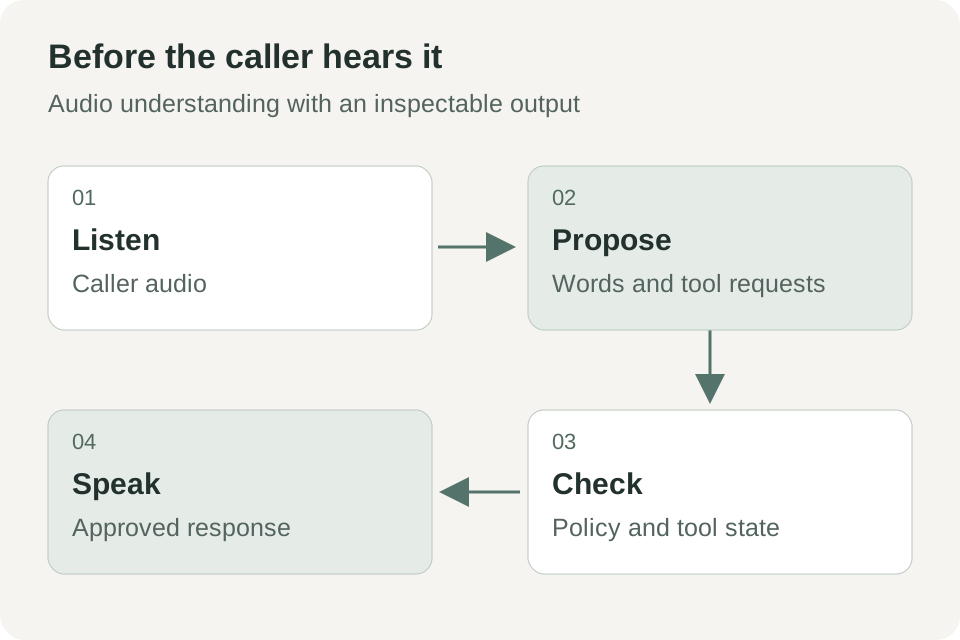 Original explanatory diagram based on Rime's October 28 announcement. Application checks and business systems are shown conceptually; this is not an official integration specification.
Here is the practical point: exposing words makes intervention possible, but the intervention still needs an owner. A policy service must decide what counts as a prohibited promise. A tool layer must enforce account permissions. A conversation controller must know whether an interruption makes a pending response obsolete.
Those responsibilities are related, but they are different. Filtering a sentence cannot reverse a booking already made by an overpowered tool. Limiting a booking tool does not ensure that the model explains its failure accurately. A useful integration checks actions and speech at the points where each becomes consequential.
Reservation changes show why tool completion must precede confirmation
Consider an illustrative hotel reservation call. A guest wants to move a booking from Friday to Saturday. The agent needs to identify the reservation, establish the caller's authority, check availability, explain any price difference, and obtain the required acceptance before making the change.
The dangerous moment is the confirmation. “Your reservation has been moved” describes a completed operation. That sentence should depend on the booking system's successful response, including the date and reservation identifier, rather than on the model's expectation that the operation will work.
A checkpoint can compare proposed wording with structured state. If the state is still pending, the application can require language that describes a pending request. If the tool reports no availability, the response can offer alternatives. If the call drops halfway through the transaction, the same structured state should tell the next handler what actually happened.
Rime's October 28 announcement describes parallel tool calls and continued listening while Prism speaks. Those capabilities make sequencing particularly important. Parallel work can reduce idle time, but dependent actions still need a defined order. Checking availability can happen early; confirming an accepted change must wait for the relevant result. Source: Rime.
For a first pilot, choose a low-impact version of this workflow. Let the agent retrieve available times and prepare a proposed change for a person to approve. That establishes whether audio handling, tool data, and outgoing words stay aligned before the system receives broader write access.
Required disclosures work only when they survive the conversation
A second illustrative use case is an account-service call with a required disclosure. The application may need to explain a fee, notify the caller about a recording policy, or present a limitation before an action. Putting a sentence in a prompt is an incomplete operational plan.
Ask what should happen if the caller interrupts halfway through. Did the person hear the necessary information? Should the agent repeat the full disclosure, resume from a specific point, or offer a different channel? The answer depends on the organization's actual requirements and should be represented in the workflow.
Text inspection helps verify that the intended words are present. The system also needs a reliable record of delivery state. “The disclosure was generated” and “the disclosure was played” are different events; a transcript alone can blur them. A useful call record connects proposed text, approved text, and the audio playback events that the application can observe.
This is where a voice product evaluation becomes a workflow evaluation. Try a scripted interruption immediately before a critical phrase. Try a correction of the account number while a lookup is running. Try a request to skip verification. The desired outcome is defined behavior in each case, not merely a pleasant voice during an uninterrupted demonstration.
Rime's product page, checked November 2, places policies and required disclosures between generated text and speech. The organization deploying the model still has to define those policies and establish whether its complete call flow meets its obligations. Source: Prism product page.
An upset caller needs an appropriate next action as well as an appropriate tone
A third scenario is a delivery complaint. A caller repeats that a package has not arrived and becomes increasingly frustrated. An audio-aware model may have a richer signal for how to respond than a transcript-only stage, but empathy should lead toward a concrete service outcome.
The useful workflow distinguishes acknowledgement from resolution. The agent can acknowledge the inconvenience immediately, retrieve the shipment status, and explain which remedy is actually available. It should avoid inventing a refund, delivery window, or supervisor escalation that the service cannot provide.
An output check can test proposed commitments against the retrieved record. A separate escalation rule can hand the conversation to a person after repeated lookup failure, a disputed charge, or a request outside the agent's authority. Tone can influence the style of a response; it should not silently grant more operational permissions.
For this pilot, include ambiguous language and background noise in your evaluation set. Also include callers who sound calm while reporting an urgent issue. Emotional cues are useful context, not a substitute for the substance of the request. A system that handles irritation well can still misunderstand what needs to be fixed.
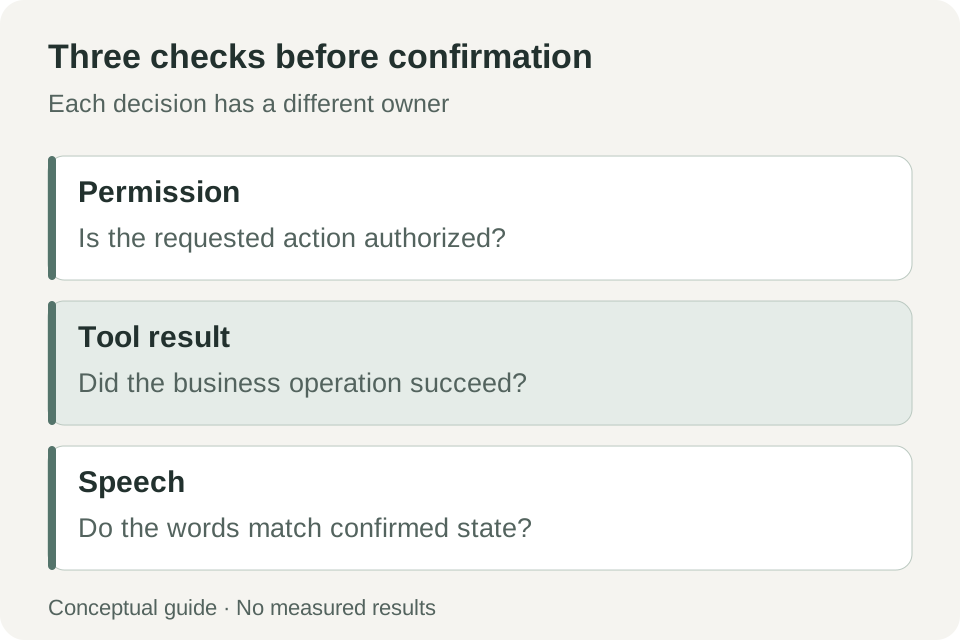 Original integration checklist: authorization, confirmed tool state, and permitted wording are separate decisions. It illustrates deployment reasoning rather than measured Prism performance.
Start with one bounded call, then widen the scope
Prism's public product page, checked November 2, offers a free account entry point and an enterprise contact path. An initial evaluation should establish product access and deployment details before assuming a particular API contract or customization workflow.
- Choose one call outcome. Define a small task such as retrieving reservation options. Write down its successful result, unsupported requests, and human handoff conditions.
- Prepare an authorized evaluation set. Use synthetic calls or customer material you have permission to process. Include interruptions, corrections, tool errors, and unsupported requests alongside ordinary examples.
- Define the speech checkpoint. Specify which commitments require structured evidence, which wording must be present, and what the application does when a check fails.
- Limit business tools. Begin with retrieval or a staged action. Verify account scope and confirmation behavior before permitting irreversible changes.
- Measure the complete call. Record task completion, wrong commitments, handoff quality, interruption behavior, and latency distributions under your own conditions.
- Confirm the deployment agreement. Establish data location, access controls, retention, operational support, and the availability of the customization features you need.
The sequence gives the pilot a decision at the end. You should be able to say which task the system can handle, what error rate is acceptable for it, and which failure sends the call elsewhere. A demonstration that produces memorable conversations without those boundaries leaves the hardest deployment work unresolved.
Keep the initial outcome small enough to inspect every call. Once volume increases, review samples from successful calls as well as handoffs. Silent wrong confirmations often look like completed tasks in a dashboard, which makes success-only monitoring a weak defense.
Decide how a person takes over before the first customer pilot. The handoff should carry the caller's request, verification state, completed tool actions, and any unresolved operation. A new handler should not have to guess whether a promised booking was actually made. That continuity is part of task completion, even if the voice model itself has already stopped speaking.
Finally, give policy checks their own failure behavior. If a check is unavailable, the application needs a defined response: wait briefly, offer a limited answer, or transfer the call. A checkpoint that quietly disappears under load provides a very different service from the one evaluated during a controlled demo. Include that degraded condition in the pilot's acceptance criteria.
A useful call scorecard measures commitments as well as conversation
For an illustrative reservation pilot, define a completed task as a confirmed change in the booking system plus an accurate explanation to the caller. Score a wrong date or an unsupported promise separately from an awkward pause. Both affect quality, but they point to different repairs.
Keep the evaluation unit close to the user's goal. A call that transfers appropriately after a tool outage can be a successful recovery, even though the AI did not complete the booking. A fluent conversation that leaves an incorrect reservation should fail the task check. This prevents a high containment target from rewarding the avoidance of necessary handoffs.
Review outcomes by scenario as well as in aggregate. Ordinary lookups, interrupted disclosures, corrected identifiers, and tool timeouts should each have enough examples to expose a pattern. A single average can conceal a weak boundary that matters disproportionately in production.
Finally, make the scorecard actionable. If the checkpoint catches a prohibited sentence, record whether the call recovered with suitable wording. If a tool result arrives after the caller has changed the request, inspect how the application cancels stale work. These observations tell the team which layer to repair: model behavior, policy logic, tool ownership, or conversation state. The deployment decision becomes clearer when each failure points somewhere concrete.
Two latency figures describe two claims, not one guarantee
Rime's launch prose says Prism responds in about 300 milliseconds. Its benchmark section separately reports 0.57 seconds to first audio, alongside a 56.6 τ-Voice score under the company's stated evaluation conditions. Those figures should remain attached to their descriptions; they do not form a universal response-time promise. Rime, October 28, 2026.
For procurement, the relevant latency includes your telephony path, policy checks, network conditions, and tools. A fast acknowledgement and a fast completed transaction are also different measurements. A voice can start speaking quickly while an account lookup remains slow.
Our take is that the checkpoint is the more durable feature to evaluate. Faster speech improves a call only if the agent says something appropriate and handles the caller's interruption. A slightly longer wait for an accurate reservation result can be preferable to an instant confirmation that must be withdrawn.
Use both median and tail observations in your own pilot. Ask whether checks can run incrementally, what happens when a tool exceeds its timeout, and whether the application can cancel stale speech. These questions connect speed to reliability instead of treating an isolated model number as the whole experience.
A controllable voice agent is a system with a visible release decision
Prism makes an important design proposition: audio understanding and inspectable outgoing words can coexist. That gives enterprise builders a concrete place to connect conversational ability to the rules their business already needs.
The next step is to make that place meaningful. Before a sentence leaves the system, can the application explain which account state, permission, or tool result supports it? That is a stronger buying question than whether the demonstration sounds human.
Sources
- Rime: Introducing Prism, October 28, 2026.
- Rime Prism product page, checked November 2, 2026.
- Rime public site and demo entry, checked November 2, 2026.
Keep your review connected to its source
Telli.sh is one option for retaining authorized source material and the notes behind a technical decision. Create a note workspace.