Can Quectel’s SP900BF-AP catch defects before the next conveyor station?
Quectel’s new edge AI module could keep inspection video inside the factory. A proposed two-camera pilot gives plant teams a way to measure timing, quality, and reliability.
A carton clears the sealing station with one corner of its label curled under. The camera sees the fold. In a fraction of a second, the carton reaches the diverter, and the controller has to know which carton to hold for a second look. The system needs a decision that arrives on time and stays attached to the right item.
On November 11, 2026, Quectel announced the SP900BF-AP in Munich. Quectel makes communications and embedded modules for equipment manufacturers, and this model puts a Qualcomm Dragonwing IQ-9075 processor inside a module designed for work such as production-line inspection. Quectel rates its on-device AI compute at up to 100 trillion operations per second, or 100 TOPS. It says engineering samples are available to selected customers and Ubuntu and Yocto Linux support was still under development at announcement. Quectel’s November 11 announcement
The practical question is whether a factory can make the inspection decision locally and send a small event record instead of a continuous video stream. A two-camera station provides a concrete test. Start with the defect and the conveyor deadline, then see how those requirements hold up once the enclosure warms and a camera misses a frame.
The new module bundles the parts of a vision station that do the computing
The SP900BF-AP is a 65 × 65 mm land-grid array module, 4.55 mm thick. Quectel lists a dedicated neural processing unit, an image signal processor, and separate video hardware, alongside the CPU and GPU. Its announcement describes configurations with up to 36 GB of LPDDR5X memory and up to 256 GB of UFS storage. That combination gives an equipment builder a path to combining capture, image processing, and inference in one enclosure. The module still has to be integrated with a carrier board, cameras, power, cooling, and a line controller. Quectel module specifications and product photo · Quectel’s configuration options
Each of those processing blocks answers a different part of the problem. The image pipeline sets up the pixels after capture, the neural processor can run a compatible defect model, and the CPU can join the results to a part identifier and send a message. Video hardware can be useful if the station saves a short clip for a disputed result. Quectel lists maximum video encode and decode rates of 4K at 120 and 240 frames per second respectively. Those codec ratings describe a different workload from detecting a defect on every frame while both cameras are active. Quectel module specifications
The 100 TOPS figure is a ceiling for arithmetic throughput. Operating precision, supported model operations, data movement, and fallback to another processor all affect how much of that ceiling a particular workload can use. A model that fits in memory can still queue behind image conversion, or it can spend much of its time moving data between processing stages. The question for a purchase order is whether the software and camera combination can produce a timely result for every required part under the agreed line conditions.
Qualcomm documents a Dragonwing IQ-9075 evaluation kit and multi-camera examples for developers who want to investigate the underlying platform. That is a way to explore the camera and model pipeline while negotiating Quectel sample access. A procurement decision still needs evidence from the chosen Quectel module, carrier, and runtime. The public product page names Ubuntu and Yocto Linux, so ask the supplier for the exact bootable image, board support package, and camera driver versions it can deliver with the sample. Qualcomm Dragonwing development guide, June 2026 · Quectel’s engineering sample announcement
One part needs one decision even when two cameras see it
Imagine a station with a top camera checking the label and a side camera looking for a raised sealing flap. The trigger gives the carton an identifier. The application attaches both views to that identifier, analyzes each relevant region, and emits one result for the programmable logic controller, or PLC. That result can be a pass, a hold for inspection, or a station fault. The controller handles the downstream action according to the line’s existing rules.
That shared identifier is easy to overlook in a single-camera demo. At production speed, a late image from carton 41 can arrive after the first view of carton 42. Joining frames by arrival order could assign the defect to the wrong carton. Join them by trigger identity, keep an explicit limit on how long the application waits for a missing view, and include the identifier in the result the PLC receives. A stopped and restarted conveyor also needs a clear rule for clearing pending items so old decisions cannot be attached to new work.
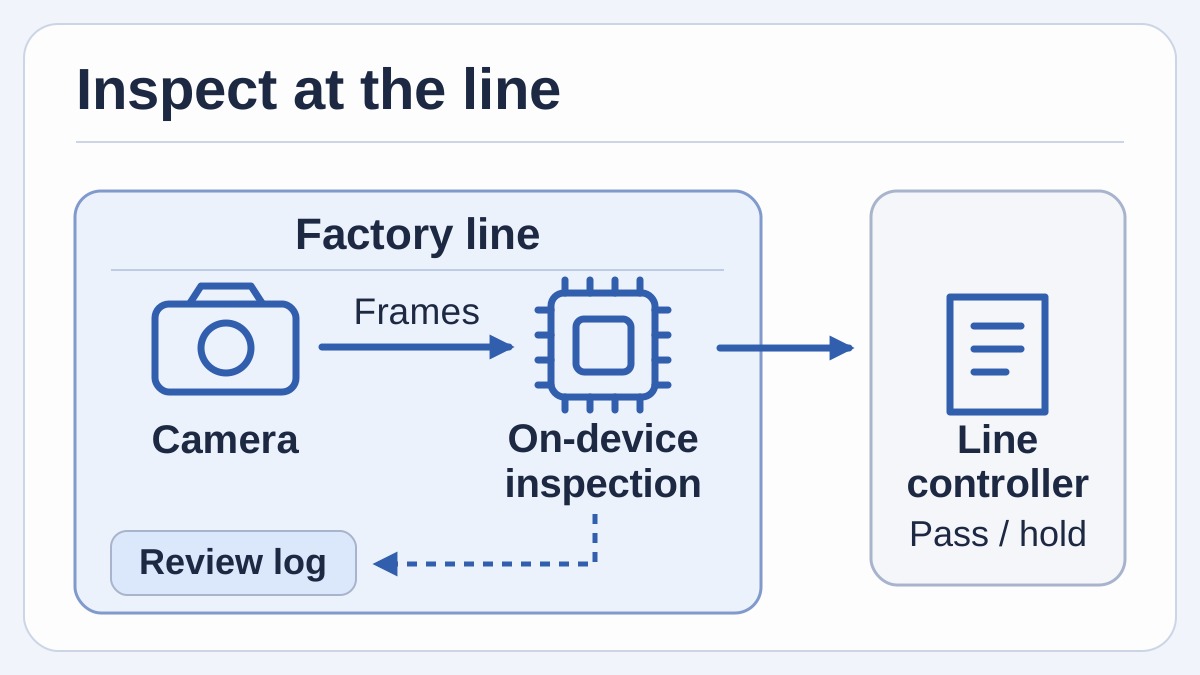
Original diagram of a proposed inspection station. The local path carries the decision to the line controller. The review path keeps a separate record of selected exceptions.
One reason to put this pipeline next to the cameras is that engineering teams can keep routine footage at the station. For example, suppose two compressed streams run at 8 Mb/s each during an eight-hour shift. Continuously transmitting them would use about 57.6 GB per shift before protocol overhead, using decimal units. Sending a part ID, time, reason code, and decision for each event has a different network profile. The numbers are planning inputs, and actual camera bitrates, event rates, and evidence retention set the real savings.
Local processing also changes who can see the evidence. Camera crops can expose product markings and process settings even when the rest of the image stays private. Give flagged crops a defined storage limit, identify who can export them, and record access in the same way the factory handles other QA evidence. A useful acceptance test disconnects the uplink, runs labeled parts, and verifies that the station can keep deciding while the event queue and any retained files remain within their limits. The team can then check exactly which data leaves when the link comes back.
The same architecture can check a metal part for a missing fastener at a fixture. In that setup, a fixed region and consistent light may make a rule-based check sufficient for the fastener, while a compact model looks for a more variable defect such as a damaged housing edge. The software can record which check raised the hold and save only the relevant image region for review. Starting with a limited set of clear defect classes makes false holds and missed defects easier to investigate before adding more cameras or models.
The conveyor sets the latency budget
Suppose the distance from the inspection trigger to the diverter is 0.20 m and the belt runs at 1.0 m/s. A part takes 200 ms to travel between them in this example. Set aside an illustrative 40 ms for controller communication, actuation, and a margin, and the application has 160 ms from capture trigger to decision ready. At 1.25 m/s, that same travel distance takes 160 ms, leaving 120 ms for the application with the same allowance. The inputs belong to the proposed station and should be replaced with measurements from the real line.
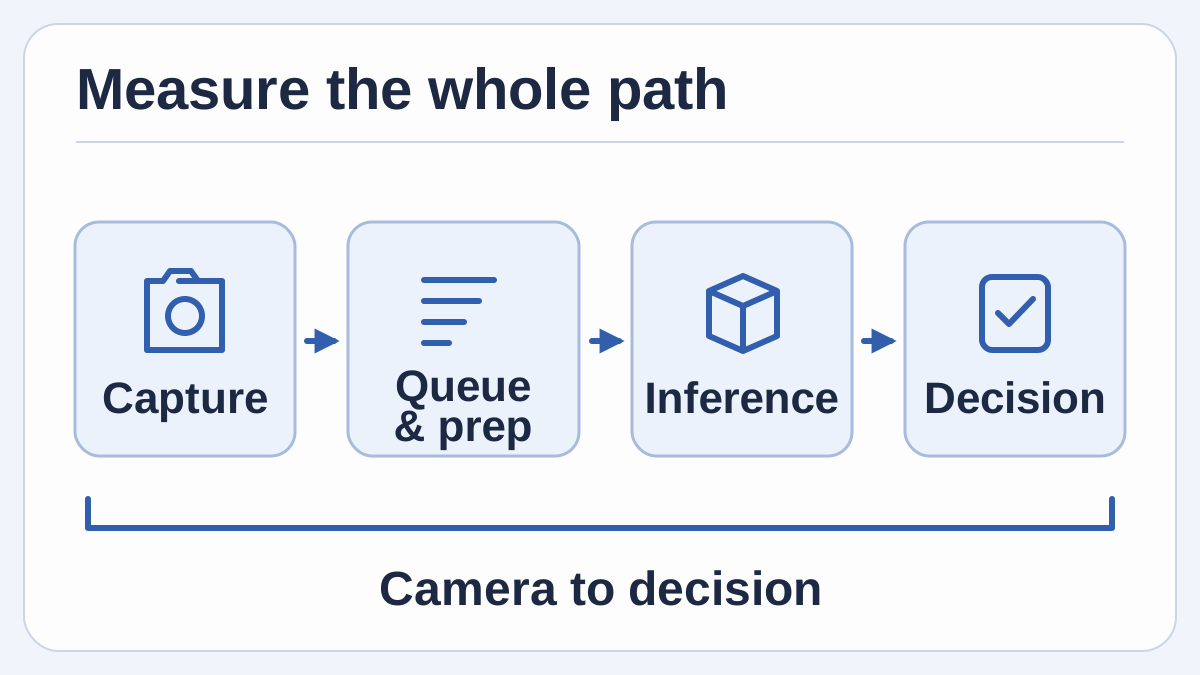
Original diagram of the stages competing for the conveyor’s travel time. The pilot needs timestamps for the whole path and an allowance for downstream control.
Start the measurement at the trigger, or calibrate the offset if the camera and controller use different clocks. Record when the last required frame is available, when preprocessing finishes, when inference returns, and when the PLC receives the decision. A fast model can appear to solve the timing problem when a benchmark starts with a tensor already prepared in memory. The trigger-to-controller measurement covers exposure, camera transfer, waiting for the second stream, and queuing alongside other jobs.
| Measure at the station | What it can uncover | How to exercise it |
|---|---|---|
| Trigger to decision ready, including the 95th and 99th percentiles | Delays from camera synchronization, image conversion, model fallback, or queue contention | Run both cameras with the selected model and logging enabled under representative line speed |
| Late, missing, or misassigned decisions | Failures hidden among the runs with valid timestamps | Reconcile the trigger count and each part ID against the controller record |
| Missed defects and false holds by defect type | A seemingly accurate average that conceals rare but costly mistakes | Use known examples, including visually borderline defects and ordinary good parts |
| Sustained power, temperatures, and queue length | Throttling or growing backlog after the initial demonstration | Keep the planned enclosure, fans, and camera traffic active through thermal steady state |
Report the denominator alongside the latency percentiles. If an image never arrives, dropping that part from the percentile calculation can make the station look faster while hiding a missed inspection. Keep deadline misses separate from classification errors, then check where they overlap. For example, a real defect could be recognized correctly but too late for the controller to act. Both engineering teams need to see that outcome.
A useful pilot starts with the same parts and ends with a decision about the line
- Request the actual evaluation configuration. Ask Quectel for sample eligibility, carrier details, camera and driver support, runtime and compiler versions, and the specific memory and storage configuration. Confirm which model formats and operators the accelerator runs with the proposed software. Get the recovery and update workflow before counting the platform as ready for the plant.
- Capture a small labeled set around one visible defect. Include good parts, confirmed defects, and cases operators regularly debate. Record lens and lighting settings with each batch. Hold back examples from another lot or shift for the comparison, so the team can see whether changes in reflectivity, packaging, or normal wear affect the result.
- Run the new station in parallel with the existing check. Keep the current controller and QA decision in charge while the candidate system records what it would do. Compare the classifications, part IDs, and deadlines on the same stream. When a result differs, look at that item’s two views and controller record together.
- Test the conditions that change the answer. Try the fastest agreed belt speed, near-simultaneous triggers, a brief camera interruption, and a cold restart. Repeat after the enclosure has warmed and while the station is writing exception records. Verify the existing line behavior when the inspection station can no longer supply a timely result.
- Decide whether the savings cover the integration. Compare bandwidth and review effort with the cost of the carrier, integration, maintenance, and periodic validation as product lines change. Include the labor needed to investigate false holds. Require an agreed deadline-miss rate and defect-specific quality thresholds before allowing the trial to influence production.
The pilot can also reveal where buying more compute would leave the actual defect unchanged. If the new camera view turns an unreadable crease into a clear signal, that physical improvement may have more impact than a larger model. If single-camera timing is stable but two views introduce long queues, profiling the handoff between image preparation and inference may yield a better answer than lowering the model’s threshold. Those findings make the experiment useful even if the existing line check stays in place.
A local inspection station earns its place one part at a time
Quectel’s sample offers manufacturers a way to try a richer vision pipeline in a compact industrial module. The best early proof would be an ordinary shift in which the station keeps footage inside the plant, sends timely decisions associated with the right parts, and gives the operator enough evidence to explain a hold later. That is the kind of record a line manager can use to decide whether to expand the trial.
Sources
- Quectel’s SP900BF-AP announcement, November 11, 2026, issued through Business Wire
- Quectel SP900BF-AP product specifications and official module photograph
- Qualcomm Dragonwing IQ-9075 processor overview
- Qualcomm’s guide to IoT development hardware, June 2026
To keep pilot observations, measurements, and decisions in a searchable record, create a Telli.sh account.