PTC Jetstream puts the design decision back beside the 3D model
PTC's new collaboration product connects browser-based design reviews, contextual feedback and AI summaries. Its real test is whether a decision remains understandable after the meeting ends.
PTC corporate mark, via Wikimedia Commons, where the source file is classified as PD-textlogo. Used to identify the company discussed; this is not a Jetstream interface screenshot or an indication of endorsement.

The supplier says the bracket is manufacturable. The engineer remembers a different hole pattern. Someone forwards a screenshot from last week's meeting, but nobody can tell whether the approval covered the current revision or the previous one. The conversation happened; the decision has lost its coordinates.
On October 21, 2026, PTC launched PTC Jetstream, a cloud collaboration product for reviewing engineering information with internal teams and external partners. It brings browser-based 2D and 3D review together with contextual discussion and AI-generated Room summaries. PTC also connects the review record to Windchill, its product lifecycle management system. Launch announcement.
Our take: the interesting development is a more precise home for agreement. A fluent summary helps only if the next person can still identify the design, the revision, the unresolved issue and the person responsible. This article explains where that connection can help manufacturers, how to evaluate it and why an AI recap cannot carry engineering authority on its own.
A product review needs more than a conversation history
PTC supplies software used to design, manage and service physical products. Windchill is part of that industrial software portfolio: the PLM system provides a governed place for product information across its lifecycle. Jetstream adds a collaboration layer around that information so contributors can participate without becoming full-time users of the engineering system.
For a manufacturer, the audience around a design is wider than the group that edits it. A supplier may understand a machining constraint. A service technician may know which fastener is impossible to reach after installation. A manufacturing engineer may see an assembly problem that does not appear in the designer's preferred view. Their expertise is useful before the design is released, but collecting it through detached files creates another coordination task.
Consider an illustrative review of a small pump assembly. The designer asks whether the housing allows enough clearance for a maintenance tool. A service representative answers against one viewpoint; a supplier replies with a manufacturing concern; a project manager turns both into an action list. If the geometry changes, the team must work out which comments still apply. A searchable message thread preserves words, but it does not automatically preserve their relationship to a particular product state.
This is the decision's missing address. The address includes the product identifier, revision, relevant view and review context. Keeping those coordinates close to the discussion makes the result easier to interpret later. It also makes disagreement more useful: two reviewers may have answered different questions against different views rather than actually disagreeing about the same thing.
Jetstream keeps feedback attached to what people reviewed
PTC describes access-controlled Rooms for colleagues, suppliers and partners. Participants can inspect supported 2D and 3D content in a browser, while feedback retains its relationship to the reviewed material. The product page describes 3D views that preserve rotation, zoom and hidden features with a comment. It also offers measurement and sectioning tools. Jetstream product details.
Those capabilities target a familiar communication failure. “The wall is too thin” is hard to act on when several walls are visible. A comment attached to a specific view gives the recipient a better starting point. It does not make the manufacturing judgment correct, but it reduces the work required to discover what the person meant.
The browser matters for participation. A purchasing specialist or supplier should not have to learn the full design application merely to contribute to a review. PTC says external participants receive access to the shared material rather than access to the customer's PLM environment. The buyer should still confirm the supported file types and required entitlements for its actual configuration; “browser-based” does not establish universal CAD compatibility.
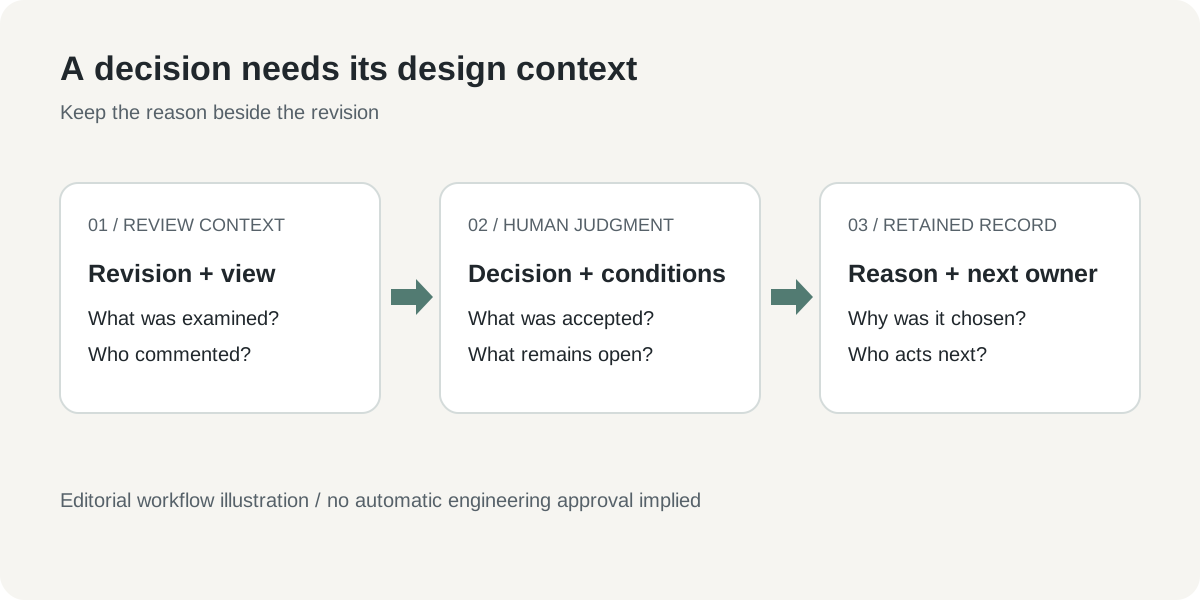
Original editorial infographic. The chain shows the information a useful design decision needs; it is not a Jetstream interface or a claim of automatic approval.
The practical benefit is a lower translation burden between specialists. The designer does less work reconstructing the supplier's viewpoint. The service team can point at the access problem it sees. The project manager has a clearer issue to assign. These are plausible workflow benefits to measure in a pilot, rather than an assumed reduction in development time.
The AI summary should help the next reviewer find the difficult part
PTC's launch describes AI Room summaries that surface important discussion, outcomes, next steps and owners. That is a useful role for AI because long reviews can become expensive to re-enter. A late participant needs to know where attention belongs before reading every comment. The summary can provide that entrance.
It also introduces a risk that a conventional transcript does not: compressing uncertainty into apparent agreement. Imagine a supplier writes, “We can make this version if the material stays unchanged.” A short recap that says “Supplier approved production” changes the meaning. The condition is part of the decision, even though it may occupy only a few words in a long conversation.
A sensible review process therefore asks the human owner to compare the summary with the comments that carry consequences. Accepted, rejected and still open should remain distinguishable. A recommendation needs a different status from a release decision. An assigned owner needs to understand the work and accept the assignment, rather than appearing in a polished paragraph by inference.
The product can make a review easier to navigate while the team retains responsibility for judgment. PTC's product page explicitly keeps people in charge of decisions. That boundary should appear in the pilot's operating rules, especially where a short summary will travel to people who did not participate in the Room.
Windchill connectivity carries a record, not an automatic engineering change
The detail that deserves attention is the return path. Jetstream can begin from Windchill, but PTC's product page describes the review outcome returning as a PDF export of Room activity, checked into the product record. That is a concrete way to retain the discussion alongside governed information. It should not be confused with automatically changing geometry, updating a bill of materials or completing a formal release workflow. Windchill handoff description.
The distinction affects how a manufacturer should design the process. A document that explains a decision is valuable evidence for the person preparing a change request. It does not by itself perform that person's job. The engineering owner still needs to identify the affected parts, make the change, perform the required checks and follow the organization's approval procedure.
| Review artifact | What it helps establish | What still needs an owner |
|---|---|---|
| Comment beside the reviewed content | What a contributor was responding to | Whether the observation is technically correct |
| AI Room summary | Where discussion and next actions appear to stand | Whether conditions or disagreements were omitted |
| Human-reviewed decision | What the team accepted and why | Who implements and verifies the change |
| Room activity exported to Windchill | A retained record beside product information | The formal change and release process |
The PDF also raises an ordinary records question: can a later reader reconnect the exported statement to the relevant revision and its supporting detail? Buyers should inspect the actual export during a demonstration. A readable document is a useful first result; a document that preserves enough context for the next person is the result that matters.
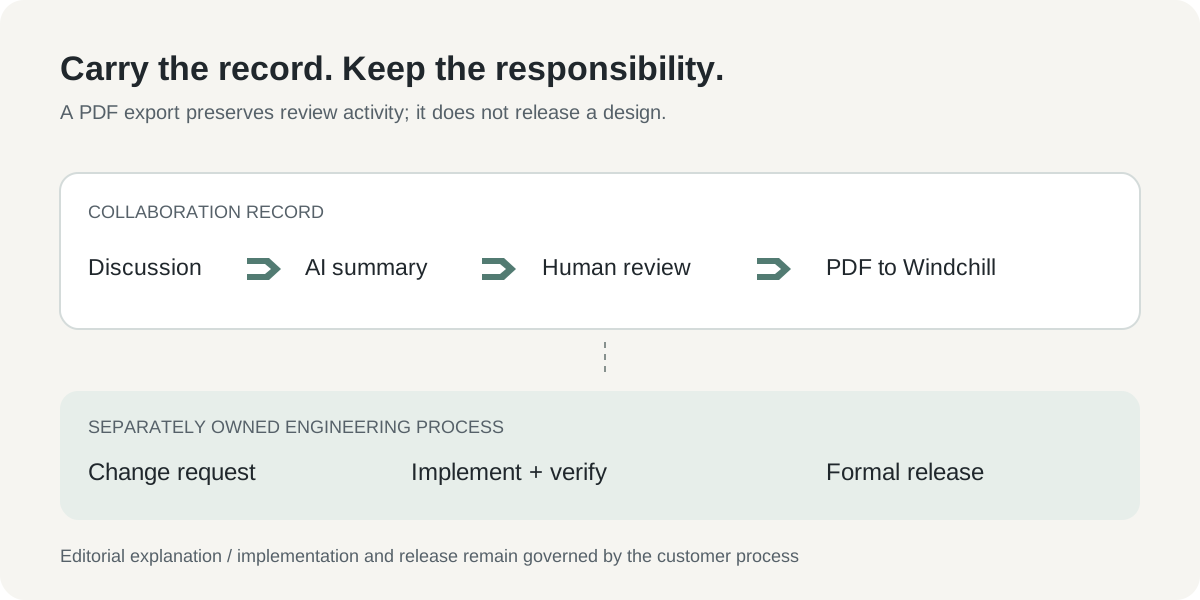
Original editorial infographic. Exporting review activity and implementing an engineering change are separate responsibilities.
Three reviews reveal whether the collaboration layer earns its place
A supplier manufacturability review is a good first example. Choose one part with a specific production question, such as tool access around a pocket. The supplier should be able to inspect the relevant view, state the limitation and explain the proposed alternative. The engineering owner then records whether that alternative is accepted, rejected or dependent on another check. The useful outcome is a decision somebody can implement without repeating the entire conversation.
A serviceability review tests a different kind of expertise. A technician may need to show how a maintenance action will happen after surrounding components are installed. A cross-section or alternate viewpoint can reveal a concern that a general document comment would describe poorly. The review should end with an explicit owner for the next design or validation step, rather than a broad statement that service has been consulted.
A cross-functional design release discussion tests the handoff. Engineering, manufacturing and procurement may agree on the design but disagree on when it can be introduced. A summary needs to preserve the distinction between technical acceptance and a supply constraint. The record should tell a later reader why a change was deferred, not merely that the meeting reached agreement.
These are illustrative scenarios, not reports of our own Jetstream deployment. Each examines a different failure mode: unclear geometry, missing operational expertise or ambiguous decision status. Starting with one constrained review makes it easier to see whether the new product solves a real problem before expanding the process across departments.
A useful pilot starts with one revision and one question
Jetstream's commercial entry point is a sales or demonstration conversation. The public product page does not supply a general self-service price list. A prospective customer should bring its actual review problem to that conversation, including a representative file, the intended external audience and the record it must retain.
- Select one bounded review. Name the part or assembly, the revision and the decision needed. “Review the product” is too broad; “confirm access to this fastener in the installed assembly” gives participants a shared task.
- Confirm the representation. Ask the vendor to show the required file type, geometry, view and any measurements using material the organization is permitted to share. Check what happens when a new revision arrives.
- Set the audience deliberately. Invite the minimum relevant roles. Check what an external reviewer can see, contribute, download and retain under the contracted configuration.
- Compare a summary with its evidence. Include a conditional answer and an unresolved objection in the pilot. Ask the review owner to check whether both remain visible in the AI recap.
- Finish the record. Export the completed review activity, attach it to the appropriate Windchill record where applicable and ask a colleague who missed the discussion to explain the decision back.
- Measure the handoff. Record the time spent clarifying comments, retrieving the accepted revision and reconstructing the reason for the decision. Compare that with the team's existing process for similar work.
The most revealing moment is often the colleague's explanation in step five. If they can identify what changed, which conditions remain and who acts next, the review has created a reusable result. If they still need a new meeting to understand the PDF, the team has moved its paperwork without closing the coordination gap.
Access controls need to match the business relationship
An invitation is a convenient action with substantial consequences. A supplier may need to see a single component, while the complete assembly contains unrelated intellectual property. A specialist may need temporary access to answer one question. The pilot should establish how sharing is scoped, how access is removed and what the recipient can retain after the review ends.
The same care applies to AI processing. Buyers should ask which content is sent for summary generation, where it is processed, what retention applies and which contractual terms cover it. These questions belong with the organization's existing security and supplier policies. A statement that Rooms are permission-based does not answer every data-handling question for every customer.
There is also a quieter adoption cost. A collaboration layer succeeds only if people understand where to place the important decision. If the authoritative answer still arrives privately by email, the Room becomes an incomplete reflection of the real process. The owner should make the agreed decision visible in the review record and identify any evidence that must remain elsewhere.
PTC's launch includes a favorable comment from GE Appliances about participation in reviews. That customer perspective explains the intended job, but it supplies no numerical reduction in rework or development time. A buyer should ask for a demonstration and references relevant to its own product complexity, supplier network and governance requirements rather than converting a testimonial into a forecast.
The lasting result is a decision another engineer can use
Jetstream's opportunity is larger than producing a shorter recap. A manufacturer benefits when expertise can enter a review early, feedback remains attached to the design state and the final decision survives the journey back into the engineering record. AI can make that process easier to enter; clear ownership makes the result usable.
The development worth watching is whether teams spend less time reconstructing why a part looks the way it does. That is a better test than the length of the summary or the number of comments collected. The next engineer needs enough context to act correctly, including the condition that prevented a simple answer.
Sources
- PTC Jetstream launch announcement, October 21, 2026.
- Jetstream capabilities, browser review and Windchill PDF handoff, checked October 23, 2026.
- PTC's guide to design reviews, background, checked October 23, 2026.
- PTC logo source and copyright classification, checked October 23, 2026.
Keep your own decisions connected to their sources
For readers who want a separate workspace for reviewed meeting notes and source links, Telli.sh is one option. Open your notes workspace.