Your recorder wants to finish the follow-up: Plaud's move from Chat to Work
Plaud Intelligence adds agent tasks, reusable routines and documents linked to conversation sources. What changes when a recording becomes the starting point for work, and where review and Credits enter the picture.
The meeting is recorded and the summary is ready. Someone still has to turn the discussion into a proposal, explain the decision to a colleague and put the next action in the right place. A saved conversation is useful material, but it is not the completed follow-up.
Plaud's October 23, 2026 introduction of its updated Plaud Intelligence puts that gap at the center of the product. Ask Plaud now distinguishes Chat, for questions about recordings and knowledge, from Work, for agent tasks that produce results and connect to other tools. The update also describes reusable Skills, automated Routines and Artifacts such as documents and slide decks. Official introduction.
Plaud makes card-shaped and wearable recording devices alongside its software. That background makes this an interesting product shift: the conversation captured in a physical meeting can become the input to a longer workflow. The question is whether the path from a spoken statement to a finished result remains understandable enough to review.
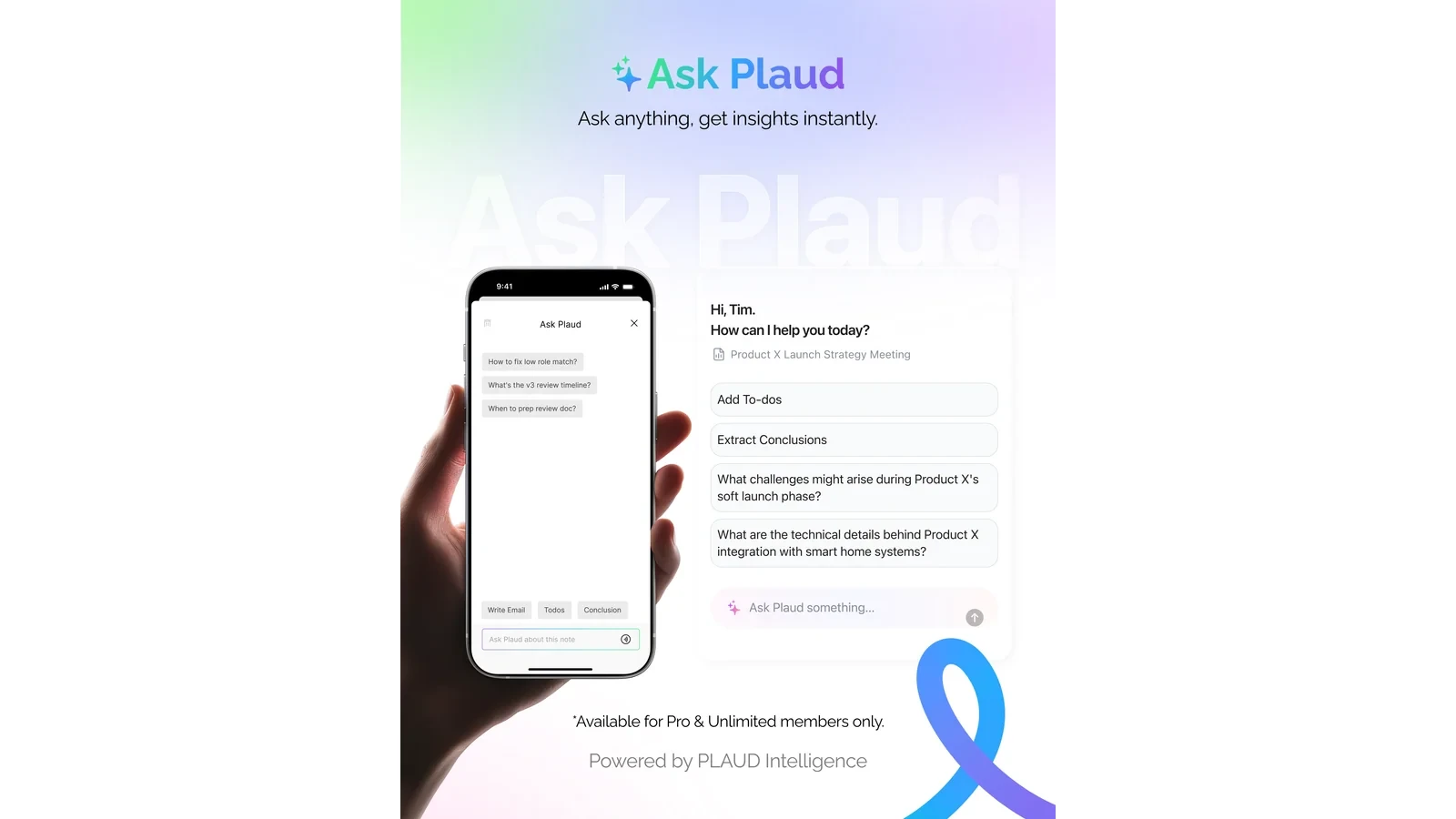 Official Ask Plaud illustration from Plaud's editorial media kit, showing an earlier interface. Image: Plaud. Resized without cropping. Plan wording inside this earlier illustration does not describe the new Chat/Work rollout.
Asking what happened and asking for work are different requests
A question about a recording has a relatively clear purpose. You may want to know what a customer asked, which deadline was discussed or where a topic appeared across several conversations. The answer helps you interpret source material and decide what to do next.
A work request goes further. It asks the system to choose steps, assemble information and produce an artifact or operation. The result could look like a finished document even when its underlying interpretation still needs correction.
Plaud's distinction between Chat and Work makes that difference visible in the product. The introduction says Chat does not consume Plaud Credits, while Work uses Credits for agent tasks. The separate Credits explanation says usage depends on task complexity and distinguishes agent work from core transcription and default summaries. Credits explanation.
Our view is that this is the right distinction for readers to evaluate. The useful question is not whether an AI can generate more text from a meeting. It is whether a particular task becomes easier to complete, check and deliver when the original discussion remains connected to the result.
A recording is the raw material on the workbench. A summary organizes it. A proposal or set of next steps uses it to make something another person will rely on. Moving between those stages should make the transformation clearer, rather than hiding it behind a single button.
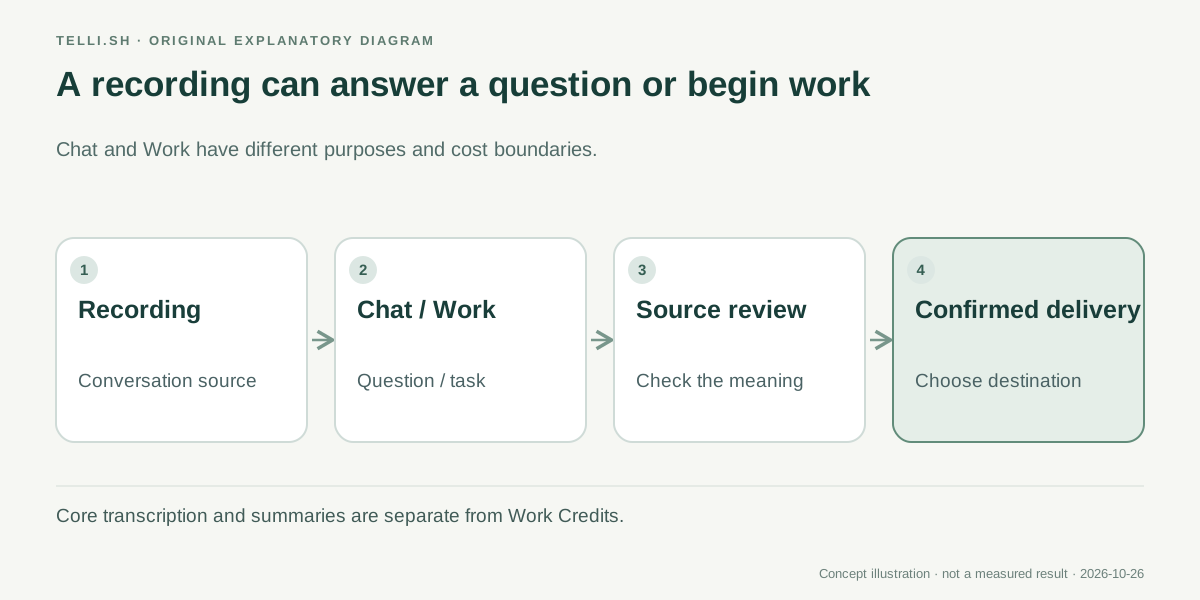 Original explanation of the difference between retrieving an answer and asking an agent to prepare a result.
A client proposal should keep the promise connected to the conversation
Consider an illustrative consulting meeting. The client describes a launch date, a constrained budget and several possible deliverables. A useful follow-up would organize the agreed scope, distinguish open questions and prepare a proposal that does not quietly turn a possibility into a commitment.
This is a strong use case for an artifact with source references. Plaud says its generated documents can link claims back to the relevant moment in the transcript. That can shorten the trip from a sentence in a proposal to the discussion that supports it. Artifacts and source links.
The link still needs interpretation. A customer saying “we may need this by Friday” is not the same as both parties agreeing to a Friday delivery. A timestamp helps the reviewer find the evidence, but the surrounding words and the status of the decision remain important.
A good first task would therefore request separate sections for agreed items, tentative ideas and unresolved questions. That structure makes ambiguity visible. It also gives the person approving the proposal a clear place to correct an inference before the document reaches the client.
You can evaluate the workflow by comparing the artifact with the source and the final approved document. Count incorrect commitments, missing constraints and the time needed to resolve each one. A document that needs only a few visual edits is different from a fluent document whose central promises need rewriting.
Routines are useful when the repeated task has a stable finish line
Plaud's updated introduction describes Routines triggered by time, events or keywords. It contrasts them with the earlier AutoFlow workflow, which focused on transcription and summary automation. That makes the new direction broader: a repeated job can produce an agent result rather than only a standard meeting summary. Routines description.
Imagine a weekly project review in which the team wants a list of decisions, owners and unresolved dependencies. A reusable routine could prepare that structure after the relevant conversation, leaving the project owner to correct missing or ambiguous assignments. The goal would be consistent preparation, not automatic agreement with every sentence in the meeting.
The finish line needs to be specific. “Handle the weekly meeting” is too broad to evaluate. “Prepare the decisions and open questions from this project's recording, with references for each proposed owner and deadline” gives a person something concrete to check.
A routine also needs a scope. A discussion about a different customer should not silently become supporting material for this week's project update. Plaud's introduction describes asking the agent within a folder so that it uses material from that folder. That is a useful starting point for organizing a trial around a bounded collection.
The maintenance work begins when the meeting changes. A new participant, a changed project scope or a different reporting requirement may make the old routine less useful. Reusability saves work only when someone remains responsible for the instructions being reused.
Skills can standardize the review, not merely the appearance
Plaud describes Skills as reusable playbooks for how an agent handles a task, including structure, tone and format. It lists ways to create them from documents, conversations, forms or an existing artifact. Skills introduction.
The obvious use is making documents look consistent. A more valuable use is preserving the questions a reviewer always asks. A client follow-up skill could require a distinction between a decision and a proposal. A project update skill could separate an assigned owner from a person who was merely mentioned.
That is useful for a growing team because good practice can be described and reused. It is also a reason to inspect a playbook before adopting it. A convenient template from a community may assume a workflow, jurisdiction, vocabulary or level of authority that does not match your organization.
For a small team, start with one output someone already knows how to review. Preserve a good example and the reasons it was accepted, then use those criteria when evaluating the generated version. The goal is a dependable process, not a library of instructions no one maintains.
The same caution applies to specialized professional work. A polished document format does not confer expertise or permission to make a decision. A playbook should help the responsible professional review the material rather than imply that the role has been transferred to the agent.
| Request | Useful output | What the reviewer still decides |
|---|---|---|
| Ask what was decided | An answer grounded in the relevant conversation | Whether the evidence represents an actual decision |
| Draft a client proposal | A structured artifact with source references | Scope, promises and the final terms |
| Prepare a recurring update | The same useful sections each time | New exceptions, missing owners and changed priorities |
| Deliver a result to another tool | Material placed in the intended workflow | Recipient, destination and permission to send |
Connected tools make confirmation part of the product
The update names connectors such as Slack, Notion, Google Calendar and Linear, with additional reach through Zapier. It says user confirmation is required before material is sent or posted. That is an important detail because preparing a useful document and delivering it outside the workspace are separate actions. Connector behavior.
A source-linked proposal can still go to the wrong destination. A project update can be correct while exposing information to an inappropriate channel. The final check needs to cover the audience and location as well as the words.
For a first trial, keep delivery manual even if the product offers a convenient connection. Review the artifact, choose the intended destination and confirm that the shared version contains only the relevant material. Once the workflow is familiar, the team can decide which steps are worth streamlining.
This is not a claim that connected work is inherently risky. It is a practical observation about where the consequences change. The moment another person receives the result, they may treat its contents as an approved statement from the sender.
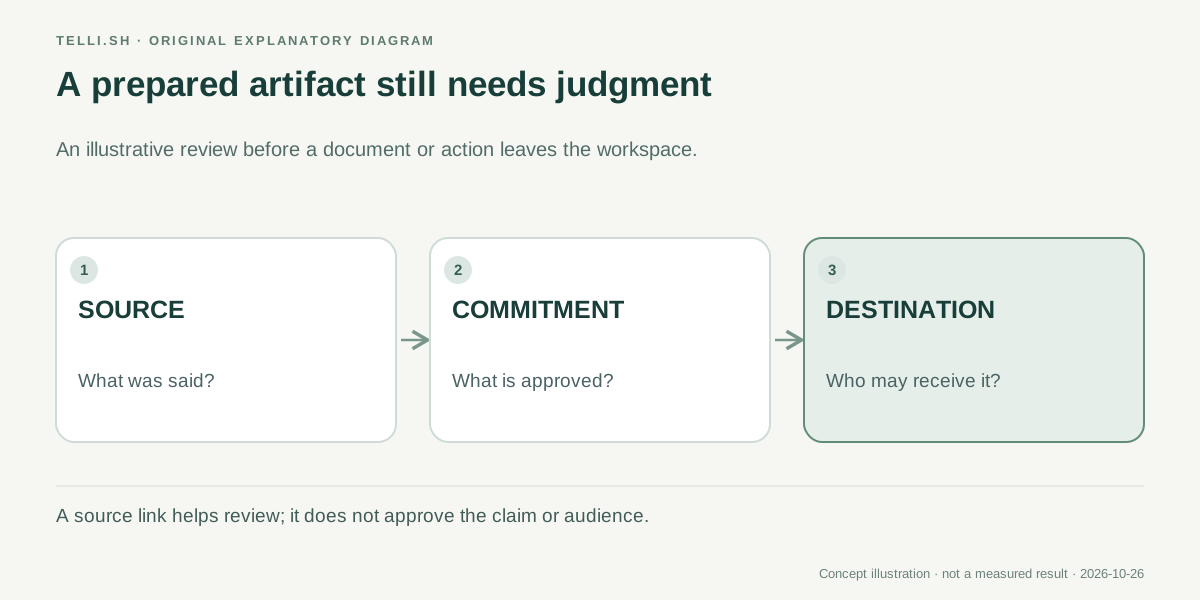 Original review sequence. A source reference, an approved claim and an appropriate destination answer different questions.
Count the cost of accepted work, not only generated work
Plaud Credits introduce another reason to choose a bounded experiment. Agent work can consume a different resource from the transcription minutes a recorder owner already understands. The Credits page explains the distinction, but a team's actual consumption will depend on the tasks it requests. Current Credits explanation.
A practical evaluation should record the complete job. How many attempts produced a usable artifact? How much editing remained? Did the reviewer return to the original audio, and how easy was the relevant passage to find? These observations connect cost with a result the team actually wanted.
Do not judge the system only on the easiest recording. Include a discussion with an unresolved question, a changed deadline and two people using similar names. A workflow that handles straightforward material well may need different instructions when the source is ambiguous.
The setup can remain simple:
- Select an authorized recording with a clear business purpose and a reviewer who understands it.
- Ask Chat a few factual questions to establish how the source is represented.
- Give Work one concrete artifact to prepare, with a stated audience and required sections.
- Follow the source references for the important claims and correct unsupported commitments.
- Inspect the proposed destination before confirming any delivery.
- Record the editing time and Credits used before repeating the task or turning it into a routine.
The measures should include usefulness and correction effort, not just generation speed. A slower first draft can still save time if it is easier to verify. A fast document that sends the reviewer searching through an hour of conversation may not.
The recorder's next job is making follow-up reviewable
Plaud's update points toward a recorder that does more than preserve the past. It can help transform a conversation into the next piece of work. The strongest version of that idea keeps the source close enough that a person can correct the transformation.
The question to ask of the next generated proposal is simple: can you explain how its most important promise came from the conversation? If the workflow makes that answer easy, the recording has become more than an archive. It has become material you can responsibly use.
Sources
- Plaud: Meet the new Plaud Intelligence, October 23, 2026.
- Plaud: Introducing Plaud Credits, checked October 26, 2026; regional publication dates may differ.
Keep an independent place for your reviewed notes
Telli.sh is one option for keeping authorized recordings and the notes you have reviewed alongside them. Start with an audio note.