Can a half-gigabyte translation model earn a place on your phone?
Preferred Networks released PLaMo 3 Translate in four sizes. Its 0.8B model makes offline text translation a practical test, starting with the phrases that matter to you.
A phone that can translate a saved Japanese message on a train with no signal could be more useful than a translation service with a higher score in a benchmark. The difference comes down to two plain questions. Does the model fit the device you have? Does it preserve the parts of the message you cannot afford to get wrong?
Preferred Networks, a Japanese AI research and development company, released the weights for PLaMo 3 Translate on November 5, 2026. The family comes in four sizes, from 0.8 billion to 31 billion parameters, and PFN lists 53 supported languages. The smallest model has an official four-bit GGUF variant listed at 0.57 GB. PFN demonstrated the 0.8B model translating text on a smartphone in airplane mode. The company says that the demonstration used an internal app that had not been released at announcement. The weights and runtime instructions are available to developers, and the demo shows one setup in which the model ran offline. PFN release · PFN technical notes and phone demo · Official 0.8B files
The useful experiment starts with the language pair and phrases you need on a real trip or in a regular workday. The phone clip gives you a reason to try it. Your own error checks determine whether to keep it.
Context photograph of airplane mode by Skitterphoto, resized from the CC0 original. PFN's official 0.8B phone demo.

A phone demo and a model download answer different questions
When PFN shows the phone working in airplane mode, it demonstrates that the model and a compatible local runtime can handle some text translations on a particular mobile setup. The official files give you something to download and test on your own hardware. A device-specific app still needs to load the model, accept the text, render the result and fit within the memory the operating system makes available. Those are separate decisions from model quality.
For a trip, imagine downloading the model and a set of hotel directions before you leave. Once disconnected, you can paste a short instruction, see the original next to the translation and pick out the number of the bus stop. An airline update delivered as a photograph calls for a separate text extraction step. A spoken announcement needs a separate way to capture and transcribe audio. The released model's job begins once the source is text.
The same boundary makes the trial easier at work. A field engineer can copy a short product instruction from a manual and test whether the unit and a prohibition survive. A team that receives scanned manuals first has to decide how to extract the text and preserve columns, numbering and headings. If the OCR gets a part number wrong, a fluent translation can carry that error forward. Keep the original scan and the extracted text available during review.
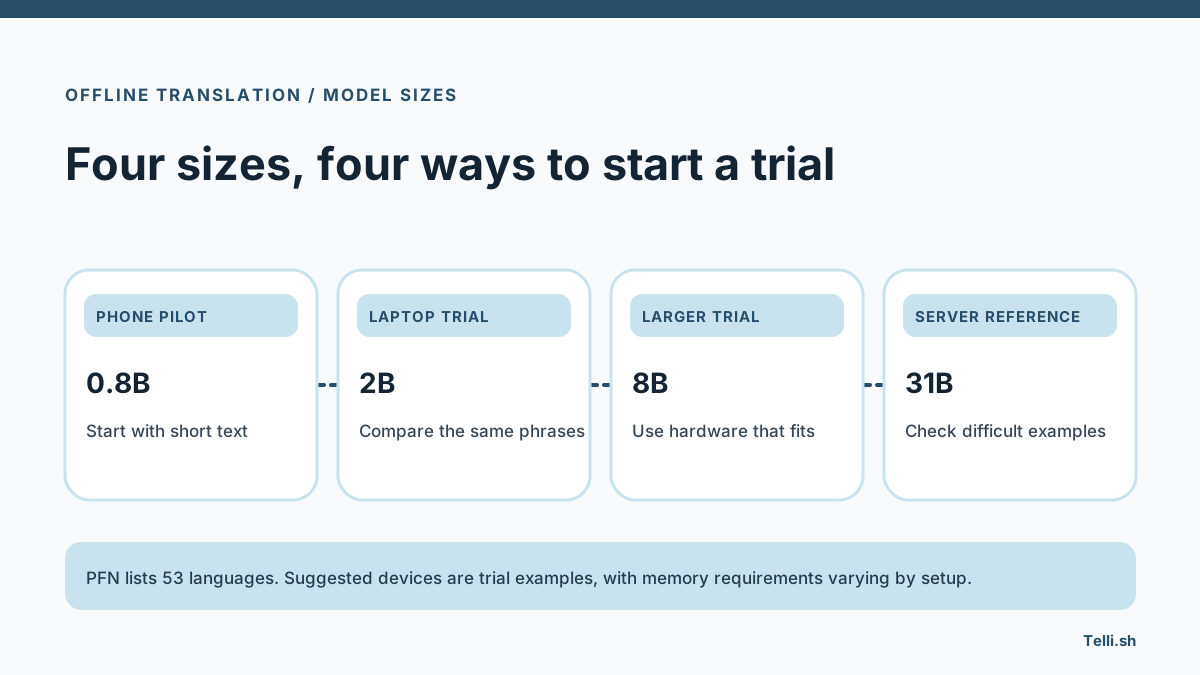
Four starting points for a trial. The device suggestions are editorial examples, and the 53-language figure is PFN's stated coverage. Original illustration by Telli.sh.
What the 0.57 GB download tells you
The 0.57 GB number is the model file listing for the 0.8B Q4_K_M variant. The same official repository lists Q4_0 at 0.55 GB, Q3_K_M at 0.49 GB and Q2_K at 0.41 GB. The suffixes denote different quantization schemes, which store the model weights at reduced precision. Choosing one can change both the file footprint and the translation output. The listing gives you a way to estimate download space. The runtime also needs memory for its working data, token context and the surrounding application. Official 0.8B file listing
For a first comparison, use Q4_K_M as the starting file because PFN's GGUF documentation uses it in the example setup. Add another quant only when you have a specific constraint, such as a device that cannot load the first build or a hard storage limit. Run both variants on the same short list of sentences. Keep the runtime, text and generation settings fixed. If you also switch from a phone to a laptop, record that as a separate comparison so any speed gain has a plausible cause.
Capture cold start and repeat translation separately. A model that takes a while to open might still translate a string quickly once loaded. That can work at a desk with the app open all day. A traveler who opens it for a single sign will feel the startup delay every time. Try pasting a paragraph after several translations, then switching to the camera or browser and returning. Note whether the app reloads the model, clears the previous result or recovers smoothly under everyday memory pressure.
Battery and heat are worth noting on the device where they matter. Ten short translations spaced throughout a day are a different workload from translating a manual in one sitting. A quick side-by-side using real input shows whether your device can finish the job at a tolerable pace. PFN's release provides vendor measurements and a phone demonstration. The device checks here are proposed tests.
Four sizes give you a reference, even if you ship one
PFN released 0.8B, 2B, 8B and 31B weights. The team describes supervised tuning followed by direct preference optimization, with larger-model distillation used in training smaller members of the family. The point of having four sizes locally available is that you can compare what the small version gives up on the text you actually care about. You can also use a larger size as a separate reference configuration while keeping the daily device small. PFN technical release notes
Treat 0.8B as an on-device candidate for short text and test 2B against it if a laptop or a better-provisioned phone can run the configuration you choose. Use 8B or 31B as a reference on hardware where the runtime fits. A larger model can help diagnose a problem when it preserves a term that the smaller run drops. It can also make the same mistake. A bilingual reviewer or source glossary remains the reference for the intended meaning.
Japanese and English offer a starting point because that pair is prominent in PFN's tests. For a product that will translate Thai into French, test Thai into French directly. Supported language coverage tells you the model is intended to handle the pair. It leaves open how well it handles a medical abbreviation, a local idiom, a long warranty clause or names written in mixed scripts.
Test the direction as a separate variable. A model that produces a useful Japanese message from English may make a different set of mistakes translating a handwritten-style Japanese instruction back into English. If your team mainly receives Japanese and publishes German, both phases of a German-to-Japanese conversation can matter. Label the direction and compare directly with your intended workflow.
Read the benchmark next to a short translation brief
PFN reports results on its internal PFTB evaluation and public benchmarks that include WMT24++ and FLORES+. The company discusses performance across language directions and notes that rankings vary by benchmark and direction. Its internal PFTB uses generated references. The results are a way to choose cases to investigate, especially for Japanese. They are vendor-reported evidence. A useful publication comparison distinguishes which evaluation is being quoted and avoids treating a result from one direction as a result for all 53 languages. PFN benchmark methodology and comparisons
Start with a brief that says what counts as an acceptable result. For a travel message, a useful translation preserves the place name, time, fare and whether the message describes a requirement or a suggestion. In a support note, it preserves the part number and distinguishes “must disconnect” from “can disconnect.” A separate review of tone tells you whether the result sounds appropriate after the factual checks pass.
Give the same brief to both people who inspect the output. If one prefers a more natural sentence and another checks the original word by word, the larger model can seem to win by sounding better while actually changing a number. A simple record with one row per source and fields for factual error, wording issue and glossary match makes disagreements visible. Save the source too. A reader can judge a trade-off much more easily with a paired sample than with one average rating.
There is a good story even if the smallest model wins on only part of the brief. A café menu can tolerate an awkward phrase that would be unacceptable in a service bulletin. A recurring hotel message might be easy while a new set of station directions needs review. Describe the specific cases that pass and the ones that still require help. That tells a reader whether to try the model today.
Glossaries and tone are useful tests of control
PFN describes controls for glossary terms and style, including plain and polite forms in Japanese. Consider a catalog that sells a “snap lock” as a named component. An unconstrained translation might choose a plausible generic term on page one and a different one on page five. A short glossary gives the model an intended rendering. Compare the output for exact part names, nearby punctuation and cases where the same words are used in their ordinary sense. The example is a test design, and the test decides whether the chosen configuration follows the glossary reliably. PFN technical usage examples
Tone offers a second check. A shop employee might want a polite customer-facing version of a brief English notice and a plain version for an internal checklist. Run both requests with the same source. Look for a shift in address and sentence endings, then verify that the requested behavior, date and quantities are unchanged. A tone change that softens a safety instruction needs a human correction.
Prefer small, task-specific glossaries at the start. Add five product terms, two unit names and one instruction about names that should remain unchanged. When you find a new failure, add the exact case to the trial instead of adding many generic rules. Keeping the prompt, glossary and model file version together makes it possible to work out which change helped or caused a regression later.
Make the offline claim measurable
Install the runtime and download the chosen files while you have a connection. PFN's official GGUF instructions pair the model with a supplied chat_template.jinja and document a llama-server example. Use the model-specific template, and keep any test service bound to the device itself when your goal is local access. The example specifies a context budget of 16,384 tokens. A shorter limit may be sufficient for individual messages, and the practical budget has to accommodate both the input and the generated translation. Official GGUF instructions
Once the setup is ready, turn off the device's network connections and try new, unique inputs the app has never seen. Confirm that the translation still works after a fresh app launch. If your deployment promises local handling, inspect any analytics, updates, sync and provider fallback behavior separately. A local model gives the application the capability to process text on the device. The data path of the complete app determines what actually leaves it.
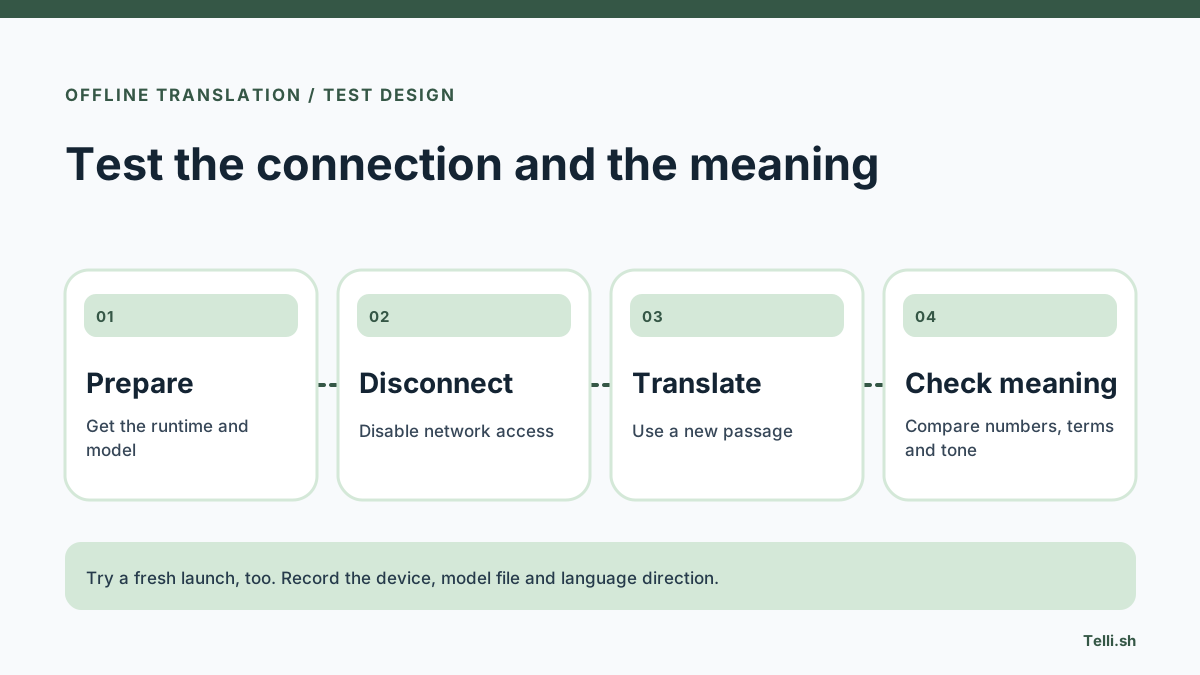
A short offline trial pairs an on-device run with meaning checks. Original illustration by Telli.sh.
For shared work, preserve the source, the local output and any reviewer correction as separate records. Limit who can see documents such as customer instructions and private correspondence. Treat a privacy benefit as something the complete workflow can show. If a colleague sends the corrected text to a cloud chat or the app backs up its history, account for that movement separately from the translation run.
Check the license before moving beyond the trial
The PLaMo Community License revised November 9 requires prior registration for commercial use under its standard terms. The user's or an affiliate's annual revenue or sales must not exceed JPY 1 billion. PFN's technical post says noncommercial users can use the models without registration or a revenue threshold. A separate agreement is required above the commercial threshold. Check the current license and PFN's registration conditions for your organization. The terms for the weights are a separate question from whether a model's output meets a professional standard. PLaMo Community License, Articles 3 and 4 · PFN license explanation
That is especially relevant if a successful personal test becomes a company app. You may need to decide whether each device downloads the weights from PFN or receives them bundled with the application. Article 4 requires distributors that provide the model or a derived model to others to pass on the license and include a “Built with PLaMo” notice, among other conditions. Plan for upgrades, a storage limit and a user-facing way to tell when local translation is enabled. These are concrete differences between running one translation in airplane mode and shipping a tool other people can rely on.
An initial pilot can stay small. Pick one language direction, one type of text and one quantization. Collect a dozen passages, with permission, and include three where a translation error would change an action. Install the runtime, check cold start, run disconnected and read the results with the original text visible. Repeat the same set in a larger configuration only if the differences could change your deployment decision. Record the cases that require review before the output is acted on.
The strongest result would be a modest one. A specific device can translate a known kind of text with a documented delay, without a connection, while preserving the terms and numbers your readers need. PLaMo 3 Translate gives you four ways to look for that result. The little file is worth trying when it makes the outcome possible on a device people already carry.
Sources
- Preferred Networks announcement, November 5, 2026, including distribution and license clarification
- PFN technical release, evaluation tables, instructions and official public phone demonstration, November 5, 2026
- Official 0.8B GGUF model card and local server example
- Official 0.8B GGUF artifacts and file sizes
- PLaMo Community License revised November 9, 2026
To keep a translation trial, source text and reviewer corrections together in a searchable note, Create a Telli.sh account.