Pika H3 Flex asks a better video question: can you keep the good parts?
Pika's reference-guided video model puts iteration first. Understand its five audio stems, local versus hosted features, and a practical way to plan a first creative project.
A generated product film can be almost right. The bottle looks good, the camera move works, and the lighting fits the brand. Then the background feels wrong, or the music swallows the line you need people to hear.
Pika H3 Flex, announced on October 29, 2026, addresses that second version. Pika, the company behind the video creation platform, has post-trained MiniMax H3 for reference-guided generation and revision. Its announcement combines multiple reference inputs, editable sound components through its API, and a draft-to-finish workflow. Pika's launch announcement frames the first generation as the beginning of creative work.
The useful question is whether those controls let a team preserve an approved idea while changing one troublesome part. This guide explains that workflow, the difference between downloading the model and using Pika's hosted services, and how a small creative team can structure a meaningful first project.
 A film-editing workstation in 2010; historical workflow context, not Pika or H3 Flex output. Image: Marcel Oosterwijk, CC BY-SA 2.0; resized with margins. Image source · License and image notes. Official product reference.

An editable result changes how you write the brief
When the output is treated as one sealed clip, every revision becomes a negotiation with the whole scene. Ask for a quieter soundtrack and you risk changing the performance. Ask for a new setting and you risk losing the camera motion that made the original work. That makes creative approval unusually fragile: a stakeholder approves an impression, then the next generation moves several variables at once.
Our take is that an AI video brief should describe both the intended change and the elements that must survive. Think of it as a preservation brief. For a product shot, that might mean retaining the package shape, front-label visibility, camera direction and final composition while replacing the background. For a character scene, it might mean retaining the gesture and timing while changing clothing and surroundings.
This is a working method rather than a guarantee of perfect control. A sensible reviewer still checks the retained elements frame by frame. The advantage is that the team has named the acceptance criteria before comparing versions, so disagreement becomes specific: the setting improved, but the package edge drifted during the turn.
The same discipline helps when several people contribute references. A mood image should control atmosphere; a product photo should control the object; a movement clip should control action. Asking one reference to supply everything leaves the model and the reviewer with a less clear job. Put each reference's intended role in the written brief and keep irrelevant references out of the first attempt.
References become directions, rather than a pile of inspiration
Pika says Flex accepts up to 12 reference files across images, video and audio. The launch examples use references to guide subjects, settings and motion, and describe edits that preserve a performance while changing other parts. Those are capabilities in the October 29 product announcement, rather than results from this article's own production trial.
Imagine a small furniture studio preparing a launch film. It has approved photographs of a chair, a sketch showing the camera approach, and a short movement reference. An illustrative brief could ask for a slow reveal in a bright room, ending with the chair in a specified part of the frame. The first review should focus on recognizable design and composition before anyone debates the soundtrack.
A second illustrative use is an educational character series. A creator can organize a character sheet, a setting reference and a movement reference into a shot brief, then compare whether identity and action remain understandable across clips. The point is to keep the character's teaching gesture clear. A visually impressive version that hides the demonstration is a weaker educational asset.
A third is a music-driven social teaser. A team might begin with an authorized dance reference, develop a new setting, then review the result for timing and unwanted changes to the body. That is a useful way to explore direction before committing to a longer edit. It still requires consent for the source performance and a deliberate review of the generated portrayal.
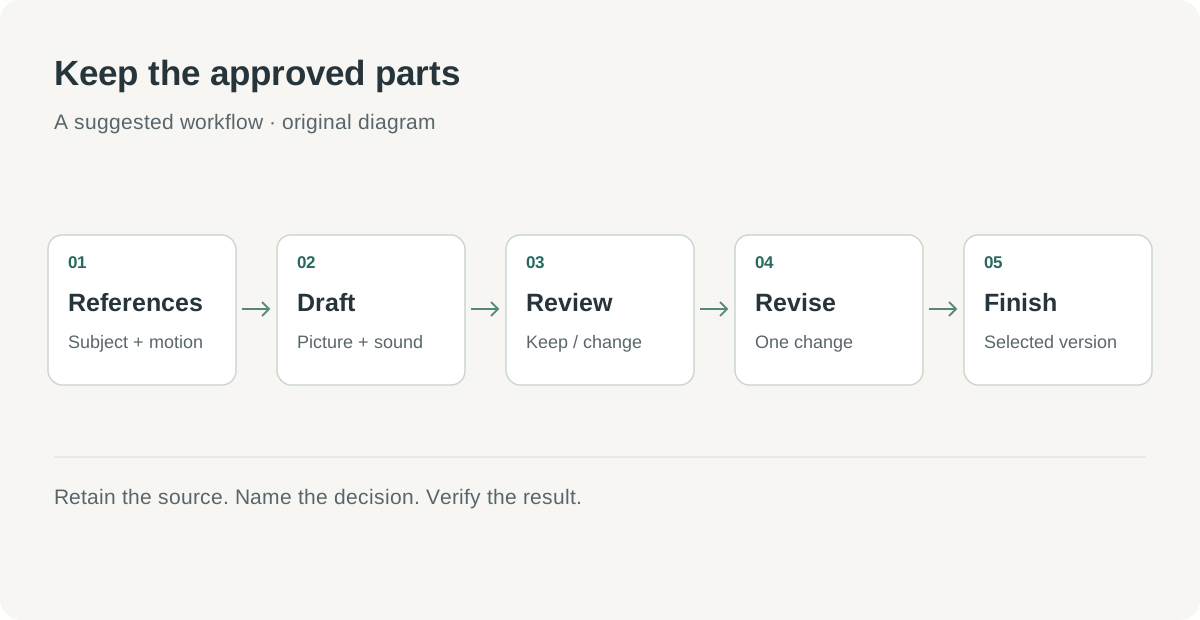 Original workflow diagram: preserve the approved parts of a draft as the team moves from reference selection to a finishing decision. This is a suggested editorial workflow, not a Pika interface screenshot.
In all three scenarios, fewer deliberate inputs are a stronger starting point than the maximum allowed count. A reference that introduces a conflicting costume, camera angle or lighting scheme can make comparison harder. Add complexity when a simple test reveals a specific missing instruction, and retain the earlier brief so the team can explain what changed.
Five sound components make revision a mixing decision
The hosted API can return five audio stems: dialogue, score, sound effects, foley and ambience, according to Pika's October 29 announcement. The technical report describes the broader video-and-audio model and its downstream editing work. The separation matters because audio approval has different priorities from picture approval.
Consider the furniture film again. A soft music bed may work on headphones but compete with a spoken product detail on a phone. Having separate components gives an editor a concrete mixing task: adjust the score, preserve dialogue, and listen again in the intended viewing conditions. The picture does not have to be the first thing reconsidered when the problem is the mix.
Do not treat component names as a substitute for listening. A useful acceptance pass checks whether speech remains understandable, whether an effect lands at the correct moment, and whether background sound changes abruptly at an edit. A mixed export and its component files should stay linked to the same approved picture version, especially when several people are revising the project.
There is also a handoff benefit. A video editor can discuss the shot with a sound editor using named materials rather than vague requests such as “make it feel less busy.” Keep the original generated mix as a comparison reference, then export the revised mix with a clear version name. That makes an approval decision reproducible even if the team later changes tools.
Downloadable inference and hosted finishing are different choices
The official repository, checked November 2, distinguishes native local generation at 480p or 768p with mixed stereo sound from Pika-hosted high-resolution processing, stem separation and other services. Downloading the adapters does not provide the entire hosted production stack. Code uses Apache-2.0, while the adapters are governed by the MiniMax H3 Community License.
That distinction should shape a buying or engineering decision. A creative team usually wants a predictable route from brief to deliverable. A developer may instead need control over inference, artifact retention or an experiment's environment. Those goals overlap, but they do not make local operation automatically the simpler or cheaper option.
| Decision | Hosted creative workflow | Local inference project | Conventional editing project |
|---|---|---|---|
| Main question | Does the service produce the assets and controls this job needs? | Can the team run and maintain the required model environment? | Can existing footage and sound solve the change? |
| First useful proof | A small approved brief with exportable results | A reproducible short generation on the intended hardware | A revision made from retained source assets |
| Cost to track | Generation, finishing, retries and review | Compute, storage, setup and engineering time | Editing time, source quality and additional production |
| Approval focus | Output quality and service terms | Output quality, licenses and operational responsibility | Output quality and source permissions |
This is a comparison of working approaches, not a performance ranking. Existing editing remains valuable when the desired change is already possible in the source project. If the team has a layered composition and recorded dialogue, adjusting those materials can be more predictable than generating a replacement. Flex is most interesting when the missing element requires new visual synthesis or reference-guided transformation.
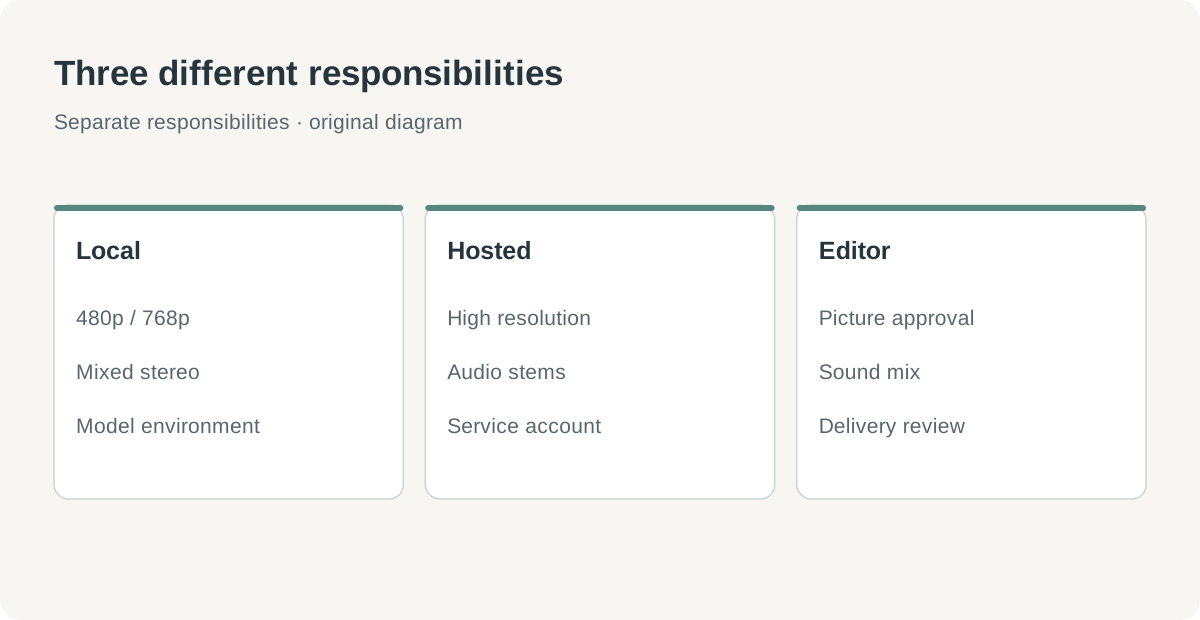 Original diagram: native generation, hosted services and editorial approval have separate responsibilities. Source for the feature boundary: Pika's repository, checked November 2, 2026.
Seven seconds measures a component of the wait
Pika's headline example is a 15-second, 768p clip in as little as seven seconds of transformer computation. The announcement describes a six-step model, compared with 50 steps before the post-training changes. The timing is specifically transformer work; uploading references, preprocessing, decoding, queueing, finishing and downloading can add time to the complete request. Pika, October 29, 2026.
For a studio, the relevant clock starts when a person commits to trying a revision and stops when the result is ready to review. Record that complete interval during evaluation. A fast model can still sit inside a slow approval loop if assets are poorly organized, references need repeated preparation, or reviewers cannot tell which version answers the brief.
Avoid multiplying a short compute time by the number of planned clips and calling the result a production schedule. A schedule needs room for rejected attempts, sound work, legal review and delivery checks. The practical benefit of speed is the chance to compare more useful alternatives within the available time, provided the team knows what it is comparing.
The same reasoning applies to resolution. Approving movement and composition at draft quality can be efficient, but finishing should follow a content decision. A sharper output cannot repair an incorrect package detail or a confusing action. Inspect the final deliverable again after finishing, because the file people receive is the asset that must pass review.
A good comparison includes the version you rejected
Build a small review sheet with the original brief, the first draft and the requested revision. Ask reviewers to judge a few named criteria in the same order: subject identity, intended change, preserved action and sound intelligibility. Keep aesthetic preference separate from a required brand or factual detail. That distinction prevents an attractive image from quietly passing a requirement it did not meet.
For the furniture scenario, a rejected version can still teach the team something precise. The lighting may be better while the chair's legs have changed shape, or the final composition may be correct while the movement becomes distracting. Record that finding beside the relevant clip instead of simply deleting the attempt. Future briefs can then reflect the actual failure without relying on someone's memory of a review meeting.
This also improves collaboration with a client. Present a small set of purposeful alternatives and explain the decision each one explores. A dozen unlabeled generations can make approval slower, even when each generation arrives quickly. The useful deliverable is a choice the client can understand and an approved version the editor can continue developing.
Start with one shot and one measurable revision
Pika announced API Club access on October 29 and named November 2 as the planned date for its creation product. The announcement's schedule is the relevant public guidance; the available surface and account entitlements should be checked when beginning a project. For developers, the repository provides a separate installation path and hardware guidance. Pika announcement, checked November 2, 2026.
- Choose a short, non-confidential creative task and collect only material you are authorized to use. Write down the intended audience, format and final message.
- Identify one subject reference and one direction reference. State what each controls and list the elements that must remain recognizable.
- Generate a draft through the available Pika surface, retaining the prompt, reference list and output together. Review the core action before asking for additional complexity.
- Request one specific revision, such as a new setting while retaining timing. Compare both clips against the preservation brief rather than against memory.
- If using the hosted audio features, review the components in an editor and make a deliberate mix. Check the result on the viewing devices that matter to the project.
- Finish only the selected version, then inspect picture, sound, captions, brand details and export settings. Record what failed as well as what passed.
For a local project, treat the repository's current setup instructions as the starting point. Allocate time for environment preparation and a small qualifying generation before promising a delivery date. A successful installation is useful evidence, but the actual short output and its retained settings establish whether the workflow is ready for the next test.
The valuable test is how much rework survives a revision
The promise of editable generation is reduced collateral change. Measure that directly. Did the revised setting preserve the approved subject? Did the audio adjustment keep dialogue usable? Could a colleague identify the selected version and continue the edit without reconstructing the brief?
Our expectation is that this is where creative teams should focus their evaluation. Spectacular samples attract attention, while repeatable revisions determine whether a tool fits daily production. The strongest pilot includes an intentionally awkward change request, because that exposes how much control the workflow actually gives the editor.
Pika H3 Flex makes the next version a first-class part of the product story. The question to carry into a trial is simple: when one thing changes, how much of the good work can you keep?
Sources
- Pika: Introducing Pika H3 Flex, October 29, 2026; checked November 2, 2026.
- Pika: H3 Flex technical deep dive, October 29, 2026.
- Pika Labs: H3 Flex repository, setup and licensing, checked November 2, 2026.
Keep a creative decision connected to its source
Telli.sh is one option for retaining authorized source material and the notes behind a creative decision. Create a note workspace.