Why PFN Wants to Stack Memory on Its Next AI Chip
PFN and SEMIFIVE's MN-Core L2000 collaboration targets a memory bottleneck in AI inference. What its development roadmap means for agents, private AI and future hardware purchases.
An AI assistant can have enough memory to load a model and still make every reply feel slow. The arithmetic units are ready, but useful computation depends on moving the right data to them at the right moment. For a company serving several private assistants, that distinction can turn an impressive chip specification into an uncomfortable wait between words.
Preferred Networks and SEMIFIVE are taking a development bet on that problem. Their November 16, 2026 announcement describes the MN-Core L2000 series, an inference-focused processor that stacks logic and DRAM vertically. The stated goal is more than twice the memory bandwidth of the preceding L1000 series. PFN posted the announcement on its website on November 17. PFN announcement
The interesting question is what that design could change for the people who eventually operate AI services. Faster data movement can matter as much as additional arithmetic, while packaging, software support and the finished server determine whether the benefit reaches a user's screen. The L2000 announcement offers a useful way to think about those decisions before a purchasing decision arrives.
The company behind PLaMo also designs the machinery beneath it
Preferred Networks is a Tokyo AI company whose work spans processors, computing infrastructure and the PLaMo model family. In this collaboration, PFN owns processor architecture and logic design; SEMIFIVE provides implementation and supply-chain services, using Samsung Foundry's platform and 3D-IC design infrastructure. PFN company and development roles
That division of work matters because a useful accelerator is more than an instruction set or a drawing of a chip. Logic design has to become manufacturable silicon, memory has to connect to it, and packaged devices have to operate consistently. A customer ultimately needs a repeatable server configuration and a software path that turns a model into an application. Each handoff can affect the finished product's cost and delivery schedule.
The connection to PLaMo gives readers a familiar entry point, but it does not establish that every PLaMo deployment will move to this hardware. A model developer and an infrastructure buyer also have different questions. The developer asks whether a workload can be expressed efficiently; the buyer asks whether the supported implementation can meet a service target over the life of the installation.
For Korean readers, SEMIFIVE's involvement is a concrete example of local semiconductor design expertise participating in inference infrastructure. The useful next question is how that expertise translates into production devices and supported systems. A collaboration announcement identifies the participants and direction; the downstream products will determine the options available to customers.
Memory capacity and memory bandwidth answer different questions
Capacity tells you how much data a memory system can hold. Bandwidth tells you how much data it can move in a given interval. A model can fit within the first limit while the second limits how quickly the processor can work through it. Adding capacity alone does not guarantee that the application becomes more responsive.
A simple planning calculation makes the first distinction visible. A hypothetical dense model with 30 billion parameters stored at two bytes per parameter needs about 60 billion bytes for those parameters alone. That arithmetic excludes runtime workspaces, cached attention data and other overhead. It is an illustration of storage budgeting, not a statement about the L2000's capacity or supported models.
The next question is how the workload uses what it stores. Processing an incoming prompt and generating successive output tokens place different demands on the system. NVIDIA's inference optimization explanation distinguishes the parallel work of prompt processing from autoregressive decoding, where memory movement can become a constraint. It also explains why batching and attention-cache management change the balance. NVIDIA's inference optimization guide, November 17, 2023
Think of memory as a pantry connected to a kitchen. A larger pantry helps keep the ingredients on site; a wider passage helps the kitchen receive them. Neither tells you how long a particular meal will take, because preparation and the rest of the workflow still matter. Hardware comparisons become more useful when those separate jobs remain visible.
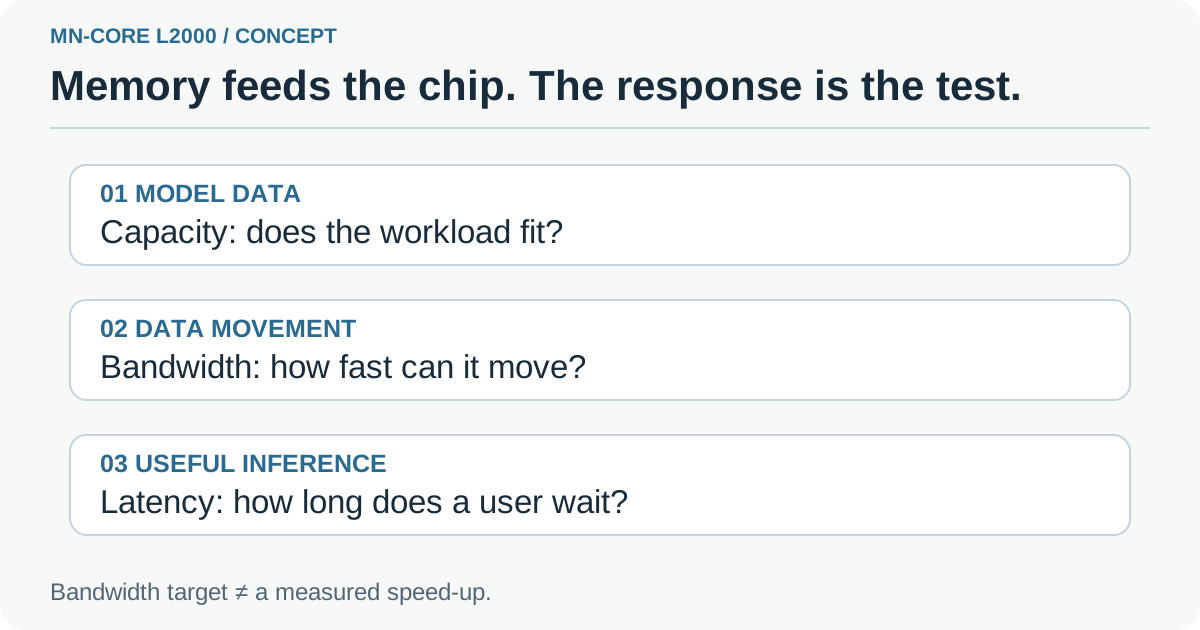
An original explanatory diagram separating storage, data movement and application response. It illustrates the decision, rather than depicting an unpublished L2000 package layout.
Stacking changes the engineering problem as well as the data path
PFN's official announcement includes a diagram of the MN-Core L series' vertically stacked logic and DRAM. It is a useful view of the direction being proposed. It does not show the complete server that a customer would install, or establish the performance of a finished application.
Bringing components into a stack means the design has to work as a physical system. Power delivery, heat removal and manufacturing consistency belong in the same conversation as data movement. These are not afterthoughts to be solved once an architecture looks attractive on a slide. They influence whether devices can be produced, packaged, cooled and supported at a useful cost.
For an operator, the package design is therefore the beginning of an investigation rather than its end. A rack has a power envelope, a facility has a cooling design, and the service has an uptime expectation. A proposed accelerator must eventually fit all three. The economic benefit depends on the complete installation, including the equipment and labor needed to keep it running.
This is also why an efficiency story should travel with its measurement conditions. A favorable result for one model, precision and concurrency level cannot describe every workload. A customer needs to see where the system performs well, where it runs out of headroom and how much energy the complete service uses to deliver useful answers.
Three workloads would ask three different questions
Consider a private document assistant for a legal or engineering team. This illustrative service has irregular arrivals and users who notice the delay before an answer starts. Its evaluation should include representative documents, retrieval time and the model's first response. An accelerator can improve part of that path while a document search or access-control check remains the larger delay.
A second example is an internal agent that calls a model repeatedly while completing a task. Here, one slow generation can affect several dependent steps. The useful outcome is the time needed to finish a correctly authorized task, including tool results and any human approval. Increasing the model's token rate helps only the part of the workflow that actually waits for generation.
A third example is an overnight processing queue that classifies or summarizes a large collection of records. It can accept more batching and care more about total completed work before a deadline. That workload may prefer a different configuration from an interactive assistant, even when both use the same model. A procurement review should preserve that distinction rather than choose whichever demonstration produces the largest headline number.
These scenarios are evaluation plans, not L2000 trials. They show why a memory-focused architecture can be worth following without assuming a single performance outcome. The best pilot begins with a workload the team already understands and a result it can compare against its current system.
| Decision | What a team should bring | What the result needs to show |
|---|---|---|
| Private document assistant | Representative questions, documents and access rules | Useful answers arrive within the agreed response target |
| Multi-step internal agent | Complete tasks, tool calls and approval points | End-to-end completion improves without losing correctness |
| Overnight processing queue | A fixed record set and completion deadline | Required work finishes reliably within the operating budget |
A bandwidth target is one input to a service estimate
Our view is that the most useful comparison starts with the work being bought. A team does not purchase bandwidth in isolation; it purchases the ability to complete tasks under constraints. That requires a chain of evidence from the model and runtime to the server and application.
Begin with model support. The exact architecture, precision and required operators have to work in the supported software stack. A compiler or runtime that can execute a demonstration may still leave integration work for a production service. Ask which versions are supported, which operations need conversion, and who maintains that path when the model changes.
Then separate response measures. Time to the first usable answer, speed during generation and total completed requests describe different experiences. Record them under the same input sizes and concurrency, with failed or incomplete responses included. A faster run that changes output quality or silently drops requests is a different result from a service improvement.
Finally, put the application back around the model. Retrieval, moderation, tool access, queues and network traffic all consume time. A hardware pilot should show how much of the full task waits on inference. That gives the team a reasonable estimate of the benefit it can actually expect from a faster inference path.
The next visible milestone is a design handoff
The announced tape-out target is the first quarter of 2027: the point at which final design data is handed over for manufacturing. That is a development milestone, not a delivery date for a finished server. PFN development roadmap
Manufacturing, packaging, bring-up and validation still need to connect the design to a usable product. Software qualification and system integration then determine what customers can deploy. Progress through those stages can produce important news well before a general sales launch, but each stage answers a different question.
The same discipline applies to the comparison baseline. L1000 is itself scheduled for a 2027 release, so the announcement compares development generations rather than two systems available for purchase today. There is no published L2000 retail price, Korean delivery schedule or finished-system benchmark in the announcement. A purchasing timetable should be based on a supplier's eventual supported configuration and delivery terms.
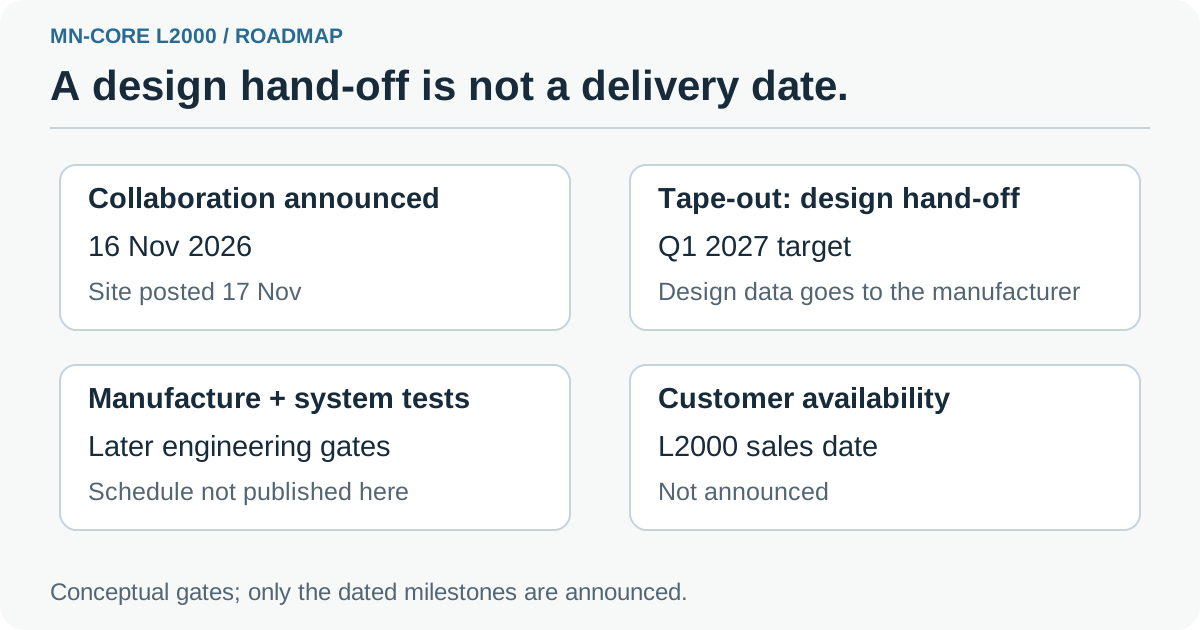
An original development-stage guide. The announced tape-out target is marked separately from later manufacturing, qualification and customer delivery; those later dates remain open.
What a practical evaluation file should contain
There is useful work a team can do while following the roadmap. It should produce a compact baseline that remains valuable whether the eventual purchase is an MN-Core system, a GPU server or a hosted service. The point is to make future hardware comparisons cheaper and more meaningful.
- Choose the complete job. Define one interactive task and, if relevant, one batch job. Record what counts as a correct completion and the response or completion deadline.
- Fix the test material and software versions. Keep the prompts, input documents, model revision, precision and runtime settings together. Use material the team is authorized to process.
- Measure the current path. Record model response time, full task time, failures and resource use under the expected load. Note when the service spends time waiting for retrieval or tools instead of generation.
- Ask for a matching supported configuration. A future vendor trial should identify the accelerator, memory configuration, host, runtime and model support. Keep any changes to quality or precision visible.
- Compare the operating decision. Include acquisition, software integration, electricity, cooling, support and recovery work. Judge whether the improvement solves the original task at an acceptable cost.
This file is more useful than a collection of unrelated throughput screenshots. It prevents a team from changing the workload each time a new system arrives. It also makes it easier to spot a genuine gain: the same job, completed well, with less delay or a lower operating burden.
For a small team, the immediate decision may be to keep using its current hardware while improving the application. If retrieval dominates response time, faster inference alone will have a limited effect. If the service consistently waits on generation under the required load, a new accelerator becomes a more relevant trial candidate. Both findings help direct spending toward the bottleneck that affects users.
The hardware story is moving closer to the memory
The L2000 collaboration is worth following because it connects an inference problem to the physical design and production work needed to address it. The next useful evidence will be progress through manufacturing and software qualification, followed by measurements on supported systems. Those results will show which workloads benefit and what an operator has to invest to obtain that benefit.
For now, the practical lesson is already available. Keep model capacity, data movement and application outcomes separate when comparing AI hardware. A model fitting into memory is the start of the conversation; a dependable service is the result the buyer needs.
Sources
- Preferred Networks, PFN and SEMIFIVE Collaborate to Develop the MN-Core L2000 Series, announcement dateline November 16, 2026; website posting November 17, 2026. Includes the official structure diagram and development timetable.
- Preferred Networks, Japanese-language announcement, the corresponding company release.
- Shashank Verma and Neal Vaidya, NVIDIA Technical Blog, Mastering LLM Techniques: Inference Optimization, November 17, 2023. Background on inference phases, batching and memory use, not a benchmark of MN-Core hardware.
Keep the workload, model settings and supplier answers together so the next evaluation starts from a comparable baseline. Start your first note with Telli.sh.