Which link should an AI cite? Perplexity’s Decider can help sort the queue
Perplexity added page scoring to its Context API. A release briefing shows how the scores could prioritize sources and why you still need to check the evidence.
An analyst prepares a Monday briefing on software releases. A search for one product turns up a vendor blog, a changelog, a reseller’s announcement and a community thread. Several entries mention the new feature. The brief still needs a link that tells readers whether they can use it today, where it is available and which version includes it.
Perplexity, the company behind an AI answer engine and developer APIs, added a way to score pages before sending them through the rest of a research workflow. On November 19, 2026, it announced Decider for its Context API. A developer can ask a yes-or-no question about the pages Context fetches, and Decider returns a score from zero to one for each page. That gives the briefing team a way to prioritize possible sources while retaining a separate check of what each source establishes. Perplexity’s Decider announcement and official demo
The result is most useful when the question describes something a reviewer can also check. In this briefing, researchers could ask whether a page appears to be the publisher’s release note for the named change. They could put likely matches near the top of the review queue, then confirm who controls each page, when it was posted and what it actually says about availability.
Fetching a page and deciding what it can support are separate jobs
Perplexity announced the underlying Context API on November 18. It takes a list of up to ten URLs per call and can return a cleaned Markdown representation, HTML, links and selected passages. The URL list comes from the application, such as a mix of known publisher pages and candidates found by search. Perplexity also describes controls for freshness and response metadata indicating whether a page came from its index or from a live fetch. Context API launch · Perplexity’s Context API overview
The distinction matters when keeping a briefing current. A search result may say a company announced a feature this month. A closer look at the page may put a public beta in the following month, or a release note may carry both a stable version and a preview version with similar names. A fetch answers whether the application can obtain the relevant text and when it obtained it. A page score can help decide what the reviewer reads first. The date, version and access conditions still have to come from the source.
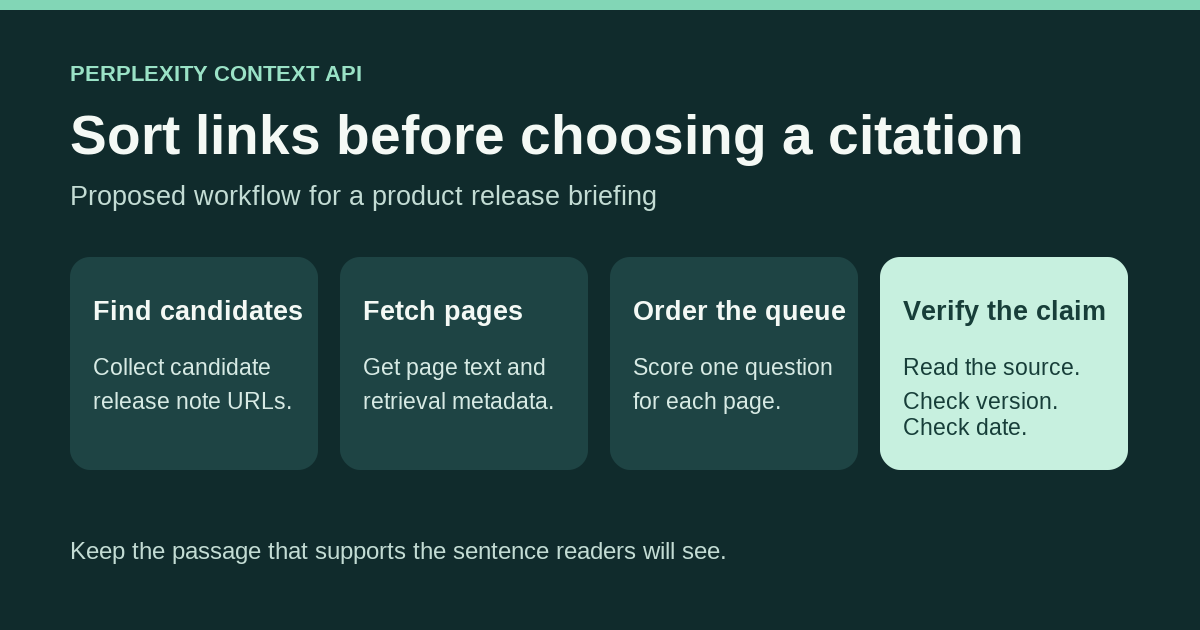
Proposed editorial workflow. Decider provides the page scores, and the surrounding application owns the queue and evidence review.
Imagine the candidate set includes a release blog announcing a feature and the current help-center article describing how to enable it. The first page might be the right source for the announcement date. The second might answer how eligible accounts turn the feature on. That is a reason to search and triage for the specific claim the briefing needs, rather than treating a single rank as a universal measure of source quality. It also lets the reader follow the exact link that supports the sentence they are checking.
A narrow question is easier to score and easier to review
An editor could begin with, “Does this page present itself as the publisher’s release note for the named product and version?” That question has visible cues such as a release heading, version number and named product. A broader question such as “Is this a good source?” mixes authority, timeliness and usefulness. Reviewers may disagree about which criterion they are applying, making it difficult to learn anything from the score distribution.
A publisher’s changelog and a vendor’s marketing blog can both come from an official domain, while only one of them can have the exact release details. A well-written third-party guide might be more readable than either. It can still be valuable as background. For this job, the team could give each link a separate editorial role. A changelog supports the version and release date, a help page supports a setup instruction, and a community report can point to a question that needs more checking.
Keep domain checks explicit. A team that regularly covers the same products can keep a small list of publishers’ known domains and documentation locations. A new domain or a surprising redirect can go to review. Search snippets, page titles and publisher names are useful hints, and a reviewer can open the page to confirm the destination, check for a stable URL and read the evidence in context. The score can accelerate that step by sorting candidates, while official origin is checked separately.
The zero-to-one scale deserves care. A score of 0.9 is a value for the question asked. Reading it as a 90% chance that a source is genuine would require calibration evidence. The November 19 announcement describes a scoring range and a demo. It provides no accuracy or calibration results for this release-note question, nor does it specify separate Decider pricing or regional availability. Perplexity’s Decider announcement
Compare the number of links you read with the sources you miss
Start from archived briefings whose relevant links are already known. Keep the full set of candidate URLs for each historical question if it is available. Have a reviewer label each URL by its role before looking at Decider scores. Include official update pages, duplicate mirrors, outdated pages with similar titles and useful nonprimary explanations. If the sample consists only of obvious hits and unrelated pages, it will tell the team very little about the links that take time to distinguish in practice.
Run a comparison using the same URL set. One queue can use the rule the team already follows, such as known official domains first. Another can use the scores within each candidate group. Check how many pages a reviewer would open and count any relevant first-party pages left below the point where review stops. If requests are made in batches or the team retries an unavailable page, retain that information. Missing content, a missing result and a negatively scored page lead to different follow-up actions.
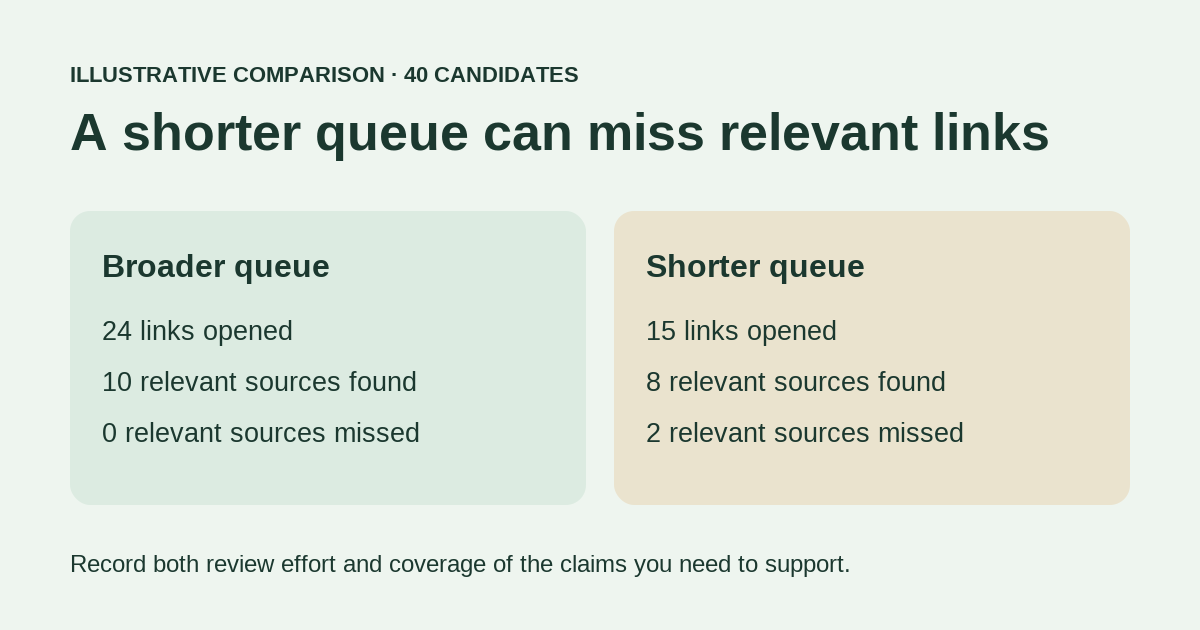
Example counts for the same 40 candidate pages. These are hypothetical and show how to read the tradeoff.
For example, suppose a review set has 40 candidates, 10 of which are relevant first-party pages. Opening 24 links might find all 10. An alternative queue that opens 15 links might find eight. The second queue saves nine page visits. It also leaves two relevant pages unread. This is an illustration of the comparison a pilot could make. Which queue helps depends on whether the two pages change the claims in the briefing, and how much time the reviewer spends recovering them.
For a claim about rollout, the missed page could be an enterprise support notice that narrows availability. An editor might choose a broader queue on purchase, access or compatibility claims and use a tighter queue on routine background research. The example also shows why counting accepted sources alone is insufficient. The team needs to know which sources would have made the answer better and whether a human still finds them in time.
Give uncertain results a path back into review
An editor can set up the queue in tiers. Show recognized publisher pages high in the queue, mark ambiguous cases for a decision and move context-only links into a separate group. Record the question used for each score along with the observation date and the URL. If a publisher reorganizes documentation or starts using separate pages for a region, the team can see which version of the rule produced its past choices and run the same comparison again.
Keep two clocks in the record. The content can have a publication date or a last-updated date. The API retrieval has its own time and freshness status. A page fetched this morning can still describe last month’s beta. For a claim that turns on timing, open the current publisher page and capture the exact date and qualifiers in the material you plan to cite. A repeated query on another day should make it easy to see whether the underlying evidence changed or a different candidate simply rose in the queue.
The team also needs a way to handle pages that fail to load. Perplexity describes a status for each URL in a Context response, which makes it possible to keep successful results and investigate an individual failure. A proposed editorial workflow would label those pages as unavailable for assessment. For a critical claim, retry or find another official page, and carry forward the uncertainty if no source confirms it. Perplexity’s Context API overview
Judge the whole workflow by what makes it into the brief
Perplexity’s Context API launch notice quoted $1 per 1,000 URLs fetched. Treat that as the published base fetch price in that announcement. The Decider announcement does not specify how scoring is billed. In a small test, record the actual usage for retrieval and scoring, and measure the editor’s time to reach a publishable claim. Minutes saved on the first pass can disappear if someone spends just as long correcting a statement downstream. Context API launch pricing · Decider announcement
There is a simple acceptance test for the briefing. Give another editor the draft claim and its citation. If they can identify the original statement, its date and the eligibility or version caveats without reconstructing the search, the workflow has produced a useful result. If they can only tell that the source ranked highly, give the next pilot a stricter evidence requirement. What matters is how quickly reviewers reach the sources that let them make a claim they can defend.
Keep release notes, citations and the passages behind each claim together. Start your first note with Telli.sh.