Pangram can flag a corner of an image. What can an editor do with that?
Pangram Image 1.0 adds heatmaps and frame-level video screening. Here is how to turn a flag into a useful verification step.
A reader sends a 12-second clip of a flooded intersection. The first few seconds look like something shot from a car window. The last few show water pouring out of a storefront, and that is the moment the sender wants the newsroom to publish. Where do you begin? You could check the whole clip for synthetic content, but what you need is a way to decide which frames to check against other evidence.
On November 4, 2026, AI-detection company Pangram released Pangram Image 1.0 and Image Flash 1.0. The flagship image model produces a heatmap that points to regions the detector associates with AI content. The faster Flash model supports analysis of uploaded video across frames, so a reviewer can see where the result changes during a clip. The release also extended Pangram's API to image and video and added image detection to its Chrome extension. Pangram release notes
Think of the heatmap as a highlighter. It can direct a person to a storefront sign, a patch of sky, or a few seconds in a video. The editor still needs to learn who supplied the file, how it traveled, and whether its claim holds up. Those questions are especially important when a finding can delay coverage or affect a person's reputation.

Context photograph of Austin’s 5th and Guadalupe streets, taken on February 20, 2021. Photograph by Jno.skinner, cropped and resized under CC BY-SA 4.0. Original photograph

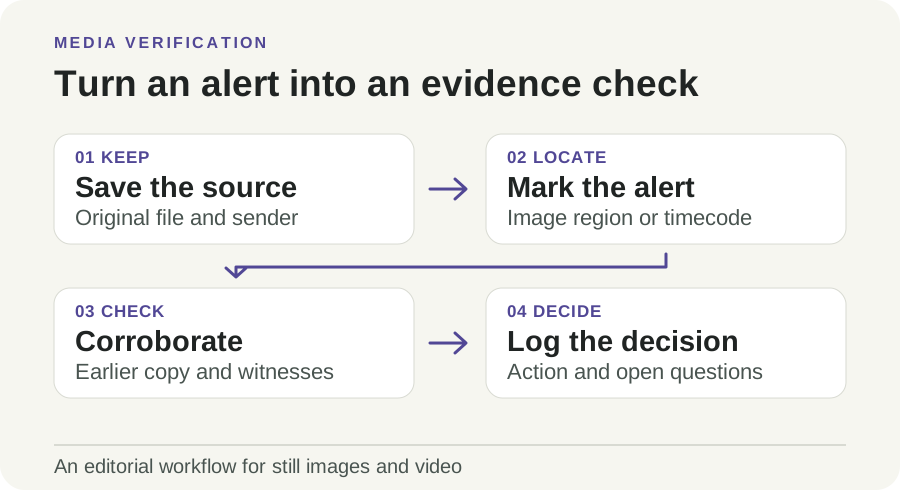
Original illustration by Telli.sh. A detector can narrow the search. Independent checks determine how much weight the finding deserves.
A heatmap makes it easier to ask for the right evidence
Suppose the flooded intersection is real, but a store logo in the clip appears smeared in a way that suggests digital editing. A person might reasonably ask for the original video and a contemporaneous photo from the same vantage point. The heated region helps them describe what to look for. The comparison should still consider shadows, motion blur, video stabilization, crop boundaries, and the possibility that a platform changed the file during upload.
Pangram's release illustrates the use of heatmaps with a photograph that contains an AI image. That example matters because a photo can mix content from different origins. A composite can also be explicitly labeled and perfectly legitimate. The practical question is whether the change alters the factual claim the image makes. Editing out a bystander's face for privacy is a different editorial decision from inserting a crowd into an empty scene. Official heatmap example
The original file matters more than the color intensity on the overlay. The version in a group chat may be smaller than the source and lack metadata. Ask for the unmodified camera export or the earliest version the sender can provide. Keep it separately from screenshots, crops and reposts. For each derivative you inspect, record where it came from and how it was made. If a finding appears only after a platform resizes the file, put that disagreement into the review record.
Pangram lowered its minimum input size from 512 × 512 to 256 × 256 pixels in this release. Its announcement says the service attaches a reduced-confidence notice below the former 512-pixel threshold. A small thumbnail can help find a better copy or identify the source account. If it is the only copy available, the reduced-confidence notice belongs next to any decision that uses the result. Input-size change
A video can change character between cuts
Consider a 12-second clip assembled for social media. The opening shows the approach to a building. A wide shot shows the entrance, and the final shot shows water inside. Each segment could have a different source, and the cut may have been made before you received the clip. A frame-level result is useful because you can jump to the transition, compare frames on either side, and ask whether the interior segment also appears in the earliest version.
Use the reported moments as timecodes, then inspect the sequence at normal speed and frame by frame. First look for changes a normal editor would make, such as a cut, crossfade, title, screenshot, or insertion of a second clip. Next match the disputed section to the event's location and time. A striking visual signal gains value when the signage, building facade, weather, or another recording independently supports a line of inquiry.
One pattern is especially easy to misread. Imagine a genuine clip with an automatically generated thumbnail, a dubbed voiceover, and a caption strip. All three changes might be obvious to the uploader and absent from the original file. A frame-level tool addresses the visual material it receives. Treat questions about the original audio, who recorded it, whether the date is correct, and whether the thumbnail represents the scene as distinct checks.
The reverse case deserves equal time. A genuine clip from three years ago can pass a synthetic-image screen and still be miscaptioned as a current event. An authentic photo reposted with the wrong location is a provenance problem even if every pixel came from a camera. Reverse-image search, event records, and the earliest known post remain useful whenever the accuracy of the caption matters. This is where a workflow built only around a detector will leave an obvious hole.
Vendor test accuracy needs a denominator and a base rate
For the image release, Pangram says it began with 100 real photos and generated 1,200 synthetic counterparts using 12 generators. Its announcement reports an aggregate image accuracy of 99.96% without spelling out how it aggregated the results. For the video comparison, the company used 129 real social clips and 1,400 synthetic clips from 14 generators. It used the first real frame and a description of the original movement to condition generation, giving pairs similar subject matter. These are Pangram's reported tests for its November 4 release. They make useful comparisons inside that setup. Pangram image and video evaluations
Why mirror the content? A benchmark where every real clip is a local news interview and every generated clip is a fantasy landscape would let a system exploit the topic. Matching the scene, subject, or first frame reduces that shortcut. Distribution still matters. A rental-market queue will have property interiors, reposted photos, watermarks and old listings in different proportions from the benchmark. The team's review threshold should come from examples resembling its real queue.
Pangram also reports a 98.7% result for Flash on DF26. DF26 is a separate research benchmark centered on talking-head video. Its researchers describe a set of synthetic and authentic clips and measure how people and detectors perform. Keep the authors' benchmark and Pangram's score on that benchmark separate when describing the evidence. A result on talking heads does not give you a measured rate for screenshots, property tours or surveillance footage. DF26 research preprint · Pangram Flash result
Here is why even a good detector needs an agreed second step. Imagine a queue of 1,000 files in which 10 contain relevant synthetic edits. For an illustrative detector that flags 9 of those 10 and flags 1% of the other 990, reviewers would see about 19 alerts. Around 10 would come from files without the edits in question. Those values describe an example, separate from Pangram's reported accuracy. They show why the proportion of real issues in a queue changes what a flag is worth.
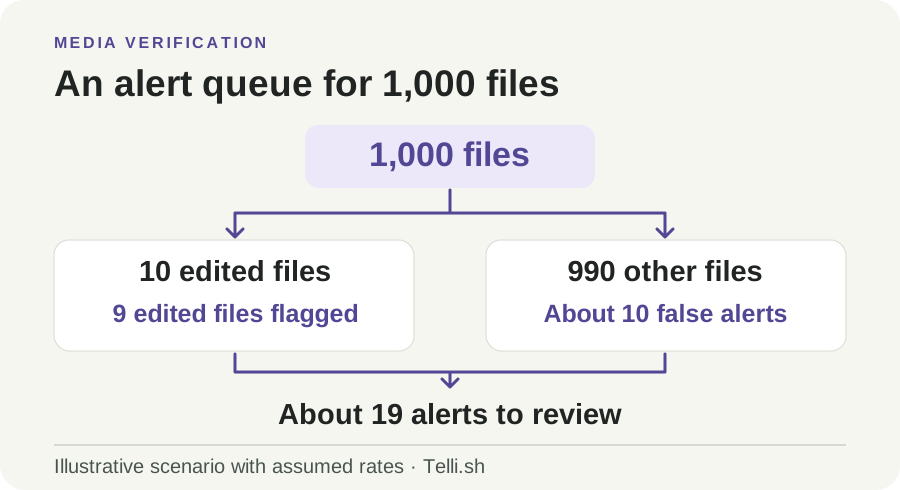
Original illustration by Telli.sh. The rates are illustrative and show why a review queue can include many false alerts even when the false-positive rate looks small.
| Review context | Evidence to preserve | Useful next check |
|---|---|---|
| Photo sent to a newsroom | Earliest file, the sender's account of capture, the published crop | Compare the highlighted region with an original or another independent view |
| Video added to a public listing | Listing date, upload version, suspicious timecodes | Ask for the original walkthrough and compare features that are visible from another angle |
| Visual claim in a product dispute | Original submitted file, post ID, moderator notes | Check whether the same photo appears in older listings or shows a different item |
| Licensed image under routine review | Source agreement, contributor description, review output | Confirm whether editing or generated backgrounds were disclosed under the applicable policy |
Give the reviewer a queue they can explain
A product marketplace has a different error cost from a newsroom. A newsroom can hold a disputed image and ask the reporter for a better copy. A marketplace may make a decision that affects a seller's account. A retailer assessing submissions can test three labeled groups separately: verified originals, intentionally generated examples, and authentic images that were resized, compressed, or edited. Include the files that look hardest to judge, such as scans of paper photos, low-light phone pictures and images with embedded overlays.
Record errors as concrete events. Count how often reviewers open a flagged item, how often they find actionable independent evidence, how many verified originals are escalated, and how much time each review takes. Watch for an error concentrated in a particular capture pipeline, such as night-mode photos from one phone family. A single aggregate score can conceal a workflow that looks efficient overall but repeatedly fails the same contributors.
People affected by a decision should be able to understand what evidence they can provide. A seller can send the camera original or show the item from a second angle. A contributor can share the publication history or license. The point of allowing that response is to resolve a specific factual disagreement. A detector score can justify gathering more evidence, while an account action should follow the marketplace's own decision policy and review process.
Ask whether the review system can identify which file and model produced a result. Different platform exports of the same scene deserve separate records, as do outputs obtained at different times. A detector update can shift behavior and affect previously borderline files. Keep the original and the review trail together long enough to answer a dispute under your retention policy, then remove what the policy no longer requires.
Set up a small pilot before adding automatic intake
- Choose a narrow decision. Define one action, such as which public news tips need a second source. Separate it from an eventual decision to publish, remove, or penalize.
- Assemble known examples. Start with a small set of owned or authorized originals. Add a matched re-encoded copy and a known synthetic or edited variant where appropriate. Include both the upload dimensions and the claimed event or subject.
- Check the service path. Pangram offers browser upload, a Chrome extension and an API. Use only the path your organization has approved for the files in question. Review retention and access terms before sending private or sensitive material.
- Review regions and timecodes. Give the reviewer the source version and the evidence they need to corroborate a finding. Have a second person check a disputed segment where the stakes justify it.
- Measure the decision you picked. Compare review time, useful follow-ups and false escalations with your existing process. Add automation only once you can explain what a flag changes in the workflow.
If a file includes a Content Credential, check what the signed record actually attests to. C2PA defines a format for verifiable assertions about media and editing history. The assertions have an issuer and a scope. A verified record can give a reviewer something concrete to inspect, while the absence of a credential may simply mean the capture or sharing path did not preserve one. Treat the credential, the source's account, and the detector result as separate evidence in the same case. C2PA specifications
The escalation point is what matters. In a newsroom, it might be a hold until a second source arrives. In a marketplace, it might be a request for a fresh image with the item in view. In either setting, name the missing evidence and give the person handling the case a way to acquire it. A result that says where to look has more operational value when the next step is defined before the queue fills up.
The best alert ends in a better question
A useful detector alert gives a reviewer a concrete next move. It may tell an editor to request the original frame at nine seconds, or a marketplace reviewer to compare the storefront crop with another photo from the same uploader. The verdict remains tied to the evidence that matters for the actual claim. When a heatmap improves the questions a reviewer asks, its contribution becomes visible even in cases where the initial flag turns out to be wrong.
Sources
- Pangram Image 1.0 and Image Flash 1.0 announcement, November 4, 2026
- DF26 research preprint and benchmark
- Pangram data privacy FAQ
- C2PA technical specifications
- Austin context photograph by Jno.skinner, CC BY-SA 4.0
For a searchable record of the discussions and source decisions behind your work, Create a Telli.sh account.