Oracle's six implementation agents target the work before an ERP goes live
Oracle AI Success Navigator adds agents for discovery, design, configuration, testing, integration and adoption. How the proposal changes ERP implementation, and what a useful evaluation should examine.
Original editorial diagram by Ken Jo, based on the sources listed below.
Before a new business system can approve an invoice, somebody has to decide who may approve it, how the company is structured and which other systems must exchange information with it. Those decisions become designs, configuration settings, integration code and tests. The software subscription is only the beginning of that work.
On October 26, 2026, Oracle announced an agentic implementation platform delivered through Oracle AI Success Navigator, with six agent roles spanning discovery, design, configuration, testing, integration and innovation. Oracle supplies business applications for areas including finance, human resources and supply chains; this announcement focuses on the work required to introduce and improve those applications. Official announcement.
The interesting change is where assistance enters the process. An agent that helps use an existing ERP works within an established setup; an implementation agent helps create that setup. This article explains the registry behind Oracle's approach, three practical evaluation scenarios and the evidence a project team should require before turning generated configuration into operational reality.
The expensive handoff happens between a business rule and a setting
Enterprise resource planning, or ERP, connects core business activities through a shared application and data structure. Even a familiar process, such as approving a supplier invoice, contains choices that vary by organization. The right configuration depends on those choices being made explicitly and translated consistently.
Consider an illustrative requirement: invoices above a certain amount need an additional approver. A project team must establish the amount, the currency, the relevant business unit and what happens when the approver is unavailable. The implementation has to preserve those decisions across the design, the settings and the tests.
An attractive diagram is not enough. If the written rule and the deployed configuration diverge, the system can behave consistently while doing the wrong thing. That is why implementation work includes repeated handoffs among people who understand the business, the software and the operating environment.
Oracle's proposal targets those handoffs. The opportunity is to carry product-specific knowledge into the work of planning and configuring a system, reducing the amount of setup reasoning that each team reconstructs. Our take: the meaningful outcome is a shorter path from a reviewed requirement to a tested configuration whose behavior the business can explain.
FSCR gives an agent a product-specific instruction set
Oracle announced the Fusion Setup and Configuration Registry, or FSCR, on the same date. It describes FSCR as a public Git repository containing machine-readable, executable implementation knowledge, including configuration options, dependencies, sequencing, testing and validation. Oracle says it maintains the registry alongside Fusion Applications. FSCR announcement, October 26, 2026.
That is a more specific proposition than giving an agent a collection of general ERP articles. A useful implementation instruction must connect a desired outcome to the settings and prerequisites that produce it. It also needs a way to check whether those settings achieved the intended result.
Think of the registry as a recipe book tied to the actual kitchen. The ingredients and sequence need to match the software that will execute the work. A recipe that ignores a required prerequisite can sound plausible while leaving the application in an incomplete state.
The registry does not choose the company's business policy. An organization still needs to decide its approval structure, operating model and acceptable exceptions. Product knowledge can help translate those decisions; it cannot resolve a disagreement between stakeholders merely by generating a longer implementation plan.
For a project team, version alignment becomes a useful question. Which product release and registry revision informed the proposed setup? If the application changes, which assumptions need to be checked again? These are evaluation questions derived from the registry approach, not claims about a particular automatic tracking control in the product.
Six agent roles divide the work into reviewable outputs
Oracle's October 26 announcement assigns the new agents different jobs. Discovery examines the current situation; design turns processes into application designs; configuration builds prototypes; testing develops relevant cases; integration addresses connections to existing systems; innovation identifies further adoption opportunities. The distinction matters because each stage should produce something a different reviewer can understand.
An implementation team should not have to approve “the AI's work” as an undifferentiated package. A business owner can review a process design, an application specialist can review the configuration and a test lead can examine whether the cases cover the intended behavior. Dividing the work by artifact makes the discussion more concrete.
| Announced role | Output a project team can examine | Question for the responsible reviewer |
|---|---|---|
| Discovery | Proposed scope, gaps and risks | Does this reflect the actual operating situation? |
| Design | Application design derived from business processes | Have the right decisions been made explicitly? |
| Configuration | Prototype settings based on the design | Do the settings implement the approved behavior? |
| Testing | Use cases and execution steps | Do the tests include exceptions as well as ordinary work? |
| Integration | Connection scope, architecture and code | Are the data and failure conditions handled correctly? |
| Innovation | Prioritized opportunities for further adoption | Which change has a clear owner and useful outcome? |
The first two columns summarize the announced roles; the reviewer questions are our proposed evaluation criteria. They make it possible to examine useful outputs without pretending that a role name establishes the quality of every result. A well-structured draft still needs to be tested against the organization that will use it.
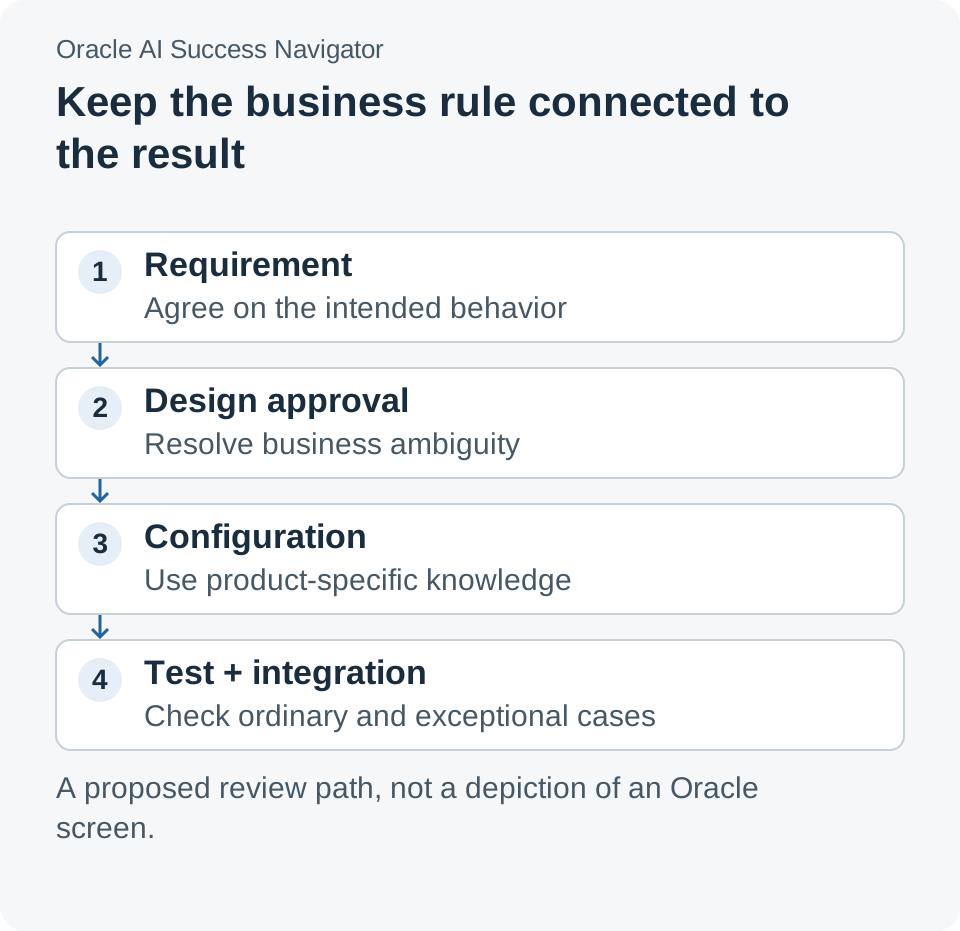
An implementation should preserve the connection between a business requirement and the configuration that satisfies it. Review points are proposed evaluation boundaries, not a claim about a particular Oracle screen.
A finance prototype reveals whether the design is specific enough
The first useful scenario is a small finance process in a test environment. Choose one approval rule with a normal case, an exception and a case that should stop for review. The purpose is to see whether the proposed design makes the intended behavior explicit before configuration begins.
For example, a team might supply a fictional supplier invoice and two possible approvers. The design should explain which person handles which case and what happens when required information is missing. These are illustrative inputs; they are not a description of a deployment performed for this article.
Once the team approves the design, inspect how the prototype represents it. The useful evidence is the relationship among the requirement, the relevant settings and the observed result of each test. A passing ordinary case is encouraging, but the exception often reveals whether the setup actually reflects the business rule.
This is also where ambiguity becomes visible. If two stakeholders give different approval thresholds, generating a configuration does not settle the policy question. The next action is to resolve the disagreement and record the approved rule, then regenerate or adjust the affected work.
An integration trial exposes the work between applications
A second scenario is a bounded connection between Fusion and an existing system. Pick a single business object and specify which system owns it, which fields must move and how errors should be handled. A small scope makes it easier to distinguish a useful generated integration from a large quantity of plausible code.
Suppose an illustrative customer record arrives twice because a request is retried. The project team should decide whether the receiving system updates the existing record, rejects the duplicate or creates a new one. The correct behavior depends on the business and technical contract; it is not something to leave implicit in a generated implementation.
Ask for evidence at the boundaries. What happens when an identifier is missing, a destination is unavailable or a field contains a value that the receiving system cannot accept? These cases turn an integration discussion from a successful demonstration into a review of operational behavior.
Oracle's FSCR announcement explicitly describes expert reviewers examining completed configurations, requesting adjustments and approving deployment. Apply the same discipline to integration outputs: review the generated work, test it with representative data and define how a failed change is recovered. Faster creation is valuable when the resulting connection remains understandable to the team that will maintain it.
An existing platform can support evaluation before every new agent is available
Success Navigator already has a public product experience around implementation and adoption. Oracle's May 11, 2026 description of its 26.1 release discusses the AI Assist homepage, update planning, release readiness, adoption roadmaps and Starter Configuration. Those existing capabilities provide context for the platform receiving the October agent additions. Official 26.1 release article.
A third evaluation scenario therefore concerns an existing Fusion customer's next update. The team can identify a candidate feature, the process it affects and the people who must understand the change. The proposed value is a more coherent decision about adoption, rather than enabling a feature because it appears in a release list.
Keep the evaluation tied to an observable outcome. If a change is meant to simplify a review process, establish how the review currently works and what would count as improvement. The team can then decide whether the feature deserves configuration and testing effort, rather than treating a recommendation as a deployment instruction.
Availability needs the same precision. The October announcement discusses early adopters and additional agents, but it does not supply one universal general-availability date or a separate price for every role. Before planning a trial, establish which capabilities and access conditions apply to the actual account.
The 80% figure describes a particular part of one implementation
Oracle quotes Lexington Health as having reduced certain design and configuration efforts by 80% through the agentic delivery approach. The statement appears in the October 26 announcement and comes from the customer. It is useful evidence of an early adopter's reported experience, with a specific boundary around the work being described.
That boundary changes how to use the number. It is not an 80% reduction in an entire ERP project's duration or budget, and it does not establish the same result for another organization. Testing, data work, integration, training and organizational decisions can occupy different shares of different projects.
An illustrative calculation shows why the denominator matters. If a hypothetical project devotes 100 hours to a particular design activity and 400 hours to other work, an 80% reduction in that design activity saves 80 of the total 500 hours, or 16%. Those invented inputs explain the arithmetic; they are not Lexington Health's project figures or an estimate of Oracle's performance.
Use a reported percentage to formulate a measurement question. Which activity became shorter, what was the previous baseline and which work remained? A project team can then compare its own bounded task without importing an attractive number into an unrelated business case.
A useful first evaluation follows one requirement to its outcome
The first trial should be small enough that people can inspect the complete chain. A narrow process with clear acceptance criteria will reveal more than a broad request to “implement finance.” The following procedure is a proposed way to evaluate the announced approach.
- Confirm access and scope. Use the Success Navigator account-request path and establish which announced capabilities are available for your organization and environment.
- Choose one business process. Name the owner, the intended result and the exceptions. Use a test environment and appropriate sample data.
- Record the starting baseline. Estimate or measure the current effort for that specific task, and keep unrelated project activities outside the comparison.
- Review the proposed design. Resolve ambiguous requirements before configuration. Preserve the approved decisions and the relevant product assumptions.
- Inspect the prototype and integrations. Trace important settings and field mappings back to the design. Ask for changes where the connection is unclear.
- Run ordinary and exceptional cases. Check successful work, missing information, duplicate requests and the applicable failure conditions. Record outcomes, not only generated explanations.
- Decide whether to expand. Compare useful output, review effort and rework with the baseline. Assign ownership for ongoing maintenance before increasing the scope.
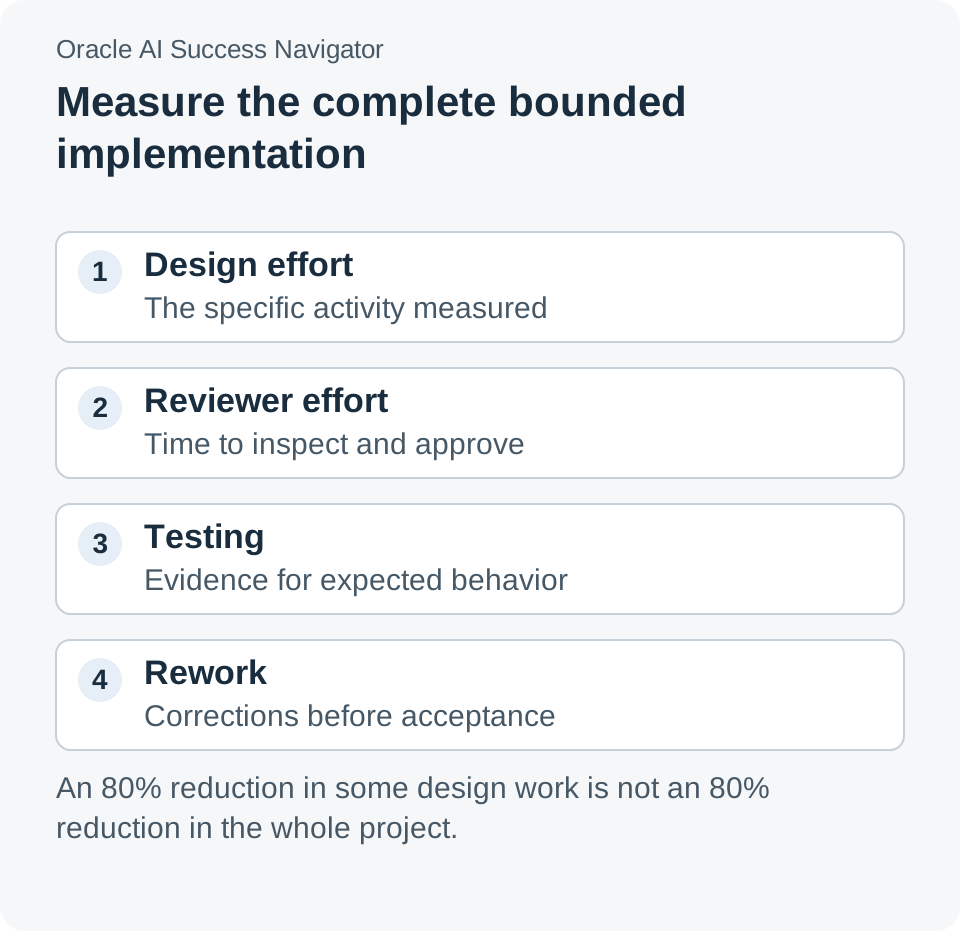
Measure the complete bounded task, including review and rework. A reduction in generation effort is one contribution to the result, not a replacement for the rest of the implementation.
The review burden is especially informative. If an agent produces a configuration quickly but a specialist must reconstruct every assumption to approve it, the apparent saving may move work from one stage to another. Conversely, a clear design and reproducible tests can make review easier even when generation is not instantaneous.
An implementation agent earns trust through a configuration people can explain
Oracle's approach brings product knowledge, executable setup instructions and specialized roles into the same implementation process. The promising outcome is a more direct connection between what the business approved and what its applications do. That connection becomes valuable when reviewers can inspect it, test it and maintain it after the initial project ends.
The right first question is therefore concrete: can the team take one real requirement through design, configuration and testing with less avoidable work and a clearer result? A successful answer to that question gives the next implementation decision something solid to stand on.
Sources
- Oracle's agentic implementation platform announcement, October 26, 2026: six agent roles, early adoption and the Lexington Health quotation.
- Oracle Fusion Setup and Configuration Registry announcement, October 26, 2026: registry scope and review model.
- Oracle AI Success Navigator 26.1 release article, May 11, 2026: existing platform capabilities.
- Oracle AI Success Navigator product page and Oracle screenshot-use policy, checked October 27, 2026: public interface, account-request path and image-use conditions.
Scenarios, proposed evaluation criteria and the 500-hour arithmetic example are illustrative. The customer percentage remains attributed to its stated source and scope; no implementation benchmark was performed for this article.
Telli.sh recommendation: Keep implementation workshop notes, approved decisions and reference material easy to revisit as a project develops. Create a Telli.sh account to organize your project notes.