NVIDIA Speech Skills: teach an ASR workflow where the jargon goes wrong
An introduction to NVIDIA's speech adaptation skills: how a coding agent can help investigate specialist vocabulary, prepare data, train selectively and evaluate what improved.
The transcript gets the sentence structure right and the important name wrong. A specialist recognizes the intended phrase immediately, but the speech model substitutes an ordinary word. Improving that result starts with a question more specific than “which model is best?”
NVIDIA's October 13, 2026 tutorial on Speech Agent Skills presents a workflow for adapting automatic speech recognition, or ASR, to a domain. A high-level skill helps scope the problem and coordinate the work; a NeMo specialist handles compatible training and evaluation. The tutorial uses air-traffic-control speech as its worked example. NVIDIA tutorial
This introduction explains what the skills add, when training is worth considering, and how to plan a first experiment. You do not need to begin with a large training run. A useful first result can be a clear account of which words fail, why they matter, and which intervention deserves a test.
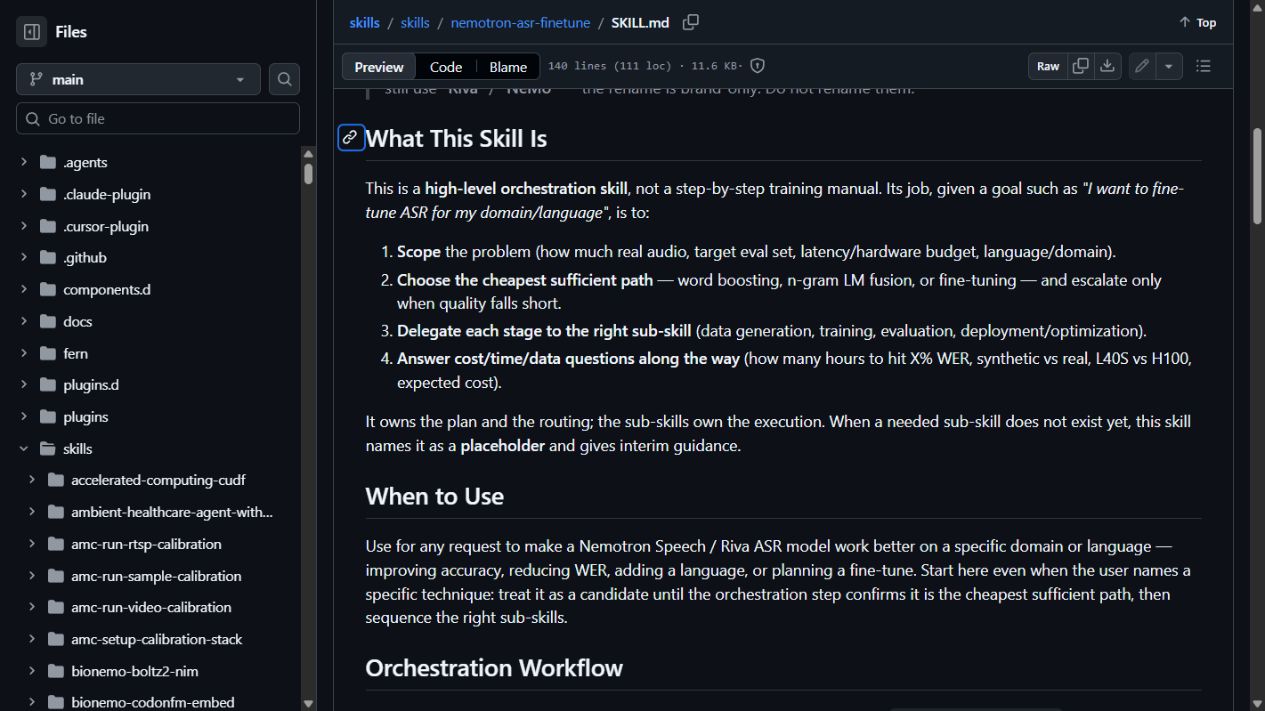 NVIDIA's public skill documentation, captured October 20, 2026. Documentation © NVIDIA, attributed under CC BY 4.0. This shows the skill's instructions, not a training run.
A skill organizes work around a model
A model contains learned parameters. A training framework supplies the machinery for updating those parameters. An agent skill supplies instructions that help a coding assistant choose and perform a workflow. Installing the instructions does not install every framework, download every checkpoint, or establish that a GPU can run the experiment.
NVIDIA separates an orchestration skill, nemotron-asr-finetune, from a specialist, nemo-speech-asr-finetune, in the tutorial. The first frames the goal and routes the work. The second handles the NeMo-specific execution when training or offline evaluation is appropriate. Workflow description
That division can be useful because “improve recognition” includes several different jobs. A vocabulary problem may need decoding support. A mismatch in speaking style or audio conditions may justify adaptation. A broken preprocessing setting may need correction before either route is meaningful.
Think of the skill as an experiment coordinator. It can help keep the goal, inputs and comparison aligned, but the experiment still needs a person to define what success means. The final artifact should be inspectable evidence, not merely an assistant saying that training completed.
Start with the error that changes the meaning
Suppose a company trains staff to say a small set of product codes during inspections. The recognizer transcribes ordinary conversation well but repeatedly confuses two similar codes. The first useful dataset is a set of those confusions with the original audio and a checked reference transcript.
A second case is an interview archive containing names and specialist terminology. Here the difficulty may vary by speaker, microphone and topic. Separate spelling conventions from acoustic errors: two written forms of the same abbreviation should not automatically be treated as different recognition failures.
A third case is equipment-support audio recorded over a noisy channel. Adding a vocabulary list may help some terms while leaving missing syllables unresolved. A domain adaptation project becomes more useful when it distinguishes language expectations from the sound actually available to the model.
These are proposed applications of the workflow, not reported deployments. They show why the input should include examples rather than only a goal sentence. A dozen well-understood errors can reveal whether the next step is data cleaning, vocabulary support or a more substantial adaptation study.
Use the least demanding intervention that addresses the failure
The public orchestration skill describes a progression through word boosting, language-model support and fine-tuning, choosing a sufficient route before escalating. That is a planning principle rather than a guarantee that every model or runtime exposes identical controls. Skill documentation
| Observed problem | Candidate intervention | What to compare |
|---|---|---|
| A known term loses to a common word | Supported vocabulary or word-boosting mechanism | Target-term accuracy and unwanted insertions |
| Domain phrase patterns are consistently unlikely | Compatible language-model or decoding support | Domain accuracy alongside ordinary speech |
| The model struggles with the domain's speech or channel | Acoustic-model adaptation | Held-out domain audio and a general-speech set |
| Accuracy suddenly collapses after a configuration change | Restore and validate preprocessing compatibility | The same checkpoint and audio under both configurations |
The table is a decision aid, not a diagnosis. A vocabulary addition can create new errors when similar ordinary words are common. Fine-tuning can improve a specialist task while degrading another kind of speech. Measure the effect you wanted and the side effects you need to avoid.
It also helps to separate transcription from downstream cleanup. A language model can rewrite an implausible phrase into something that sounds reasonable, but that is not evidence that it recovered the spoken words. Keep the original recognition output so you can judge the acoustic task independently.
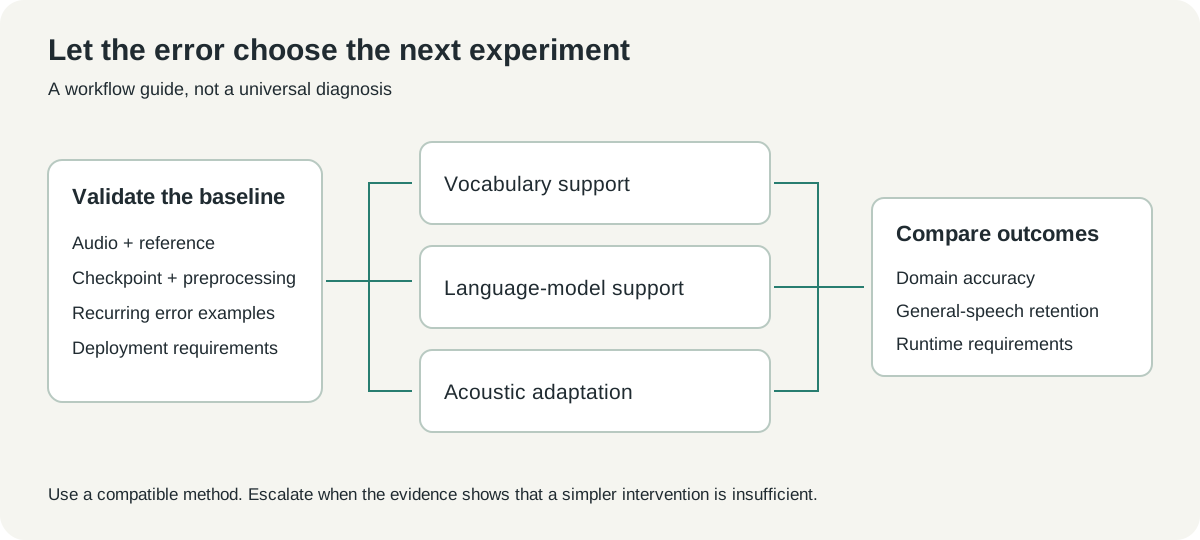 Original decision diagram based on the documented workflow. It is an introduction to possible routes, not a claim that one route fits every recognizer.
The reported improvement has a precise denominator
In NVIDIA's worked study, the tutorial reports Nemotron's word error rate falling from 77.00% to 22.46% on a two-hour human-annotated ATCO2 test set, a 70.8% relative reduction. It also reports general-English WER moving from 3.50% to 3.63%. These are the publisher's results under that study's conditions. October 13 tutorial
Word error rate counts substitutions, deletions and insertions relative to the reference words. It is not the percentage of sentences with at least one error, and the reported relative reduction is not a percentage-point change. Keeping those quantities separate makes a result easier to compare honestly.
The example is useful because it shows both the target domain and another domain. A specialist result alone cannot tell you whether the recognizer retained the ordinary speech ability you still need. Even a small general-domain change deserves to be read beside the improvement rather than omitted from the story.
A different microphone, language or transcription convention can produce a very different result. The headline should therefore motivate a method: measure a baseline, adapt under controlled conditions and score a held-out set. It should not become a promise that a company can remove the same proportion of errors from its own calls.
Separate the material that teaches from the material that judges
An adaptation dataset needs distinct roles. Training examples change the model. Development examples guide choices such as checkpoints and decoding settings. Test examples judge the selected system after those choices are made.
Splitting by random short segments can create misleading independence. Two clips from the same recording may share a speaker, channel, phrase and background sound. When possible, design splits around the unit that matters to deployment, such as recordings, speakers or collection sessions.
Keep the reference convention explicit. Decide how numbers, abbreviations, punctuation and hesitation sounds are represented before scoring. If one output writes “twenty one” and the reference writes “21,” the chosen normalization can change the score without changing what a listener understood.
For a starter project, prepare a small inventory rather than racing to collect a large corpus. Record where the audio came from, what use is permitted, who checked the transcript, and what role the item has. A clear inventory is much easier to review than a folder whose filenames are the only provenance.
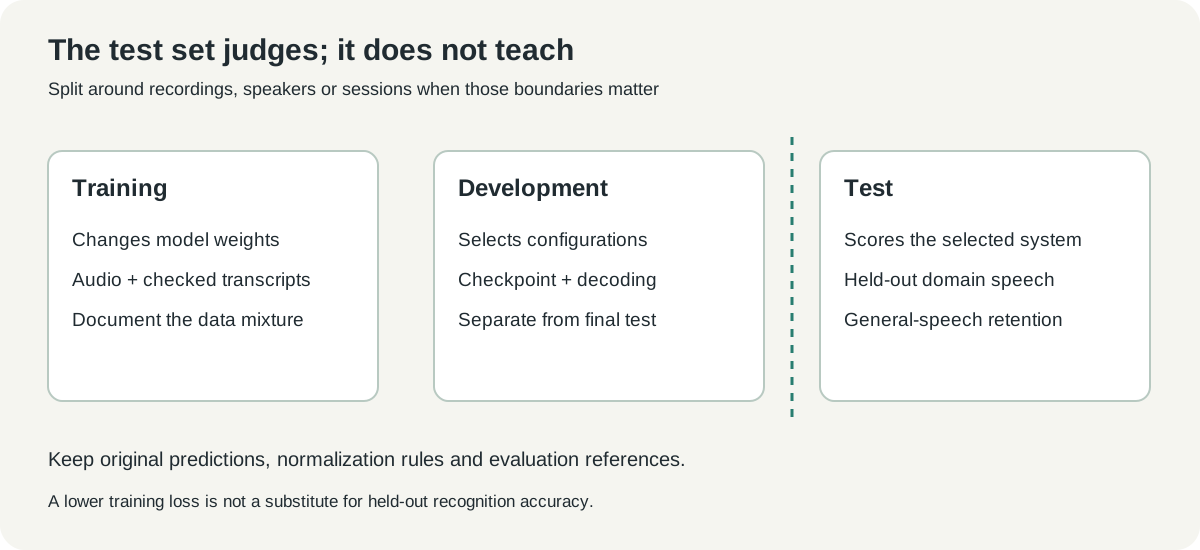 Original explanatory diagram. The test lane remains outside training and checkpoint selection; ordinary-speech retention is evaluated alongside the domain task.
A first request should ask for a plan and a baseline
The skill can do more useful work when the request contains an observable target. “Help our inspection transcripts” is a start, but it leaves the recognizer, language, deployment mode and error cost ambiguous. Add those details and ask for a bounded first stage.
For example, a proposed request could read:
Inspect a small, licensed set of our inspection recordings and reference transcripts. Identify repeated term confusions, validate the current recognizer and preprocessing, and measure a baseline. Compare vocabulary support with a training proposal. Preserve a held-out test set and report domain accuracy, ordinary-speech retention and resource requirements before a longer run.
The example defines the evidence the agent should return. It also leaves the method open until the data supports a choice. That is usually more productive than starting with a command to fine-tune a specific checkpoint for an arbitrary number of steps.
A useful initial report should identify the exact checkpoint, the runtime configuration, the evaluation set and the recurring errors. It should also explain which part of the process is currently limiting progress. A poor transcript caused by a wrong sampling configuration needs a different repair from one caused by genuinely unfamiliar speech.
Install both instructions and execution dependencies deliberately
NVIDIA's tutorial documents separate installation commands for the orchestration and specialist skills. The second is not automatically installed merely because the first refers to it. The following commands reproduce the tutorial's skill-selection route; inspect the repositories and choose the intended installation scope when prompted.
npx skills@latest add NVIDIA/skills --skill nemotron-asr-finetune
npx skills@latest add NVIDIA-NeMo/Speech --skill nemo-speech-asr-finetune
npx skills@latest list
Start a fresh coding-agent session after installation and confirm that the expected skills are available. This establishes that the agent can discover the instructions. It says nothing yet about whether the machine can load a checkpoint or perform training.
The tutorial uses a Linux GPU host and a pinned NeMo Speech container, 26.07.00, for its documented setup. Check the current image's driver, GPU and framework requirements before preparing a host. A skill installed on a laptop is not a substitute for that execution environment. Environment preparation
Keep the first environment check narrow. Verify imports, GPU visibility, checkpoint loading and a short inference pass before allocating a training budget. Record the versions and container identity so a later result can be connected to the software that produced it.
Streaming and offline recognition need separate comparisons
A streaming recognizer must produce output while audio arrives. An offline recognizer can use a different execution pattern after the recording is available. They may both transcribe speech, but latency, context and decoding choices can differ enough that one score is not a complete comparison.
For a live application, record when partial results appear, when they stabilize and how final text is delivered. A more accurate transcript that arrives too late may not serve live captions. For an archive, a slower offline process can be acceptable if it produces a better final record.
Use the same mode before and after adaptation when making the core comparison. If you also change chunking, decoding, checkpoint and text normalization, an improved score will not tell you which change mattered. Add a separate experiment when you want to compare the full alternative workflow.
The same discipline helps with downstream evaluation. Speaker labels, timestamps and recognition words are distinct outputs. A transcript can have a good WER while assigning an important statement to the wrong person, so judge those capabilities separately when the application needs them.
An evaluated checkpoint is more than a successful training log
A decreasing training loss tells you the optimization process is fitting its objective. It does not establish that a new speaker will be recognized more accurately. The useful artifact is a selected checkpoint together with its configuration, predictions and evaluation results.
Keep the original model available and score it under the same protocol. Include several representative failures in the report so a domain reviewer can understand the remaining gap. A table of averages should lead to examples, rather than conceal them.
Deployment adds another set of questions. Can the target machine load the artifact? Does the serving runtime support its architecture and tokenizer? Does the output retain the conventions that downstream software expects? A training environment and an application runtime can disagree even when both support “speech recognition.”
NVIDIA's tutorial distinguishes released tools from Gold-refined checkpoints described there as forthcoming. Treat code availability, example results and downloadable adapted weights as separate release states. A public tutorial is enough to begin planning; it does not mean every demonstrated artifact is already packaged for your deployment.
Better adaptation begins with a smaller, clearer question
Our view is that Speech Skills is most useful as a way to make specialist ASR work inspectable. It turns an open-ended request for better accuracy into a sequence of decisions about errors, data, compatible methods and evaluation. That can save an experiment from becoming a long training run with no agreed finish line.
Begin with the words that matter and the recordings that prove the problem. Ask whether a simpler intervention works, then escalate with evidence. The checkpoint is valuable when it improves the transcript under the conditions your readers or listeners actually face.
Sources and media
Checked October 20, 2026. Numerical results are attributed to NVIDIA's study; no training, inference or demo result was reproduced for this article. The screenshot shows public NVIDIA documentation, captured by the author, with CC BY 4.0 attribution. The diagrams are original. See the media record.
- NVIDIA tutorial, October 13, 2026
- Orchestration skill
- NeMo specialist skill
- NeMo Speech framework
- NVIDIA documentation and source licensing
Keep the audio evidence beside the review
Keep the source references, terminology decisions and evaluation notes together so the next experiment starts from a clear record. Telli.sh can help organize that research. Create a Telli.sh account