Your meeting didn't fail. The 24 hours after it did.
The bottleneck isn't the meeting — it's the day after, when decisions lose their edges, owners blur, and follow-ups die in DM threads. A practical walkthrough of the note-taking loop that execution-first teams run: capture the decision, owner, and date live; distribute within minutes; reopen the note at the start of the next meeting.
Tuesday, 2:00 p.m. A 45-minute pricing review. Four people, three real decisions, everyone nodding. At 2:47 the call ends on "great, let's do it."
Friday morning, none of it has happened. Not because anyone dropped the ball on purpose. Two of the three decisions never got written down in a form anyone could act on, and the third one got quietly renegotiated in a Wednesday DM thread that only two of the four people ever saw.
That gap is what this post is about. Not how to run a better meeting, and not how to write a prettier note — how the note itself carries a decision across the 24 hours where most decisions die. We will walk one realistic meeting through that loop, from the moment a decision gets made to the moment somebody checks whether it actually happened.
TL;DR:
- The bottleneck is rarely the meeting. It is the 24 hours after it, when decisions lose their edges, owners blur, and follow-ups scatter into DMs.
- Teams that execute treat the note as an execution artifact, not a transcript: every decision carries an owner and a date, written down during the meeting rather than reconstructed that evening.
- The loop has three moves — capture live, distribute within minutes, reopen the note at the start of the next meeting. Skip any one and the other two stop working.
Image: "Wiki Ed planning sprint at WINTR, 2015-12-10, 03" by ragesoss, licensed under CC BY-SA 2.0, via Wikimedia Commons.

The meeting was fine. The handoff wasn't.
When a project stalls, the postmortem almost always blames the meeting. Too long, too many people, no agenda. Sometimes that's true. But go looking at the stalled projects on your own team and you will keep finding meetings that went well — clear discussion, genuine agreement, people leaving energized — followed by a week where nothing moved.
We have a name for what happens in between: decision decay. It is the predictable way a sharp decision loses its edges over the hours after it is made, until what remains is a vague sense that the team is "aligned on pricing" with nobody able to say what was actually decided.
Decay shows up in three recognizable forms, and once you can name them you start seeing them everywhere.
The first is drift. In the room, someone said "we're going to three tiers." In the note, it becomes "discussed moving to three tiers." One is a commitment; the other is a summary of a conversation. A week later nobody can tell from the written record whether the team decided or merely deliberated — so the safe move is to discuss it again, and a decided thing costs a second meeting.
The second is owner diffusion. "Marketing will look into the messaging" feels like an assignment. It isn't. A team is not a person, and a task assigned to a team is assigned to nobody in particular, which means it gets picked up by whoever feels most guilty about it or, more often, by no one. The moment the note says "Priya" instead of "marketing," the decay stops.
The third is channel scatter. This is the one remote and hybrid teams feel hardest. The meeting ends, the real follow-up conversation happens in three DM threads and a channel nobody muted, and the decision gets amended in a place where only some of the participants can see it. Nothing was hidden on purpose. The record simply fragmented, and now the authoritative version of the decision lives in someone's private messages.
| Symptom | How it reads in the note | Why the work stalls | The fix |
|---|---|---|---|
| Drift | "Discussed moving to three tiers" | Nothing distinguishes a decision from a conversation | Write it as a decision, present tense |
| Owner diffusion | "Marketing will look into the messaging" | A team is not a person, so nobody starts | One named human |
| Channel scatter | Nothing — it moved to DMs | The authoritative version is invisible to most of the room | One shared place, every time |
None of that is exotic. It is the default outcome of a meeting that ends without a written handoff, and it is why the 24 hours after a meeting deserve more design attention than the meeting itself.
Plenty of vendors have noticed the same pressure, especially in hybrid workforces. In a July 6, 2026 press release, EverGrow Tech said its VOMO note-taking app had passed 400,000 users, and the company pushed a version of that announcement aimed specifically at India's hybrid workforce. Treat the number as a vendor's self-report rather than an audited figure — but the direction it points at is real enough: teams spread across offices, homes, and time zones cannot rely on the hallway conversation to repair a bad note.
Three fields turn a conversation into a commitment
Here's the point, and it is smaller than most note-taking advice makes it sound. A note becomes an execution artifact when every decision in it carries three fields: what was decided, who owns it, and when it is due.
The decision line has to be written as a decision. Present tense, active, specific enough that someone who wasn't in the room could act on it. "Ship three tiers — Starter, Team, Scale — replacing the current two" survives the week. "Talked about tiering" does not. If you find yourself unable to write the sentence in that form, that is useful information: it usually means the decision wasn't actually made, and you should write that down instead.
The owner has to be one named human. Not a team, not two co-owners, not "whoever gets to it first." Co-ownership sounds collaborative and behaves like an unassigned task, because each owner reasonably assumes the other one has it. If two people genuinely need to work on something, one of them owns the outcome and the note says so.
The due date does the most work and gets skipped the most often. A decision without a date is a wish — it never becomes late, so it never becomes urgent, so it never gets done. The date does not need to be the completion date. In practice the more useful date is the next visible checkpoint: not "pricing page shipped" but "pricing page copy in review by the 12th." A checkpoint you can verify in ten seconds beats a milestone you have to interpret.
One optional fourth field earns its place: a single line of because. Not the discussion, not the debate — one clause explaining why. It exists for a specific execution reason: it is what stops the decision from being relitigated in three weeks by someone who wasn't there. It also means that when the same question comes back next quarter, the reasoning is findable rather than re-derived from scratch.
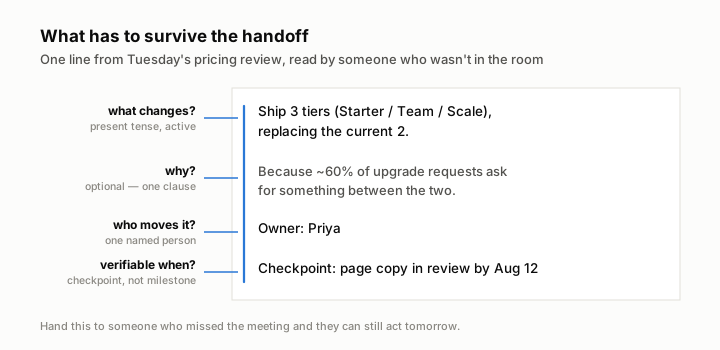
Figure: the four fields, on one real line from the pricing review.
Write it during the meeting, or you're writing fiction
Most teams intend to write the note afterward. That intention is where the loop breaks, and not because people are lazy.
In our Tuesday pricing review, roughly nine of the 45 minutes contained decisions. The other 36 were context, tangents, one good digression about a competitor, and the ordinary friction of four people getting to agreement. By 6 p.m., the nine minutes have blurred into the 36. What you write that evening is not a record; it is a reconstruction, assembled from the parts of the meeting that were most memorable rather than the parts that were most binding. Memorable and binding are not the same thing — the heated exchange sticks, the quiet "fine, I'll own that" does not.
So the capture has to happen live. Not a full transcript by hand, which just turns one person into a stenographer who can't participate. What has to happen in the room is narrower: the moment a decision lands, someone writes the decision line, the name, and the date.
And then — this is the part no tool can do for you — someone says it out loud. "So that's Priya, pricing page copy in review by the 12th." Five seconds. Three things happen in those five seconds: Priya gets a chance to say no, the date gets a chance to become realistic, and the other two people become witnesses to a commitment rather than an audience to a discussion. A written line that nobody confirmed aloud is still a draft.
This is also where AI note-taking genuinely helps, and it helps in a more specific way than "it writes the notes." It removes the scribe problem — the reason nobody wants to capture decisions live is that the person capturing them can't fully take part. When recording and transcription run in the background, the human job shrinks to the part that actually requires a human: hearing that a decision just happened, and confirming the owner and date out loud. The tool handles the record. The team handles the commitment.
If it isn't out within minutes, it isn't out
The second move is distribution, and the window is smaller than it feels.
Send the note within minutes of the meeting ending — while people are still in the mental context of the meeting, before the next call starts, before the afternoon overwrites everything. A note delivered at 2:52 gets read and corrected. The same note delivered at 9 the next morning gets archived unread, because by then everyone has decided what they think happened and the note is just one more unopened item.
Fast distribution changes the note's error rate too. When four people read the decision list while the conversation is still warm, mistakes get caught in the only window where correcting them is cheap. "That's not quite what I agreed to" on Tuesday afternoon costs one message. The same objection on the following Monday costs a meeting and a small amount of trust.
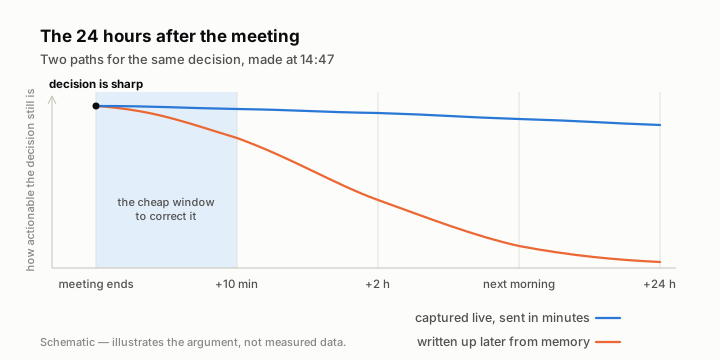
Figure: the same decision on two paths. Schematic — it illustrates the argument, not measured data.
Send it to one place, and the same place every time. The failure mode here is well-intentioned: someone forwards the action items to each owner individually, so everyone gets exactly what's relevant to them. It feels considerate and it recreates channel scatter by hand. Four private lists mean no shared version, which means when decision two gets amended on Wednesday, nobody knows which of the four lists is now wrong. One list, visible to everyone who was in the room, is the whole point.
The next meeting opens with the last note
The third move is the one almost everyone skips, and skipping it is what makes the first two feel pointless.
Open the next meeting with last meeting's decision list. Not a status round, not a re-discussion — 90 seconds of reading the list out and marking each line one of three ways: done, not done, or no longer relevant.
"Not done" needs to be safe to say. If the honest answer costs someone social capital, you will get a fog of "in progress" instead, and a list of things in progress is indistinguishable from a list of things not started. The useful follow-up to "not done" is a new date, not an explanation.
"No longer relevant" is the state teams forget exists, and it is expensive to forget. Priorities move, and a task that made sense on Tuesday can be genuinely obsolete by the following week. Without a way to retire it, it stays on the list forever, half-alive, contributing nothing but guilt every time someone reads past it. Zombie action items are how a follow-up habit dies: the list grows, the signal drops, and eventually nobody opens it.
Here's the compounding part. Once a team knows the list gets read out loud next week, the quality of what goes on the list improves immediately — without anyone being told to improve it. Vague items stop getting proposed because their owner knows they will have to report on them. The check at the start of meeting two is what makes the capture in meeting one honest.
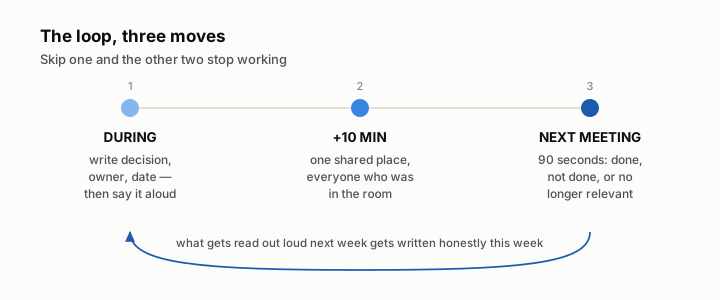
Figure: the three moves — and why the last one makes the first one honest.
Tuesday's note, on Thursday
Put the loop together and the artifact looks different. Here is the note most teams would have produced from that pricing review:
Pricing review
- discussed moving to 3 tiers
- concerns about grandfathering existing customers
- marketing to look into messaging
- revisit next week
Everything in it is true, and none of it is actionable. There is no owner, no date, and no way to tell a decision from a topic. Now the same meeting, captured as an execution artifact:
Pricing review — Tue Aug 4, 14:00-14:47 · Priya, Daniel, Mina, Sam

DECIDED
1. Ship 3 tiers (Starter / Team / Scale), replacing the current 2.
   Because ~60% of upgrade requests ask for something between the two.
   Owner: Priya · Checkpoint: pricing page copy in review by Aug 12
2. Existing customers keep their current price for 12 months.
   Owner: Daniel · Checkpoint: support email draft + billing flag by Aug 7

NOT DECIDED
3. Annual discount percentage. Revisit Aug 11 with churn numbers.
   Owner: Mina brings the numbers.
Same 45 minutes, same conversation. The second version went out at 2:53, and by 3:20 Daniel had replied that 12 months should be 6 for monthly plans — caught in the cheap window, amended in the shared place, visible to all four.
Thursday morning, the difference is concrete. Priya has a draft in review because a date on the 12th made Wednesday the obvious day to start. Daniel's support email went out Tuesday night, because "by Aug 7" turned out to be trivial once he stopped waiting to find out whether anyone else was handling it. And item 3 is the interesting one: it is explicitly not decided, so nobody has spent two days building on an assumption about annual discounts. In the first version, that same open question was invisible — indistinguishable from the settled ones, and equally likely to be treated as either.
That last part is worth sitting with. The most underrated thing a good note does is not record what was decided. It records what wasn't.
The bottom line
A meeting note is not a record of a meeting. It is the first task of the project — the baton in the handoff, and the only part of the meeting that has to survive contact with the rest of the week.
Which means the question to ask about your notes is not "are these thorough?" It's narrower and more useful: if the four people in this room lost the memory of this conversation tonight, could they still execute tomorrow from what's written? If the answer is no, the note is a souvenir. Fix that, and the meeting itself gets shorter almost as a side effect — because a team that trusts its record stops re-deciding things.
Where we come in. We build Telli.sh, so read this as the interested party's recommendation. The loop above has one hard part: capturing decisions live without turning someone into a scribe. Telli.sh records the meeting, transcribes it, and produces a summary with action items in the same session — so the decision list exists minutes after the call ends, in one shared place, rather than being reconstructed that evening. The confirming-out-loud part is still yours. The record isn't.