Neuron AI asks robots to remember what their cameras cannot see
NEURA Robotics is combining vision, touch, sound and memory in Neuron AI. The practical opportunity is more adaptable physical work; the real test is how quickly a new task becomes reliable.
NEURA Robotics wordmark, credited to NEURA Robotics GmbH and classified as PD-textlogo on Wikimedia Commons. Shown unchanged with neutral padding for editorial identification; it is not a photograph of a working Neuron AI installation.

A connector can look attached before it clicks into place. A towel can slip behind a robot's gripper while remaining exactly where the task requires it. A camera sees part of these events; contact, sound and recent history explain the rest. That gap is where NEURA Robotics is positioning its new model.
On October 14, 2026, the German robotics company introduced Neuron AI, combining 3D vision, touch, audio, robot state and language with memory. NEURA calls the approach a Perception-Language-Action model, or PLA. Its announcement describes training across five robot embodiments and a route for adapting skills through the Neuraverse platform. NEURA's announcement.
Our take: the valuable change is a robot that can use more evidence about whether its action worked. For buyers, the question becomes how much teaching, checking and recovery a new job requires. This article explains what Neuron AI adds, where that could help, and how to evaluate the promise without confusing an impressive demonstration with a dependable process.
Touch supplies an answer that an image can leave open
Consider putting a lid on a container. The lid's visible position tells you something about alignment. Resistance tells you whether an edge is caught. A click can tell you that a latch engaged. The next action depends on combining those observations: press again, adjust the angle, or move on. Better visual recognition alone leaves some of that decision unresolved.
NEURA's Neuron AI product page, checked October 23, describes tactile and force-torque information, contact sounds, joint positions and velocities entering the model alongside vision and instructions. The company also says inference runs locally on the robot. Those details place the product in physical control, where a useful answer must arrive in time to influence the next movement.
The familiar phrase “multimodal AI” often means a model can discuss an uploaded image. Here, the modalities concern an ongoing interaction. An observation matters because something is being held, pressed, moved or released. Language specifies a goal, but the world keeps supplying feedback as the robot attempts it. Readers should expect the quality of that feedback loop to matter as much as the fluency of an explanation.
Local inference also changes the questions a deployment team should ask. Losing an internet connection need not interrupt every control decision, according to NEURA's stated design. That does not establish the performance of a particular installation. Ask separately about training uploads, fleet updates, diagnostic access and the system's behavior when a sensor becomes unreliable. “Runs locally” describes one useful property; a complete operating arrangement needs more detail.
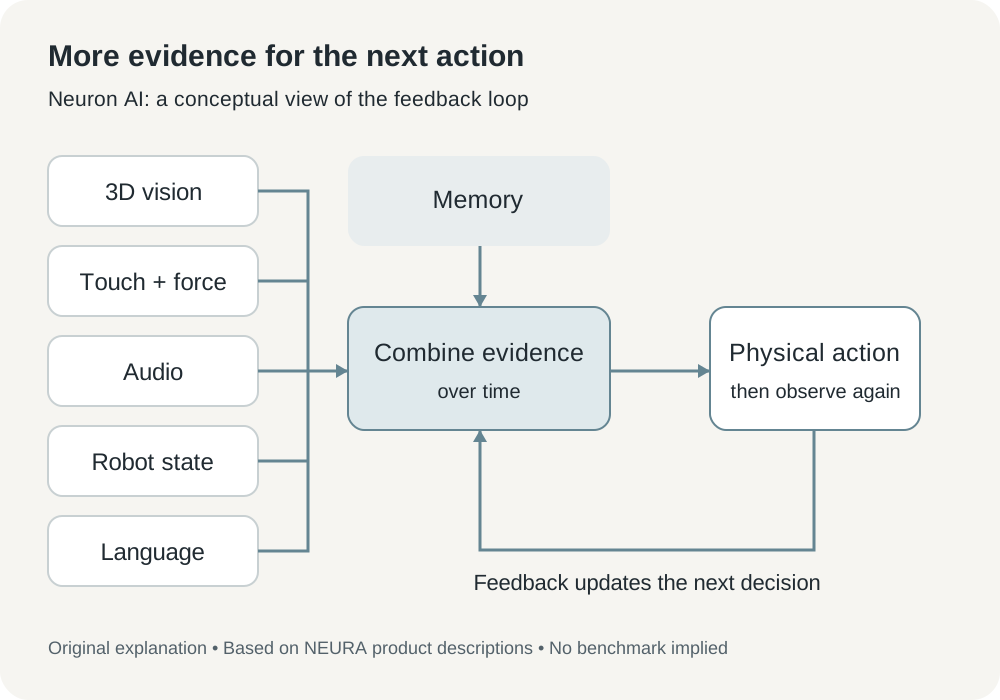
Original explanatory diagram based on NEURA's published modality descriptions. It illustrates the role of feedback and memory; it does not reproduce a proprietary architecture or report a performance measurement.
Memory matters when the task continues out of view
Imagine setting a part behind another component while preparing an assembly. An assistant that treats each view as an isolated picture has lost useful information. An assistant that remembers the placement can continue from the previous state. It still needs to revise that belief if someone moves the part. Memory becomes useful through both persistence and correction.
The October 14 announcement says Neuron AI retains context when objects leave the camera's view. The practical implication is continuity across a sequence. Picking an item, opening a receptacle and putting the item inside are connected decisions. A failure early in the sequence should change what the robot attempts later, rather than allowing a plausible plan to continue after its assumptions have broken.
That suggests a concrete way to judge the feature. Ask what happens when the object is occluded, when its position changes, and when a handoff fails. A robot that notices uncertainty and pauses can be more useful than one that confidently completes the wrong sequence. The desired behavior depends on the job: a missing cloth and a missing safety component deserve different responses.
This is the product's central challenge of remembering while acting. Every movement changes the scene the model must interpret. Useful memory should preserve relevant consequences while making room for new evidence. A buyer therefore needs examples of correction and recovery, including the moment the system decides that its remembered state is no longer trustworthy.
NEURA is connecting the model to a robotics business
NEURA is based in Metzingen, Germany, and builds robots, sensing technology and the infrastructure used to train and deploy their skills. That background matters for readers encountering the brand for the first time. Neuron AI enters a company with physical machines and industrial relationships, so the proposition includes the work of collecting experience and putting a learned behavior onto hardware.
Its Neuraverse page, checked October 23, describes a platform connecting robots, developers and industry, including orchestration and application development. Its NEURA Gym page describes facilities for training in realistic, variable conditions. Together, these explain the commercial direction: reduce the effort between knowing how a task should work and getting a robot to perform it reliably.
For a factory, the difficult knowledge may belong to a technician who can feel an imperfect fit before an inspection camera notices it. Capturing that expertise requires deciding what to demonstrate, what signals to record and what counts as a successful result. A general model is a starting point. The value of the surrounding platform depends on how clearly it supports that translation from workplace knowledge to an accepted robot skill.
The announcement describes customer fine-tuning and fleet deployment, with an option to keep skills private. A buyer should carry that distinction into the contract. A learned procedure may reveal tolerances, materials or production methods even if it contains no obvious personal information. Private skills, shared training data, software updates and remote support should each have a defined owner and a defined permission boundary.
There is also a concrete development since the model announcement. In an October 22 update, NEURA and the Technical University of Munich announced a RoboGym spanning more than 2,300 square meters. NEURA says its Neuron AI-powered 4NE1 Gen 4 is operating in the training facilities and is being prepared for series production. That provides an entry point for company-specific task work; it does not establish an unrestricted household release or a delivery date for every buyer.
Three potential jobs reveal different kinds of value
The following are illustrative evaluation scenarios, not reports of our own trials or claims that these deployments have been completed. Their purpose is to make the product direction concrete. Each asks the robot to use evidence that extends beyond the latest camera image, but each also needs a different definition of success.
A laundry-handling station needs to manage soft objects that change shape as they move. An operator could compare successful transfers, dropped items, tangled fabrics and manual recoveries across different loads. The useful result would be a consistent flow through a defined station. Folding every garment in an unfamiliar home is a much broader problem and should have a separate evaluation.
A connector-assembly station could use sight to approach a socket and contact or sound to judge engagement. The evaluation should include misalignment and incomplete insertion, rather than only clean examples. A useful result is a correctly connected part with an inspectable check. If a human must repeatedly finish the last small movement, count that work in the process cost.
A parts-handling cell could test whether context survives temporary occlusion and a change in the order of operations. The operator might move one object while the robot is busy with another. Success requires detecting the updated situation before taking the next action. This scenario makes memory's limitation visible: retaining an earlier observation is helpful only while the observation still describes the relevant world.
| Illustrative job | Evidence worth testing | Outcome to count |
|---|---|---|
| Laundry transfer | Grip feedback, changing shape and sequence state | Completed loads and manual recoveries |
| Connector assembly | Alignment, insertion force and engagement signal | Verified connections and rework |
| Parts handling | Object location, occlusion and changed placement | Correct next actions and safe pauses |
These comparisons should use the same output standard as the existing process. A robot's smooth movement does not make an incorrectly assembled part acceptable. Equally, a slower system may be worthwhile if it reduces scrap, handles an awkward shift or frees a skilled person from repetitive supervision. The business question is the whole task, including the work performed around the robot.
An eleven-minute sequence is a demonstration plan, not a reliability score
NEURA's October 14 release announced an eleven-minute laundry sequence for its 4NE1 humanoid at NVIDIA GTC Berlin, October 20–22. It described sorting, loading and unloading machines and moving laundry to a dryer. That published plan supplies a tangible example of coordinated steps; it does not supply a repeated-run success rate or establish how a customer's site would perform.
A sequence demonstration can answer whether the intended behavior is understandable and whether the chosen hardware can carry out the visible motions. A deployment evaluation needs additional observations: starting conditions, retries, interruptions, failed attempts and the amount of preparation. Both forms of evidence have value, but they answer different questions about readiness.
One useful request is a continuous record of an agreed test block, accompanied by the operator's interventions. Another is a list of conditions outside the supported task. Neither request needs to be adversarial. They help both sides avoid a purchase in which the customer imagines a flexible general worker while the supplier has validated a carefully bounded station.
The distinction also changes how to read a duration. Eleven minutes identifies the planned demonstration's length. A buyer still needs throughput, quality and recovery figures for the intended workload. Those figures should include slow or unsuccessful attempts, because employees must deal with those attempts during an ordinary shift.
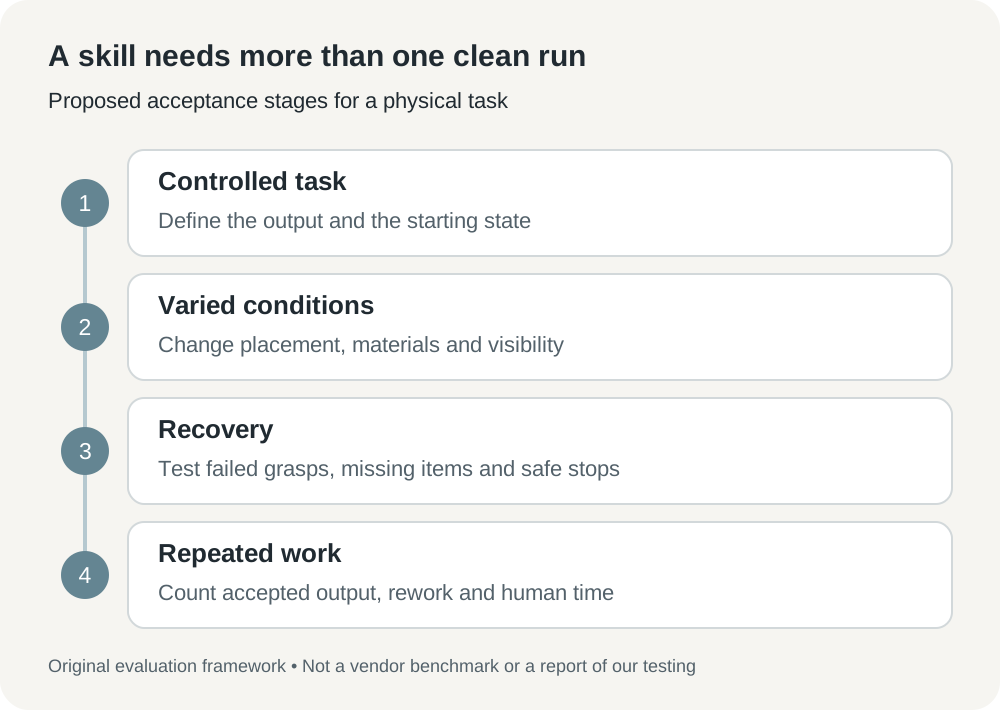
Original evaluation framework: demonstrate a task, vary its conditions, test recovery, then measure operation over a shift. These are proposed acceptance stages, not NEURA benchmark results.
Start with one skill and define the handoff back to a person
NEURA uses Time-to-Skill as a measure of progress in the October 14 announcement. That is a useful purchasing question because a robot that needs extensive retuning for every small process change can remain expensive after installation. The number needs a definition, however. Decide where timing begins, which teaching work counts, and what reliability threshold ends the exercise.
For an initial discussion with the supplier or an integrator, prepare a bounded task brief rather than an ambition such as “automate this department.” Include the accepted output, allowed objects, physical space and circumstances requiring a stop. Then use the following sequence to make the evaluation actionable.
- Record the current process. Document one complete job, its inspection step and the moments when an experienced person adjusts their technique. Use workplace-authorized recordings and avoid unrelated personal information.
- Define a supported operating range. Specify materials, placement variation, lighting, object sizes and permitted human presence. Ask which robot, hand and sensing configuration the supplier proposes for that range.
- Agree on a teaching budget. Count demonstrations, preparation, annotations, hardware setup and subsequent retuning. Define Time-to-Skill from the same start and finish points for every comparison.
- Test controlled variation and recovery. Include occlusion, a failed grasp, an absent object and a changed location. Agree on safe conditions for each test and the expected human handoff.
- Measure the complete work block. Count accepted output, rework, intervention time, downtime and maintenance. Keep model and skill versions with the results so a later update can be evaluated against the same task.
This procedure makes the first purchase conversation more productive even before access is granted. The current product page directs interested organizations to contact NEURA. Public announcement materials do not establish a universal price, delivery date or ready-to-download model package. A practical next step is a scoped feasibility discussion, with an acceptance plan that both parties can inspect.
The economic promise is faster adaptation to ordinary variation
A robot that becomes easier to teach could make smaller or frequently changing jobs more attractive to automate. The savings would come from less setup effort, fewer brittle assumptions and a shorter wait before useful work starts. That is a reasonable expectation to test. It should appear in a budget as a hypothesis with a baseline, rather than as an automatic consequence of adding a foundation model.
Costs also extend beyond the model and robot. A workcell may need fixtures, protective measures, integration, cleaning, calibration and a person responsible for unexpected states. Additional sensing supplies more information and adds components that can drift or fail. When a result changes, the team needs a way to distinguish a model problem from a damaged sensor or a changed material.
Fleet deployment creates another tradeoff. Reusing a validated skill across similar stations can reduce duplicated work, while differences between stations can undermine a careless rollout. Ask how an update is tested, which machines receive it, and how to restore the previous behavior. A skill deserves a release process because a software change can alter a physical action.
The expectation worth keeping is a closer relationship between perception and the outcome of work. Vision, touch, sound and remembered events can give a machine better reasons to continue, correct itself or pause. For Neuron AI, the decisive evidence will be how quickly those reasons become repeatable behavior in a customer's process. The useful robot is the one whose next action still makes sense after the world has changed.
Sources
- NEURA introduces Neuron AI, October 14, 2026; includes the announced GTC demonstration plan.
- Neuron AI product description and local inference, checked October 23, 2026.
- Neuraverse platform, checked October 23, 2026.
- NEURA Gym training infrastructure, checked October 23, 2026.
- TUM RoboGym opening and 4NE1 Gen 4 status, October 22, 2026.
- NEURA press hub and company context, checked October 23, 2026.
- NEURA Robotics wordmark and PD-textlogo record.
Keep the evaluation beside its evidence
For readers who want to organize authorized demonstration recordings, reviewed notes and follow-up questions in a separate workspace, Telli.sh is one option. Start with an audio note.