Running MONAI Label? Check what 0.8.6 changes and who can still reach your server
A confirmed MONAI Label security update gives research teams a clear target. Verify the running version, access controls, and exposure history before closing the incident.
A research team can update MONAI Label on its shared workstation and still have an older copy serving annotations from a lab GPU node. For a project that moves between workshops, compute clusters, and shared imaging workspaces, that distinction matters. The project published a security advisory on November 18 and released MONAI Label 0.8.6 on November 22. AWS reported observing exploitation in an incident it investigated. If your team operates the server, establish which copy is running, who can reach it, and what the service could access during the vulnerable period. MONAI Label advisory, 0.8.6 release, AWS observation.
MONAI Label is an open-source system for assisted imaging annotation. A researcher can open an imaging study in a connected viewer, request a model-suggested annotation, correct it, and save the reviewed result. Teams often host the annotation service separately from the viewer. The people who know where the service answers, where studies are stored, and which account manages the server can belong to three different groups. A single update request needs to reach all three if the team expects to verify the full deployment.
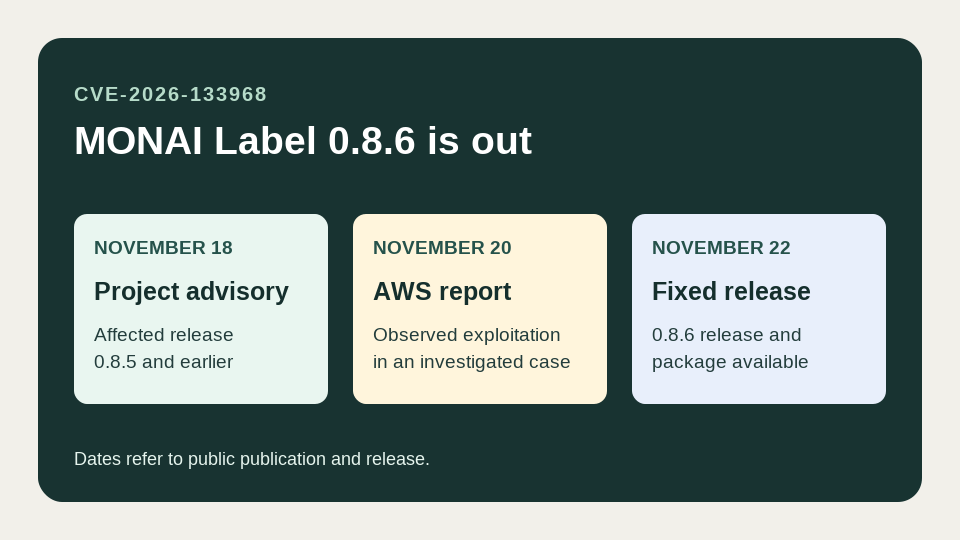
The published advisory, field report, and available fixed package establish three separate facts.
What the advisory establishes
CVE-2026-133968 affects MONAI Label 0.8.5 and earlier. The project describes a risk of unauthorized filesystem writes and possible code execution in the server's security context. Its guidance also calls out that the server runs without authentication by default. The environment determines which files and datasets that account can access, whose systems can connect to it, and which additional controls apply. A shared login gateway on one route offers limited assurance if another route reaches the same service independently. Conversely, a genuinely isolated server presents a different exposure history from a lab deployment that accepted requests from many systems. Both need the version update. Project advisory.
The November 22 release notes and package record establish that 0.8.6 is available. The AWS report establishes that exploitation was observed in a system AWS investigated. An institution needs its own evidence to assess whether its service was reached, which resources were accessed, and whether any data was copied or altered. A lab can track these as separate findings. For example, “0.8.6 now serving the viewer” can be verified the same day as the update, while “historic exposure of the old server” can remain open as network and storage logs are collected. That distinction also keeps an incident report from overstating either safety or harm. 0.8.6 on PyPI, AWS observation.
The service account is a useful starting point for determining potential impact. Some deployments grant the service read access to a dedicated imaging folder and write access to a separate label store. Others run inside an environment with broader project mounts for convenience. If the second environment was reachable during the affected period, the review needs to include the other resources the service account could access. A clinical or privacy lead can decide whether the nature of those resources changes notification and handling requirements. Even a dataset prepared for research can have separate linkage information or contain annotations that teams expect to keep inside a restricted workspace.
Find the server the lab actually uses
Start with the address configured in the approved annotation viewer or workspace template. Ask the service owner to map that address to the running instance or group of replicas. If the team has several active projects, record each instance, which studies it handles, the process or deployment owner, and where the implementation is maintained. Include archived projects that still operate a server. Graduate students may have stopped opening an old project months before its compute reservation or lab host was retired.
| Deployment | What to identify | Strong completion evidence |
|---|---|---|
| Researcher-owned workstation | The Python environment and the server process the team actually uses | A restarted process on a fixed version and a verified local access boundary |
| Shared lab service | Every active instance, the viewer routing, and team access policies | Per-instance release evidence and a normal session through each expected access path |
| Cluster job or container service | The image used by running work and the template for future jobs | Fixed image identity in live instances and updated templates for new jobs |
| Centrally hosted research service | The group that owns the update, network review, and log retention | A dated operator confirmation with current runtime, reachability, and evidence owners |
An image tag that looks current is a useful lead. Ask the owner for the immutable image identity associated with the service currently running and with the job or deployment that will start the next instance. In a Python installation, examine the package evidence inside the environment hosting the service. An administrator may have updated a user-level environment while a supervisor continues restarting an older environment. Both owners can truthfully report what they changed. Recording the effective service instance brings their accounts together and gives the lab a usable answer.
There is a related inventory problem in a small department that shares one machine across courses. A course lead may ship a clean environment for the next cohort while a prior cohort uses a service created from a separate template. Confirm which projects still resolve through the old instance, and ask the compute owner to retire any redundant service with the project lead's agreement. If a class or grant requires an old environment for reproducibility, preserve the research artifacts and consider maintaining the old software offline under the institution's archival procedures. Reproducibility for an offline workflow and availability of a network service are independent decisions.
Roll out the fix while preserving ongoing studies
- Capture the current state. Record the release, deployment identity, intended audience, service owner, and data stores. If there is reason to suspect prior exposure, ask incident responders to preserve relevant logs and snapshots under the institution's retention rules before replacement.
- Build or install the fixed release. Move each affected deployment to MONAI Label 0.8.6 or a later applicable release. Repeat the update in the source image, workstation instructions, or cluster template that would otherwise recreate the older service.
- Align access with the research workflow. Review approved network routes and authentication with the service owner. The project's access recommendations can complement the version change, especially when different groups connect from shared buildings, managed workspaces, or remote facilities.
- Validate a routine case. Use approved synthetic or nonclinical material to open a study, request an ordinary annotation, record a correction, save it, and reload it through the same viewer researchers use. Check that a saved label appears in the expected store and belongs to the intended test record.
- Verify all live instances and remove obsolete access. Confirm the current version locally in the relevant environment or by approved hosting records, check that every active instance has the expected build, and verify that old temporary server addresses no longer serve the application.
- Record independent follow-ups. Assign ownership for any historical review and for the update of future lab templates. Completion of the technical rollout can be documented while either review is still pending.
A small research group can run this as a scheduled swap during a break in annotation. An institutional service may prefer to start a fixed instance, confirm a test workflow, and move groups in a planned order. In either case, tell users when partially saved work could be interrupted and which team owns recovery. Verify that the fixed server writes to the correct environment before reopening real studies. A test that can display an image but cannot persist a correction provides only partial coverage.
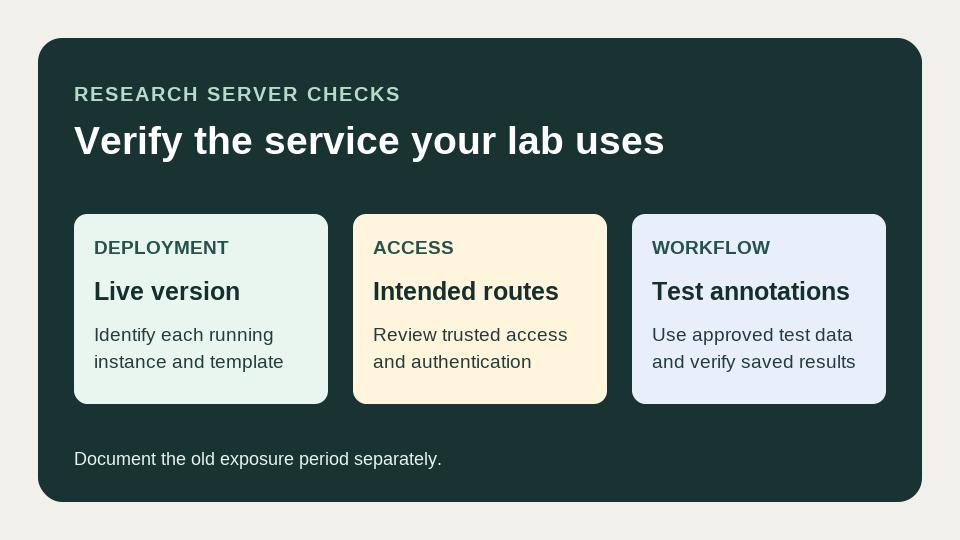
The live deployment, access boundary, and ordinary annotation workflow each provide different evidence.
A fallback plan should name a known-good fixed environment. If the new release exposes an unrelated viewer or model compatibility issue, switching to a previously validated fixed build or using the institution's restricted recovery process allows the team to preserve continuity without assuming that the previously reachable, vulnerable copy is suitable. Where a fixed substitute is unavailable, coordinate a temporary pause and limited authorized access with the service and data owners. Preserve the lab's results and configuration in the normal backup system so that the recovery decision can focus on service safety.
Assess exposure across the period before the update
The first question for an older deployment is how far back you can establish that the service was running and reachable. Record intended reachability separately from what access records can substantiate. A researcher might remember a server as an internal tool, while a shared hosting group remembers granting remote access for a collaboration. Date those decisions and use the dates to select logs. A service log, hosting inventory, access gateway record, and network record can support different parts of the timeline. A gap in any one source should be visible in the conclusion.
If an untrusted route existed, route the case to the institution's security response team and preserve available records. The relevant evidence may include service and operating-system logs, access-policy history, image revisions, and relevant file-change history. Dataset-access conclusions belong with the people authorized to handle the data. Analysts can identify which sets were within reach of the service account and whether available records show access or changes. A documented gap, such as an inactive network log or a short collection window, gives reviewers a reason to lower confidence in the exposure assessment.
Consider a hospital research collaboration with several compute projects on separate application accounts. One lab's service might have access to a de-identified study and its labels, with original records kept in a different controlled system. The project and security owners should document that separation if they can substantiate it. If the service also had access to shared team directories, include that fact in the scope review. If logs show unexpected changes, preserve the evidence and investigate through the established team rather than restoring files before the event can be examined. Patch status, authorization status, and the investigation's findings can be communicated separately to the principal investigator and infrastructure owner.
Leave a record that survives the next study
A useful closing record includes the old and new release, runtime identity, access routes reviewed, verification result, and follow-up owner. Attach the source of each assertion. A live deployment screen can support a version claim. A normal lab test can support workflow continuity. Network or access configuration can support the intended boundary. Historical evidence supports only the period it covers. This record helps the next researcher distinguish the server they should connect to from the template they should use to start a new project.
A lab maintainership handoff can also capture the conditions under which the service may be shared. A new collaborator may need access for a short study, a workshop might provide independent accounts, and a centrally managed GPU workspace may replace sessions automatically. Those changes have operational owners and dates. Updating that record as courses and collaborations start makes the next advisory easier to apply, because the team can find affected servers without relying on its original maintainer's availability.
The fix is available now. The practical measure of progress is an identified fixed server for each annotation workspace, a validated research workflow, and a recorded decision about historical reachability. Keep any unresolved exposure questions visible even when the update is complete.
Sources
- MONAI Label security advisory
- MONAI Label 0.8.6 release and package record
- AWS Security incident observation