When a robot picks the right move and still fails, how do you find out why?
The Mind2Act World benchmark breaks robot failures into memory, motion and the ability to adapt after acting. Its simulated results reveal the gap between those skills.
A robot arm identifies the correct part and reaches for it. The part shifts as the gripper closes. The robot continues toward the bin as if it had picked the part up. A single success rate records a failure. To improve the system, the team needs a more precise answer. Did the arm lose its grip, did the camera miss the shift, or did the system fail to change its plan after seeing what happened?
Mind2Act World is a simulation benchmark that gives robotics teams a way to investigate that distinction. The researchers’ technical report, submitted to arXiv on November 19, 2026, separates tasks that test memory and reasoning, tasks that test physical execution, and tasks that require the robot to use the outcome of an action to decide what comes next. In the authors’ evaluation, their strongest agent succeeded in 52.7% of reasoning episodes, 39.0% of execution episodes and 12.0% of combined episodes. Mind2Act World technical report
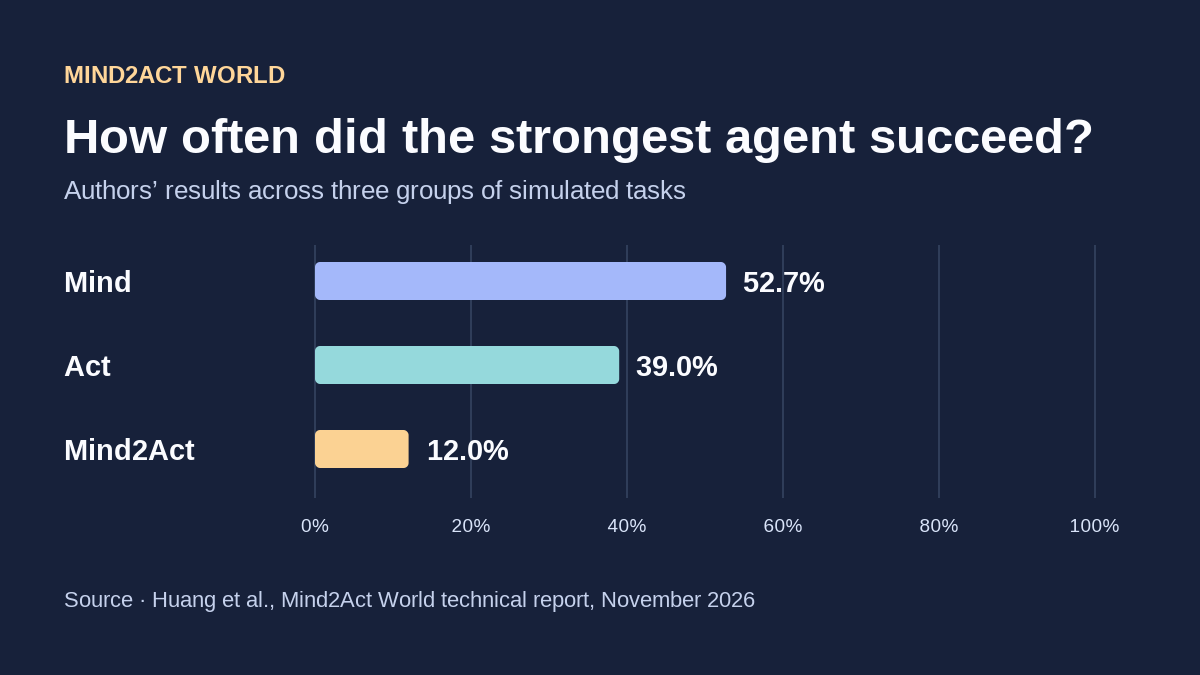
What changes when the robot has to act on its own feedback
The benchmark includes 30 simulated manipulation tasks. The authors run tasks at three difficulty levels across two scene settings, for 180 configurations. A reasoning task might ask the robot to reconstruct the layout of a tray after it rotates. An execution task might ask it to pick objects off a moving conveyor. A combined task like assembling a meal on a conveyor asks the robot to retain the goal, manipulate the right items and update what it does as the scene changes. The project’s official repository lists the tasks and links to videos for each difficulty level. Task list and official demonstrations
These are three separate groups of episodes. Each score summarizes success on its own task group, so the percentages should be read alongside the tasks and protocols used to obtain them. The paper reports that a strong tested agent retained task state yet struggled with sustained contact, while the tested end-to-end policies handled some practiced motions but retained little task state. The authors maintain separate leaderboards for agents that use motion tools and models that generate robot actions end to end. Evaluation protocol and findings · Official project repository and introduction video
The two system families have different ways to turn an observation into motion. In the paper, an agent reads camera images and robot state, then selects from available motion tools. The end-to-end policies receive task observations and an instruction and produce robot actions after adapting on the provided demonstrations. Both face the same tasks and physical scoring rules. The inputs and objectives give teams a common evaluation reference, while the different control methods inform where to look when one approach succeeds more often. System families and policy interfaces
For example, step-by-step reasoning helps if the next action depends on recalling which tray a part came from. A continuously updated motion controller may be a better fit for keeping a gripper aligned during a contact-heavy step. The difficult part is handing information between those systems. The controller needs to communicate what the robot actually accomplished. The task planner needs to know whether it can continue, should request another observation or should hand the job back to an operator. Passing only the intended destination along that connection leaves the planner with little evidence when a placement fails.
The three rates tell you which questions to ask next
The report identifies GPT-6 Astra as the strongest evaluated agent on these task groups. Its 12.0% combined completion rate represents 36 successful episodes out of 300. The authors report that 18 of those successes came from a single combined task, conveyor meal assembly. An average across a task group is convenient, while the per-task breakdown tells a team how concentrated that success was. One prompt or controller change that improves a familiar task can lift the average while leaving entirely different manipulation skills untested. Results and task breakdown
The separate views help make the next comparison specific. A team could keep the scene and the target fixed while changing how long the system must remember an observation. Then it could hold the instruction fixed and vary where the part rests or the angle at which the gripper approaches. After those checks, combine the kinds of variation the real workflow allows. What matters is the first place the process diverges from the intended result. An episode can fail at the same final bin for three different reasons, and changing the part of the system that failed first gives the next run a better chance of explaining the outcome.
There is a timing detail worth reading before applying the results. Mind2Act World uses Isaac Sim. The paper says simulation pauses during model computation, and it records elapsed evaluation time separately from simulated task time. A conveyor in a workplace continues moving while the planner computes unless the installation has a way to stop it. A long pause can change which parts are reachable and whether an earlier view of the scene is still accurate. For a timed physical workflow, report the end-to-end elapsed time and whether the observation was still current when the action began. Simulation and timing protocol
The benchmark also varies difficulty and scene configuration. In a parts-sorting workflow, results gathered on a clean tray might reveal whether the nominal controller works. Scenes with different layouts can show when success depends on a position that happened to be stable during development. Report these conditions separately. If the robot succeeds on arranged parts but repeatedly overlooks one behind a taller object, the team has a specific visibility problem it can compare across camera positions and pick strategies.
How a team can use the distinction during a pilot
Take a parts-sorting pilot. First, show the robot several parts and check whether it can identify the right bin after a part moves out of view. Then provide the correct pick location directly and test how often the gripper closes securely under different orientations. Finally, move or release an item during a pick and test whether the system observes the result, updates its understanding and attempts an appropriate recovery. This is a proposed pilot inspired by the benchmark. Its results would come from the equipment and parts being evaluated.
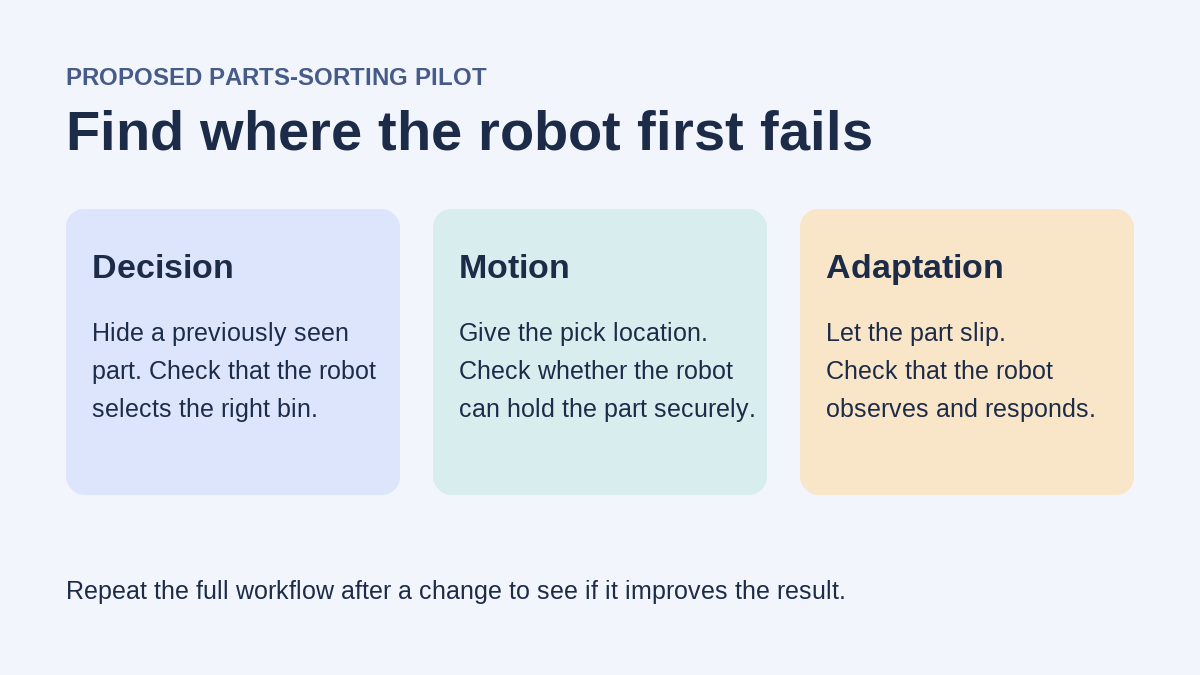
Tagging the first failure can make the next engineering decision less ambiguous. If the system chooses correctly and repeatedly drops a glossy part, changes to grip or sensing become testable hypotheses. If it drops the part and the next motion still assumes a successful grasp, examine how sensing feeds back into the task planner. Run a combined trial again after either change to see whether the full workflow improves.
Use a consistent pass rule for each check. The decision passes if the system returns the expected product and destination from the evidence it was allowed to see. A pickup passes if the intended part is securely transferred. A combined run passes if all requested parts reach the designated bins within the pilot’s criteria, including any allowed recovery. Save the case setup with the outcome. A decision test is much easier to interpret when the evaluator can confirm that its instruction and initial scene gave the system enough information to choose.
Here is an example of a compact trial log. Each row describes a different run, with the results shown only to illustrate the diagnosis.
| What the evaluator observed | What to check on the next run |
|---|---|
| The requested part remained occluded and the system selected a different part | Compare what the camera showed with the information supplied to the planner, and repeat with a clear view |
| The right part was selected and the gripper failed to hold it | Give the correct location directly to isolate pickup consistency by part material and orientation |
| The gripper lost the part and the task still advanced to placement | Check how grip and camera observations are reported to the planner and when the next action is selected |
| A retry placed the part correctly after an unplanned delay | Count recovery as a separate outcome and compare the total elapsed time with the target cycle |
A short recording of the relevant cameras and corresponding task state helps the evaluator decide between those explanations. Review one time interval around the first unexpected result. The same view of an empty gripper may arrive before the next action is chosen or after it is already underway. If the system supports a review mode, compare its predicted next step against what the equipment actually commanded. Save both before changing the prompt, tool interface or controller so a later test can identify which change produced the improvement.
Benchmarks can inform a pilot built around your own operating limits
The paper’s diagnosis work assigns failures for selected systems to categories and reports them in model profile cards. An operations team can use a smaller version for its own equipment. A test record can pair the expected next state with the observed state, first failing step, recovery outcome and whether a person intervened. One owner can maintain the test cases while separate owners fix the controller and the planner. That shared record lets both sides reproduce the same conditions even as their components change. Authors’ diagnostic analysis
Decide what to compare before changing a component. A conventional scripted sequence, a learned action policy and an agent using motion tools may each be appropriate for different steps. For a stable station with a familiar part in a fixture, a scripted sequence provides a relevant baseline. For a part presented in many poses, a learned policy may improve pickup flexibility. If the task depends on when a part was seen or on a decision revised after a slip, the planner and feedback channel deserve a focused comparison. Keep the hardware, task objective and test cases consistent when evaluating alternatives.
Ask how the system recovers within the boundaries of the installation. A real pilot can record whether recovering from an ordinary failed pickup requires an operator or can reuse the station’s established safe retry behavior. Count interventions and aborted runs along with completed tasks. A recovery that consumes so much time that the next two jobs are delayed has a different operational consequence from one that returns the station to its regular cycle. Those outcomes matter even when both runs finish with the part in the right bin.
The paper measures performance in simulation. A team working with real arms still needs to check how its own sensors, gripper, materials and cycle time affect the findings. In an adoption decision, the useful comparison is how often the robot completes a representative job, how it responds to common interruptions and how often a person has to intervene.
Sources and dates
- Huang et al. submitted the report on November 19, 2026. The recorded scores are the authors’ results for the evaluated systems. arXiv preprint and submission record
- The project repository records its initial agent leaderboard on November 9 and publishes an introduction video, task descriptions and documentation. Official repository and video
Keep trial observations, failure times and changes across runs in one place. Start your first note with Telli.sh.