Can Meta AI remember that your plans changed?
Meta’s November rollout brings Active Memory to Muse and Meta AI. Meta reports that Muse also recovers from task setbacks more often. Here’s how to test an assistant when plans change.
You usually take the earliest train you can get. For Saturday's trip, however, a friend asks you to take the 10:40 so you can travel together. Your AI assistant remembers both facts. Then the 10:40 is canceled. When you ask the assistant to rebuild the plan, will it quietly bookend your itinerary around a departure that no longer exists? Will it assume you always prefer late trains? Or will it remember the reason you made the exception and ask what your friend can actually catch?
That is a more interesting test of AI memory than asking an assistant to repeat a favorite color. Memory is useful when it helps carry a task forward. A plan that stretches across days also asks the assistant to sort preferences from exceptions, check the current state, and stop at decisions you still own. Meta's November update to Muse and Meta AI is an opportunity to test how much of that work can now be delegated.
What Meta started rolling out in November
On November 6, 2026, Meta said it was beginning to roll out specialized versions of its existing models in Muse and Meta AI. Meta had trained them using Muse Wonder, the research model series it introduced separately. Muse is Meta's personal agent for longer tasks, while Meta AI is its general assistant. Availability is a phased rollout, so the announcement alone cannot establish which account, region, or interface has received the update.
Meta describes two capabilities that address different parts of a changed plan. Active Memory, described for both products, helps the assistant determine which context to remember, how long it remains relevant, and when more recent information changes its meaning. Meta describes Active Focus in Muse as continuing to pursue the user's goal after an unexpected obstacle. For Meta AI, it describes related improvements in conversation, such as asking follow-up questions and adapting when you change direction. In the train example, memory concerns what to carry forward about departure times and your friend. Focus concerns how to propose a workable trip once the chosen train disappears.
This distinction matters if you want to judge the update on something you could use. An assistant can correctly repeat your new constraints and then give up at the first blocked option. It can also enthusiastically produce a new itinerary using last week's inputs. A result is useful when it satisfies both tests. It uses the current constraints and it adapts the next step in a way you can check.
Meta reports that its Muse benchmark rose from 76% to 90% for correctly using critical context, a gain of 14 percentage points. The company also reports a 67% improvement in completion of everyday Muse tasks that encounter unexpected problems. The second figure measures relative improvement. Both results come from Meta's evaluation. An individual trip, study routine, or work handoff can have different constraints and needs its own checks.
Meta publishes a guided tour of Muse on the product site. The cover is a historical photograph of Facebook's Menlo Park campus, taken by LPS.1 in 2014 and released under CC0. Telli.sh resized and cropped the original photograph.

Three kinds of context in a single plan
When someone says a trip is on Saturday, a train leaves at 10:40, and they generally like an early start, those facts can look equally useful when first recorded. They age differently. Treating them as three different roles makes it easier to tell what an assistant did well when the plan changes.
| Kind of context | Fictional example | What should happen when the train is canceled |
|---|---|---|
| Standing preference | I normally prefer an early departure. | Keep it as a preference and use it to rank options that satisfy the current constraints. |
| Current trip constraint | I need to meet my friend at the station no earlier than 10:15 this Saturday. | Apply it to this trip, even when the usual early departure preference points elsewhere. |
| Replaced detail | We planned to take the 10:40. | Drop it from the active itinerary while keeping it as background if the conversation needs to explain why the plan changed. |
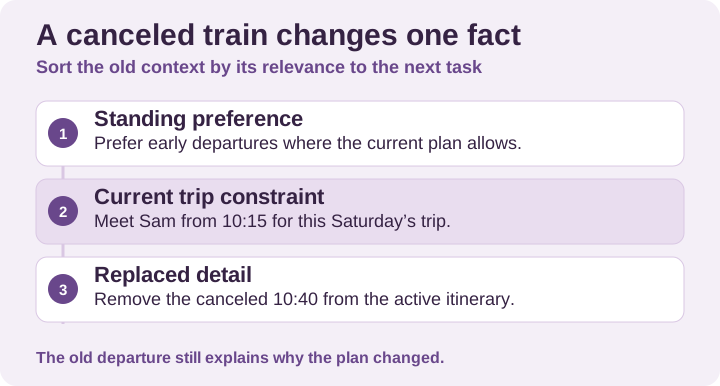
Original Telli.sh diagram of an illustrative trip. The labels are an editorial way to examine answers, rather than a view into Meta's internal memory.
Notice the difference between removing a canceled train from an itinerary and forgetting that it ever existed. If a friend asks why you changed the plan, that historical detail is still relevant. If you ask what to book, it is an obsolete option. The right answer depends on the task the assistant is doing with that fact. The visible behavior to look for is whether it selects the context appropriate to the question.
The same distinction applies to a preference. Someone who requests a quiet restaurant for one meeting may not want that to govern birthday plans. Someone who says a seat preference has changed permanently might reasonably expect the assistant to use the new preference for a separate trip. Describing the time scope explicitly is a small, practical way to improve the quality of an experiment and the quality of the plan you eventually use.
A short trial for an account that has the update
Start with invented details and ask for a plan in text. Keeping the first trial entirely fictional lets you inspect the assistant's handling of changes without submitting real travel information or granting it access to accounts. You can record the exact prompts and the replies and run the same test again later if the interface changes. If the update is not visibly available on your account, the replies can still tell you how that interface behaves today, but they cannot identify which underlying model produced them.
- Set the durable preference. Say, “In general I prefer the earliest available train. For Saturday's fictional trip, I am traveling with Sam and we can only meet from 10:15.” Ask it to summarize the preference and the trip constraint separately.
- Give it a plan that will become stale. Say, “Our first plan was the 10:40 train and a museum entry at 13:00. Assume the train ride takes 75 minutes and allow 30 minutes from the station to the museum.” Ask it to draft the itinerary without searching the web or booking anything.
- Replace one detail and introduce an obstacle. Say, “The 10:40 was canceled. The only available departures are 10:00, 11:00, and 11:30. The museum entry is still 13:00. Use those times as fictional inputs and tell me which option fits.” The 10:00 conflicts with the meeting. The 11:00 arrives at the museum at 12:45. The 11:30 arrives at 13:15.
- Inspect the justification. Ask, “What changed, what still applies, and what would you ask me before changing a reservation?” A well-grounded answer can explain why 11:00 fits, show the 15-minute margin, and leave any rebooking to a separate confirmation.
- Test the boundary of the exception. In the same chat, ask how it would plan a different fictional trip where Sam is absent. If your interface supports carrying context to a new chat and you want to test it, repeat that second question in a fresh chat. Record those observations separately because using visible conversation history and using context across chats are different experiences.
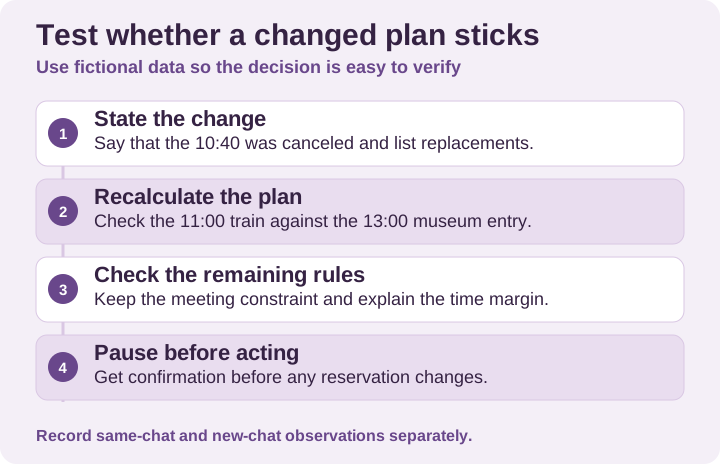
Original Telli.sh diagram of a trial you can run with made-up inputs.
Save one simple verdict per step. Mark it pass if the assistant used the available facts correctly and explained its result. Mark it fail if the result contradicts a constraint or resurrects an obsolete option. Mark it ambiguous if you cannot tell whether the answer depends on remembered context, an assumption, or information that happened to be visible. The verdict belongs to that interaction on that date. Repeating a successful test with a second example can help establish whether you are seeing a pattern.
You can also reverse the test to see whether it catches a necessary tradeoff. Move the museum entry to 12:30 and ask again. None of the departures now fits all constraints. A useful response makes that conflict visible and asks which commitment can move. A polished answer that quietly changes the museum time would make the plan look finished while transferring the problem to you.
Where the same feature could earn its keep
Study routines with temporary exceptions. A learner normally wants short practice sessions on weekdays. For a week of travel, they ask for two longer sessions and request that the original routine resume the next week. Give the assistant a dated scenario and ask it to show the calendar for both weeks. The benefit would be fewer repetitions of a standing preference. The concern is that a one-week instruction can propagate after it has expired. The practical check is whether the study plan resumes on the requested date and whether a changed exam date correctly supersedes the old deadline.
Volunteer event planning across changing constraints. A group generally avoids weekday evenings, but one member offers a venue for an exceptional Tuesday. The venue then becomes unavailable. Supply an invented list of possible rooms and availability. Ask the assistant to recommend options and include what it still needs from the organizer. The useful behavior is keeping the rest of the group's needs intact while adapting to the changed venue. A suggested option is easy to undo in a draft. A message sent to all attendees has a higher cost and needs its own review.
A recurring work handoff. Imagine a small team that prefers one-page status notes. Its current project has an exceptional reporting deadline and a dependency that has just slipped. Ask the assistant to produce a revised handoff from an invented timeline, clearly label the new estimate, and keep the one-page format. A useful assistant can bring forward the stable format without burying the new schedule. The downside appears if it repeats a stale deadline or presents an uncertain dependency as settled. A table of current facts and dates still gives the reader something concrete to check.
Across these examples the opportunity is less re-entry and better continuity when a task spans multiple conversations. The risk is that old information becomes harder to notice precisely because the answer sounds fluent and familiar. Inference also complicates the result. An assistant might infer that a temporary exception is a broader preference even if you never said so. When scope matters, state when it starts, when it ends, and which old detail it replaces. Then inspect the next answer for the effect you expect.
The control point is the next consequential step
An assistant that can recover from surprises can save time drafting alternatives. The more capable it appears, the easier it is to let a recommendation blend into an action. Decide up front where you want that boundary. For the train example, showing a revised itinerary is an easy step to review. Buying a new ticket, canceling the old one, or sending a friend the plan changes the situation outside the conversation. Ask for a separate confirmation before each of those steps if the product and your connected tools make them possible.
Treat the itinerary as a working copy. Keep the final bookings and confirmations in the services that issued them and verify critical facts there. If you are comparing two runs of the assistant, write down what inputs it had at the time. A result generated after a timetable changed should be compared against that timetable, not an old screen you saved earlier. Meta's rollout statement and evaluation describe its objectives. The behavior you observe with your own input is the evidence you can use for your next decision.
The early promise of Active Memory and Active Focus is that a longer task may need less re-explanation even after the world changes. The trial worth repeating is whether the assistant keeps the reason for a decision, discards the part that expired, and exposes a conflict while there is still time to resolve it. If that happens consistently on your low-risk examples, you have a basis for letting it draft more of the plan and still reviewing the step that carries real consequences.
Sources
- Meta's November 6 announcement on specialized models for Muse and Meta AI
- Meta's separate introduction to Muse Wonder
- Official Muse product guide and tour
- Cover photo by LPS.1, CC0
About Telli.sh
Telli.sh turns recordings, notes, and documents into a searchable personal knowledge base so you can find the source behind a decision later. Try Telli.sh to keep your working notes and the context that informed them together.