The re-meeting: how to stop your team deciding the same thing twice
OpenAI's July 2026 research found that 43.5% of occupation-specific ChatGPT messages are about work outside the user's own job. That kind of work runs on context — and most of an organization's context evaporates in meetings. A practical guide to turning meetings into searchable work knowledge: what to capture, how to name it, which meetings deserve a durable record, and what search changes for onboarding and handovers.
On July 27, 2026, OpenAI published research on more than 800,000 work-related messages from U.S. ChatGPT users. The headline finding: 16.8% of work-related messages, and 43.5% of the occupation-specific ones, concern tasks normally associated with a different job than the person doing them. OpenAI calls the pattern task crossover, and the shares get steep in some roles — 77% of occupation-specific messages from customer experience workers, 75% from designers, 69% from human resources.
The number that should stop you, though, is buried in the methodology. Before OpenAI could measure crossover at all, it had to discard a category of work it described as "shared too broadly across occupations to be evidence of crossover." Its three examples were writing, summarizing, and scheduling. Those activities are so universal that they say nothing about who you are.
Here's the point: the work that is too common to be evidence is exactly the work that decides whether an organization compounds knowledge or repeats itself. This post is about one slice of it — meetings — and about a specific, unglamorous method for turning them into something a colleague can find eighteen months later. What to capture, how to name it, which meetings deserve a durable record and which ones don't, and what actually changes once the archive is searchable.
TL;DR:
- OpenAI's July 2026 study found 43.5% of occupation-specific AI messages are about work outside the user's own role — and crossover work runs on context the person doesn't personally have.
- Most of that context is spoken aloud in meetings and never written down, so teams pay a hidden tax: the re-meeting, held only to recover what an earlier meeting already settled.
- Search reaches titles and summaries, not audio. A meeting becomes a knowledge asset when it has a recording, a speaker-attributed transcript, a summary, and above all a title written in the words a stranger would search for.
Image: Alicia Fagerving, Wikimedia Commons, CC BY-SA 3.0.
Crossover work runs on context you were never given
Read the OpenAI findings again with a practical eye. A customer experience worker whose non-generic AI use is 77% outside their own occupation is not doing customer experience work with AI. They are doing something closer to analysis, or legal review, or troubleshooting. OpenAI's own framing is that "the worker closest to the problem is more likely to take on the problem rather than delegate" — and the report finds more of this in small organizations, where the outside-occupation share runs 18.9% in workspaces of 2–5 seats against 16.3% in workspaces above 100.
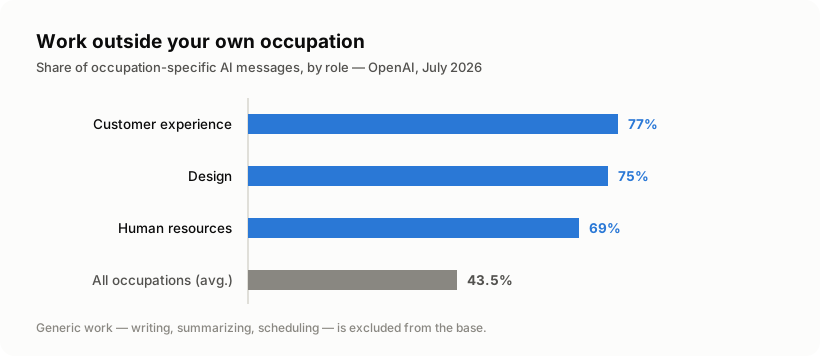
Figure 1: Crossover is not spread evenly. In three roles it runs far above the 43.5% average. Data: OpenAI, July 2026.
That shift has an obvious consequence that the report does not need to spell out. When you take on a task from outside your own job, the model can supply the general skill. It cannot supply the part that is specific to your company: why the pricing tiers are shaped like that, what the vendor promised in March, which approach the team already tried and abandoned, who has authority over the decision you are about to touch.
That knowledge exists. It is just not written down anywhere. It was said out loud, in a meeting, to the six people who happened to be in the room.
Financial calculation and technology troubleshooting show up among the three most common outside-occupation tasks in all seven of the other occupation groups OpenAI studied. Both are exactly the kind of work where the general method is easy and the local facts are everything. AI made the method cheap. It did nothing about the facts.
The re-meeting is a tax you are already paying
Most organizations run a shadow calendar of what we'll call re-meetings: meetings held for the sole purpose of recovering something an earlier meeting already produced. Nobody schedules them under that name. They appear as "quick sync on the checkout flow," or "aligning on the vendor decision," or the message that starts "sorry, did we ever land on..."
A re-meeting is not a disagreement being resolved. It is a retrieval failure being papered over with people's time. And it is expensive in a way that never shows up in any budget line, because the cost is distributed: eight people, forty minutes, to reconstruct a conclusion that four of them were present for.
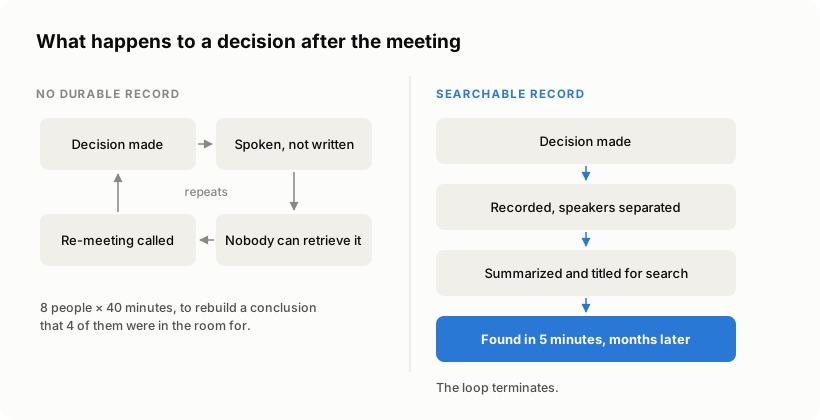
Figure 2: The re-meeting is a closed loop. A searchable record is what turns it into a line with an end.
The tell is easy to spot. If someone in the room says "I think we discussed this" and nobody can say what was decided, you are in a re-meeting. If the answer arrives from one person's memory rather than from a record, you got lucky, and you will not get lucky next quarter when that person has moved teams.
Here is the uncomfortable framing. Your organization already has a knowledge base. It is made of audio that nobody has ever listened to twice, and of memories that are silently decaying. The question is not whether to build an archive. It is whether the one you already have is reachable.
You cannot search sound
The reason meetings evaporate is mechanical, not cultural, and it is worth being precise about it.
Search engines — the one in your notes app, the one in your chat tool, the one in your head — operate on text. Audio is opaque to all of them. A folder of 200 recordings named zoom_20260731_142.m4a is not a knowledge base; it is a landfill with timestamps. And this stays true no matter how good the recording is, which is why "we record everything" is a strategy that reliably produces nothing.
Once you transcribe, four distinct layers exist, and they are not interchangeable. It helps to know which one search actually touches.
The recording is the ground truth and the court of last appeal. You go to it rarely — maybe twice a year, when a summary is contested or a number looks wrong. Its job is to exist, not to be read.
The transcript with speakers and timestamps is where the detail lives. A 60-minute meeting produces roughly 8,000 words of speech, which is a short novella. Nobody reads that voluntarily. But it is the layer where a full-text search for a vendor name or an error code actually lands on a specific minute, and speaker attribution is what makes the hit useful — "who committed to this" is answerable from a diarized transcript and unanswerable from an undifferentiated wall of text.
The summary is the layer humans actually read. It is what makes a hit worth clicking, and what lets someone triage twelve search results down to the one they need in ninety seconds.
The title and metadata are the layer that decides whether the record is found in the first place. Everything above it is worthless if nobody arrives.
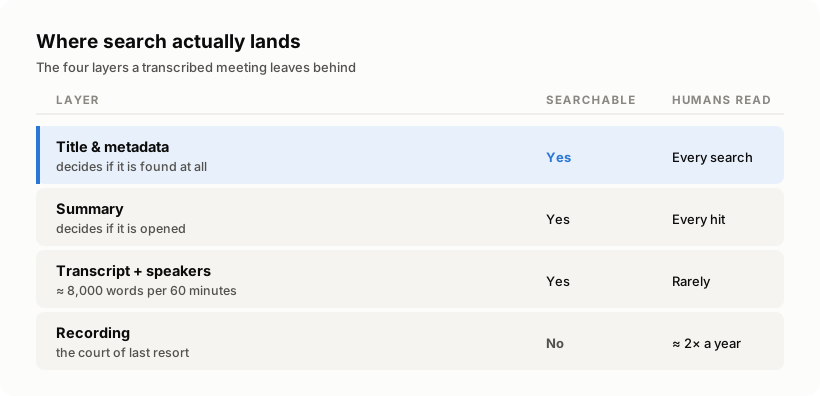
Figure 3: Search never touches audio. The title is the only layer that decides whether anything is found at all.
Teams get this order exactly backwards. They obsess over transcription and treat the title as an afterthought — and the title is the only layer that determines retrieval.
Name the record for the stranger who has not heard of it
Information retrieval researchers named this problem in 1987. Furnas, Landauer, Gomez and Dumais published a study in Communications of the ACM showing that when two people spontaneously choose a term for the same familiar object, they pick the same word less than 20% of the time. They called it the vocabulary problem, and it is why your future self cannot find your own notes.
The practical translation: a title must contain the words someone would search for who does not already know the meeting happened. That rules out almost everything teams currently use. "Weekly sync" is unsearchable — there are 200 of them. "Meeting with Anna" is unsearchable unless you already know Anna was involved, which is the thing you were trying to find out. "Q3 planning" is nearly unsearchable, because nobody in month fourteen searches for "Q3."
A title that works has three parts: a date, the proper noun, and the outcome.
2026-08-04 — Checkout redesign: chose Adyen over Stripe for EU cards2026-07-22 — Acme renewal: agreed 18-month term, pricing unresolved2026-06-30 — Mobile onboarding: dropped the tutorial screens, kept the email step
Notice what each one does. The date sorts chronologically and answers "when was this settled." The proper noun — Adyen, Acme, the actual feature name — is the search term, because that is the word a stranger types. And the outcome clause means the search result answers the question without being opened at all, which is the highest form of retrievability: the archive replying from the results list.
Two more conventions are worth adopting, and only two, because filing systems die of elaborateness.
Pick one organizing axis and commit. Project or team or client — not all three. The moment a record could plausibly live in two folders, the folder structure has stopped being an index and become a guessing game. Most teams should organize by project, because projects are what people remember the names of.
And keep the tags flat and few. Tags earn their place when they cut across the folder axis — decision, customer, postmortem — and lose it the moment there are forty of them and half are synonyms. If you cannot list your entire tag vocabulary from memory, your colleagues certainly cannot, and they will invent new ones.
Not every meeting deserves a durable record
This is the part most guides skip, and skipping it is how teams end up with an archive so noisy that search returns nothing useful. An archive is a signal-to-noise instrument. Filling it indiscriminately breaks it.
A meeting earns a durable record when it produces at least one of three things: a decision that someone later has to live with, a commitment with a name attached, or a shared understanding that a person who was absent will need. Vendor selections, architecture calls, pricing changes, customer escalations, incident reviews, kickoffs, anything where "why did we do it this way" will be asked later — all of these qualify.
Recurring status standups usually do not. They are coordination, not knowledge, and their content is stale within a week. Recording them produces exactly the volume that makes search useless.
And some meetings should deliberately not be preserved, which is a judgement call worth making consciously rather than by default. Performance conversations, anything involving an individual's conduct, early legal exposure, and unstructured brainstorms where half-formed ideas get attributed to named people — a durable, searchable, attributed record of these does more harm than good. The value of a brainstorm is that people say things they have not thought through. Archiving it punishes exactly the behaviour you wanted.
| Meeting | Durable record? | Why |
|---|---|---|
| Vendor choice, architecture call, pricing change, incident review, kickoff | Keep | Produces a decision, a named commitment, or context an absent person will need |
| Recurring status standup | Usually skip | Coordination, not knowledge — stale within a week, and the volume is what breaks search |
| Performance talk, individual conduct, early legal exposure, open brainstorm | Deliberately don't | A searchable attributed record deters exactly the candour these depend on |
Consent belongs here too. Recording rules vary by jurisdiction, and in most places the practical standard for internal meetings is that everyone knows a record is being made. Announce it once at the start. It takes four seconds and removes the entire category of problem.
What changes when the archive answers
The payoff arrives in three places, and it arrives suddenly — an archive is close to useless until it crosses a coverage threshold, then becomes reflexive.
Onboarding stops running on interruptions. A new engineer's first two weeks are traditionally a sequence of twenty small questions asked of five busy people. With a searchable archive, most of those questions have an answer that predates the question. The new hire searches the service name and reads the four meetings where it was designed, argued about, and scoped. They arrive at the same understanding without spending anyone else's afternoon — and, more importantly, they get the reasoning, not just the conclusion.
Handovers stop being a memory dump. The standard handover is a departing person writing everything they can remember into a document over two days, which is both incomplete and unverifiable. When the archive exists, the handover document shrinks to a map: here are the six threads you are inheriting, and here is where each one was last discussed. The detail is already captured. The leaving person's job becomes pointing, not recalling.
Decision archaeology becomes possible at all. "Why is it like this?" is the most expensive question in any organization older than two years. Without a record, the honest answer is a shrug, and the team either preserves a constraint that stopped applying long ago or removes one that is still load-bearing. Both mistakes are costly. With a record, someone searches the component name, finds the meeting from nineteen months ago, and reads that the constraint came from a customer contract that expired in March. That is a five-minute lookup replacing a three-week argument.
There is a cross-language version of this that is easy to underestimate. If half your meetings happen in one language and part of your team reads another, the archive is only searchable for the people who share the language of the room. Retrieval is not just about whether text exists — it is about whether it exists in words the person searching would type. A record that a colleague cannot read is, from their side of the org, identical to no record at all.
The bottom line
A meeting is not an event. It is an unwritten document that happens to be delivered aloud, once, to whoever showed up.
For most of working history that framing was useless, because turning an hour of speech into a findable document cost more than the document was worth. That constraint is gone. Transcription, speaker separation, and summarization now cost cents and minutes, which means the only remaining reason an organization forgets what it decided is that nobody gave the record a name a stranger could find.
OpenAI's data shows people increasingly reaching outside their own job to do work. The tool for that is now abundant. The context is still scarce — and the context is sitting in your recordings, waiting for a label.
If you want the four layers without assembling them yourself, that is what we built Telli.sh for: it records or ingests a meeting, produces a speaker-attributed transcript and a summary, and keeps all of it in one searchable place, in your team's languages. The naming discipline is still yours — no tool can guess the word a stranger will search for. But everything under the title comes ready.
