How LYNX-10 turned a book page with a cable-driven wrist
A 10-degree-of-freedom research robot turned a page by coordinating two fingers, its wrist, and its arm. Here's what the experiment reveals about cable routing, precision, and grasp reliability.
An open book gives a robot two jobs at the same spot. One finger has to keep the page steady while another lifts a single corner. Once the sheet comes free, the gripper has to carry it across the spine without pulling the book along. In a research demonstration, the LYNX-10 arm completed that sequence with motors positioned closer to the base and cables transmitting motion toward the wrist and gripper.
On November 13, 2026, Scientific Reports published the peer-reviewed, accepted version of the LYNX-10 paper ahead of the final edited version. The team from Nanyang Technological University and Procter & Gamble built a prototype with a six-degree-of-freedom arm and a four-degree-of-freedom gripper. Their experiment makes a mechanical problem visible. When one joint moves, it can change the path length of a cable that controls another joint. At the edge of a page, the resulting wrist movement can disturb even a well-positioned fingertip. Scientific Reports article and publication history
The paper reports a page-turning demonstration alongside measurements of position repeatability, load capacity, and pinch force. Each measurement answers a different question. We can use the page turn to see what the mechanical design made possible, then ask what evidence a team would need before trusting the same approach with delicate material all day.
Moving the motors changes what the wrist has to carry
A motor attached near the gripper moves along with the gripper as the arm swings. Place the actuator closer to the base and run a cable to the joint, and more of the actuator mass can stay farther from the tip. The distance matters because mass farther out has a larger effect on the inertia a rotating joint has to overcome. The actual benefit depends on the assembly being moved, its pose, the task, and the transmission that replaces the local motor. Modern Robotics dynamics, chapter 8
LYNX-10 pairs a vertical lifting assembly and a SCARA positioning stage with a wrist that rotates about three axes. SCARA is a common arm layout in which rotary joints position the tool in a plane. In this prototype, the lifting stage adjusts height, the positioning stage places the wrist over the work, and the wrist orients the fingers for contact. The gripper's four degrees of freedom give the thumb and index finger separate motions so one can support the sheet while the other moves it. Accepted manuscript, mechanism design and manipulation demonstration
Consider how that distribution changes the work at a page corner. The arm has to position the wrist over an edge that may already curl upward. The wrist has to orient the fingertips so the first contact is gentle enough to leave the page where it is. The fingers then need room to change relative position while holding the same edge. A lighter moving wrist is attractive for this kind of coordinated work. The paper gives separate evidence for precisely placing and loading the prototype, while a controlled comparison with a heavier wrist would be needed to quantify task speed or energy savings.
An elbow movement can change the length of a wrist cable
Imagine routing a cable across a hinge. If it passes around the outside of the bend, flexing the hinge can lengthen the path it has to follow. A route that stays nearer the axis of rotation can limit the change. In a robot, the cable continues onward to a joint, which means a small path change upstream can move the wrist even when the desired wrist angle stays fixed. Engineers call this interaction coupling.
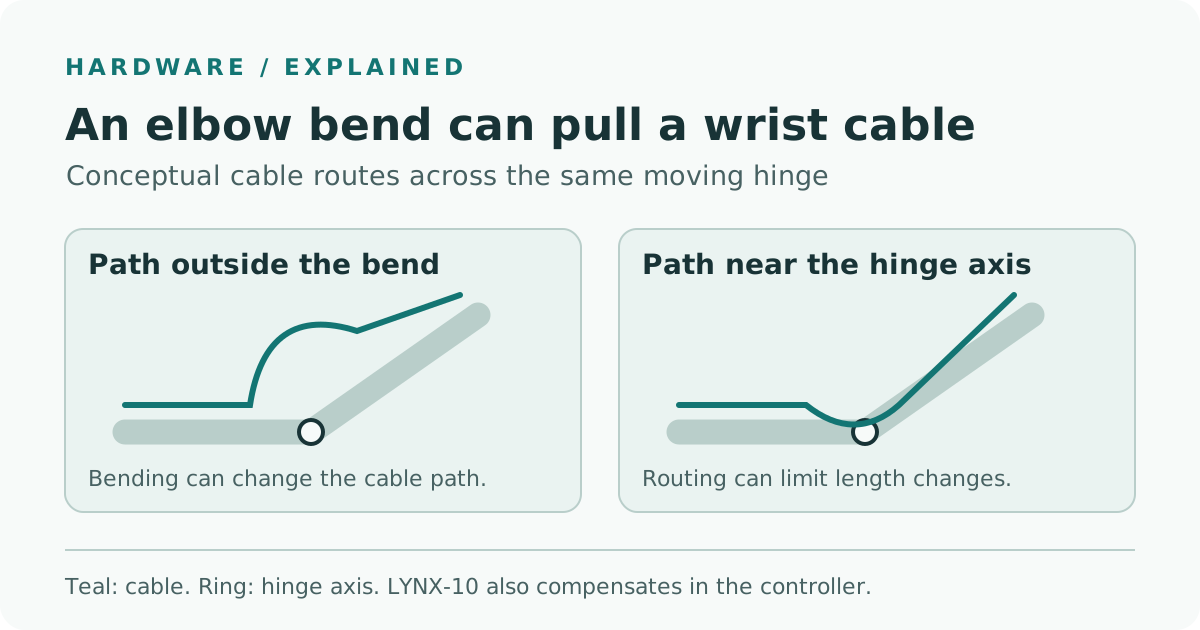
Original conceptual diagram of cable routing and upstream coupling. The labeled routes illustrate the principle.
The LYNX-10 team addressed coupling in two places. An elbow routing mechanism reduced the interaction mechanically. The controller then used a geometric model to estimate the remaining length changes as joints moved and adjust the commands to account for them. The authors report that using compensation substantially reduced unintended wrist yaw during elbow rotation and unintended pitch during combined elbow and wrist-yaw motion. Here, yaw is a turn from side to side and pitch is a tilt up or down. Accepted manuscript, coupling mechanism and experiments
The authors describe the compensation as quasi-static. For this correction, the model calculates how changing joint positions redistributes cable length. A faster motion, a change in cable pretension, or different loads could introduce behavior a geometry-based estimate captures less well. That makes speed, direction of travel, and the condition of the transmission useful things to record when repeating a test. A robot that reaches the right pose after settling could still travel through a pose that scrapes the paper somewhere along the way.
This is also where hardware matters for AI robotics. A task policy can request a wrist angle or a position for the tool, and the robot's low-level controller must convert that request into motion. LYNX-10's authors evaluated mechanical routing, model-based compensation, and a coordinated manipulation sequence. Evaluating a learned policy would also require a test of how the robot selects or adapts the sequence when the object or its position changes. Joint motion and contact both shape the inputs that such a policy would have to work with. Scientific Reports article · Modern Robotics on joint motion and forces at the tool
The fingers, wrist, and arm each do a different part of the page turn
The accepted manuscript shows a full cycle in Figure 9. The index finger steadies the page as the thumb lifts a corner. The two fingers establish a pinch on the raised edge. The arm and wrist then coordinate the transfer across the book, after which the gripper places the sheet, opens, and returns to the starting position. The separate motions let the gripper change who supports the paper at each step. Accepted manuscript, Figure 9 and its accompanying description
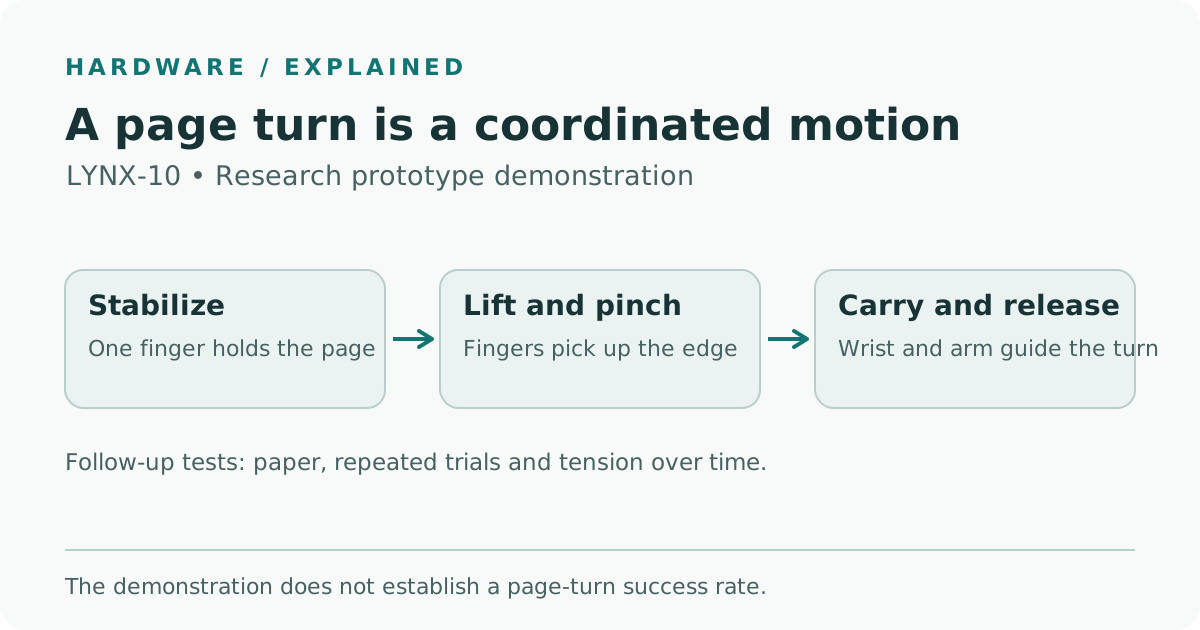
Original diagram showing the roles of the fingers, wrist, and arm in one page turn. The accepted manuscript contains photographs of the demonstration.
The difficulty changes once the corner is in the gripper. Initially the fingertips need to separate one sheet from the stack without gripping the stack itself. During the transfer, the paper bends and the tangent at the contact edge changes with the motion. The wrist can follow that change while the arm provides reach. At the end, opening the gripper releases the paper, but withdrawing the arm at the wrong angle can still drag or lift it.
Watch what happens to the sheet between the frames. A robot can perform the gross arm movement and still miss the task if it captures two pages or loses the edge before reaching the other side. A record of those outcomes would tell a team whether to change the corner-lifting action, the gripper's path, or the timing of release. The paper uses the completed cycle to demonstrate the available manipulation motions. A rate of one-page success would require a series of attempts with a clear pass criterion.
The 0.4 mm figure describes repeatability at three tested positions
The authors report that end-effector position repeatability was better than 0.4 mm when calculated separately for each measured coordinate, using three standard deviations at three tested positions. The end effector is the tool at the arm's tip. Repeatability describes how closely repeated visits cluster. A robot could repeatedly arrive at a spot that is offset from the intended target. Measuring that offset would answer a separate question about absolute positioning accuracy. Accepted manuscript, repeatability experiment
The paper also reports that the 6 kg assembly handled up to 6 kg of payload in the test. The usable ranges of shoulder and elbow motion narrowed as load increased. Separately, the gripper generated about 30 N of mean sustained pinch force across five measurements. The 30 N result characterizes the gripper in that test, while the amount of force a sheet can tolerate depends on the material and contact. Someone picking up thin paper also needs to know how finely the gripper can control lighter contact and whether that control holds across multiple cycles. Scientific Reports abstract and accepted manuscript
| Reported result | What it measures | What a deployment evaluation could add |
|---|---|---|
| Below 0.4 mm at three positions, per coordinate at 3σ | Spread of repeated endpoint positions in the tested setup | Absolute pose error and path error under the intended load and speed |
| Up to 6 kg of payload with a 6 kg assembly | Load handled within the tested motion ranges | Reach, speed, and duty cycle under that load in the target layout |
| About 30 N mean sustained pinch force across five measurements | Sustained force in the gripper test | Low-force control, slip, and damage limits on the target material |
| A demonstrated page-turn cycle | Coordination of the fingers, wrist, and arm on thin paper | Repeated single-page success, cycle time, damage, and recovery |
The trials were run by the research team on its prototype. Keeping their measurement conditions visible makes the paper easier to use in a design discussion. If the intended task is lifting more weight at a short reach, its load and motion data are a starting point. If the task is picking one page without leaving a mark, repeatability, contact behavior, and success over many attempts matter more than the greatest pinch force the hand can sustain.
A follow-up test can show which part of the movement needs work
Imagine an archive that wants to advance a bound volume under a fixed camera. Its target is a clean single-page transfer with the book still aligned for the next capture. A small edge crease can matter, and two pages picked together can leave a gap in the record. The LYNX-10 paper gives that team a sequence to examine. The archive would need to evaluate its own materials, book supports, and handling rules before trying the motion on valuable documents.
A packaging lab could use a similar test with thin separator sheets. Here the team may care less about keeping a book aligned and more about restarting after an incomplete pickup in a predictable amount of time. Sheets can vary in stiffness or cling together. A useful trial would count double pickups separately from dropped sheets and surface damage. Those cases may require different fixture or gripper changes, even when they all appear as failed pickups in a single metric.
- Choose the materials and define a pass. Begin with replaceable material and group samples by thickness, surface finish, and stiffness. For a page, count a pass when exactly one sheet lands on the intended side and the book stays within your agreed position tolerance. Take a picture after release so the outcome can be checked later.
- Measure before touching the material. Run the arm through the relevant elbow and wrist motions in a guarded lab setup. Record commanded and measured pose along the path, especially near approach, pickup, and release. Repeat with the same payload and approved speeds so a change in pitch or yaw can be compared across trials.
- Change one condition at a time. Keep the fixture, sheet position, and motion sequence fixed when comparing controls or hardware. Then vary the starting position or sheet type to see which results depend on the setup. Include repeated approaches from both directions where the equipment permits them so the team can detect a direction-dependent error.
- Log grouped outcomes alongside cycle time. Count completed single-sheet moves, doubles, drops, visible damage, and interventions. Record when the pickup first failed and whether the machine recovered. Include trial counts with any percentages so an early pilot and a longer run can be read at their proper scale.
- Repeat after use and maintenance. Compare records at agreed cycle counts and after inspecting or servicing the transmission. Check the same poses and samples before adjusting calibration. Look for changes in the tool's path and the sheet outcomes alongside any change in tension or wear that maintenance observes.
Treat an improvement in the endpoint trace as a reason to examine the transfer itself. An adjustment could reduce unintended wrist rotation while the sheet still catches on the fixture. Conversely, a change to how the book is held could improve transfers with identical arm settings. Logging the path and the sheet outcome together helps locate the improvement in the fixture, gripper, or controller.
The best reason to look closely at a turned page is how many parts of the machine have to agree before it lies flat. LYNX-10 gives researchers a physical example of that coordination, supported by measurements of the wrist, the tip, and the gripper. For the next experiment, I would mark the moment the sheet lifts and the moment it settles. The movement between those two points is where changes to cable routing or control have to earn their place.
Sources
- Zhu and colleagues, Scientific Reports, accepted article first published November 13, 2026
- Publisher's accepted manuscript PDF, including the experiments and photographs in Figure 9
- Creative Commons Attribution-NonCommercial-NoDerivatives 4.0 license cited by the article
- Lynch and Park, Modern Robotics, velocity kinematics and statics
- Lynch and Park, Modern Robotics, manipulator dynamics
To keep test videos, observation notes, and design decisions together in a searchable record, create a Telli.sh account.