LG's CLOiD worked in a factory demo. What would it take to move to a second line?
LG and NVIDIA connected plant data, synthetic variation, simulation and onboard inference for CLOiD. Here's how to tell which parts of the work would carry over to another factory line.
A robot can learn to move a part from one tray to another. What happens when the next line uses a tray with higher sides, puts the station under different lighting and runs on a shorter production cycle? The motion still looks similar from across the room. Up close, the robot has to find the object, reach it without touching the bin and place it accurately enough for the next step.
LG Electronics and NVIDIA reported a CLOiD demonstration involving robotic manipulation and manufacturing tasks in an actual manufacturing environment. NVIDIA discussed the work at AI Day Seoul on November 9, 2026, Korea time. The reported workflow used real-world data, NVIDIA Cosmos for data augmentation, Isaac GR00T for training, simulation for evaluation and Jetson AGX Thor for onboard computing. The collaborators described work on a repeatable development and validation process. NVIDIA Korea event coverage · NVIDIA's account of the LG collaboration
That gives us a concrete question about robots that learn from data. Which parts of the workflow could a team reuse when the station changes? A second-line transfer test would reveal more than a successful run at the first station. It would show whether the data, simulation and control assumptions hold up in a different physical setting.
Start with the work the team actually demonstrated
LG introduced CLOiD as a home robot at CES 2026. Its January announcement presented tasks including household chores in a connected home. The November account describes an industrial development project using the same named robot. The public statements illustrate two settings for the platform. A factory pilot has its own parts, schedules, process constraints and safety requirements, so the evidence for it comes from the manufacturing work. LG's CES 2026 CLOiD introduction · NVIDIA's account of the LG collaboration
The November statement establishes that the robot performed manipulation and manufacturing tasks in a manufacturing environment as part of the collaboration. It does not give a public count of repetitions, a per-cycle time distribution or a measure of operator intervention. Keep those three questions open if you are deciding how far the demonstration travels. A repeatable research process can be valuable long before it delivers the reliability a line operator needs on an ordinary shift.
The examples below are hypothetical. Imagine a plant that wants the robot to pick a component from a tote and place it into a fixture for a later step. Define a successful trial as the correct component seated in the correct orientation, within the normal process window, with the station ready for the next cycle. A grasp alone does not establish success if a human has to correct the placement every few attempts.
In a second example, the robot moves empty carriers from a staging point. That task may involve a larger object but a looser placement tolerance. It could be an easier first transfer if the carriers have predictable handles and their destination is clearly marked. The question for each task is where the remaining variation lives. It might be in the camera view, the robot's reach, the fixture or the state of the downstream station.
One training cycle has several places to catch a mistake
NVIDIA's collaboration announcement connects five pieces. A team collects real observations, augments those data with Cosmos, trains a model using GR00T, evaluates through simulation and uses Jetson AGX Thor for onboard computing. NVIDIA's GR00T developer materials explain the general workflow in more detail, including the use of demonstrations for policy training and simulation for evaluation before a physical deployment. Those materials describe a reference platform. They do not identify the exact model version or evaluation protocol LG used for the reported demonstration. NVIDIA collaboration announcement · NVIDIA's GR00T developer workflow
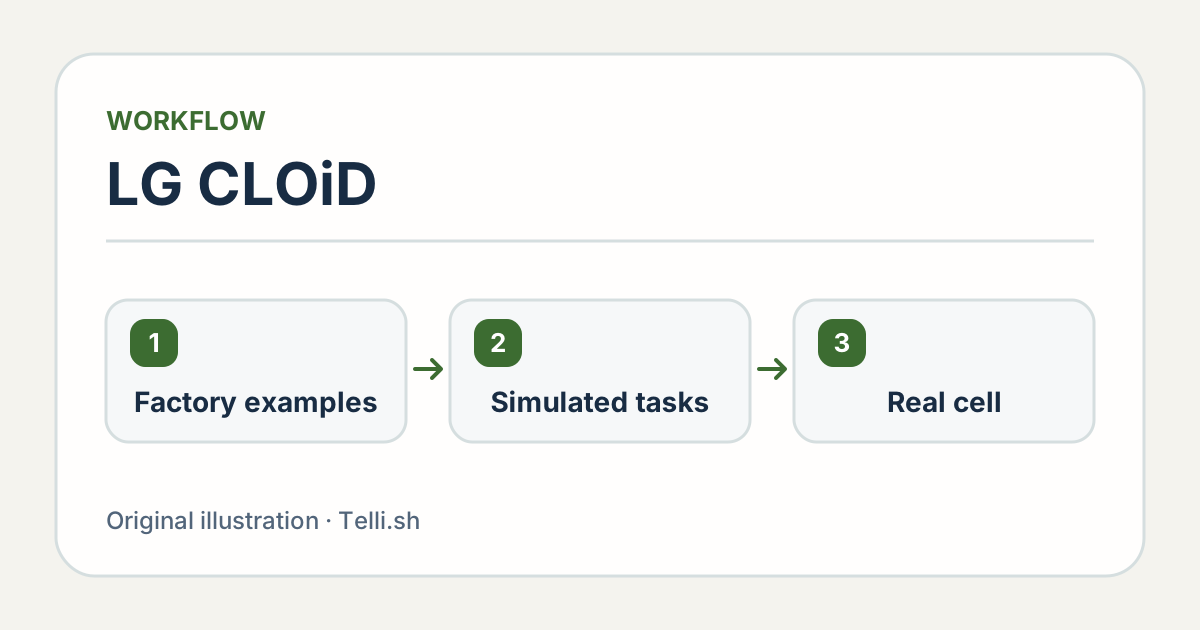
Real examples, simulated tests and physical trials answer different questions in a robot training cycle. Original illustration by Telli.sh.
Start with the collected examples. A demonstration of a person handling a part can reveal where it is safe to grasp, how its orientation changes and when a placement is complete. A set that contains only centered, well-lit parts offers fewer clues about the difficult cases. Record which trays, viewpoints and part variants were in the demonstrations so that the team can choose different conditions for evaluation.
Augmentation can add controlled variation without asking an operator to recreate every scene. For a hypothetical tray transfer, you could vary visual backgrounds or the position of a compatible tray in a simulation. This can help expose a model that relies on a fixed scene. A visual variation does not establish that a physical gripper can tolerate different friction, weight or dimensions. Those changes need a physical model adequate for the question and a check on the real station.
A learned robot policy maps observations and an intended task to actions. Training may help a robot respond to small differences it would be cumbersome to enumerate with hand-written rules. You still need the right tooling around the model. Fixtures determine whether a placement is physically possible. Sensors provide evidence about the object and station. The line control system determines whether the next step should begin. Those pieces remain important even if the learned motion looks smooth.
A different line changes more than the camera view
Simulation can test combinations that would be time-consuming to assemble on the factory floor. Model the station as a set of specific conditions and make the evaluation cases explainable. A result is easier to use when you know it came from a shifted bin, a partly occluded part or a delayed station signal. A single aggregate result can hide a failure mode the plant encounters every day. NVIDIA's Isaac Sim materials describe tools for building physically based scenes and incorporating robot, sensor and environment models. NVIDIA Isaac Sim documentation
Suppose the second line puts a guide rail near the fixture. If the rail changes the approach, an old motion may now run too close to the obstacle. A camera could still recognize the part correctly, so an image classification check would miss the issue. A transfer test has to include the robot's movement through the changed workspace. Simulation can narrow down conditions to check before a carefully controlled physical trial.
Conversely, suppose the fixture stays the same and the second line has more reflective packaging. Some cases that worked in simulation may fail because the real sensor saturates or a bright surface obscures an edge. Keep a small set of physical examples that were not used in training. They make it easier to see whether a new policy learned the task or adapted to details of the training environment.
| Change between lines | Useful controlled comparison | What to confirm physically |
|---|---|---|
| Tray shape or height | Simulate the new tray geometry and approach paths | Clearance and reliable grasp under approved conditions |
| Lighting or packaging finish | Vary the recorded or simulated camera conditions | Recognition and placement on a physical station |
| Shift timing or throughput | Replay the task with the expected timing constraints | Completed cycles and their timing distribution |
| Part missing or misaligned | Test detection, safe stop and handoff cases | The operator receives the right state and can recover |
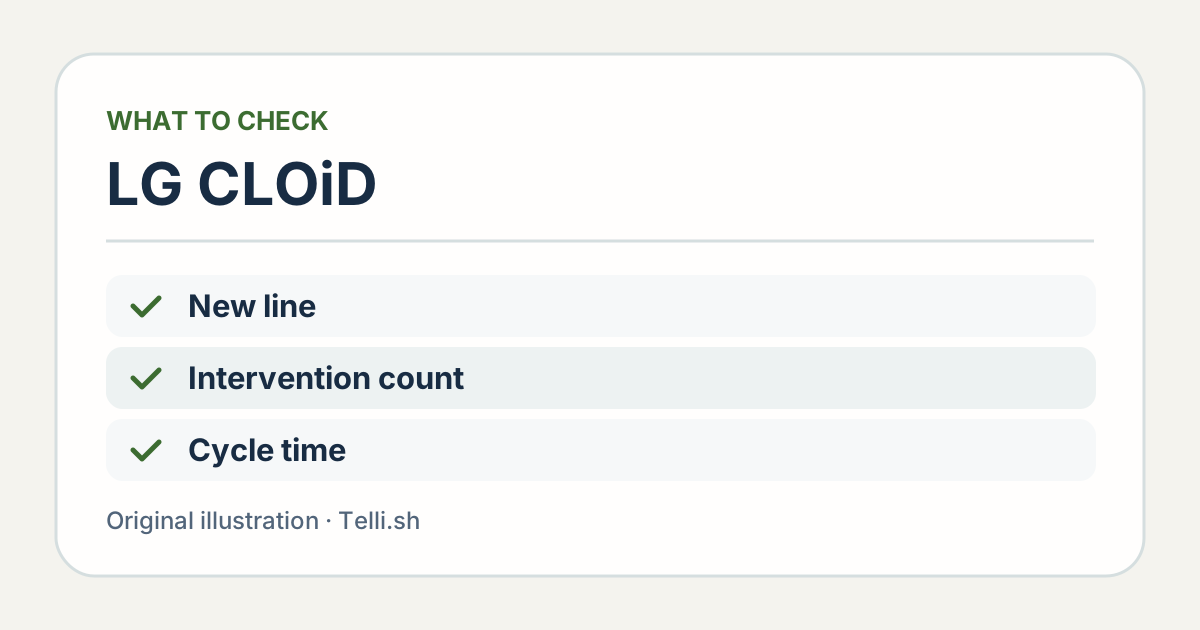
Change one station condition at a time so a transfer failure points to something the team can inspect. Original illustration by Telli.sh.
The team needs to count interventions and recovery time
Onboard computing can keep some inference close to the robot. NVIDIA says Jetson AGX Thor was part of the reported LG workflow. That makes the robot-side runtime part of the evaluation. Consider how the robot behaves when the available compute, camera rate or timing of a station signal changes. A single demonstration can look polished even though the team has yet to measure the tail of the timing distribution over repeated runs. NVIDIA collaboration announcement
For a useful comparison, report completed placements, wrong placements, interventions, and elapsed time with their denominators or measurement windows. If a run finishes after an operator nudges the tote, record that intervention. If the robot correctly stops because a component is outside the approved position, record the stop and how the operator brought the process back to normal. A good stop can be the expected outcome for a failure scenario.
A hypothetical line can illustrate the difference. One configuration might make 18 correct placements out of 20 without intervention and stop on two difficult cases. Another might finish all 20 but require five resets or operator corrections. Neither result is from the CLOiD demonstration. They illustrate why a deployment decision needs both the end result and the effort required to achieve it.
Timing can tell a similar story. A median below the station budget sounds encouraging, but an occasional long cycle may block the next operation. Compare completion timing during ordinary runs and after recoverable interruptions. Look at how long the line takes to return to a ready state when someone has to intervene. These observations help a plant choose a task whose variation matches what it can support.
A second station gives the reuse claim a measurable target
- Define one bounded task and record the conditions in which it is approved to run. Include the part, fixture, expected final state, process timing and how a person takes over. Set the success and stop criteria with the responsible operations and safety teams.
- Collect and label baseline examples at the first station. Keep a small set of examples separate for evaluation. Record which variations went into training and which are reserved as tests.
- Evaluate changes in simulation using the station's known constraints. Choose scenarios that reflect the proposed second station and record the reason for each case. Keep evidence for any conditions simulation does not represent reliably.
- Repeat on the second station in a supervised, approved trial. Compare correctness, interventions, recovery and timing across similar batches. Run a limited set with the old policy before making changes so the team can tell which adjustments mattered.
- Record what transferred unchanged, what needed local data and what required a tooling or process change. That record can guide the third station and help the team estimate how much the first transfer actually saved.
An efficient pilot also needs a baseline that fits the job. If a fixed fixture and conventional automation already handle one highly repetitive operation reliably, compare against that workflow. A learned policy might offer more value on a station with several compatible part variants. The comparison should include the time to collect data, retest and maintain the workflow, since those costs can reappear every time the process changes.
One way to check the maintenance cost is to hold back a small, approved process change until the end of the pilot. A new tray supplier or a differently colored batch of otherwise identical parts may be enough. Ask who would notice a decline, which records they could use to investigate and what test would justify returning to normal operation. That exercise gives the second line an operational owner after the development team moves on.
CLOiD's reported manufacturing work shows how a robot project can connect real data, model training, simulation and onboard execution. A second-line test would make the next claim easier to judge. It would show exactly which parts of that process help a plant reproduce the result when the work changes.
Sources
- NVIDIA Korea's November 9, 2026 AI Day Seoul coverage
- NVIDIA's report on LG's manufacturing demonstration and physical AI workflow
- LG Electronics' CLOiD introduction at CES 2026
- LG Electronics' official CLOiD photo gallery
- NVIDIA Isaac GR00T developer workflow, July 7, 2026
- NVIDIA Isaac Sim developer overview
To keep notes and decisions from equipment trials together, create a Telli.sh account.