Jev chooses instead of chatting: three demos and the limits behind them
What TypeSafe's Jev actually does, with a Browser Use GIF and playable demo, a 1,500-email X case, and official game demos. Learn where typed decisions help, where they fail, and how to evaluate a real workflow.
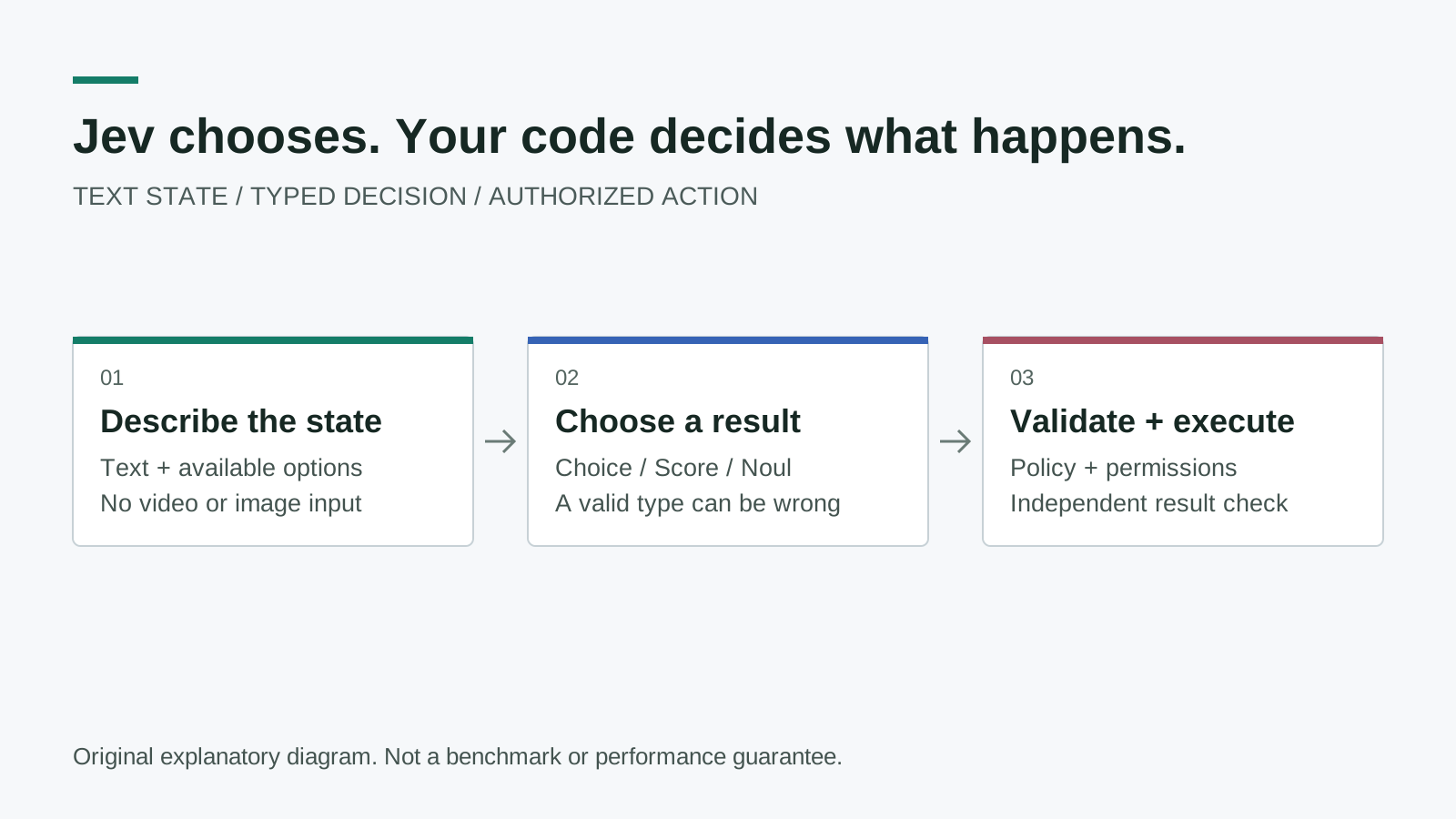
Original explanatory diagram, not a vendor benchmark. The model chooses within a defined space; application code still owns permission, validation, and execution.
An inbox classifier does not need to write an essay before choosing a folder. A browser controller often needs to choose one available button, not invent a new command. Those small decisions are where Jev, TypeSafe AI's first System One model, makes the most interesting case for itself.
TypeSafe introduced Jev on September 15, 2026. The useful distinction is not simply that it is another fast model: it returns constrained decisions rather than open-ended prose. That changes how you can build the surrounding program, but it does not remove the possibility of choosing the wrong answer. See the official launch for the vendor's framing.
This guide follows three public demonstrations: a browser task with downloadable GIF and video evidence, an author's report of classifying 1,500 emails, and TypeSafe's game demonstrations. We also turn those examples into a concrete evaluation plan. The Tistory use-case article, published September 18, was the starting point for the research; its proposed applications are not treated here as independently verified customer deployments.
TL;DR:
- Jev can select, score, or assess a proposition from text; it is not a replacement for a model that writes arbitrary text.
- A valid typed result can still be semantically wrong. Keep validation and final authorization in code.
- The browser recording is real, but one task is not a general benchmark. The email example is an author's report, not a published accuracy study.
- Start with reversible classification, measure errors on your own data, and make abstention a supported outcome.
A small answer can require a very clear question
The API's three core primitives are Choice, Score, and Noul. Choice selects from named alternatives. Score evaluates ordered, described levels. Noul returns a probability for a yes-or-no proposition; a value near the middle represents uncertainty about that proposition, not a medium severity level. The primitive documentation defines these contracts.
The practical shift is to define the possible outcomes before asking the model to decide. Instead of requesting a paragraph about an incoming support message, you can ask whether it concerns billing, account access, a product defect, or an unresolved category. Your application then decides which queue to show. The result is a switch on a railway track, not the entire train: it helps direct work but does not provide every capability needed to finish it.
| Primitive | Useful question | Application responsibility |
|---|---|---|
| Choice | Which of these queues best matches this message? | Define a complete option set, including a review path |
| Score | How strongly does this message match these described urgency levels? | Define the levels and test whether reviewers agree |
| Noul | Does this message explicitly request a cancellation? | Decide what probability justifies review or a reversible action |
Writing good alternatives is part of the engineering work. If two labels overlap, an apparently confident choice can hide a problem in your taxonomy. If no label fits, forcing a selection disguises missing coverage as certainty. A review option is often more valuable than another narrowly named category because it exposes where the decision contract needs to improve.
As checked on September 30, 2026, the model reference lists jev-1.13.0, text-only input, and a price of $0.042 per million input tokens, with output tokens free. That is the model's token price, not the total cost of running an agent. Browsers, extraction, helper models, retries, and human review belong in the operational budget too.
The browser GIF shows an actual search, not a flight booking
Browser Use's public jev-ultrafast repository includes a recorded Google Flights task from Zurich to London. Jev chooses an operation and a target from the current page representation. A separate generative helper supplies text when the selected operation requires typing. This is a composed system, not evidence that Jev itself generates every string or interprets video frames.
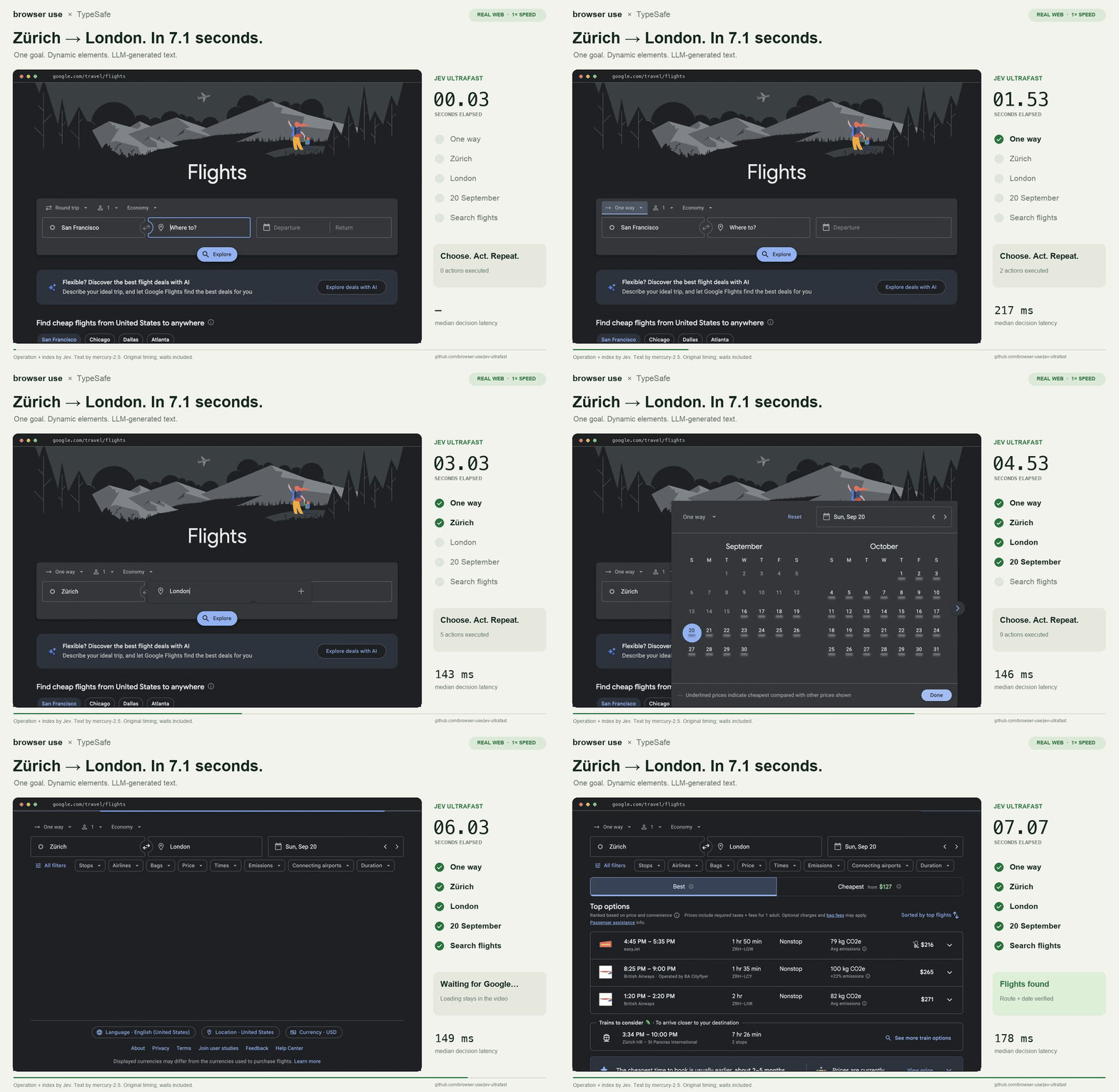
Actual author-recorded GIF from Browser Use, pinned to commit 1231850a0bf1a0c0341fe408ef1668dbbfdfac46. Copyright 2026 Browser Use, MIT license. It demonstrates a search flow, not a purchase. The same recording is playable below.
Author's MP4, shown at its recorded speed with browser controls. Original recording and measurement notes; retained MIT license. We inspected the public artifacts; we did not rerun this benchmark.
The author's measured completion time for the recording is 7.073 seconds. Its clock begins at the first prediction after the initial homepage observation, not when a fresh browser is launched. Setup, initial navigation, and the fresh independent post-run verification are outside that timed interval. Search results are checked; no ticket is selected or purchased. Those boundaries are essential to understanding what the number means.
The same report compares six alternating runs, three for each runtime. Median task time moves from 9.450 seconds to 7.092 seconds, while median browser protocol calls drop from 1,092 to 101. Both arms use Jev and the same text helper, so this is principally a runtime comparison, not a contest between two model families. The author explicitly calls out the small sample and live-web variability in the performance report.
Our reading is that the surrounding browser loop deserves as much attention as the model. Repeatedly collecting the page, resolving targets, and invalidating decisions can cost more than the apparent simplicity of a click suggests. A faster decision engine does not compensate for an unreliable description of the button it is supposed to choose. The repository keeps independent result verification because a model saying it is done is not proof of completion.
This is also where the demo's limitations become useful. The documented implementation does not cover every frame, canvas, upload flow, or arbitrary keyboard widget. A team evaluating it should reproduce its own representative task and failure paths, not infer that a successful flight search establishes general browser competence. Treat the recording as inspectable evidence of one working composition.
The 1,500-email post is a promising case with missing denominators
On September 16, 2026, vogel (@ryanvogel) posted on X that he had tried Jev on 1,500 of his own emails and was impressed by the classification results. The original post includes a video. It is a useful real-user example because the workload is concrete and the source is the person reporting the experiment, rather than an unattributed list of hypothetical applications.
It is not, however, an accuracy report. The post does not establish a public labeled test set, a measured error rate, agreement between reviewers, or the cost of the mistakes. A count of processed messages tells us the experiment's scale, not its correctness. Readers should watch the original X demonstration with that distinction in mind; its video is linked rather than copied without a redistribution license.
Email classification is nevertheless a sensible place to begin an evaluation because it can be made reversible. Show suggested labels beside the existing inbox, keep the original message untouched, and record corrections. Compare confusing pairs such as an invoice versus a payment reminder, or a cancellation request versus a complaint that merely mentions cancellation. Those cases reveal whether the categories correspond to your actual workflow.
An initial deployment should not automatically delete mail, send replies, or approve transactions just because a classification appears confident. Those actions introduce different permissions and consequences. Start with a suggestion or a review queue; only promote a narrow action after measuring its error pattern. This is our proposed evaluation procedure, not a claim about the X author's implementation.
Doom and Wikiracing make the decision loop visible
TypeSafe's launch includes a Doom demonstration and a Wikiracing demonstration, both linked from the official launch article. They are useful visual explanations of repeated decisions. They are not evidence that Jev is a general-purpose visual model or that it can solve arbitrary planning problems.
In the Doom example, the model receives a structured textual description of state, not screenshots. In Wikiracing, it chooses from available links rather than inventing a destination URL. The interesting mechanism is the repeated cycle of observation, bounded choice, and action. Game demonstrations make that cycle easy to see, while still leaving open how well it transfers to a different environment.
The same separation appears in TypeSafe's smart-home demo documentation. Different questions can classify aspects of a request, while another component handles free-form conversation or splitting a compound request. You should not describe that architecture as a single model that both generates language and executes every decision. Names such as assistant or agent often hide those boundaries unless the implementation makes them explicit.
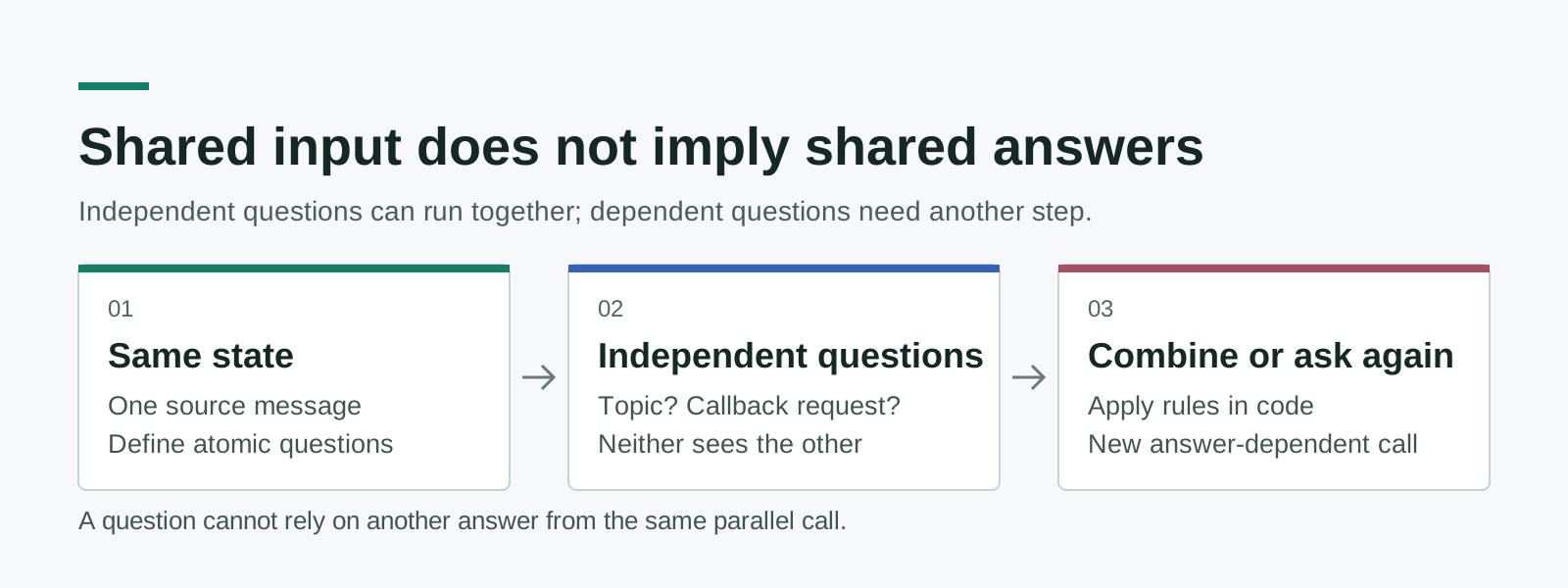
Original diagram based on the documented fan-out contract. Simultaneous questions share state; they do not secretly read one another's answers.
The fan-out pattern can reduce serial waiting when several questions depend on the same source. For example, a message's topic and whether it explicitly asks for a callback can be assessed independently. A question that depends on a newly chosen topic cannot assume that answer already exists inside the same call. Split that dependency into a later step or combine the independent results deterministically in code.
A typed answer is not the same as a correct answer
The most dangerous interpretation of a constrained model is that a well-formed answer cannot be wrong. It can. A classifier can choose a permitted but inappropriate label, and an action selector can choose a valid button on the wrong form. Eliminating malformed prose from an interface is valuable, but it addresses a different failure class from misunderstanding the task.
TypeSafe's Jev 1.13 jaggedness notes, last reviewed September 17, describe weaknesses around arithmetic, counting, date comparisons, distracting context, and adversarial input. For exact comparisons, parse dates and compute quantities in ordinary code. Do not turn a deterministic rule into a semantic judgment merely because the model can accept the question.
The confidence documentation also matters: Choice and Score expose probability distributions and a derived confidence value; Noul has no separate confidence field. That number is not a universal probability that the answer is correct. Thresholds need validation against your own task, especially when the consequences of a false positive are different from those of a false negative.
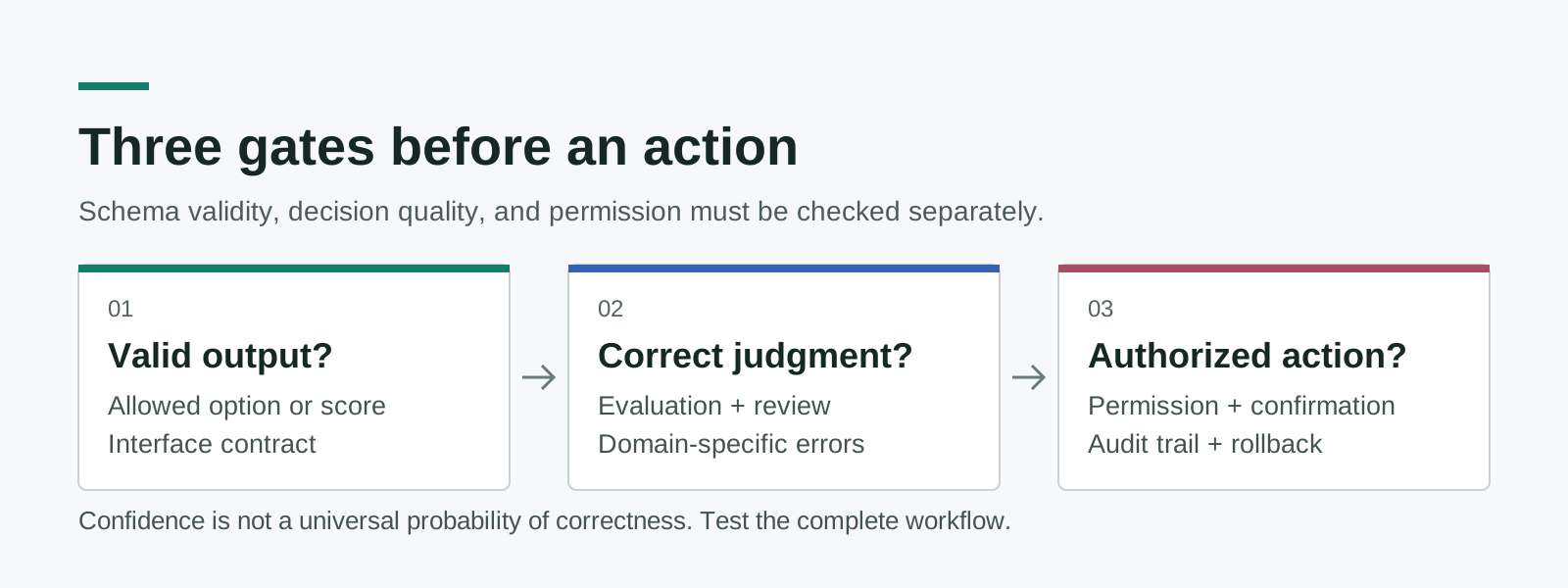
Original evaluation diagram. Passing one gate does not imply passing the next; an allowed output still requires a correct interpretation and an authorized action.
For multilingual work, test each language you actually serve. The model documentation says English is the primary training language and that quality is not uniform across other languages, including CJK scripts. A Korean support queue or mixed-language newsletter archive should therefore be its own evaluation slice, not an assumed extension of an English score. Translation can also alter the evidence, so preserve the original if you evaluate a translated representation.
Build a trial that can fail honestly
A useful pilot starts with a decision your team can label consistently. Choose a reversible task such as suggesting a support queue, flagging a possible duplicate, or labeling a document for later review. Avoid defining success as whether the demo looks smooth. Define the incorrect outcomes you would notice, the ones you might miss, and what each costs the user.
- Write the decision contract. List the possible outcomes, the source fields needed, and the review option. Separate semantic interpretation from calculations and permissions.
- Create an evaluation set. Use material you are authorized to process. Include typical items, ambiguous boundaries, mixed languages, empty fields, and malicious instructions inside source text.
- Keep a held-out slice. Tune criteria on one set, then measure on material that did not shape the wording. Record disagreements instead of silently redefining the expected answer.
- Measure the workflow. Track per-category errors, review rate, end-to-end latency, retries, and total cost. A fast model call inside a slow retrieval loop is still a slow product.
- Run in suggestion mode. Log the chosen option, relevant probabilities, model version, and human correction without automatically performing consequential actions.
- Promote one bounded action. Require explicit authorization where appropriate, preserve an audit trail, and keep a rollback path when the source or model version changes.
This procedure is deliberately stricter than watching a recording. It asks whether the model helps with your distribution of cases, including the awkward ones. A review rate that looks high may be preferable to a small number of silent, expensive mistakes. Decide that tradeoff before choosing a threshold, not after discovering an incident.
Pin a version for reproducible evaluation and record the version returned with each result. Moving aliases are convenient for exploration but can change behavior without a source-code change in your application. An evaluation artifact should let another person reconstruct the criteria, inputs, expected outcomes, and execution boundary. That is how a promising experiment becomes a maintainable feature rather than a collection of impressive clips.
The bottom line: move judgment into a bounded contract
Jev is most interesting when it makes a small, inspectable decision inside a program that already knows its rules. The browser video shows a working composition, the email post supplies a concrete experiment worth testing, and the official demos expose the loop. The next question is not whether the model can choose an answer, but whether your system can recognize a bad choice before it matters.
Sources and media credits
- TypeSafe: Introducing System One Models and Jev, September 15, 2026; official launch and game-video context.
- Browser Use: jev-ultrafast, pinned source inspected September 30, 2026. GIF and MP4 copyright 2026 Browser Use, MIT license; no affiliation implied.
- Browser Use: recording and matched-run measurements, inspected September 30, 2026; author measurements, not our reproduction.
- vogel on X: 1,500-email classification experiment, September 16, 2026; self-reported use case with original video.
- TypeSafe primitives, models, confidence, fan-out, and smart-home demo, checked September 30, 2026.
- Jev 1.13 jaggedness, last reviewed September 17, 2026; checked September 30.
- Jev use-case article on Tistory, September 18, 2026; research starting point, not deployment verification.
Keep the evidence beside your notes
When researching a new model, preserve the source, its date, and what the demonstration actually proves. Create a Telli.sh account to organize your own research material and derived notes without confusing a summary with the original evidence.