Can clinical trial sites get the same briefing without waiting for the same meeting?
ICON’s FIRECREST video engine makes a testable case for faster site feasibility briefings, with sponsor review and version control at the center.
A study team is preparing to ask dozens of clinics whether they can recruit participants, allocate staff, and meet the equipment requirements for a trial. Each site needs to understand the same protocol assumptions before answering. A recorded briefing can reach teams in different time zones, but the briefing has to change when the protocol, the audience, or the jurisdiction changes. Even a short video becomes a coordination job when its source, approval, and distribution have to be tracked.
On November 5, 2026, clinical research organization ICON announced a FIRECREST engine for producing AI-directed video communications within FIRECREST. Its first application is site selection and feasibility, the stage where sponsors assess whether a clinic can participate. FIRECREST provides the context for producing and delivering the material. ICON says sponsors retain control over production, review, and launch. The company reports that the time needed to produce the material can fall from days to hours, approximately tenfold. The release does not publish an independent comparison or an endpoint for trial outcomes.
A researcher prepares a participant for a scan in an NIH pain study, independent of FIRECREST. NCCIH, National Institutes of Health, public domain, cropped and resized. Image source · License.

What the video changes at a study site
Study feasibility briefing. Original illustration by Telli.sh.
Consider a multicenter study that requires sites to process a sample within a specified window. The existing feasibility questionnaire might ask whether the site can meet that requirement, while an attached deck explains the sequence. A short video could show the sequence in order and then point to the exact questionnaire item. A coordinator can circulate the briefing internally and collect a single answer after the lab, pharmacy, and study team have reviewed their parts.
The potential gain is a shorter path from a document to a usable conversation. A coordinator still needs the applicable protocol and the sponsor’s named contact. If the sample window changes, the study team needs a revised briefing and a way to identify which sites answered under the older assumption. A synthetic presenter does not make a regional adaptation scientifically or operationally valid. The sponsor decides what has changed and who must review it.
The first useful test is whether different sites answer the same feasibility question consistently after seeing the new format. If the calls get shorter but ambiguous answers increase, the workflow has displaced the work to the people reviewing questionnaires. If smaller sites can prepare questions without waiting for a shared webinar, the time saved may be more useful than the speed of producing a single video.
Sponsor approval is part of the workflow
The phrase AI-directed can make video creation sound like the entire problem. In this setting, reviewers must be able to identify the source sentence behind a requirement, match the briefing to the current study version, and recall obsolete instructions. Whether the engine actually supports a specific audit or recall mechanism should be checked during a pilot. ICON’s public statement establishes sponsor control over review and launch. It does not document the mechanics of every control.
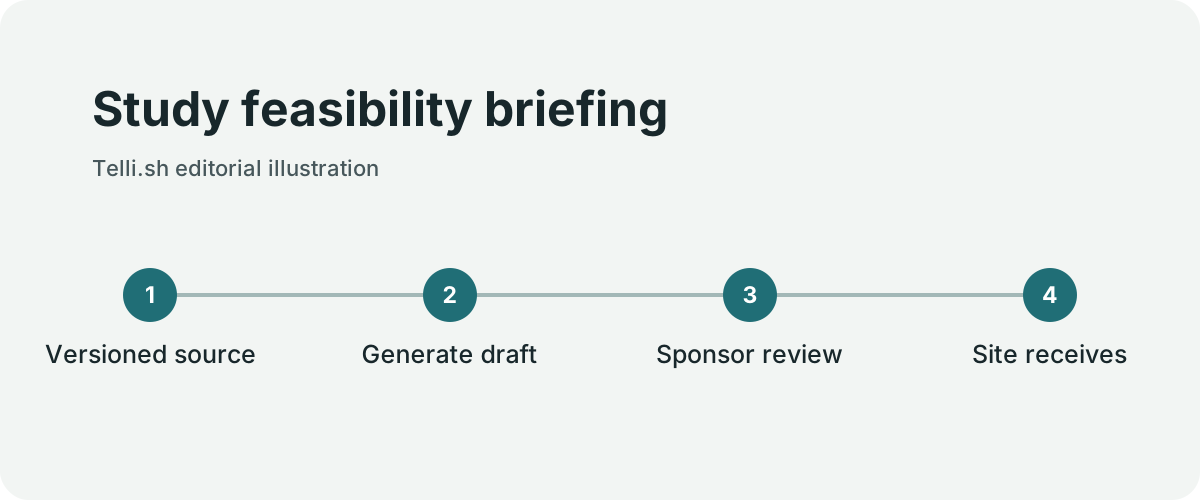
A trial operations team can give the production process a stable handoff. Start with a versioned feasibility package, mark the statements that need verbatim treatment, and identify the sources for any country-specific material. The sponsor reviewer signs off on both the narration and the captions, including quantities, units, deadlines, and exceptions. The distribution record can then tie a site to the exact approved version it received. Those are acceptance criteria for the buyer’s process, not a feature list for FIRECREST.
| Step | Evidence to retain | What to test |
|---|---|---|
| Source | Protocol version and approved feasibility material | Every operational instruction has a traceable source |
| Review | Named approver and signed video version | Spoken and written values agree |
| Distribution | Site, language, version, and release time | Only the intended sites can retrieve the briefing |
| Change | Superseded version and replacement notice | Returning viewers reach the current instructions |
The access question matters when the same production process handles materials at different stages of a study. Before trying the feature, a team can map which staff can upload source documents, edit a script, approve a language, release a video, or see viewing logs. A demonstration built with dummy documents makes it possible to verify those boundaries before confidential information is involved.
How to test the time claim
Correct a briefing. Original illustration by Telli.sh.
A pilot could produce the same six-minute briefing through the existing process and through the new engine. Time the steps from receipt of the approved source packet to the first site being able to see the approved output. Track editorial time, sponsor review time, accessibility corrections, and distribution separately. The review queue may dominate total time even if generation takes only minutes.
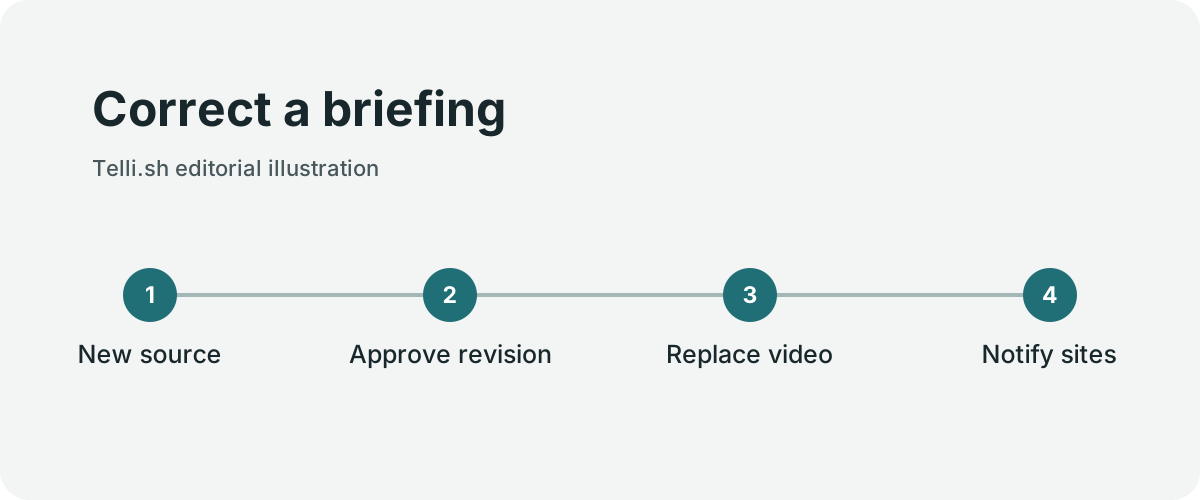
A second test should introduce an intentional correction after initial release. The correction could change a laboratory instruction or replace a table referenced by the script. Check how long it takes to approve the replacement, whether an existing link still opens the obsolete copy, and whether a site that viewed the old briefing can be identified. Record a change as complete when the relevant people have been notified and can reach the replacement.
A third test should use the same briefing across a small mix of locales. A reviewer familiar with the local process can check pronunciation, terminology, caption timing, and which instructions need local context. A site might need a written transcript to share with colleagues or review on a constrained connection. Those requirements determine whether the new format widens access or simply creates a second set of materials to maintain.
Compare two kinds of sites
A hospital with a central laboratory can often assess a sample handling requirement by asking one person to review the equipment schedule. A smaller clinic may depend on a courier and an external lab. The same briefing could help both understand the requirement, but their follow-up questions and the person who signs off will differ. A trial team can send both the common explanation and separate written instructions for how to report a local exception.
Another study might need clinics to recruit people who can attend appointments at specific times. A clear explanation of visit cadence can help each site estimate staff hours and room availability. A video could turn a written schedule into a short walkthrough. The clinic still needs the current schedule and the qualifications for participation. That lets the site check its own assumptions even if a detail in the narration is unclear.
The sponsor can compare the questions each site asks after viewing the briefing. Are sites asking how to apply a rule locally or asking for facts the briefing should have supplied? The distinction reveals whether the format saved a live meeting or simply postponed the explanation to an email thread.
Give reviewers an actual approval exercise
The ICH E6(R3) guideline addresses investigator selection. Use it as context for the sponsor’s responsibilities, alongside the trial's own procedures and applicable requirements. The useful question for the product pilot is what evidence the sponsor can retain for the communications it actually releases. A product announcement does not establish that an organization has met a specific requirement.
- Pick a dummy feasibility package with a schedule, a site-capability checklist and one deliberately ambiguous sentence.
- Have the study team mark who owns each requirement and where it came from. Use a separate copy for the comparison process.
- Produce an approved briefing in both workflows. Record elapsed time, time spent by subject experts and time spent on captions, transcripts and access checks.
- Send the versions to a small representative group and ask each reviewer to answer the same four scenario questions. Ask where they found the evidence.
- Correct one instruction after the first group has seen it. Record the replacement version and verify that an existing site link leads to the intended rendition.
- Compare the results and decide whether the original objective was faster production, clearer site responses or easier corrections. Each goal needs its own measure.
Use a realistic review calendar. If the sponsor’s subject expert is available only twice a week, a shorter production step may still save a full review cycle, or it may leave the delivery date unchanged. Keep both outcomes visible. The most useful record is the end-to-end time a site needed to get a current, intelligible briefing.
Decide which details belong in video
A short video works best for sequences and shared context. A versioned checklist is better for quantities, addresses, exception codes or a condition staff need to look up later. Provide the current written material beside the video. If several languages are needed, have someone familiar with the trial operations review each rendition as part of the same approval. A correct local term is often more important than a fluent sentence.
A smaller pilot can validate one briefing before the trial team standardizes anything. Keep the acceptance threshold grounded in comprehension, availability and recovery. The final question is whether a site team can understand the requirement, ask the right follow-up question and find the latest approved instructions when it needs them.
Make language quality a separate acceptance check
A translated script can sound natural and still turn a narrow instruction into a broad one. Give each local reviewer the source passage, the script and the caption track together. A reviewer can compare a visit window expressed in days with an equivalent calendar example, then check that the narration and the captions use the same unit. Verify proper names, role titles and abbreviations. A familiar name for a job in one country may describe a different responsibility elsewhere.
A production coordinator should also test changes that affect only one language. If the local reviewer spots an ambiguous instruction, decide whether the source needs clarification or the issue sits only in that translation. Approve the affected renditions and confirm which versions are accessible to each site. A regional correction may be easier to manage when the source and each derivative have separate identifiers.
Include reviewer time in the cost comparison
Imagine the existing process spends six hours on production and two on sponsor review. A new engine might cut production to two hours while the review still takes two. Total staff time would fall from eight hours to four in this illustrative example. If the script needs two extra hours of fact checking, the savings fall to two hours. A second audience may improve the economics if it can reuse approved material, but it can also add reviewers.
Use the same team and source complexity for the two versions. Count the time to resolve one change, including the people who reopen the source, approve the corrected rendition and verify distribution. An organization can then decide whether to use the tool for an entire briefing, a short standard explanation or only a draft script.
Where the result would matter
FIRECREST’s initial use fits work that combines repeatable instructions with meaningful variation across studies and sites. When the input is stable and the reviewers already agree about the wording, a faster production loop could make short briefings practical for more site teams. Where the underlying protocol is changing quickly, publishing one more format adds a version to manage. The trial team needs to know which scenario dominates its own work.
The model to carry into a pilot is straightforward. Treat video as one approved rendition of a versioned source package. Keep site responses tied to the version they saw. Measure comprehension, turnaround, and correction time together. If that handoff works, faster video production has a concrete role in site readiness.
Sources
For a searchable record of the conversations and decisions behind your work, Create a Telli.sh account.