GPT-6 Cyber puts the scope of a security test in the spotlight
OpenAI’s restricted cybersecurity model brings attention to the gap between discovering a flaw, validating it within authorization and shipping a fix.
A maintainer receives a report about a browser bug. Before asking an agent to reproduce it, the team needs a test build, a clear list of allowed systems and a record of the change that will fix it. Finding a plausible weakness is the beginning of that job.
OpenAI introduced GPT-6 Cyber on November 5 and said initial API and Codex access was limited to select approved Daybreak Red customers. It describes training the model for vulnerability research and to respect the scope of authorized tests. The accompanying results, and Mozilla’s record of fixes shipped in Firefox, make it possible to discuss both the discovery work and the release process that gets protection to users.

The San Francisco building that housed OpenAI’s headquarters in June 2025. Context photo by Coolcaesar, cropped and resized, CC BY 4.0. Image source · License.

A useful test has boundaries a tool can enforce
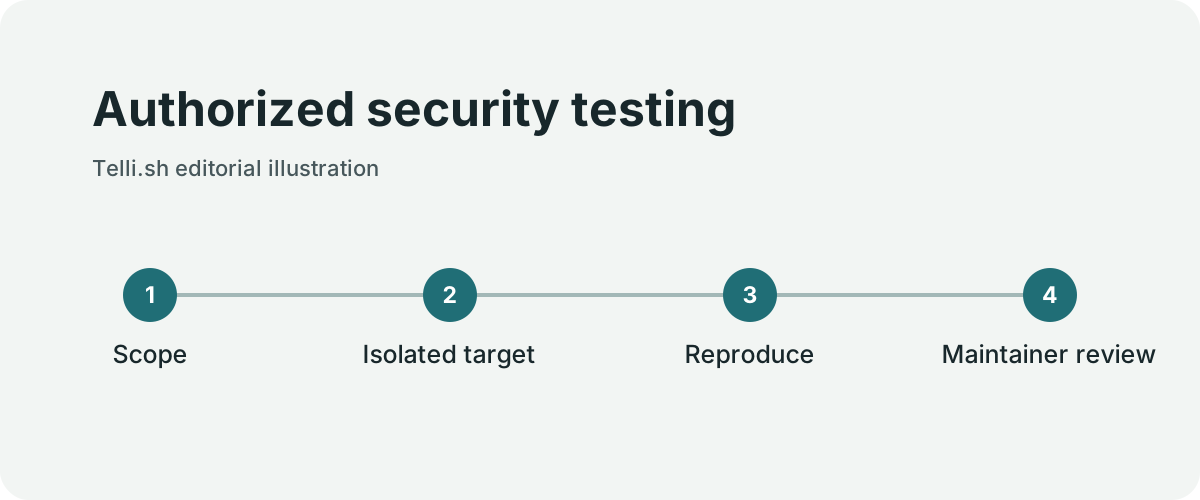
Authorized security testing. Original illustration by Telli.sh.
A security team may authorize an agent to inspect a repository, run a test against a local service and write a candidate patch. Access to the test repository does not imply permission to scan related services or contact other hosts. Give the agent a clear description of the allowed target and use the environment to enforce it.
| Decision | A concrete test contract |
|---|---|
| Target | A named repository, test build and isolated test service |
| Data | Synthetic fixtures or data explicitly approved for testing |
| Actions | A defined set of build, test and analysis tools |
| Stopping point | A minimal reproduction and a report for a human reviewer |
| Publication | A maintainer-approved disclosure and release plan |
Treat the approved scope as a contract between the operator and the tools. A network restriction protects a boundary even when the model misunderstands a request. Tool permissions can prevent it from writing to systems that have nothing to do with the task. Logs can show a reviewer which resources were actually accessed.
The details change with the environment. An offline build can work for a parser bug. Testing a network-facing feature can require a service you explicitly host and authorize for that purpose. In either case, the team should be able to recreate the scope from the record. Broad directions such as “test what you need” make it harder to tell when the work is finished or what a later reviewer should inspect.
The two benchmark questions deserve separate answers
OpenAI’s ExploitGym figure compares performance on an evaluation where the system has a specified vulnerability to exploit. The company reported 48.5% for GPT-6 Cyber and 32.1% for GPT-5.6 Cyber. That is a difference of 16.4 percentage points within the stated test. A separate test examined whether the model stayed inside the scope of an assignment in an isolated environment.
These are separate outcomes. A system that is more capable at reproducing a flaw gives a security team a chance to validate a report more quickly. Staying within scope is a property to check alongside that ability. OpenAI reported strong scope adherence under its test conditions, including perfect results with the deployment prompt in that evaluation. An operational plan should still have an explicit boundary and a review process.
Pay attention to the starting point of each benchmark. Given a known flaw and a lab target, an agent can spend its work on reproducing behavior. A maintainer receiving an ambiguous report has to determine whether it applies, which versions are affected and what a patch would change. Those decisions require evidence from the actual codebase.
A Firefox fix has a release window
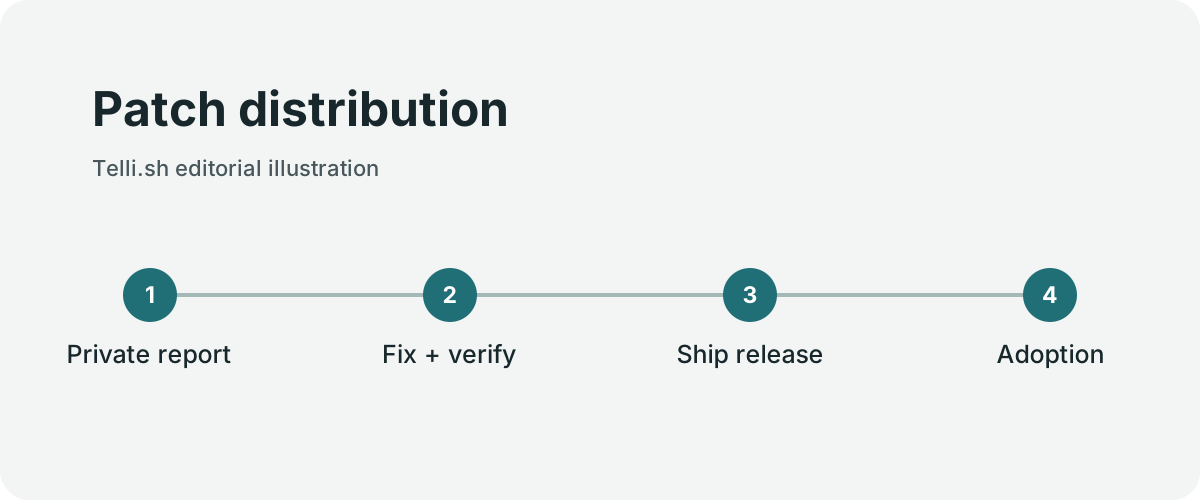
Patch distribution. Original illustration by Telli.sh.
OpenAI reported that the model helped find previously unknown high-severity Firefox issues, and linked to Mozilla’s advisory for Firefox 159. The advisory independently establishes that fixes shipped in that version. Read the advisory for affected components, severity and release information. The counts and model attribution in OpenAI’s announcement describe its own research campaign.
Mozilla’s October 29 explanation of the patch gap gives this work an important second half. When a fix becomes observable before a large share of users have installed it, someone may infer the underlying problem by studying the change. Shipping a fix to the repository, making it available through an update and seeing people install it happen on different clocks. A security team needs to coordinate all three.
This is one reason to decide what evidence should be shared and when. A concise reproduction helps maintainers verify a patch. An early public reproduction can also make an unpatched version easier to target. Work with the project’s disclosure process, and give the people responsible for the release a chance to validate its contents and timing.
Make the review packet reproducible
- Define the systems, versions, data and permitted actions in writing. Run the work in an environment whose network and tool access reflect that scope.
- Give the model a precise question, such as whether a reported regression reproduces in an affected test build. Keep production credentials and unrelated services out of the workspace.
- Ask for the affected component, a minimal test in the authorized environment and the evidence that distinguishes the reported behavior from a normal error.
- Validate a proposed patch against the test and existing behavior. Have a maintainer inspect the change and the possibility of unintended effects.
- Record what was confirmed, which versions are affected and how remediation will reach users. Use the project’s private reporting channel when disclosure is pending.
- Track release and uptake as separate events. After an update ships, support and operations teams can help users identify and move to the fixed version.
A good packet also records a negative result. If a report cannot be reproduced under the expected conditions, a precise description helps the next reviewer decide whether to close it or try a different fixture. The record is more valuable than a confident conclusion without a way to repeat the check.
Recheck a fix against a regression
A maintainer can start with a report from an internal tester who saw a browser or service crash while processing a malformed fixture. The first useful question is whether the failure reproduces on a named revision under a documented configuration. A scoped model can help sort relevant logs, point to a plausible component and assemble a minimal review packet. A teammate should be able to reproduce the observation in the same isolated environment.
The patch verification needs a separate test. Run the original fixture on the vulnerable revision and on the candidate revision, then exercise ordinary nearby behavior. A fix can stop a crash by skipping a code path that legitimate users need. The evidence should tell the reviewer whether the malformed input was handled correctly and whether valid inputs still produce the expected result. Record that state before measuring how quickly the model proposed an explanation.
A rollout owner then has another decision. A fix in a source branch and a fix installed on the affected computers are different milestones. Determine how the supported release trains, managed endpoints and downstream packages receive the change. For a service, confirm which production revisions serve traffic and how quickly older instances drain. A test result belongs with its exact revision and cannot stand in for deployment evidence.
Give capability and scope tests different denominators
OpenAI reports that the GPT-6 Cyber campaign surfaced 81 previously unknown Mozilla-high-severity issues and 30 severity reassessments. That is OpenAI’s campaign account. Mozilla’s Firefox 159 advisory documents the fixes and credits under that release. The two sources answer different questions and are useful together because the advisory gives the reader a specific shipped version to verify.
OpenAI's ExploitGym Honeypot is a separate scope evaluation. The report gives 99.93% for the unprompted condition and 100% with the deployment prompt under the reported setup. Those figures describe behavior in the vendor's evaluation. They should be read alongside the test conditions and failure cases, rather than as evidence that a client network, a target allowlist, or an operator permission check can be omitted. The separate ExploitGym capability result compares the share of technical tasks solved.
An internal evaluation can make that distinction operational. Test both the scoped task and a harmless out-of-scope fixture. A useful assistant can make progress on the first. The environment must prevent actions on the second even if the model suggests them. Review prompt text from logs and web pages as data, including text that presents itself as a new instruction. Retain an execution record so the operator can distinguish a proposed action, a rejected action and an action that actually ran.
Close the report when the right people can verify it
A maintainer may need to share a small private evidence bundle with the component owner and a separate release note with users. Keep unnecessary target data out of both. A useful internal bundle contains the tested revision, the intended scope, enough evidence to reproduce the issue safely, the proposed fix, and the results of the verification run. The public note should follow the project’s disclosure process.
The acceptance test for the workflow is a verified fix that can reach users without premature disclosure. Record time to reproduce, time to review, time to ship and adoption separately. A faster initial investigation is valuable when it leads to a faster confirmed result. An improving model can make the first stage cheaper while leaving the release and update work as the limiting factor.
Follow a fixed build through release and adoption
A browser team may have a stable desktop channel, an extended-support channel and builds distributed through downstream package managers. A patch can appear on each timeline at a different moment. The release owner needs to know which build first contains the fix, when users in each channel can obtain it, and whether managed clients have installed it. A published advisory can identify a fixed version; a deployment inventory can show how much of a fleet is still on an older one.
| Milestone | Evidence | Operational question |
|---|---|---|
| Candidate fixed | Regression test on the candidate revision | Does the fix handle both the fixture and ordinary inputs? |
| Supported build shipped | Release artifact and advisory | Which versions can users obtain? |
| Managed clients updated | Inventory or version reports | Which machines still need an update? |
| Offline clients covered | Owner acknowledgement or planned update window | What remains outside the normal distribution path? |
An enterprise with managed clients can compare inventory against the advisory’s version list. The same organization may have training or lab machines that are normally offline. Those machines need a different handoff. Assign an owner to the supported update procedure and record when a fixed version can be verified. Treat machines that have not reported back as unknown in the fleet view.
Use the patch gap when deciding what evidence to publish and when. Mozilla’s account explains the risk window between a visible patch and installed updates. The authorized testing team can keep reproducible material inside its approved review process while the release owner prepares builds and mitigations. Set a clear time to recheck adoption and report what the data can establish.
For a small internal service, the same exercise can use a deployment label and traffic logs in place of browser update telemetry. A smoke test on a replacement instance says the replacement works. Old instances may continue to serve while a rollout drains. Attach the tested revision, serving revision and completion time to the record so a later incident review can determine when the risk actually changed.
Count the time to a verified fix
A cybersecurity model can make validation work faster and find cases a team might have missed. The improvements matter most when a maintainer can see the scope, reproduce the result and ship a fix responsibly. Measure how long it takes a real issue to move from a defensible report to a verified release. That metric connects model capability to the reason the work exists.
Sources
For a searchable record of the conversations and decisions behind your work, Create a Telli.sh account.