GPT arrives on Google Cloud: the buying channel becomes part of model choice
Google Cloud's private preview of OpenAI models connects model selection with enterprise purchasing and governance. Here is what changes, what remains on the roadmap and how to evaluate a new route without confusing access with readiness.
Official Google Cloud mark from its Press Corner assets, proportionally resized with neutral padding for editorial identification. Google Cloud is a trademark of Google LLC. This independent article is not endorsed by or affiliated with Google. The image identifies the platform; it is not a screenshot of the preview.
A developer can prefer a model long before their company can buy or operate it. The missing work often involves an approved contract, a budget owner, a data-handling decision and a support path. A better answer in a test prompt does not automatically clear those gates.
On October 21, 2026, Google Cloud announced OpenAI models in its model garden, rolling out in private preview to selected enterprise customers. The named models are GPT-6 Astra, GPT-6.1 Sol and GPT-6 Luna. Google describes Marketplace purchasing, a single cloud invoice and eligibility to draw down existing cloud commitments as part of the offering. Google Cloud announcement.
Our take: this is a change to the route between a model and a working enterprise application. It gives organizations a new procurement option to evaluate alongside model quality. The useful question is whether that route makes a specific workload easier to buy, govern and improve, with the preview's limits kept visible.
Model Garden is a catalog with different operating choices
Google Cloud provides infrastructure and managed services that organizations use to build and run applications. Model Garden is its place to discover models and their available deployment paths. The documentation distinguishes models offered as managed services from models that customers deploy themselves. A shared catalog therefore does not mean identical infrastructure, contracts or operational responsibilities for every entry. Model Garden overview, checked October 23.
That context helps readers unfamiliar with enterprise AI platforms. A model is the system producing an answer; a platform is part of how an organization obtains, controls and operates that system. Moving the purchasing channel can change who approves expenditure and where administrators look for activity. It does not by itself change what the model knows or how reliably it completes a particular task.
This is why the announcement matters beyond a familiar name appearing in another catalog. Organizations rarely adopt a model in isolation. They attach it to documents, tools, people and existing workflows. The route through those connections can become a substantial part of the effort required to put an apparently simple API call into everyday use.
The launch separates access from the roadmap
The October 21 release describes API access and connecting local Codex CLI and Desktop inference workflows for participating customers. Zero Data Retention options and Confidential Compute are coming soon, alongside future integration into Gemini for business and Google Antigravity. Private preview access is the current rollout state; these future features should be evaluated separately. Availability and roadmap.
For a prospective customer, the practical next step is to express interest through the announcement's form and confirm eligibility with the account team. A public announcement is useful for planning, but a production decision needs the actual access conditions, supported features, terms and limits offered to the account. Those details should remain attached to the evaluation rather than disappearing after a successful demonstration.
A team can usefully prepare before receiving access. It can identify a workload, define acceptable answers and establish which data a pilot may use. That preparation does not depend on assuming a future privacy feature is already present. It also gives the preview a clearer purpose than trying every available model and choosing whichever response sounds most impressive.
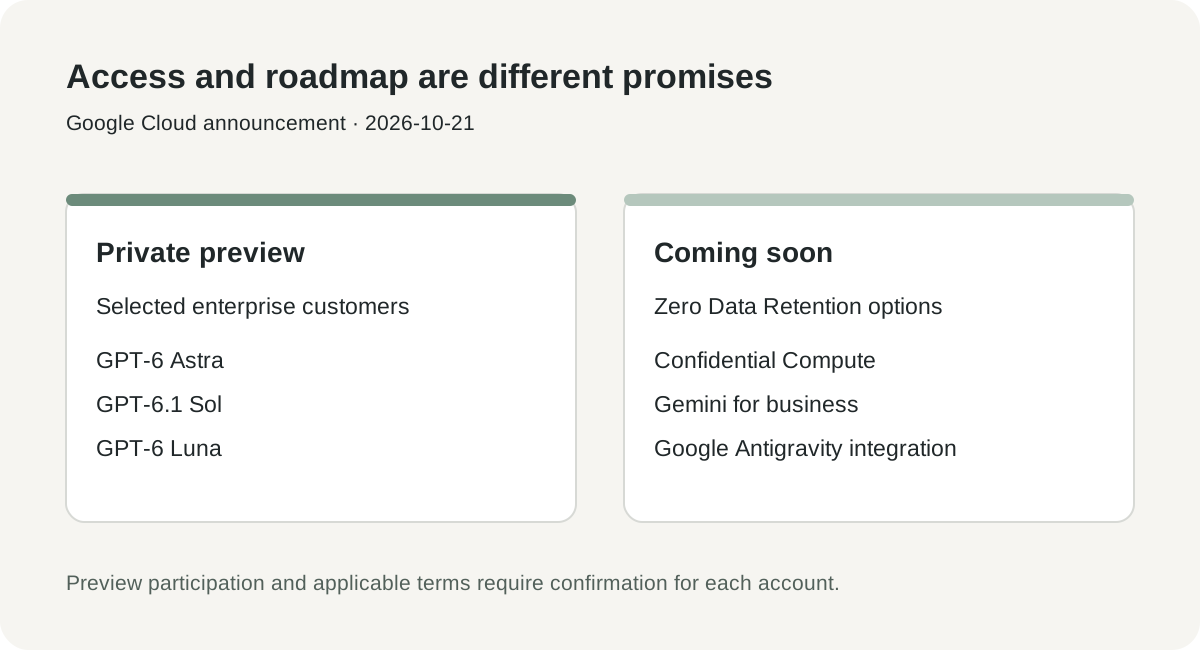
Original infographic based on the October 21 announcement. Preview participation and applicable terms require confirmation for each account; roadmap items have no release date implied here.
A single bill can simplify administration without settling the economics
Google Cloud Marketplace documentation explains that Marketplace product charges appear as separate items in cloud billing reports and exported billing data. It also distinguishes product charges from the cloud resources used with them. That distinction is useful background for any application budget: consolidating a bill does not remove the need to understand its components. Marketplace billing documentation, checked October 23.
An enterprise evaluating this route should compare the complete cost of its own workflow. Model requests are one item. Retrieval, storage, repeated attempts, tool execution and human review can also matter. A lower price for an individual generation can lose its advantage if more outputs need correction before they are useful.
Cloud commitments add another consideration. Spending through an existing agreement may fit a company's budget more conveniently than establishing another vendor relationship. That can be a real operational benefit while leaving the application-level economics unchanged. The finance question is which eligible spending arrangement applies; the engineering question is how much useful work that spending completes.
Imagine an illustrative internal assistant that handles 1,000 requests during a pilot. One model completes more of them acceptably on the first attempt, while another needs repeated retrieval and manual editing. The relevant comparison is cost per accepted task, along with the consequences of the failed tasks. This example sets up a measurement method; it does not predict a result for any of the named models.
Keep capability, purchasing and governance in separate columns
A useful evaluation has three columns. The first asks whether the model does the work. The second asks whether the organization can purchase and support that route. The third asks what happens to data and which actions the application can take. Combining these into one score can hide the reason a promising pilot is unsuitable for production.
| Decision | A useful question | Evidence to retain |
|---|---|---|
| Capability | Can it complete this workflow accurately enough? | Representative inputs, accepted outputs and failure cases |
| Procurement | Can this account buy and budget for the offered service? | Applicable offer, eligible spend, quotas and support route |
| Governance | Are the actual data and action controls suitable? | Account-specific terms, configuration and observed behavior |
The columns also help people disagree productively. A developer can demonstrate that an output is better while a security reviewer identifies a missing control. Finance can identify a more convenient contract while the operations team finds an unacceptable support gap. Those findings can all be true at the same time. The goal is a decision that explains the tradeoffs, rather than a debate over which team understands AI best.
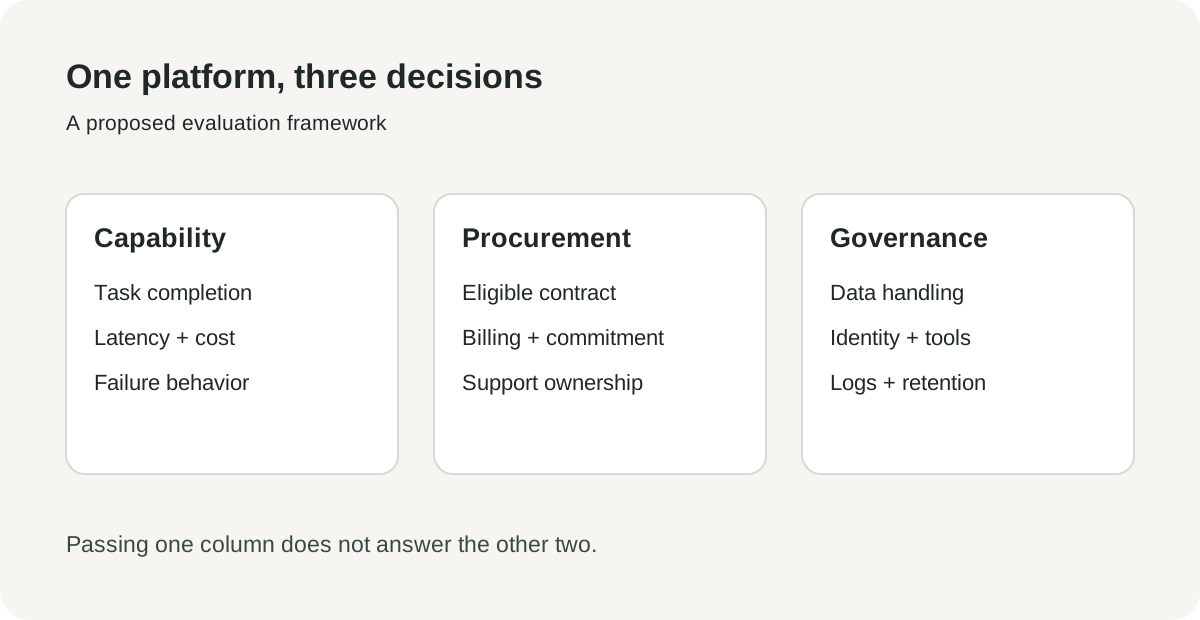
Original editorial framework. These are proposed purchasing criteria, not a claim that one platform supplies every listed control for every model.
An internal document assistant is a useful first comparison
Consider an illustrative assistant answering questions from a company's approved product documentation. The task sounds simple until the documents disagree, an answer depends on a date or the user lacks access to a source. A comparison should include those awkward cases. The best-looking answer on a clean document is only one part of the job.
A team could assemble a small reviewed question set with expected supporting passages. Evaluate whether an answer uses the correct version, cites the relevant source and admits when information is missing. Keep the retrieval setup stable while comparing models, so the exercise can reveal a meaningful difference rather than a change in which documents were supplied. Measure the amount of review needed before the answer is ready for a colleague.
The access boundary needs its own check. An assistant should not answer from a document merely because the application can retrieve it somewhere. The user needs the appropriate access too. This is a proposed application requirement, and it remains necessary regardless of the company name on the model or the invoice. A more convenient purchasing route cannot compensate for an incorrectly connected document system.
Coding pilots should measure a completed change
A second use case is an internal coding assistant. A team may already have an approved development environment and a clear process for reviewing patches. That gives the pilot observable outcomes: a proposed change, relevant tests, a reviewer decision and any revision needed. The useful unit of work is the accepted change, rather than the volume of code generated.
Choose a few bounded tasks that resemble actual maintenance. An example set might include correcting an input-validation defect, updating a small dependency integration and adding a missing regression test. Keep the starting repository state and instructions consistent. Record whether the assistant understood the relevant code, preserved the contract and explained its result in a way a reviewer could assess.
Tool access should be deliberate. Reading source files, running a test and publishing a release have very different consequences. A pilot can begin with a disposable environment and a narrow action set, then expand only when the behavior is understood. The inference provider is one component of this workflow; the coding tool and its permissions still determine what the assistant can actually change.
This is also a useful way to avoid a misleading speed comparison. Faster text generation may save little if a reviewer spends longer correcting an incorrect approach. A model that takes more time per request could still complete the task sooner. An enterprise pilot should therefore retain both request-level timing and the time required to reach an accepted result.
Repetitive support work reveals the cost of exceptions
A third illustrative case is drafting support replies from an approved knowledge base. Most messages may be routine, but a small set involves refunds, account access or an unresolved service problem. A model that writes polished routine replies is useful. A model that handles the exception badly can create disproportionate work for the support team.
Separate drafting from action during the pilot. Let reviewers see the source used, the proposed answer and any missing information before a message is sent or an account is changed. Include cases where a handoff is the correct outcome. The evaluation can then ask whether the assistant recognizes the limit of its available evidence without penalizing it simply for escalating a difficult case.
The platform's value here would be easier operation of a bounded workflow, rather than an abstract promise that all support becomes autonomous. A useful deployment leaves the team with fewer repetitive tasks and clear exception handling. That result depends on the application design and the actual model behavior working together.
Training restrictions, retention and tool permissions answer different questions
Google's current data-governance documentation distinguishes restrictions on using customer data for model training from retention that can occur for particular services and features. It describes specific actions and conditions associated with achieving zero data retention. Some advanced features may prevent that configuration. The general documentation gives readers a useful vocabulary, while the applicable terms for this preview still need account-specific confirmation. Data-governance documentation, checked October 23.
Three questions should remain separate in a procurement conversation. Can submitted material be used for training? Can it be retained, for what purpose and for how long? Which connected tools can read or change other systems? A favorable answer to one does not supply the answer to the others. That is especially important when a presentation combines model access, retrieval, logging and an agent taking actions.
Application logs deserve attention as well. A workflow can retain sensitive content in its own debugging or monitoring systems even when the inference configuration has restrictive settings. Review the full route from user input to stored result, including exports and human review. A diagram of that route is often more useful than a broad assurance that the organization has adopted enterprise AI.
More models can reduce one dependency and deepen another
A catalog that makes several providers easier to evaluate can improve a team's negotiating and technical options. It may become easier to ask which model suits a workload rather than treating the first integration as permanent. That is a useful direction for buyers who want to reassess quality, latency and cost as products change.
Portability still needs design work. Prompts, tool descriptions, output structures and operational assumptions can become specific to an application stack. A model selected through a common platform may still behave differently when the team changes the endpoint or surrounding services. The practical test of portability is a repeatable migration exercise, with the evaluation set and expected behaviors preserved.
There is also a concentration tradeoff. Bringing more AI spending and controls into one cloud environment can simplify daily administration. It can increase the consequences of a platform-level quota, policy or availability problem. A team should decide which dependencies it accepts, which alternatives it maintains and how it will recognize when a fallback produces a materially different result.
A preview is most useful when the exit criteria are written first
Google's evaluation documentation describes methods for assessing generative outputs with defined metrics and rubrics. A tool can help organize that work, but the organization still has to decide what counts as a useful answer for its task. A clear rubric makes the result easier to discuss than an informal collection of impressive responses. Evaluation service overview, checked October 23.
For a practical pilot, the steps can stay concrete:
- Confirm preview eligibility, the offered model identifiers, supported features, regions, quotas and applicable commercial terms with the account team.
- Choose one workload and a permitted test dataset. Define acceptance, escalation and prohibited actions before connecting live systems.
- Establish a baseline using the current workflow. Retain representative successes and failures rather than only difficult examples.
- Compare candidate models under consistent inputs and tool permissions. Track accepted results, review effort, total latency and the complete workflow cost.
- Inspect actual logging, data handling and failure behavior. Document any control that depends on a future feature instead of treating it as implemented.
- Decide whether to expand, revise or stop the pilot. Keep the evidence so a later model or commercial offer can be evaluated against the same task.
The useful unit of choice is a working task
OpenAI models appearing through Google Cloud makes enterprise model choice more concrete. It connects a technical option with a place where an organization may already buy and operate software. That connection can remove friction, provided the buyer keeps preview access, current controls and promised additions distinct.
The strongest outcome would be a team that can change its model choice without losing its understanding of the workflow. The lasting advantage is the ability to say why a task is accurate enough, affordable enough and controlled enough to run. A larger catalog is valuable when it helps produce that answer.
Sources
- Google Cloud brings OpenAI models to customers, October 21, 2026.
- Model Garden overview, Marketplace billing, data governance and Gen AI evaluation overview, checked October 23, 2026.
- Google Cloud Press Corner assets and Google books and media brand guidance, checked October 23, 2026.
Keep the evaluation and the decision together
For readers who want a separate workspace for source links, pilot findings and their own reviewed decisions, Telli.sh is one option. Open your notes workspace.