GitHub puts a firewall in front of package installation
GitHub's new package firewall preview moves a security decision to the moment an agent or developer fetches a dependency. Its usefulness depends on policy, coverage and a workable exception process.
GitHub wordmark via Wikimedia Commons, classified there as PD-textlogo. Used for company identification; this is not a screenshot of package firewall. Proportionally resized with neutral padding; no endorsement implied.

A coding agent proposes a useful shortcut: install a package, add a few lines and run the tests. The visible code change may be small enough to review in a minute. The dependency brings a separate decision into the session, however. Somebody is choosing an external artifact that will enter the developer's environment or the build. Reviewing the generated function does not fully answer that second question.
On October 20, GitHub introduced package firewall in public preview for Enterprise Cloud customers, including those using data residency. Configured endpoints route package requests through policy checks before fetching from upstream registries. The initial ecosystem is npm. This is a commercial security feature with particular relevance to AI-assisted development: as agents make adding dependencies easier, the moment of installation becomes a more important place to apply a shared rule. GitHub announcement.
Our take: moving a decision earlier can be useful, provided the boundary is real and the exceptions are usable. The firewall should be judged as a policy layer in a development workflow. A package being allowed is not the same as its contents being proven harmless, and a package being blocked is not by itself a verdict on its maintainer.
The new product sits before a familiar GitHub workflow
GitHub is a code-hosting and collaboration platform, with pull requests, automated Actions workflows and security tools around the development process. The new firewall focuses on what happens when a workstation, runner or coding agent asks for a package. That places it at a different point from reviewing a pull request or proposing a repair to code already in a repository.
This distinction is easy to miss in a crowded security announcement. A code-fixing agent can help modify vulnerable application code. A package firewall can apply policy to a dependency request before the artifact reaches the configured endpoint. They address different parts of the same development process, so success in one part does not remove the reason to inspect the other.
For a team using coding agents, the practical appeal is consistency. A human developer may remember that the organization avoids a newly released dependency for a short period. A fresh agent session may not carry that habit. A rule enforced on the request path can apply without relying on every prompt to restate the policy. That is the product's most interesting contribution: turning an organizational preference into an operating constraint.
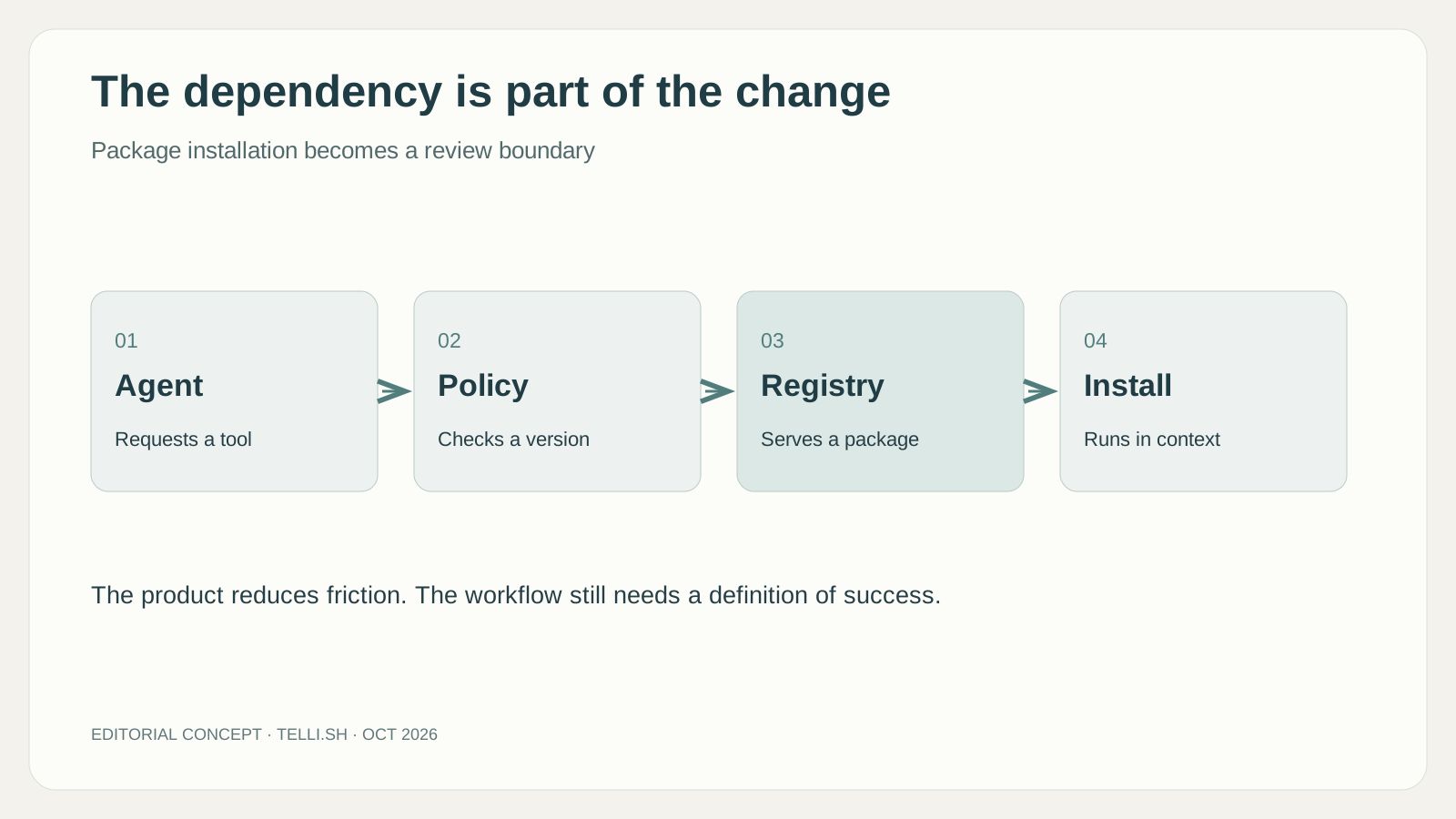
Original editorial infographic. A conceptual request path, not a complete deployment diagram.
What the preview checks—and where it applies
The announced controls include a minimum package age, checks against the GitHub Advisory Database for malware or vulnerabilities, and supply-chain signals such as attestation downgrades. Both package metadata requests and downloads pass through the service when the endpoint is configured to use it. An exception workflow handles requests for packages that policy has blocked. How the firewall works.
GitHub's documentation describes a configurable minimum age from zero, which disables that control, to 365 days; the default is one day. The waiting period gives new information time to emerge. It does not transform a package into a safe artifact when the clock expires. The same documentation explains how blocked requests appear in development output and how a user requests an exception. Endpoint protection documentation.
Coverage deserves as much attention as the list of checks. The preview does not automatically protect every dependency used by every application. It starts with npm, and endpoints need to route their requests through the firewall. A team with Python services, container images and JavaScript applications still has several different artifact paths to consider. Even within a JavaScript project, the useful question is which actual requests follow the enforced path.
The commercial conditions are also specific. The service is free during the preview, with metered pricing planned at general availability. That makes the preview a chance to understand operating behavior, rather than a basis for assuming permanent zero cost. A representative trial should include the requests made by CI and agents, not only a developer's occasional manual installation. Availability and pricing status.
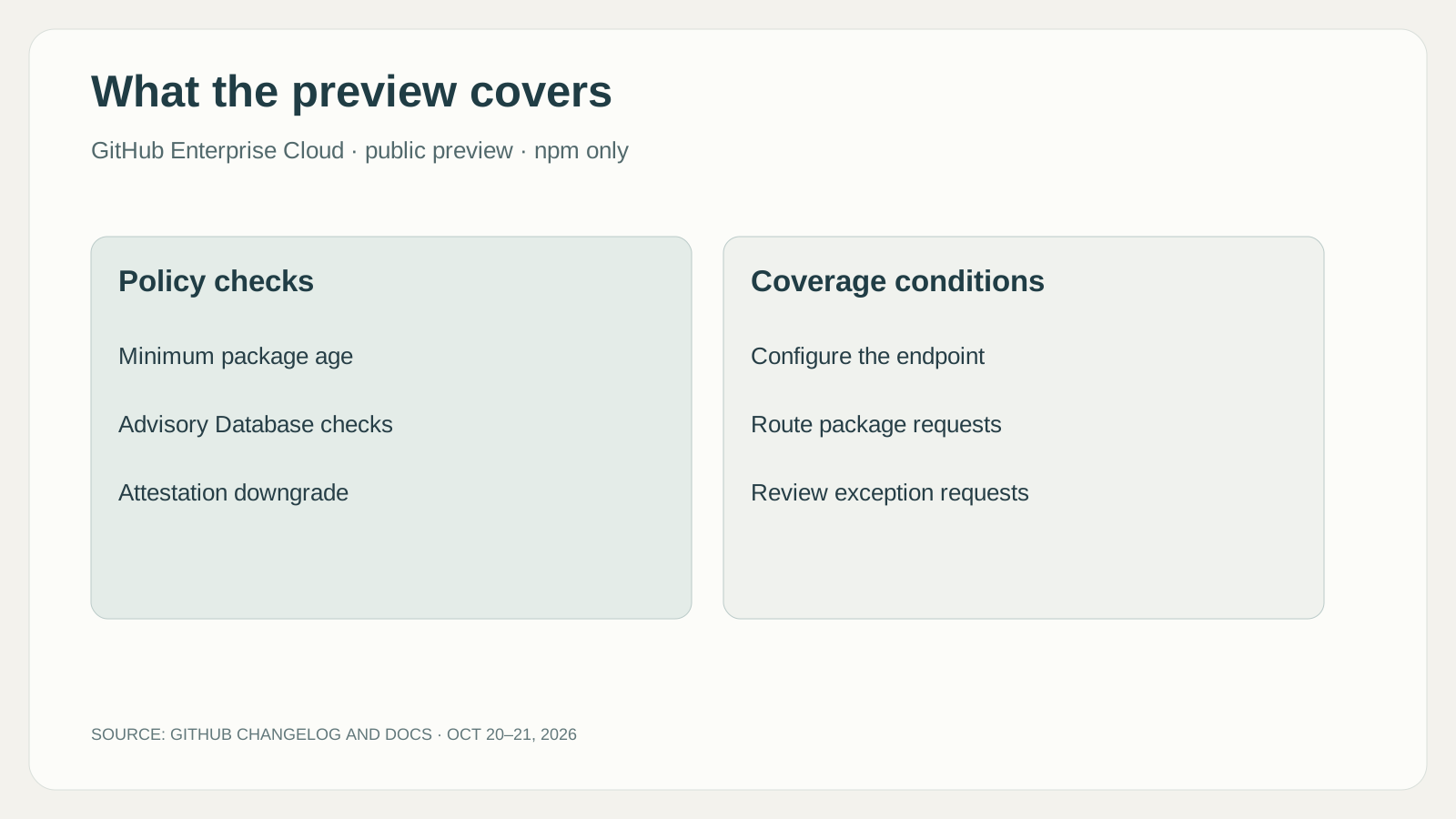
Original infographic summarizing the announced scope. npm support and Enterprise Cloud eligibility describe this preview, not every future version.
Why coding agents make this boundary more visible
An agent's appeal is that it can move from an idea to a working change with fewer pauses. Finding a library, changing a configuration and running a test can become part of the same conversation. That convenience compresses several decisions into one apparent action: “implement the feature.” The dependency decision may receive less attention precisely because the overall process feels so efficient.
Imagine an illustrative task to add a small date-formatting feature. The agent proposes a new package because that is the quickest path it recognizes. The code review should still ask whether the existing project already solves the problem. A firewall cannot answer that architectural question. It can apply a separate rule to the requested version. The two reviews are complementary: one asks whether to add the dependency, the other whether this request meets the organization's current policy.
A second case is an agent-driven maintenance branch. Several packages are upgraded, tests run and the branch looks ready. If one requested version is too new under policy, the developer should receive a clear reason and an actionable next step. The block is useful if it produces a considered wait or a documented exception. It is less useful if the agent interprets failure as an invitation to search for an ungoverned installation path.
The workflow therefore needs to treat a policy block as meaningful information. Agents should be able to report the blocked package, the reason and the unresolved task. They should not silently change the project to an unrelated dependency merely to make the installation succeed. That expectation belongs in the surrounding development process; it is not a claim that the firewall controls every subsequent decision an agent can make.
A cooldown buys time and can delay a useful fix
The minimum-age control captures a real trade-off in a simple form. Waiting gives a newly published artifact more time to attract scrutiny. It can also delay a release that fixes a serious problem. A blanket delay may be easy to explain, while a good exception process determines whether the team can respond intelligently when the ordinary rule fits poorly.
Consider a team facing a broken build caused by a dependency regression. A maintainer publishes a corrected version shortly afterward. The new version may be exactly what the team needs and still fall inside its cooldown window. The relevant review is whether the evidence for using it justifies an exception for this situation. Quietly removing the rule everywhere would discard the benefit for unrelated work.
The opposite case matters too. A package that passes an age rule may still contain a problem that has not been reported. Waiting is a way to change exposure, not a substitute for understanding the dependency or limiting what the environment can access. This is why a successful installation should not end the team's reasoning about software supply chains.
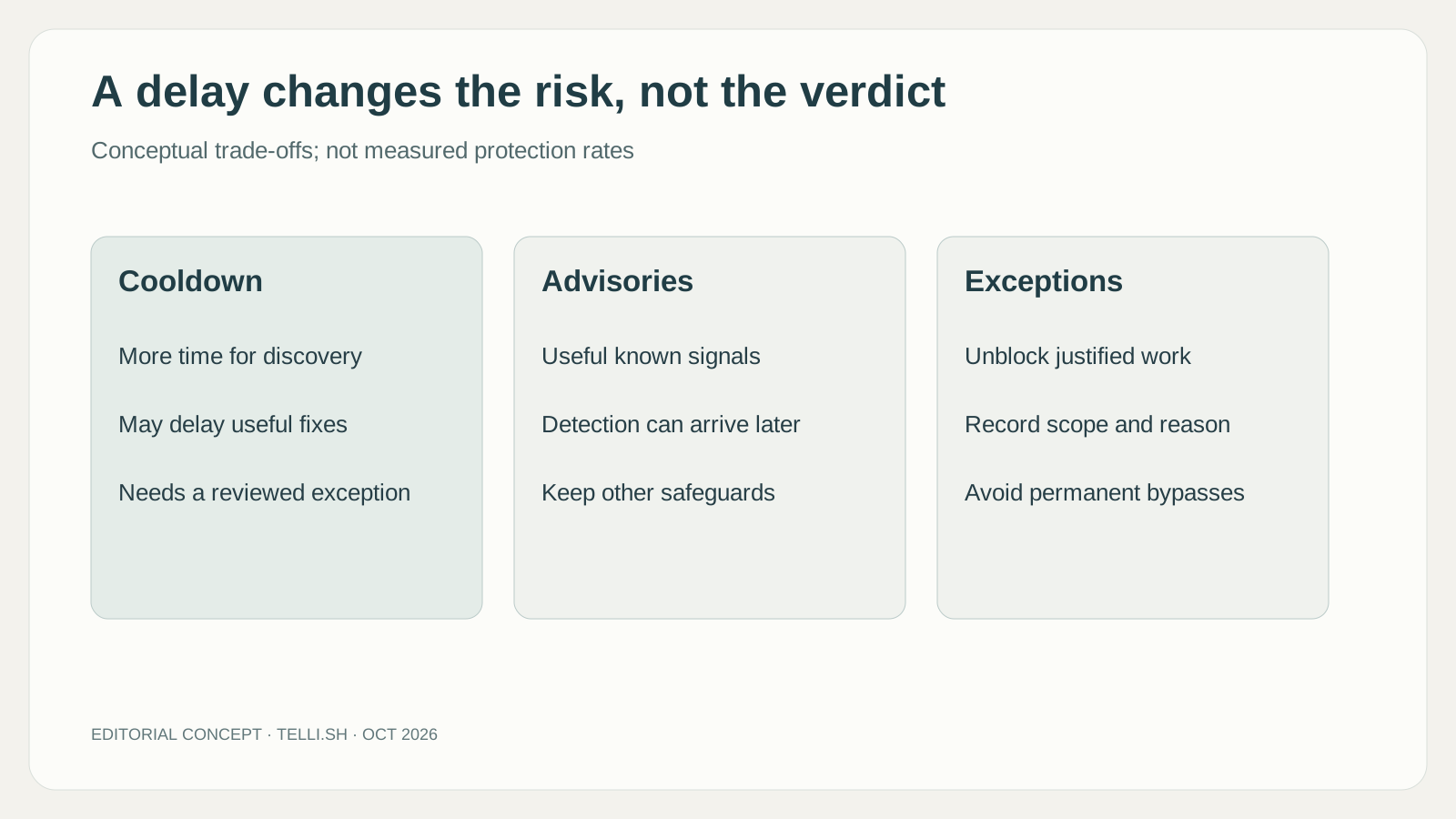
Original conceptual comparison. It does not show measured detection rates or claim that an allowed package is safe.
The exception process can determine whether the policy survives
The waiting rule also changes over time in a way a code diff does not. A version blocked today may become eligible tomorrow without any edit to the proposed feature. Conversely, newly reported information can change the policy result for a version the team has used before. Developers should therefore keep the requested version and the reason for a block together with the task. That record makes a later decision understandable. “It installed this time” is an observation about one attempt, while a reviewed dependency choice explains what the team intended to adopt and why it considered the choice acceptable.
Security rules often fail socially before they fail technically. If a block produces an unexplained error and a long wait, people learn to regard the control as an obstacle. If the reason is visible and the exception can be reviewed by someone with the right context, the same block can become a useful pause. The new feature's request workflow should be evaluated with that ordinary human experience in mind.
A meaningful exception records the package and version, why it is needed, the relevant evidence and the scope of the decision. It should be clear whether the approval is for one immediate request or a broader policy change. Otherwise, a justified exception can gradually become a permanent gap that nobody remembers creating.
The reviewer also needs a practical route to a decision. “Please approve” is not enough when the dependency is unfamiliar. The development task should explain whether the package is essential, what changed in this version and whether an existing approved version remains usable. These are proposed working practices around the product. They do not imply that the service automatically supplies all of that context.
For agents, a good exception report is an opportunity to become more useful. Instead of repeatedly retrying an installation, the agent can preserve the work completed so far and present the precise blocked step. That makes the human decision smaller and more reviewable. The gain is continuity: the task can resume after a decision without losing the reason for the pause.
Provenance and script controls answer different questions
The firewall is easier to assess when placed beside two other supply-chain controls. npm's provenance documentation describes a verifiable connection to a package's source and build instructions, while explicitly warning that provenance does not guarantee the absence of malicious code. GitHub's artifact-attestation explanation similarly describes signed build provenance, including repository, workflow and commit information. Those records can explain where an artifact came from; the firewall applies a policy to whether a requested version can be fetched through its endpoint.
That difference matters during an incident. A newly published package can have an authentic build history and still contain an unwanted change. An older package can lack the evidence a team expects from its maintainers. A waiting period, an advisory check and a provenance record each contribute a different observation. Combining them can improve the basis for a decision, but no single green indicator settles whether the code is suitable for the particular application.
| Control | Question it helps answer | What remains outside that answer |
|---|---|---|
| Package firewall policy | May this requested version pass the configured acquisition rules? | Whether every behavior of the allowed code is appropriate |
| Build provenance or attestation | Which recorded source and build process produced the artifact? | Whether that source expresses trustworthy intent |
| Install-script restrictions | May package lifecycle scripts execute during installation? | What imported application code does later |
The third row comes from a separate mechanism. npm's configuration reference says ignore-scripts suppresses scripts specified in package manifests, while an explicitly requested script such as npm test still runs its intended target. This can reduce a class of installation-time execution, but it can also affect packages that legitimately need a build step. It is a capability to evaluate against the dependency set, not a universal switch that makes any package harmless.
Maintainers and developers experience the policy from opposite sides
There is a constructive maintainer perspective behind this machinery. Teams that publish repeatable builds and useful release information give downstream users more evidence to review. A shared firewall policy could make those practices matter consistently across many developers instead of depending on each person remembering an informal rule. The benefit is more predictable acquisition, provided the rule and its exceptions remain understandable to the people whose work it affects.
The same policy can look different to the author of an urgent fix. A package released minutes ago may be correcting the exact issue a customer needs resolved. If age alone blocks it, the application team needs a way to inspect the change and explain a deliberate exception. That does not invalidate a cooldown. It shows why the product's operational quality depends on whether a legitimate release can move through review without encouraging permanent bypasses of the controlled path.
An illustrative evaluation could follow one ordinary update and one urgent repair through the same organization. Compare the evidence visible to the reviewer, the time until a developer understands the decision and whether the chosen exception is recorded. Include a dependency with a legitimate install step so the team can distinguish acquisition policy from script-execution behavior. These are proposed evaluation tasks, not results from our use of the preview.
The larger opportunity is a common language for dependency decisions. A developer can ask whether a version is too new, affected by known information or missing expected provenance, instead of receiving an unexplained rejection. A maintainer can see which evidence would help. An agent can be given a clear failure state to report rather than repeatedly trying another download route. GitHub's position in the development workflow could make that coordination valuable, even where the underlying rules are intentionally conservative and the final judgment still belongs to the organization.
An allowed package still enters an environment with consequences
The firewall's position on the download path is valuable because the endpoint is where the artifact will be used. That endpoint may have source code, credentials or access to other services. A package policy reduces one class of uncertainty, while environment design limits what a mistaken decision can affect. The useful question is how the controls work together in the actual development setup.
A CI runner with narrowly scoped credentials presents a different situation from a long-lived workstation holding access to many projects. An agent sandbox that can only modify a disposable checkout differs from one that can reach deployment secrets. These examples explain why a product cannot be evaluated solely by the names of its checks. The same allowed dependency can have very different consequences in different environments.
Teams should also distinguish a policy event from a software failure. A blocked download, an upstream outage and a package that installs but breaks a test need different remedies. If all three appear to the agent as “installation failed,” the automation may make poor recovery choices. Clear reporting helps people decide whether to wait, request an exception or investigate the application.
The next step is a representative preview, not an all-clear label
A useful trial would trace an ordinary workstation, an Actions workflow and a coding-agent environment through the request path. Check that the intended endpoints are covered, that a representative block gives a useful explanation, and that an approved exception has the expected scope. These are suggested evaluation criteria; we have not operated this preview in a production enterprise account.
The business measure should include both protection and friction. Count the policy events that produced a useful review, time spent resolving false blocks, and places where requests escaped the intended path. Estimate future metered cost from representative activity when the relevant pricing becomes available. A control that creates a manageable decision at the right moment can be more durable than an aggressive policy that everyone learns to work around.
GitHub package firewall is interesting because it recognizes package acquisition as part of the change being made. In AI-assisted development, the code diff is only one visible piece of the agent's work. The requested dependency and the environment that receives it deserve their own attention. The preview offers a place to put that attention into policy, while leaving teams responsible for deciding what a good dependency choice looks like.
Sources
-
GitHub package firewall public preview, October 20, 2026.
-
Protecting endpoints with package firewall, checked October 21, 2026.
-
npm provenance and its limitations, checked October 21, 2026.
-
GitHub artifact attestations, checked October 21, 2026.
-
npm script configuration, checked October 21, 2026.
Preserve the reasoning behind a dependency decision
If you want a separate workspace for source links and your reviewed technical notes, Telli.sh is one option. Open your notes workspace.