Genie 4 lets you interrupt the world, then hear what happens
Google DeepMind's research preview combines interactive worlds with native audio. A practical guide to exploring scenes, comparing tools and testing continuity before trusting a simulation.
A film director can ask for a rainy street. The more interesting request arrives a moment later: keep the street, move behind the person crossing it, and let a delivery bicycle pass close enough to hear.
Google DeepMind announced Genie 4 on October 27, 2026, describing an interactive world model with native ambient sound, music and dialogue. Users navigate with keyboard controls and steer an evolving scene through text. It is a research preview for trusted testers; broader access through Project Genie for Google AI Ultra subscribers and selected Gemini API and AI Studio partners is planned. DeepMind announcement.
That makes Genie 4 interesting as a place to ask follow-up questions through actions. This guide explains where that interaction could help, how to compare it with video generation and authored environments, and what a useful first evaluation should actually measure.
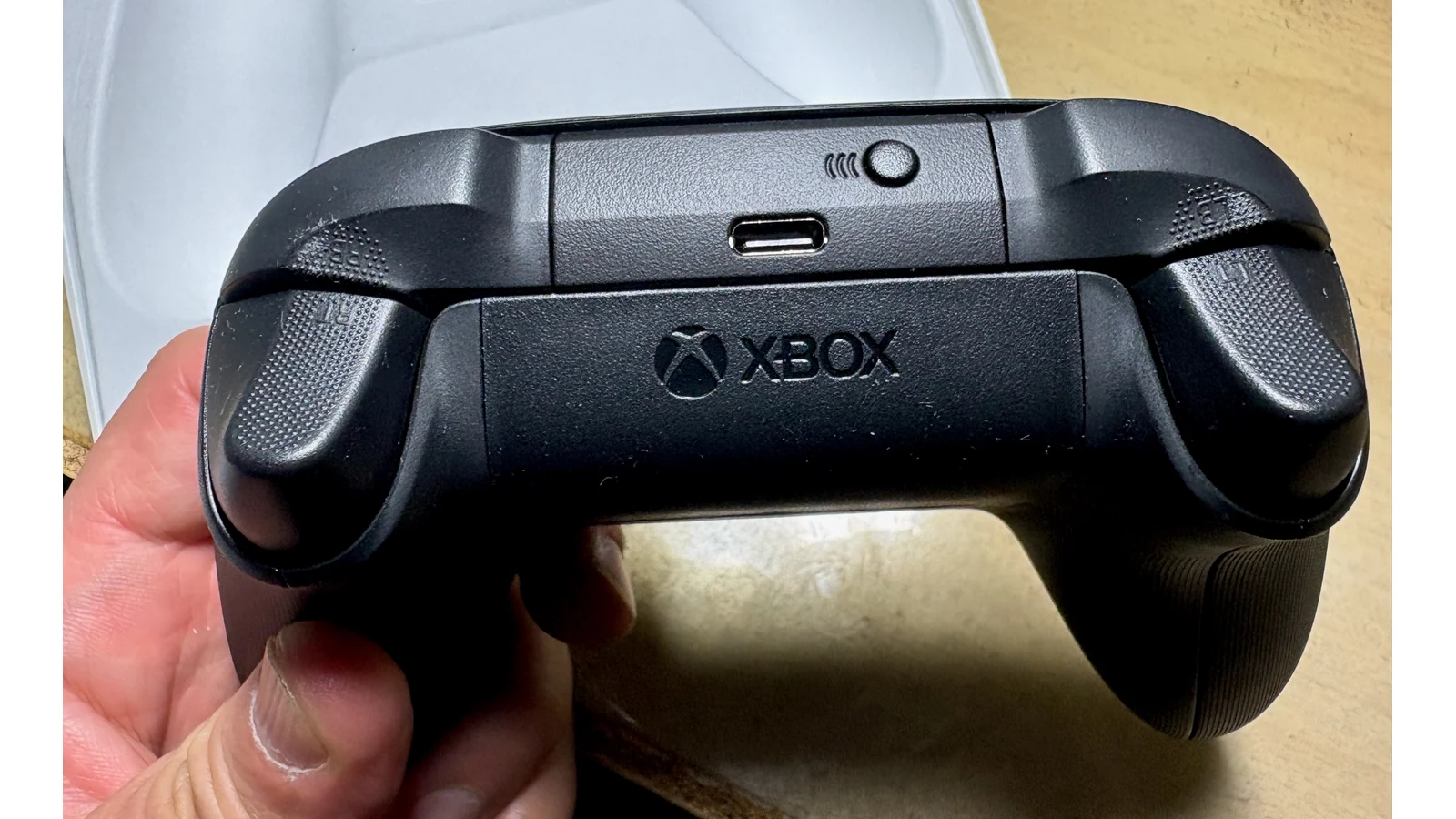 An Xbox wireless controller in 2025, illustrating player input for interactive worlds. This is not Genie 4 output or an endorsed Genie controller. Photo: Kyu3a, CC BY-SA 4.0; resized with margins. Image source · License and image notes. Official product reference.

The useful unit changes from a finished clip to a continuing encounter
A generated clip answers a request with a sequence of frames. An interactive environment adds another question: what happens when the viewer changes the situation? The difference matters even when both outputs look cinematic, because the work you can perform with them is different.
Consider blocking a scene around a narrow doorway. A conventional previsualization workflow asks you to anticipate the camera positions that deserve a render. An interactive exploration would let you investigate the doorway, move into the adjoining space, and discover whether the blocking still makes sense from the other side. Its value comes from discovering the next useful question while the scene exists.
Our take: the important creative resource here is continuity between decisions. If changing a light requires rebuilding the whole idea, you spend attention reconstructing context. If you can make the change while keeping the rest of the situation recognizable, you can spend that attention judging the change itself.
Think of it as a rehearsal room. A rehearsal is valuable because someone can stop the action, adjust a condition and try again. It does not need to become the final performance to improve the final performance. That is a productive standard for a research system whose strongest early applications may happen before expensive production commitments.
The distinction also helps you decide what to save. A spectacular frame is useful for mood; a sequence of interventions and responses is useful for explaining why the team preferred one idea. Keep both when the access conditions allow it, with clear labels for generated material and the choices that produced it.
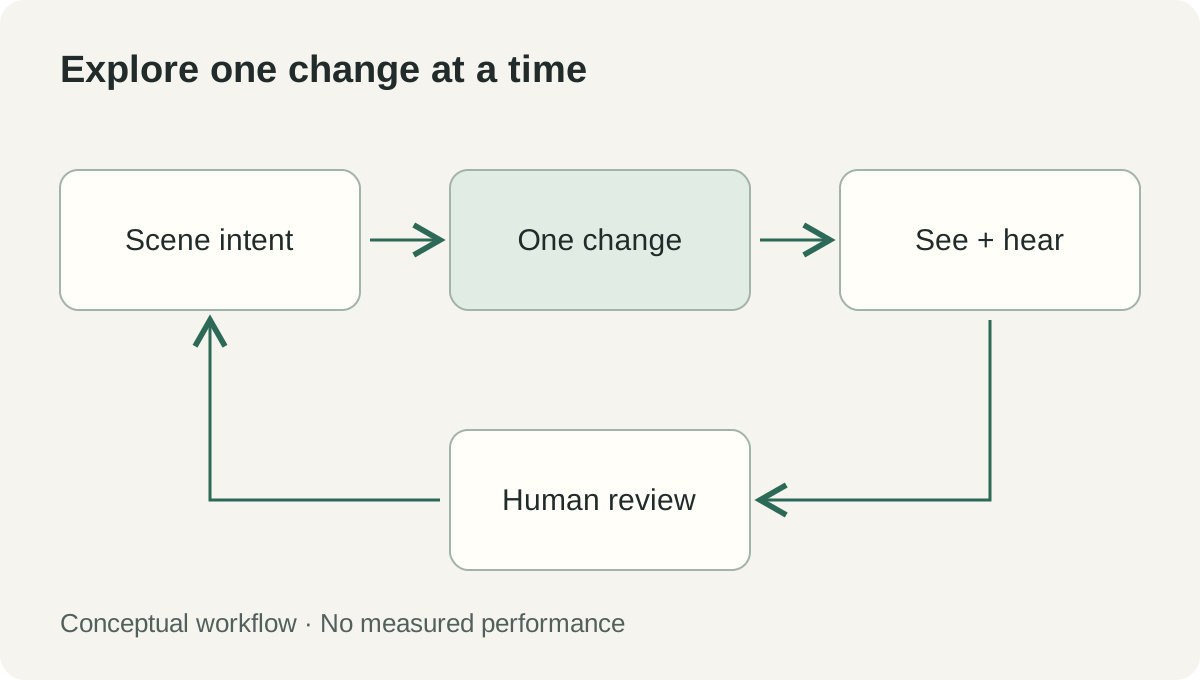 Original explanatory diagram: a proposed creative evaluation loop, based on the interaction described by DeepMind. The arrows show a working method, rather than a published model architecture.
Sound makes a different kind of continuity visible
The official Genie model page, checked November 2, presents the experience as an audiovisual world. That invites a practical question: does what you hear help you understand what changed? A scene can look plausible while its sound communicates the wrong distance, material or event.
Suppose an illustrative scene contains a café with an open door and a passing bus. A useful exploration would compare the sound while the listener stands outside, crosses the threshold and turns away from the road. The point is to examine whether the audiovisual relationship supports the intended experience. You would still need a separate sound-production workflow for a deliverable with specific mixing and editing requirements.
A second exercise could remove an obvious visual cue. Let the bus leave the camera's view while the listener remains near the entrance. Does the continuing sound make the space feel coherent, or does the environment seem to reset around the camera? That question is more informative than simply asking whether the audio sounds impressive.
For dialogue, judge more than the words. In an illustrative encounter between a visitor and a shopkeeper, the useful questions include whether the exchange follows the situation, whether turns remain understandable, and whether an interruption changes the interaction sensibly. A fluent sentence alone does not tell you whether the character belongs to the scene you are exploring.
These are evaluation ideas, rather than reported test results. They turn a broad audiovisual promise into things a creator can observe and discuss. They also reveal where ordinary production assets remain essential: a controlled voice performance, a legally cleared soundtrack, or an editable sound session may still be the right destination for the idea.
Three early uses reward exploration before precision
A director can compare staging before committing to a shot list
Imagine a small production planning an evening encounter at a station. The director wants to understand whether the emotional beat works better as an approach, a reveal through a doorway, or an interruption from outside the frame. An interactive world could serve as a shared visual conversation about those alternatives.
The team would begin with one simple space and two people. It would change one condition at a time: viewpoint, arrival direction or atmosphere. After each intervention, it would describe what improved the scene and what became confusing. That produces a useful planning artifact even if none of the generated frames enters the final film.
The handoff should be a decision, such as “hold the reveal until the person crosses the doorway,” supported by selected references. A shot list, location plan and production schedule still require their own decisions. Keeping that distinction clear prevents an evocative exploration from quietly becoming an unworkable shooting promise.
A game designer can investigate whether an idea invites the next action
An illustrative game-design exercise might start with a market square and a sound coming from a side passage. The question is whether the sound, sightline and movement together make the passage worth investigating. This is a question about curiosity and spatial storytelling before it is a question about a finished level.
Try different cues separately. Move the sound source without changing the lighting, then change the visual cue without changing the route. A designer can use the resulting observations to refine an authored prototype with explicit rules. The useful output is a clearer hypothesis about player attention.
An authored game engine remains preferable when the team needs reproducible collisions, exact navigation geometry or a scripted state machine. A generated exploration can help identify what to build in that engine. The two workflows can sit on either side of the same design decision.
An educator can explore perspectives while keeping factual instruction separate
For an illustrative lesson about urban spaces, students could compare a square from a pedestrian's viewpoint, from a doorway and from a balcony. The exercise would ask how viewpoint and sound affect interpretation. Students could explain which details influenced their description and which details they would need to verify elsewhere.
The generated environment should carry an explicit label and a bounded learning purpose. If the lesson concerns an actual historical place, use authoritative records for dates, architecture and social context. A plausible street scene can support discussion about perspective without becoming evidence that a particular street looked or sounded that way.
That division is especially useful for teachers evaluating new media tools. It gives the exercise an assessable outcome: a student can compare observations and explain uncertainty. The lesson does not depend on treating generated details as factual reconstruction.
Choose the tool by the question you need answered
The following comparison is a planning framework, rather than a feature benchmark. It separates the main artifact you need from the environment in which you explore it. Specific products and plans still determine export formats, access and capabilities.
| Your immediate question | Workflow to consider | Artifact worth keeping |
|---|---|---|
| How should a short sequence look? | Video-generation and editing workflow | Selected clip, prompt and edit decisions |
| What happens when I interrupt this scene? | Interactive world exploration such as Genie 4 | Intervention sequence and continuity observations |
| Will a mechanic behave reproducibly? | Authored game or simulation environment | Rules, assets and repeatable test case |
| What must the production team build? | Previsualization plus production planning | Approved storyboard, requirements and shot list |
This is a useful comparison because it starts with a deliverable. A team seeking a precise asset should ask about the asset. A team investigating an experience should ask about the interaction. The excitement around a model should not decide the artifact for you.
It also changes how you compare cost. The cheapest attractive output is not necessarily the cheapest route to an approved decision. Include the time required to reconstruct context, explain the result to someone else, and transfer the idea into the tools that will produce the final work.
For example, an exploratory session that reveals a blocking problem early may be useful even when its imagery is imperfect. A beautiful session that cannot be translated into a workable design may create more review work. Those outcomes are best judged against the team's purpose, rather than a generic realism score.
Longer encounters need a continuity test you can explain
DeepMind's October 27 announcement identifies drifting visual details, object permanence, spatial precision, complex physics, audio accuracy and longer-term consistency as ongoing research problems. Those limits make session duration and repeated edits relevant to any evaluation. Published limitations.
Build a small continuity card before exploring. It might name a red bag on a bench, an open doorway and a sound source behind the camera. These are illustrative anchors you choose for the test. Their purpose is to make later observations comparable, rather than to set a universal model requirement.
After moving away and returning, check whether each anchor still serves the intended scene. Record what changed, when it changed, and whether it affected the creative decision. A shifted decorative detail and a missing doorway have different consequences for a director planning a route through the space.
Repeat the exercise with one additional intervention. If a weather change also alters the location of an important prop, the team should know before relying on the scene for continuity planning. The more clearly you define the anchors, the easier it becomes to distinguish a useful exploration from a misleading reference.
The same method applies to physical behavior. An object that appears to roll convincingly has answered a perceptual question. Using that behavior to predict a real mechanism would require validated physical assumptions, controlled conditions and an appropriate simulator. A visually persuasive event does not supply those requirements by itself.
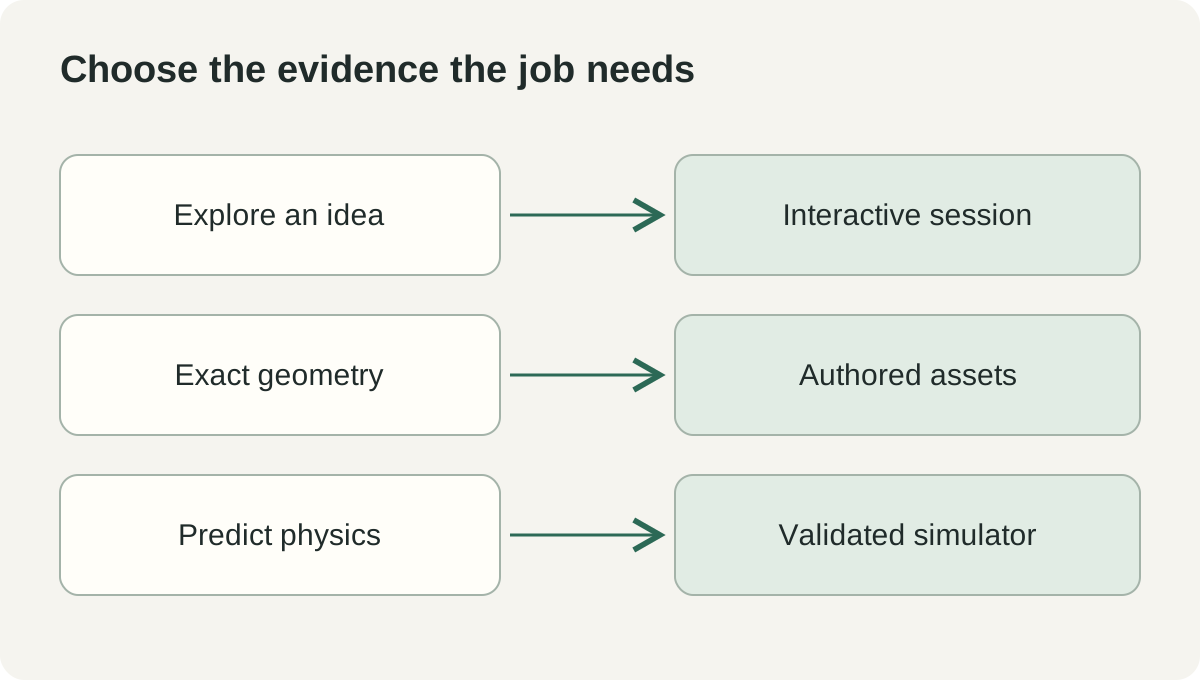 Original decision aid: use generated exploration to develop ideas; choose separately validated tools for exact physical or production requirements. This is editorial guidance, with the research limits documented by DeepMind.
A first evaluation can be useful before broad access arrives
As of November 2, the practical entry point is the official Genie 4 page and waitlist. A planned access channel is different from an account that can run the model today. Check the current access offer before building a deadline around the preview.
- Choose one decision. Write a question such as “which entrance makes the reveal clearer?” Avoid asking a first session to validate a whole film, game or training environment.
- Prepare a bounded scene. Specify the space, the viewpoint, the few objects that matter and the sound you want to investigate. Keep a short written list of the details that should remain stable.
- Review the official demonstrations first. Observe how the examples present navigation, interventions and audio. Use them to refine the evaluation question while keeping the distinction between a vendor demonstration and your own results.
- When access is granted, change one variable per pass. Save the starting intent, the intervention and a brief observation. Follow the service's recording, sharing and content rules.
- Return to the anchors. Revisit a place, object or sound after moving and editing. Describe any discontinuity in terms of its effect on the chosen decision.
- Transfer the outcome into your production workflow. Produce a revised storyboard, authored prototype or lesson brief. Treat that approved artifact as the handoff.
You can prepare most of this before receiving access. That preparation is useful because it prevents the first session from becoming an unstructured tour. It also gives collaborators a common language for feedback: what was intended, what changed, and what decision the team can now make.
For a team evaluating several tools, use the same creative question while allowing each tool its natural workflow. A video system should be judged on the clip and edit it enables; an interactive system on the exploration and handoff it enables. Forcing identical inputs can be less fair than comparing how well each workflow resolves the same need.
A world model becomes useful when an interruption teaches you something
Genie 4 points toward creative software in which the next instruction can arrive inside the experience. That is a meaningful shift for people whose ideas become clearer through movement, sound and response. The work begins with knowing what you want the interaction to reveal.
The strongest early result may be a better question for the director, designer or teacher to carry into the next tool. A convincing world earns its place in the workflow when exploring it improves a real decision outside it.
Sources
- Google DeepMind: Genie 4, a new generation of world simulation, October 27, 2026; checked November 2, 2026.
- Google DeepMind: Genie model and demonstration page, checked November 2, 2026.
Preserve the material behind a decision
Telli.sh is one option for keeping authorized source material alongside the notes you have reviewed. Create a note workspace.