Gemini Robotics 2.5 can sort car parts. Can the factory use every kit?
Google DeepMind reports a 96% success rate in an Apollo 2 automotive kitting pilot. The next questions are tray accuracy, handoffs and repeatable cycle time.
Two metal brackets look nearly alike in a bin. One goes into the next tray and the other belongs to a different vehicle configuration. The wrong bracket can still sit neatly in the right compartment. A robot that carries parts accurately has completed one useful job. A kit that arrives with the right parts in the right order completes the job the factory pays for.
On November 10, 2026, Google DeepMind announced Gemini Robotics 2.5 and said it was rolling out to robotics partners. DeepMind reported a 96% success rate in an automotive kitting proof of concept with Apptronik and Mercedes-Benz. The trial used Apptronik's Apollo 2 humanoid at active production lines in Kecskemét, Hungary, and Sindelfingen, Germany. DeepMind announcement and factory demonstration · Apptronik's Apollo 2 description
The demo matters because it gives a broad robotics model one concrete industrial job. Follow the tray through that job, and the evaluation becomes more useful than a single headline percentage. Does the system deliver the correct tray on time, and can the people on the line tell what to do when something goes wrong?

Mercedes-Benz’s Sindelfingen plant, photographed in 2014. This exterior view identifies one of the two trial sites. Photo by qwesy qwesy, Wikimedia Commons, CC BY 3.0. Resized by Telli.sh.

Kitting makes the difference between a successful pick and a successful delivery visible
Automotive kitting is the work of collecting and organizing parts in the sequence they are needed. In its account of the Mercedes-Benz pilot, DeepMind describes bulk supply bins and sequencing containers. Apollo 2 picked metal brackets and placed them into those containers. DeepMind says its Gemini Robotics ER model kept track of the process, while Gemini Robotics 2.5 controlled the robot's hands and arms. The company identifies Robotics 2.5 as a vision-language-action model, a model that uses what it sees and the task instructions to guide physical actions. DeepMind's description of the factory proof of concept
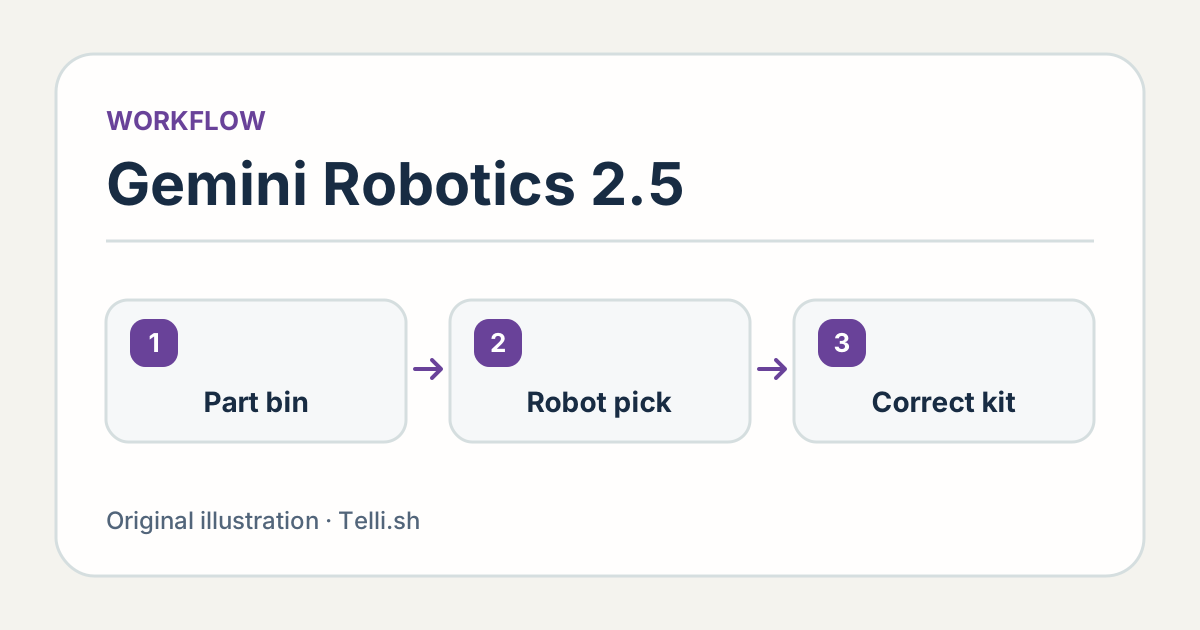
A conceptual view of automotive kitting. The handoff check shown here illustrates a pilot acceptance rule. Illustration by Telli.sh, informed by DeepMind’s account of the Mercedes-Benz trial. DeepMind case and video
A kitting station connects upstream stock to downstream assembly. When a bracket is missing or a tray is late, the next technician needs a clear state and a way to finish the job. An isolated successful grasp says little about that part of the workflow. Even when the robot places several items correctly, a tray with one missed item may still need rework.
For an illustration, suppose a tray needs three distinct items. The first two placements look correct. The third looks mechanically correct as well, but the item is the left-hand bracket for a different configuration. In a pick-by-pick count, the robot can appear to have placed three items. In a kit-level count, the tray needs correction. The example is deliberately simple and does not describe an observed error from the Mercedes-Benz pilot.
The usefulness of a reasoning model also depends on how the station defines an exception. A compartment might be empty because the expected item has not been placed yet, or because that vehicle configuration does not require it. A station can distinguish those cases only if its task state and the approved production instructions agree. The public trial describes the robot correcting gaps. It does not describe how the plant's inventory, sequencing and exception systems were integrated. DeepMind's factory proof of concept
Read the 96% figure alongside the unit of work
DeepMind's November 10 post reports a 96% success rate for the pilot. It does not provide a trial denominator or a breakdown of cycle times and human interventions. The number tells a reader what the participating research team reported in the described proof of concept. A factory deciding whether to scale needs the count of good kits that arrived when they were needed and the range of conditions the pilot actually covered. DeepMind's published pilot result
Consider two hypothetical interpretations. If 96% means 96 complete kits out of 100, four kits needed recovery under that test's definition. If 96% instead refers to individual picks, kit success depends on how many picks there are and whether failures tend to occur together. With five independent picks at 96% each, the chance of all five working is about 82%. That calculation only illustrates how the metric changes with the denominator. It is not an estimate for the Mercedes-Benz station, and real pick outcomes may be correlated.
Timing changes the comparison too. A robot might complete most kits on the first pass and need unusually long pauses for a few hard cases. Averaging those cycles can hide stalls at the wrong moment. Look at typical and slow cycles alongside the number of kits sent downstream. Report whether the work stopped when the robot requested help or whether an existing process kept the station moving.
| Question for a follow-up pilot | Measure | Why it matters |
|---|---|---|
| Does the technician receive the right parts? | Complete, correctly sequenced kits accepted on first handoff | A pick can succeed without producing a usable kit |
| Does the station keep pace? | Distribution of cycle times, including slow cases | Long waits can affect the next station |
| Who handles the exceptions? | Interventions and time to recover by reason | A system can transfer work to people even as it automates picking |
| Does the result survive a change? | The same measures after an approved part or tray change | One reliable setup provides limited evidence about another setup |
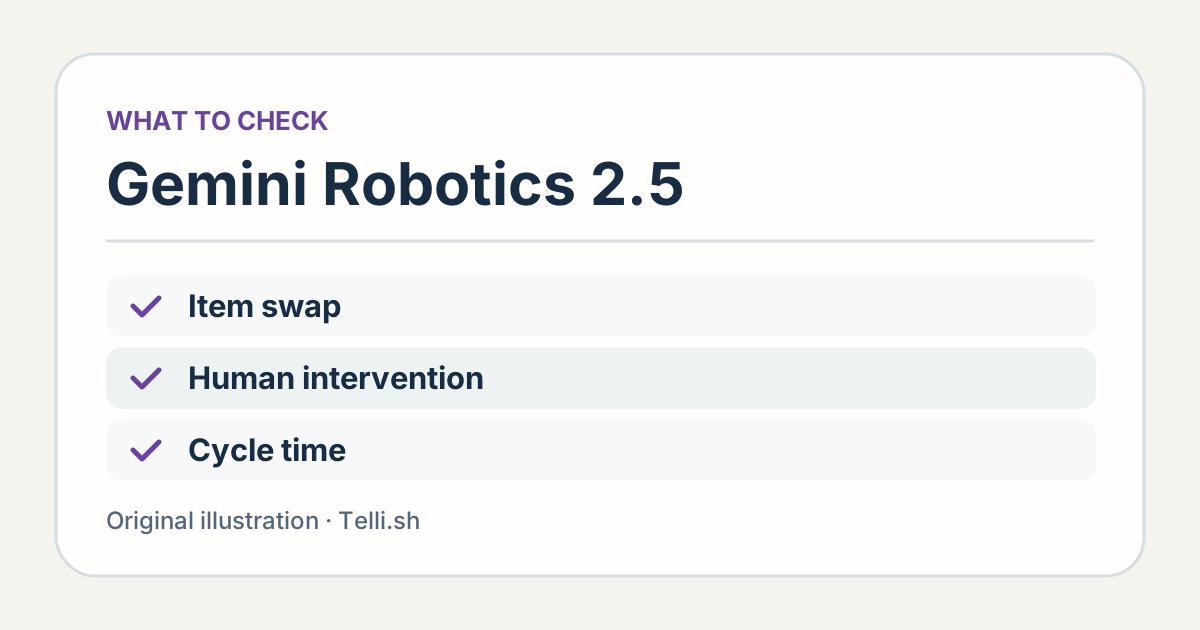
Four measures a production team could collect alongside a vendor-reported success rate. The scorecard is a proposed evaluation, not data from the Mercedes-Benz pilot. Illustration by Telli.sh.
A good changeover tells you which part of the workflow adapted
DeepMind says it evaluated Gemini Robotics 2.5 across about 200 distinct tasks and reported improvements in its own evaluations over prior baselines. Those tests include tabletop operations and more complex manipulation. The ability to handle different objects makes a good research case for a general model. For the production team, the useful measure is how much work it takes to adapt the station when the expected mix changes. DeepMind evaluation and examples
Start from the actual reasons a station changes. A supplier can deliver a part with a different surface treatment. A new model year can introduce a similar bracket. A supervisor might change how the parts are staged because another cell needs space. Each change affects a different piece of the task. Recognition, grasping and correct sequencing deserve separate observations even if the final measure is a completed kit.
Imagine that a new approved container holds the same parts in a different arrangement. If people have to teach a fresh procedure, record that time and who has to do it. If the robot can adapt without a new program, measure how many trials are needed to return to the earlier accuracy and throughput. A team should compare the whole changeover, including fixture changes, configuration and verification. This is the work a general robot could save, and it is easy to overlook in a video of a smooth run.
The same argument applies when considering another type of station. A robot that succeeds on familiar brackets is a useful result for kitting, and a move to delicate components brings a new set of acceptance criteria. Tooling, contact with the part, contamination rules and how an operator checks damage can all change. Transfer means the next station has to meet its own requirements after a measurable amount of additional work.
An evaluation should include the operator’s handoff
DeepMind describes improvements to physical safety guidance alongside Robotics 2.5. Those model features are one input to a station assessment. The people responsible for the cell still need clear operating limits and a documented stop and recovery process for the equipment and environment they actually use. A facility's safety staff and integrators should own that work. The published model evaluation cannot establish that a particular deployment is ready for people to work around it. DeepMind's safety discussion
A dry run can also test the information people receive. If a tray stops mid-process, can an operator identify which compartments were completed and whether the next action is to continue or set the tray aside? A visible status, a short reason and an unambiguous escalation path can prevent another person from having to diagnose the interruption from scratch.
There is a practical benefit to including technicians in the evaluation. They know which variations are common, which missing parts can be handled by the next step and which ones require a different sequence. A robot should give them information at the same level they use to make those decisions. Ask a technician who did not help design the pilot to describe what they would do when the station flags a kit, and use their answer to improve the handoff.
Build the next trial around the tray the plant actually needs
- Choose a single bounded work cell and part family. Ask production and safety staff to identify the ordinary workflow, the accepted process and the reason for testing a robot there.
- Define one correct delivery. Record required parts, compartments, sequence and acceptable timing. Track each delivered tray rather than treating every pick as a completed job.
- Capture the baseline. Measure a representative period of the existing process, including cycle times, usual exceptions and their effect on the next station.
- Repeat under approved variations. Compare the initial setup with normal changes in stock or schedule that the site has cleared for the trial. Use identical acceptance rules before and after each change.
- Review the result with the operators and integrators. Ask what happened during the slowest and least successful runs, and agree which failures the next trial needs to address.
These are evaluation steps for an authorized industrial trial, not a report of what the partners ran. Their proof of concept offers an example of a meaningful task with a clear physical output. A team can use the example to decide what it would need to measure at its own site, even if it never uses this particular model or robot.
Use one run sheet per trial so the interpretation stays stable. Record the approved part family, input condition, expected delivery, outcome and elapsed time. When there is a recovery, separate the time the robot is unavailable from the time a person actively spends resolving the case. A brief gap in robot work and a large delay downstream are different outcomes, and the people planning staffing need to see both.
Pay attention to where you place a comparison boundary. A person doing the existing task may also replenish bins or flag a mislabeled container as part of the same shift. If a robot does the picking and a person takes over those other tasks, the kitting result can still be useful. Include that work in the description so readers and plant staff can see which responsibilities the cell can take on and which stay with a person.
The station succeeds when the next person gets a usable kit
The reported Mercedes-Benz result is a step toward answering whether adaptable manipulation can be useful on a real production line. The next decision belongs to the entire process. A reliable station consistently hands off the right parts at the right time and makes exceptions clear enough to recover. That is what turns a promising kitting demo into a result that another factory can judge.
Sources
- Google DeepMind’s Gemini Robotics 2.5 announcement, pilot and videos, November 10, 2026
- Apptronik’s Apollo 2 product description
- Sindelfingen factory exterior photo by qwesy qwesy
For a searchable record of pilot debriefs and decisions, Create a Telli.sh account.