From Gems to Skills: Gemini customization is becoming a reusable workflow
Google's staged transition is more than a new label. Prepare your instructions, reference files and verification examples before moving a familiar Gem into a composable skill.
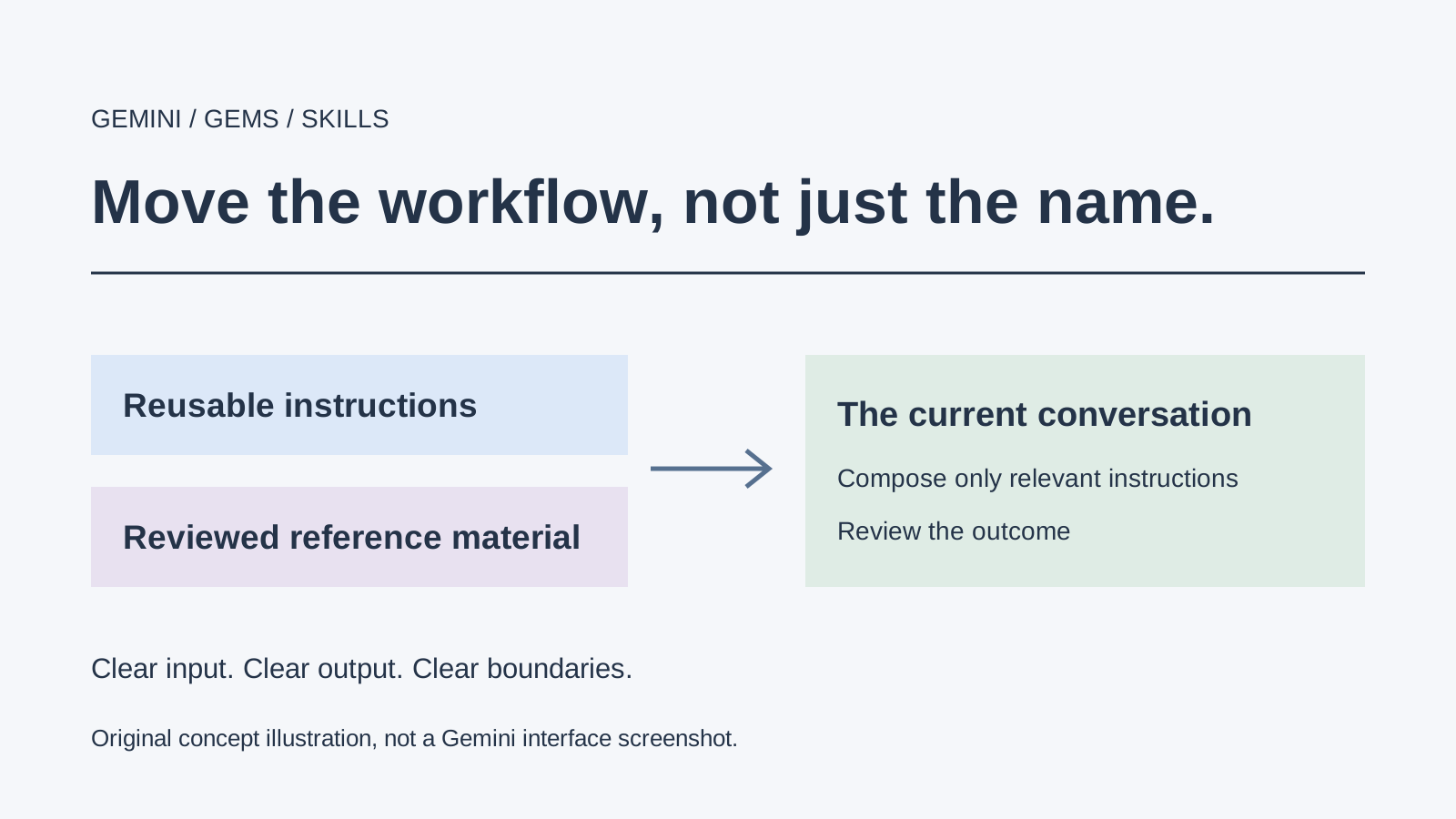
Original editorial illustration. It depicts the idea of reusable instructions, not a screenshot of Gemini or its internal architecture.
Customization is becoming one of the most interesting parts of consumer AI. A useful assistant does not simply know many things; it remembers how a person wants a recurring task approached. A research briefing, an editorial review and a project handover need different standards. Repeating those standards in every conversation is tedious, and leaving them implicit creates inconsistent results.
Google's transition from Gems toward Skills addresses that friction: reusable instructions can be invoked or applied in the conversation already in progress, and multiple Skills can be combined. The change makes customization more composable, but a familiar Gem still needs a deliberate migration: its task, reference files and expected output should be clear.
The rollout differs by account type
Google schedules the Gemini app Skills rollout from October 13, 2026, with completion expected by mid-November; the Workspace Skills rollout starts October 5. These are staged rollouts, so availability can differ by account. Google Workspace announcement
Google's help page schedules the Gems transition for personal accounts in November 2026, Workspace business, enterprise and non-profit accounts in March 2027, and Workspace education accounts in June 2027. These transition dates are separate from the Skills feature rollout. Check the guidance for your account and consult your administrator for managed availability. Gems-to-Skills transition help
Before migrating, keep a readable copy of each Gem's name, instructions and reference files. That gives you a way to preserve its purpose and compare the new workflow when Skills becomes available in your account.
A skill should describe a repeatable job
Google describes Skills as reusable instructions that can be used across chats, selected explicitly or applied when relevant, and combined for more complex work. The creation guide supports a root SKILL.md with optional reference material; it also says scripts requiring internet access are not supported and reference files must be uploaded with the Skill. These constraints make a Skill an instruction and reference bundle, not an unrestricted program for operating websites. Create and manage Skills for Gemini Apps
The easiest mistake is to turn every long prompt into a skill. Length is not the defining quality. A useful skill has a recognizable job, a clear input, a standard for the output and conditions under which it should not act. If those elements are missing, automatic reuse may repeat an ambiguity rather than save time.
Consider a hypothetical "research brief" customization. It should not merely say "be thorough." It could require a research question, a cutoff date, primary-source links and a distinction between confirmed findings and interpretation. It could forbid inventing a source when evidence is unavailable. Those requirements make the output easier to review and the task easier to recognize.
Now consider a separate "editorial style" customization. It might specify short paragraphs, plain language and consistent headings. Keeping that separate from evidence requirements can make reuse more flexible. A user could apply the same evidence standard to a technical investigation and a news brief while choosing different writing styles. That is the appeal of composition, provided the instructions do not contradict each other.
Inventory the intent before copying the text
Before moving a Gem, write down what it does well. Which tasks do you use it for? What information do you usually provide? Which parts of the output do you always correct? Which reference files are essential, and which were added months ago for a one-time task? This inventory is more valuable than preserving a prompt whose accidental complexity nobody understands.
Separate durable rules from temporary context. "Distinguish a company's claim from an independent measurement" is a durable research rule. "Our launch is next Thursday" is temporary context and can become wrong as soon as the calendar moves. A reusable instruction should not quietly carry old facts into a new task simply because they were useful once.
Check for private information embedded in examples. A real customer name, internal address or unreleased business plan may have entered the original prompt as a convenient sample. It does not necessarily belong in a reusable configuration. Replace unnecessary specifics with neutral examples and keep required sensitive material under the appropriate account and access controls.
The inventory should also identify assumptions that were never written down. Perhaps a colleague always checked the final figures, or you always supplied a source document before starting. If the new workflow makes the skill available in many conversations, those assumptions may no longer hold. Turn them into explicit requirements rather than hoping the surrounding context will remain the same.
Preserve a portable reference copy
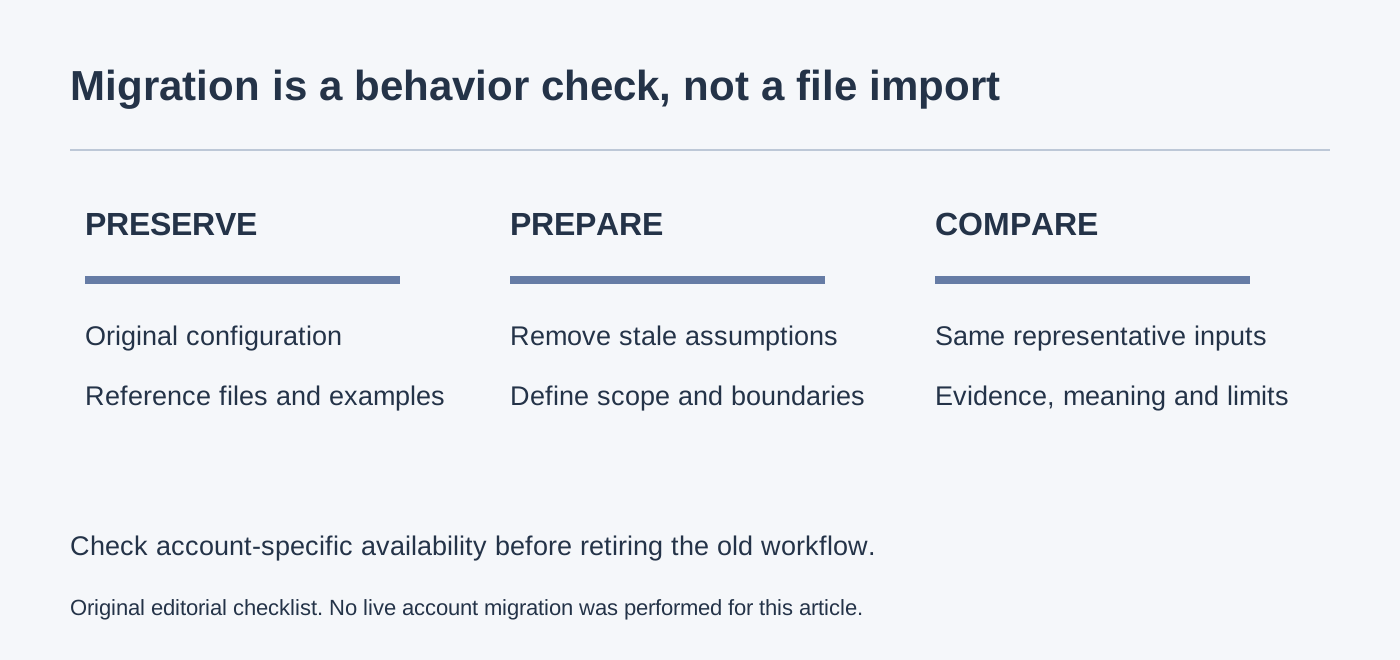
Original migration checklist showing a practical comparison, not a Gemini interface.
A portable copy gives you something to inspect when an interface changes. Keep the name, purpose, instructions, reference-file list and a few example tasks in ordinary readable formats. It preserves the meaning of the customization even when import mechanisms differ; it does not guarantee one-click compatibility with every product.
For reference files, record why each file is present and when it was last reviewed. A policy document may be authoritative for one organization and irrelevant elsewhere. A style guide can become outdated. A table might contain information that must not be shared outside the team. The file name alone rarely captures those constraints.
Keep the original configuration while evaluating the candidate. A migration can preserve the wording and still change behavior because the surrounding model, tools or conversation context is different. A rollback reference helps distinguish an instruction problem from a platform change. It also prevents a rushed rewrite from becoming the only surviving version.
Do not confuse portability with unrestricted distribution. A configuration can include licensed reference material or private information. The fact that it fits in a text file does not make it appropriate to publish or send to another service. Review the contents and the destination before sharing a skill with colleagues or importing one from an unfamiliar author.
A compact template makes the contract visible
This compact research template makes the workflow's contract visible. Adapt it to your task and check Google's current format requirements before importing.
---
name: source-linked-research
description: Draft a research brief that separates evidence from interpretation.
---

# Inputs
- Research question and intended audience.
- Cutoff date and approved sources or search scope.

# Method
- Prefer primary sources for factual product claims.
- Label announcements, measurements and personal analysis separately.
- Mark missing evidence instead of inventing facts or citations.

# Output
- Main finding, supporting links and unresolved questions.
- No external submission or publication without separate approval.
The value is not the particular wording. It is the visibility of the contract. A reader can identify the input, inspect the rule for missing evidence and see that publishing is a separate action. A future editor can change one requirement without having to untangle a page of unrelated persona instructions.
Keep examples small enough to expose a failure. If the task is source-linked research, include a case with conflicting dates and a case where a claim lacks a primary source. If the task is document review, include a file with an ambiguous requirement. A template that succeeds only on easy, complete inputs has not demonstrated much about daily work.
Avoid encoding secrets, authentication tokens or unrestricted tool instructions in a skill file. A reusable instruction should describe the job, not act as a credential store. If a task needs access to private information, that access belongs in the platform's appropriate permission and account controls. Convenience should not make sensitive material invisible inside a configuration.
Combining skills can also combine conflicts
Composition is appealing because real tasks have several dimensions. A report might need a research standard, a house style and an audience-specific explanation. But instructions can conflict: one demands a short answer while another demands a comprehensive audit; one encourages decisive recommendations while another requires unresolved uncertainty to remain prominent. A useful workflow notices the conflict rather than producing an arbitrary compromise.
Start with two complementary skills before adding many. Check whether the evidence standard survives the style instruction and whether the output remains suitable for the audience. If the result changes unexpectedly, test each skill separately. Otherwise, a mistake becomes difficult to attribute, and users may respond by adding still more instructions to a growing pile.
For consequential work, explicitly choose the intended Skill when possible and inspect whether the output follows it. Automatic relevance is convenient, but it can make the applied instructions less obvious.
Keep scope narrow enough that a skill does not attach itself to unrelated work. A "financial research" rule should not quietly reshape a creative-writing conversation. A customer-support template should not turn a personal question into a formal ticket. Good personalization includes knowing when the customization is irrelevant.
Use comparison tasks before retiring the old workflow
A practical migration review uses the same small set of inputs before and after the change: one ordinary case, one incomplete input and one edge case that previously needed correction. Compare substance, not just formatting. Did the new version preserve caveats, avoid inventing details and retain boundaries around external actions?
For research, inspect load-bearing links. For editorial work, check that meaning survives the rewrite. For a handover, confirm that responsibilities and unresolved questions have not become completed work. Match the review to the task instead of relying on a generic quality score.
Record the date, account type and configuration version. If a result changes after an update, that reference helps distinguish an instruction change from a source-material or platform change.
For personal use, a short checklist and a few saved examples can catch obvious regressions. Teams with consequential workflows may need more formal review. In either case, check the intended behavior, not just whether the instructions imported.
Personalization needs ownership as well as convenience
The transition points toward a broader future in which users carry reusable ways of working between tasks instead of starting from a blank prompt every time. That can be valuable. It can also create a new kind of accumulated software: instruction sets and reference collections that influence important decisions even though they do not look like conventional applications.
Someone needs to own that collection. Who updates the reference files? Who reviews a shared skill after a policy changes? Who decides whether an imported instruction is appropriate? Those questions are easy to postpone when customization feels like casual prompting. They become harder to ignore when the same configuration is reused across a team's daily work.
For individuals, the responsibility may be modest: keep readable copies, remove stale assumptions and verify consequential outputs. For organizations, it may require approved configurations, access rules and a review process. Neither arrangement should treat personalization as a guarantee of correctness. A familiar assistant can still make an unfamiliar mistake.
Move the workflow, not just the name
The most useful preparation is to preserve the job your Gem performs and make its requirements explicit. Keep a reference copy, identify the files it depends on, separate stable rules from temporary facts and test the candidate on representative inputs. Then use the rollout information for your actual account rather than assuming a single global deadline.
Skills can make customization more reusable and composable. The benefit will come from clear contracts and careful review, not from the word "skill" itself. As AI tools become more personal, the valuable configuration is the one you can understand, maintain and verify. Migrating that understanding is more important than copying a prompt into a new screen.
Keep your migration decisions in one place
For readers organizing research, configuration notes and review decisions, Telli.sh is one optional workspace. Create a review note.