How much reasoning does a weekly report need? A Gemini 4 Hydrogen test plan
Use the same meeting recording, PDF and spreadsheet to compare Gemini 4 Hydrogen's reasoning settings on review time, cost and source accuracy.
The meeting ended forty minutes ago. There is a recording, a spreadsheet and a revised project PDF. Your director wants a short briefing with the approved deadline, the owner of each action and the reasons for any change. A response can arrive in seconds and still cost you another fifteen minutes if you have to replay the meeting to figure out where the deadline came from.
Google launched Gemini 4 Hydrogen on November 12, 2026, as the Gemini 4 model for everyday coding and agentic work. The announcement lists the Gemini app, Google AI Studio, the Gemini API and several other Google surfaces. In Google Cloud's Agent Platform, Hydrogen accepts audio, images, video and text, as well as several Office and OpenDocument file types. Four reasoning levels let developers vary the amount of thinking for otherwise similar requests. Google launch announcement · Google Cloud model documentation
Our suggested first test is one report you already assemble every week. Ask two Hydrogen settings to produce the same brief from the same files. Then time how long it takes someone to approve each version. That comparison makes it easier to decide whether deeper reasoning saves work when the sources disagree.
A short answer can have a large evidence burden
Imagine that slide 12 in the project PDF says the launch is planned for May 14, the tracker says May 19, and the recording captures a proposed move to May 21. Those are three different kinds of information. The proposal may matter enough to include in the briefing, but it deserves a different label from a confirmed deadline. A useful model output preserves the distinctions even when the final paragraph is only four lines long.
This is a promising workload for native multimodal input because the relevant evidence sits in different media. A speaker in a meeting can explain why a spreadsheet figure changed. A PDF can establish which version of a plan was distributed. A cell can contain the approved amount, with the units stated in its column header. Keeping those items together can save the work of manually extracting a transcript, retyping a table or pasting selected pages into the same prompt. It also makes the model's choice of evidence more consequential.
Give each input a stable name before the comparison. For a recording, name the file and state how timestamps should be formatted. For a spreadsheet, specify the sheet and ask for cell or row references. For a PDF, distinguish the document's printed page label from its file page number when they differ. This small amount of structure makes a citation easy to check even after the files move to a shared folder.
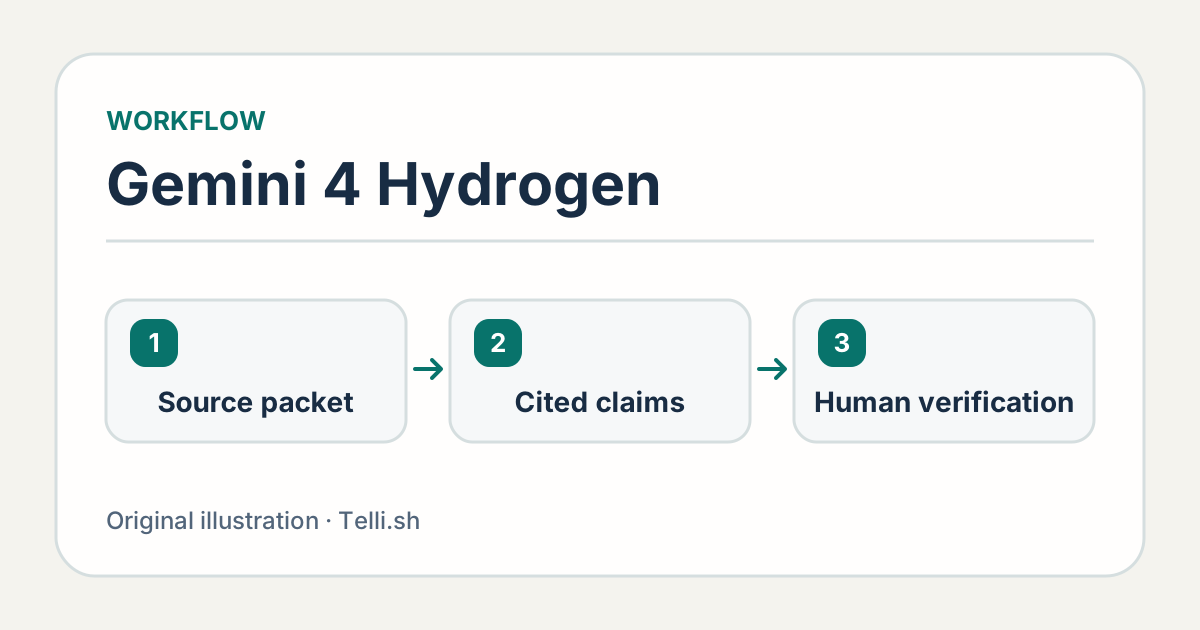
Give each material claim a source that a reviewer can open. Original illustration by Telli.sh.
Put an especially easy case into the test as a control. If the approved budget appears in one clearly labeled sheet, both settings should retrieve it with little trouble. Then add a harder case, such as a meeting that discussed two different budget scenarios without making a final decision. Give credit for marking the decision unresolved. The comparison becomes useful when the harder cases resemble the review mistakes your team actually encounters.
Four thinking levels give you a testable control
Google Cloud documents LOW, MEDIUM, HIGH and XHIGH for Hydrogen. HIGH is the default on the documented API surface. A team comparing settings can begin with LOW and the default, then add another setting if neither handles a recurring edge case well. Check the surface you plan to ship through. A choice exposed in an API need not appear as an identical four-option menu in a consumer app. Google Cloud model documentation
Keep the configuration simple. Use the same model ID, attachments, prompt and expected response shape. Disable tools you do not need for the comparison so that a document review does not turn into a web search or a series of unrelated actions. Keep the answer short enough for the real audience. A review committee that needs six decisions on one page should receive six decisions on one page, even if a setting can generate a much longer report.
Record elapsed time from request to complete response, along with the timing of the first output if someone reads it while it streams. Then track how long a reviewer spends checking, correcting and signing off. Long first-token latency can feel awkward in an interactive app. A fast first token can coexist with a response that takes a long time to finish. Both observations can matter, and neither includes the human time needed to correct an unsupported number.
For a shared report, put both drafts in the same review format and conceal their settings from the person grading them. Have the reviewer mark each deadline, owner and numerical claim. Give an exact-source citation more credit than a link to the general project folder. Distinguish a factual correction from a stylistic edit so that changes to tone do not drown out the model's record on evidence.
| What to record | A useful observation | Why it matters |
|---|---|---|
| Complete-response time | Elapsed time until the final answer is ready | Captures the wait before a batch reviewer can begin |
| Source accuracy | Whether the exact page, cell or time range supports the claim | Checks the cost of trusting a citation |
| Conflict handling | Whether conflicting dates remain visibly unresolved | Reduces silent promotion of a tentative plan to a decision |
| Human review time | Minutes to confirm, correct and accept the brief | Includes the real work left after generation |
| Request cost | Usage and billing for the selected surface, including retries | Shows the cost of a report the team can actually use |
One million tokens still have to be allocated
Google Cloud lists 1,048,576 tokens as a shared input-and-output limit on the documented Hydrogen surfaces. Output in that accounting includes thinking, function calls and the final answer. A foreground segment can generate up to 65,536 output tokens, while supported continuation flows can extend a generation subject to the shared total. That distinction matters if you are comparing the model with another system that describes its context and output limits separately. Google Cloud model documentation
There is little reason to put a whole department's archive into the first run. For a weekly decision brief, give the model the current sources and the smallest amount of history needed to interpret the change. A superseded tracker may be useful if you want a change log. Leaving it beside the current file with no date or status increases the number of plausible answers the system can cite.
Audio and scanned documents also deserve their own cases. A person who spoke quietly or used several similar names can be harder to identify than the person listed in meeting metadata. Google Cloud documents that OCR for scanned PDFs is not used by default. If the scanned attachment is central, verify whether your specific pipeline exposes the necessary text before concluding that a reasoning level made the difference. Google Cloud model documentation
One way to spend the context deliberately is to pair two questions with the same source packet. First ask for the decisions in a compact list. Then ask for an audit of one disputed statement, with the corresponding passages or timestamps and a note about any uncertainty. The first answer should be easy to skim. The second should give the reviewer enough material to resolve a difference without starting from scratch.
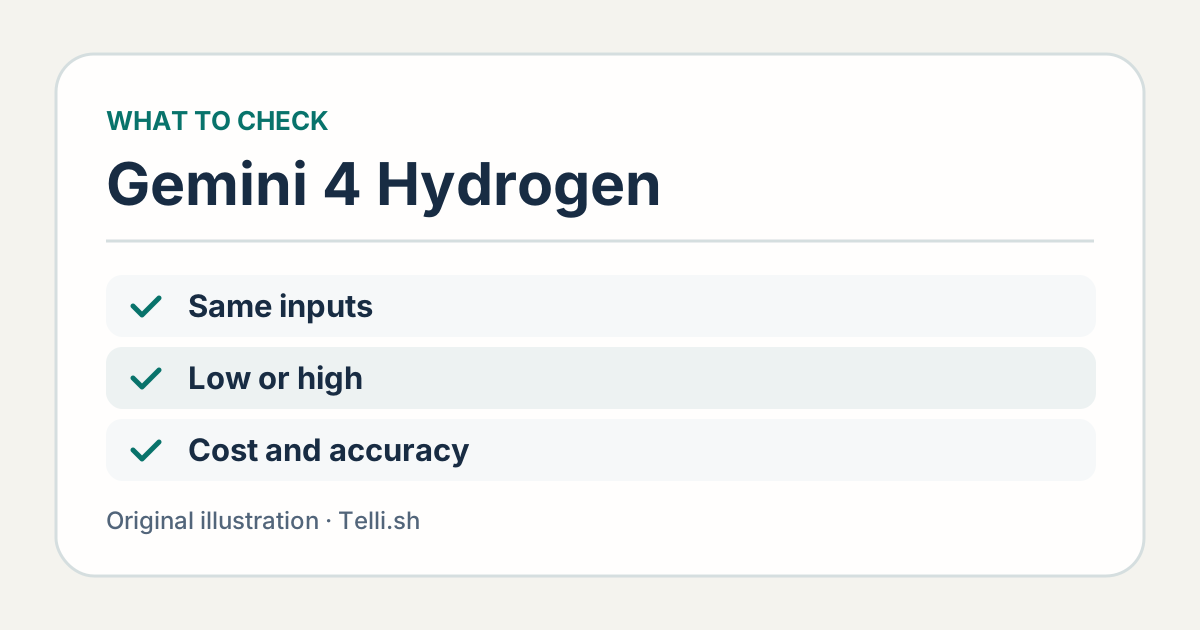
Compare two settings on the same inputs and count the review work after generation. Original illustration by Telli.sh.
A fast draft only wins if someone can approve it sooner
Google's launch reports 53.4% on the Multimodal Knowledge Agent benchmark and 71.6% on Agents' Last Exam v1.1 for Hydrogen. Those are Google-reported results on named evaluations. They provide a reason to include document synthesis in a pilot. A team with a recurring dispute over spreadsheet versions still needs its own cases, and its evaluation should account for what happens when the answer looks convincing but the spreadsheet says something else. Google launch benchmarks and demos
Consider a hypothetical pair of runs. The first draft arrives in 20 seconds and takes four minutes to verify because two references are vague. The second arrives in 45 seconds and takes one minute to verify because every figure has a specific source. The faster generator lost the time comparison that the reviewer cares about. Conversely, a deeper setting that spends more time explaining an unambiguous file can make a routine brief slower without improving it.
Make a simple worksheet for the comparison. Track whether the answer needed a second generation and why. For an especially important error, note whether the model ignored an input, misunderstood a date format, cited a real passage that did not prove its claim, or inferred an approval that never happened. These categories point to different fixes. Missing information may call for better file preparation, whereas misreading contradictions may justify a different model setting or a targeted human check.
Separate speed measurements for cold and repeated requests if your workload repeatedly refers to the same background material. Google Cloud describes implicit caching for Hydrogen. Account for cache behavior and actual billing when you compare settings, since the second run can differ from the first for reasons that have little to do with reasoning. If you want a credible estimate for a weekly report, mimic the pattern of files and repeated context you expect in production. Google Cloud model documentation
A small pilot can guide the next report
- Select three previous report packets whose decisions and sources you already know. Include a routine packet, one with a revision in a separate file and one with a genuine conflict. Use public, synthetic or approved materials on the service you choose.
- Open Hydrogen on the API or workspace surface relevant to your deployment. When comparing reasoning levels through an API, verify the active setting and keep the rest of the request stable. Start with
LOWandHIGHon the documented Cloud API surface. - Ask for a one-page brief with decision, owner, timing and exact source for each item. Instruct the model to keep a proposal separate from an approval and flag a source conflict explicitly. Require page references, sheet cells or timestamp ranges where possible.
- Score each draft before knowing which setting produced it. Count evidence errors separately from wording edits. Track full-response latency, total reviewer time, retries and observed cost using the service's usage information.
- Route work by what the comparison shows. If easy packets pass consistently, start there. Where discrepancies are common, use the stronger setting or a human check for the disputed claim. Add new examples when the workflow changes.
This comparison works for other jobs with the same shape. A customer success team can pair a recorded handoff with a statement of work and extract what was promised. A researcher can combine a recorded briefing with a published results table and check whether the spoken interpretation matches the numbers. In either case, build the answer around the source locations people will actually use to verify it.
When the workflow sends the finished brief to others, take a last look at how it handles uncertainty. An early draft that says “the owner is unconfirmed” can be more useful than a confident guess. Keep the missing fact visible when you generate the final version, and record which item needed a human decision before it went out. That makes the next review easier even if the model is the same.
Hydrogen's reasoning options give you more control over the time spent generating a report. The better setting earns its place when it reduces the work between opening the source files and approving a trustworthy account of what happened.
Sources
- Google's Gemini 4 Hydrogen announcement, November 12, 2026, including benchmarks and official demos
- Google Cloud model specifications and supported interfaces
To keep source documents, meeting records and follow-up notes together, create a Telli.sh account.