Gemini 4 Carbon's harder promise: useful work after the first day
Google's new frontier model emphasizes long-running engineering and cyberdefense. Understand its staged access, benchmark claims and the practical boundaries of a multi-day agent task.
A difficult software bug rarely arrives as a neat coding exercise. It appears as a report, an intermittent failure or a symptom several layers away from its cause. The useful work may involve reading history, testing competing explanations and discarding a patch that seemed promising an hour earlier.
Google announced Gemini 4 Carbon on October 28, 2026, emphasizing long-horizon engineering and cybersecurity defense. Google DeepMind says its internal teams have seen the model persist for days on complex work, including subtle bugs in large codebases. That is an internal observation, rather than a promise that every customer task will run successfully for days. Google's announcement also makes the access boundary clear: initial availability is for selected cyberdefenders, with additional trusted partners through Fairwind and broader availability planned.
The practical question is what a longer-running model should leave behind. This guide explains the new model's position, how to read the published comparisons, and how an engineering team can prepare a task that remains reviewable after many hours of work.
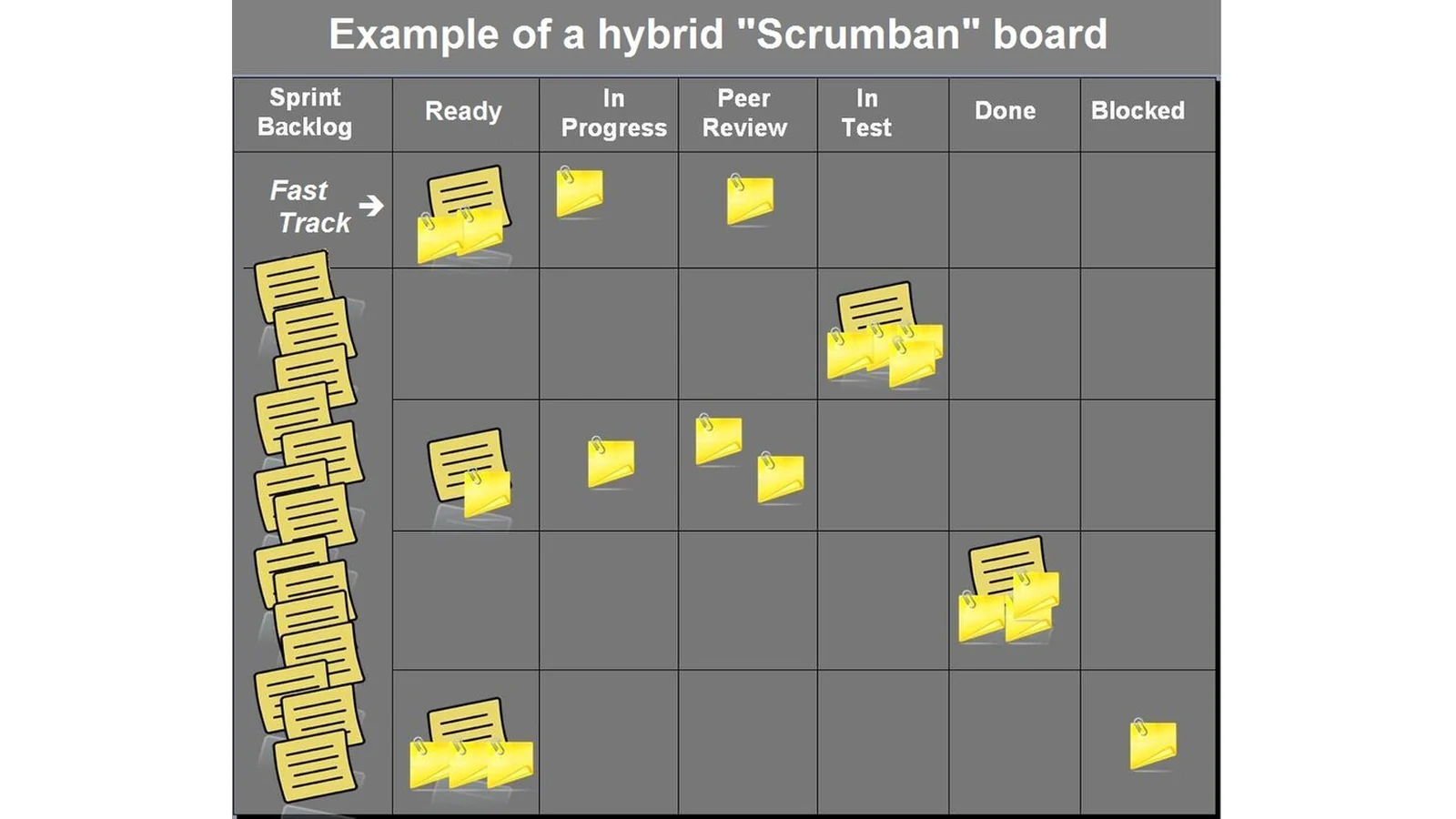 A Scrumban task-board example from 2013, illustrating visible work states in a continuing project. This is not a Gemini interface or model result. Image: Dr ian mitchell, CC BY-SA 3.0; resized with margins. Image source · License and image notes. Official product reference.

Duration is useful only when the task retains its meaning
A coding agent can remain busy without making the problem clearer. It can search more files, try more patches and run more commands while drifting away from the original failure. Longer execution increases the opportunity for progress and the opportunity to accumulate mistaken assumptions. The product challenge is preserving the task's purpose through that activity.
Our take is that a long-running task needs a durable contract. The contract states the problem, the evidence that would establish a repair, the permitted scope and the actions that still require a person. It should survive changes in hypotheses and implementation. Otherwise, a model can reach a convincing ending by solving an easier problem than the one the user assigned.
Consider an illustrative synchronization bug. A report says that an item appears to save but disappears after refresh. A useful agent task is to reproduce the behavior, identify the ownership or persistence failure, propose a scoped repair and verify the same user-visible path. A less useful result is a large refactor accompanied by a passing test that never exercised refresh.
The distinction becomes more important over time. After several hours, reviewers need a record of the strongest evidence and the remaining uncertainties, rather than a transcript of every command. That record should tell a teammate where to continue if the run stops and what would justify accepting the result.
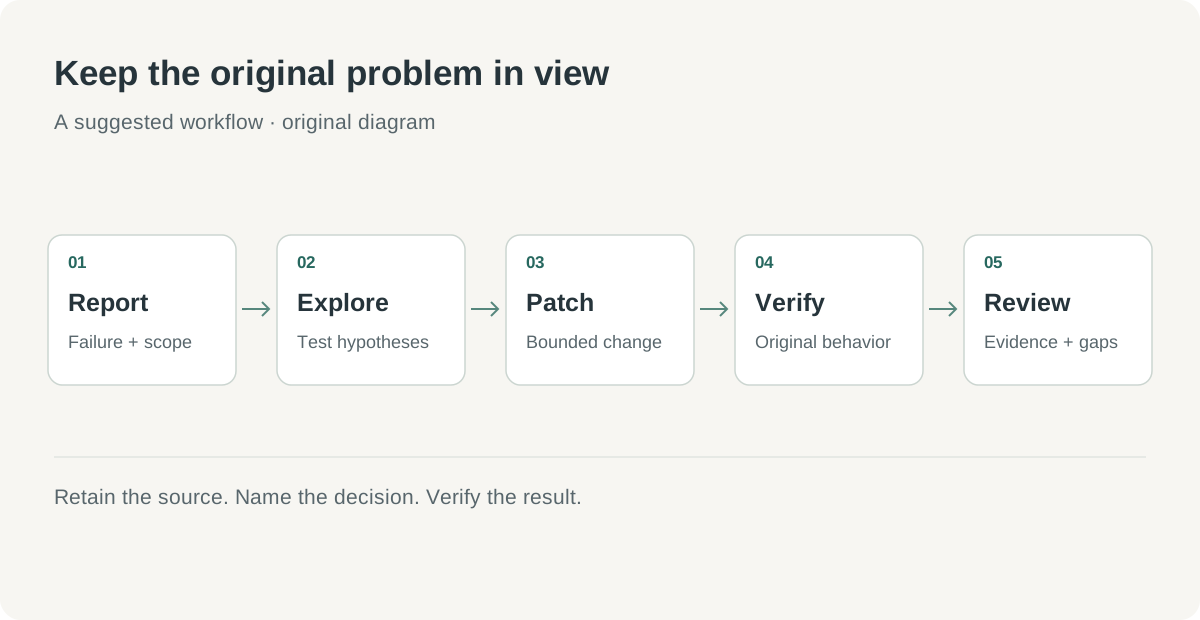 Original task diagram: sustained work should produce a traceable repair, with the original acceptance criterion preserved across exploration.
Carbon's comparisons describe several different kinds of work
Google DeepMind's model comparison page, checked November 2, lists Carbon and Argon on multiple evaluations. For example, it reports 65.2% versus 57.1% on Terminal-Bench 4.0, and 61.2% versus 55.0% on FrontierSWE 2. These are published comparison results with distinct benchmark names and conditions; they should not be added into a single product success rate.
A coding team should begin with the task that resembles its own workflow. Terminal interaction, repository repair and browser-based work put different demands on an agent. A model that performs well in one evaluation can still need a different tool setup or more human context in a production repository. The benchmark helps choose an experiment; the repository's own behavior determines whether the experiment succeeds.
| Evaluation question | Evidence to look for in a team pilot | What a benchmark score alone leaves open |
|---|---|---|
| Can the agent find a cause? | A reproduction and a supported causal explanation | Whether the team's failure is represented in the benchmark |
| Can it repair the behavior? | A focused change and a regression check | Whether hidden integration contracts remain intact |
| Can it use tools responsibly? | Clear permissions and inspectable actions | Whether the production tool configuration matches the evaluation |
| Can another engineer review it? | A concise diff, results and unresolved gaps | How much review effort the team's standards require |
| Can the work stop and resume? | Retained state and an actionable handoff | Whether the surrounding agent system persists the needed artifacts |
This table is an evaluation framework, not a restatement of Google's test methodology. It turns a broad capability claim into a set of questions a team can answer. A strong local result should include failures and blocked steps so the team understands where the model helps and where the surrounding workflow still needs work.
Comparison also needs a stable baseline. Keep the repository revision, tool permissions, task statement and test environment the same when comparing model configurations. If one run receives a reproduction and another has to discover it from scratch, the difference in completion time does not isolate the model. Record the conditions before interpreting the outcome.
Cyberdefense needs a chain from finding to verified repair
Google's October 28 announcement reports Carbon scores of 88.2% on SEC-bench Pro, 54.8% on ExploitGym and 71.0% on CWE-bench, and notes that these external-benchmark evaluations were performed without guardrails. The figures address different tasks across finding, validating and patching vulnerabilities. Google's announcement is the source of those vendor-published results.
For a defender, the useful sequence starts with an authorized target and a finding that can be inspected. Validation should establish the relevant risk within the agreed environment. A repair then needs to address the cause and preserve legitimate behavior. Those stages have different evidence requirements, even if one agent helps with all of them.
An illustrative internal library review shows the distinction. The team gives an agent an isolated copy of a library and a defined concern about input handling. The desired result is a specific finding, a bounded reproduction in the test environment and a patch with regression coverage. The agent should not expand that assignment into unrelated systems merely because it discovers links or credentials in project material.
A second illustrative scenario is triage of an existing report. The agent can help connect the report to code paths and determine which tests would distinguish a real issue from an incorrect assumption. A useful “no repair needed” conclusion still requires evidence. Closing a report through a confident explanation is weaker than showing why its claimed path does not apply to the evaluated revision.
The final owner remains the engineering or security team responsible for the system. A proposed patch needs review against the actual service boundary, deployment process and compatibility requirements. Successful isolated tests are one part of that decision, while production rollout and monitoring remain separate steps.
A model's safety result does not define its deployment permissions
Google describes improvements in alignment, resistance to prompt injection and reduced unsupported claims. Those are relevant areas for a model intended to keep working through ambiguity. The operational implication is to evaluate them in the intended workflow, rather than treating a headline safety result as permission to connect every available tool.
Long-running work benefits from staged authority. Reading a repository, modifying an isolated checkout and deploying a service are different actions. A team can let an agent gather evidence and prepare a reviewable change while retaining a distinct approval for publication or production effects. The boundary should be enforced by the environment as well as described in the task.
Untrusted material creates another practical concern. A source file, issue description or fetched page can contain instructions that conflict with the assigned work. A well-designed agent system should keep task authority separate from the contents it reads. Review evidence should make unexpected scope changes visible, especially when a run has lasted long enough that nobody is watching each action.
The same applies to credentials. Give the task only the access it needs and prefer an environment where an accidental action has a bounded effect. A useful pilot can establish whether the model asks for missing context and leaves an honest blocked state. That behavior matters as much as the number of files it can change before stopping.
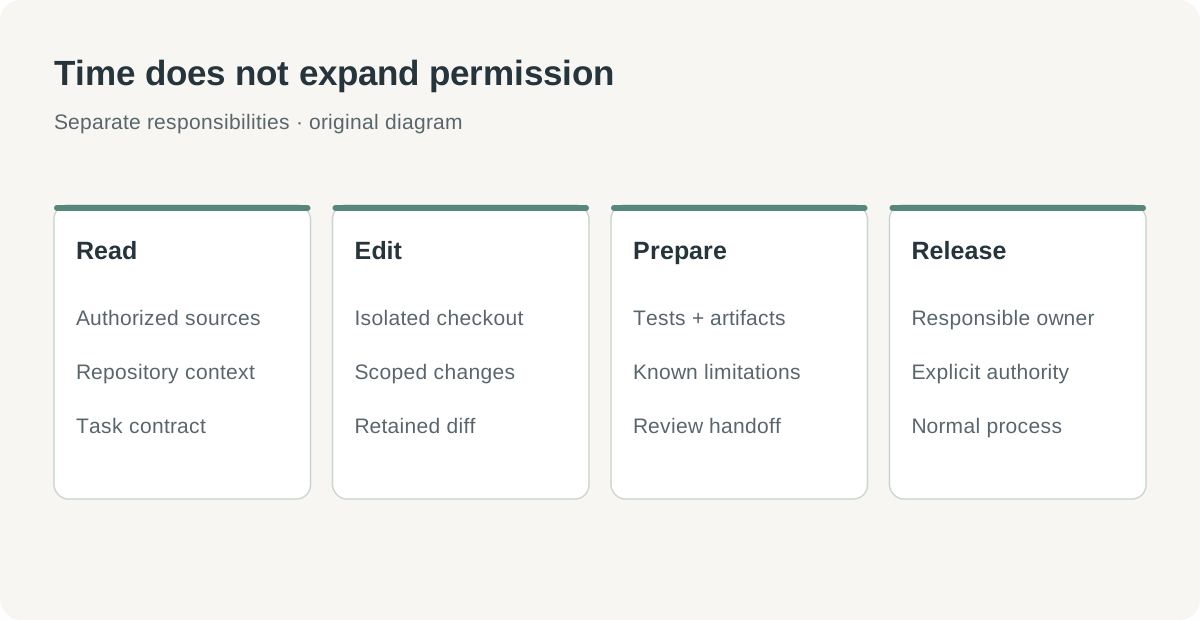 Original authority diagram: longer execution does not automatically expand permission. Each stage has a different owner and a distinct completion condition.
Staged access gives most teams a preparation task first
The public launch describes selected cyberdefender access, then additional trusted Fairwind partners, with general developer, business and consumer surfaces still to come. A model announcement and broad product availability are separate events. The current access route should be checked through Google's official channels before planning a delivery around Carbon. October 28 announcement, checked November 2, 2026.
Teams without access can still prepare useful work. Choose a difficult but bounded task, retain the relevant repository revision and collect the evidence that currently makes it hard. Define the tests and reviewer expectations. That preparation is reusable when access arrives and makes comparisons with available tools more meaningful today.
Avoid treating preparation as a promise of unattended completion. A good task may reveal missing test infrastructure, unclear ownership or an unreliable reproduction before any new model runs. Fixing those conditions can improve the team's engineering process regardless of which model eventually performs the exploration.
A third illustrative use is a cross-layer application defect. A frontend state looks correct while the server stores a different value. The task can require an end-to-end trace through request, persistence and refreshed UI, followed by a narrow repair. The value of sustained reasoning is keeping those layers connected while investigating, rather than merely generating more code in each layer.
The cost of a long task includes review and recovery
Published token prices are only one part of a long-running job. Tool execution, repeated context, test infrastructure and engineer review can all contribute to the real cost. A task that finishes with a readable, well-supported patch may be more valuable than a cheaper run that leaves hours of uncertainty for a reviewer.
For the first pilot, define a spending and time boundary in the agent system where possible. Decide what evidence should be produced before extending the run. A stalled task should leave a useful checkpoint: the last confirmed fact, the strongest remaining hypothesis and the next test. That makes continuation a decision based on progress rather than on the hope that more time will help.
Review burden is measurable too. Track whether a teammate can understand the cause, inspect the diff and reproduce the relevant checks without replaying the entire session. If the answer is no, improve the deliverable format before expanding the agent's authority. A long task should compress uncertainty for the team, not transfer it into a longer review document.
Begin with a repair that has a clear finish line
- Confirm the available access route and the exact model offered. Keep the announced Carbon rollout distinct from access to another Gemini model.
- Select an authorized, isolated task with a stable repository revision and a reproducible failure. Avoid making the first evaluation depend on uncontrolled production state.
- Write the acceptance criterion in user-visible or system-behavior terms. Include contracts that must remain intact and name external actions that require approval.
- Provide the required tools and minimal permissions. Retain changes, logs and test artifacts where another engineer can inspect them.
- Require checkpoints that distinguish confirmed evidence, current hypotheses and blocked work. Review those checkpoints before extending scope or budget.
- Evaluate the proposed repair against the original failure and the affected regression suite. Inspect the resulting diff for unrelated changes and hidden contract migrations.
- Have a responsible reviewer decide whether the patch is ready for the normal release process. Record incomplete checks and required external verification explicitly.
The pilot should include one deliberately inconvenient condition, such as a failing unrelated test or an unavailable optional service. Observe whether the deliverable separates that limitation from the repair's actual evidence. A model that reports an honest verification gap is easier to integrate than one that turns every uncertain state into a claim of completion.
A multi-day agent should leave a shorter path to a decision
Carbon's announcement points toward a different expectation for coding AI: work that persists through dead ends and produces a repair worth reviewing. The surrounding engineering system must make that persistence useful. Clear scope, retained evidence and bounded authority give the model a task it can finish meaningfully.
Our expectation is that the strongest evaluations will focus on the quality of the handoff. Did the model preserve the original question? Did it identify what actually failed? Can an engineer verify the result and decide what happens next? Those questions connect a long run to a practical engineering outcome.
The promise of longer-running AI is a shorter path from a hard report to a justified decision. Time spent working becomes valuable when the next person can trust what remains.
Sources
- Google: Introducing Gemini 4 Carbon, October 28, 2026; checked November 2, 2026. Internal observations and benchmark results are attributed to Google.
- Google DeepMind: Gemini model comparison, checked November 2, 2026. Benchmark versions and conditions must remain attached to their scores.
Keep an engineering decision connected to its source
Telli.sh is one option for retaining authorized source material and the notes behind an engineering decision. Create a note workspace.