Exa 3.0 asks a better search question: what can the agent leave out?
Exa's search update combines cross-result highlights, a cheaper Lite tier and broader coverage. The opportunity is smaller, more useful context; the risk is losing the condition that changes the answer.

Exa mark from its official brand assets, displayed with its original colors and proportions for editorial identification. This is not a search-result screenshot or a reproduction of Exa's benchmark charts; no partnership is implied.
An agent researching a software subscription finds the answer on ten pages. Each repeats the product description, navigation and sales pitch. The actual decision depends on three details: the price, the billing period and whether the required feature belongs to a different plan. More text can make the answer harder to find.
On October 19, 2026, Exa released Exa 3.0, upgrading its search infrastructure and making Dynamic Highlights generally available. The company also introduced Lite at $4 per 1,000 requests, alongside Auto at $7 per 1,000 requests. Exa supplies web search and content APIs for applications and agents; it is infrastructure a developer connects to a product, rather than merely another chat interface. Launch announcement.
Our take: the meaningful change is the attempt to choose useful evidence across a whole result set. Smaller context can reduce cost and distraction, but the important question is which details survive. Here is how that tradeoff affects practical research, what the pricing means and how to evaluate an integration without mistaking a vendor benchmark for your own workload.
The search result has become part of the model's working space
A conventional search engine helps a person select a page. An agent often consumes the returned material directly, then decides whether to answer, search again or call another tool. Retrieval quality therefore affects more than the list of links. It shapes what the next model invocation can know.
This creates a context tax: each irrelevant paragraph occupies space that could hold something useful. Repetition compounds the problem. Five pages quoting the same press release can crowd out one technical document that contains an important limitation. A large context window gives the application more capacity, but it does not decide which source deserves attention.
Exa's product direction addresses that selection problem before the answering model receives the material. Its search endpoint can return URLs and relevant passages together. Its separate Contents API can retrieve information from already known URLs. Developers choose the role the service plays: finding candidates, extracting evidence or supplying material for a larger research process. Search API reference.
That distinction is useful for readers unfamiliar with the company. An application built with Exa still needs its own instructions, presentation and decision rules. The API can provide evidence; it does not define what counts as an acceptable answer for a legal comparison, a shopping assistant or a software migration. Those remain product design choices.
Dynamic Highlights changes the allocation across pages
Ordinary excerpts can be selected one page at a time. That approach may give every result a similar allowance even when several pages repeat the same fact. Dynamic Highlights considers the retrieved documents together, allowing the selection to favor stronger material and spend less space on repetition. Exa introduced the feature as a research preview on August 28 and moved it to general availability with the October release. Dynamic Highlights explanation.
The difference is easiest to understand with an illustrative comparison. Suppose six pages describe a product launch, two supply the same specification table and one explains a restriction. Giving every page a fixed excerpt can produce a long, repetitive bundle. Allocating the shared budget across results gives the system a chance to retain the specification once and make room for the restriction.
That is the desirable behavior, not a guarantee about any particular query. Retrieval has to recognize that the restriction matters. If the question asks only for the headline price, a condition about enterprise deployment may look peripheral even when the eventual buyer considers it decisive. Better query design and a follow-up check remain part of the workflow.
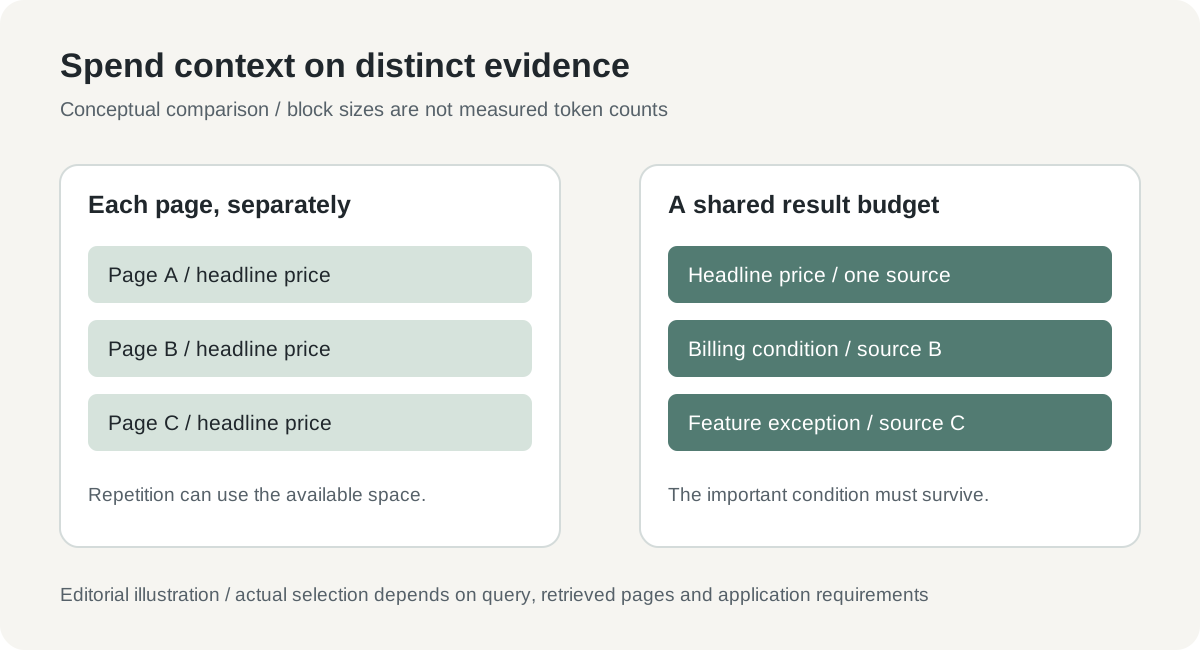
Original editorial infographic. The blocks explain the allocation principle; they are illustrative and do not reproduce measured Exa token counts.
Exa says Dynamic Highlights uses 95% fewer tokens than full-page text in its evaluation. The comparison baseline matters: full pages include much more material than already selected excerpts. The August report separately describes a 30% reduction in total agent token usage in its agentic evaluations. These figures concern different quantities and should not be treated as interchangeable savings on an application's total bill.
The evaluation lesson is straightforward. Count the material returned by search, but also count the model's subsequent work. A smaller search response is a weak bargain if missing evidence causes several extra searches or produces an incorrect answer. Useful compression preserves the facts that let the agent stop for the right reason.
Lite and Auto offer a choice worth testing on actual questions
Lite and Auto use the same index, according to Exa's release. Auto spends more computation on retrieval stages. That gives a developer a practical choice between a lower base request price and a mode intended to deliver higher retrieval quality. It does not establish that Lite is sufficient for every simple-looking question or that Auto is necessary for every important one.
The published rates make a small pilot easy to reason about. At the stated base prices, 10,000 Lite requests cost $40 and 10,000 Auto requests cost $70. These are arithmetic examples for search requests, not quotations for complete agent tasks. A workflow can make multiple calls and incur other charges.
| Question for the application | Lite | Auto |
|---|---|---|
| Announced base price | $4 per 1,000 requests | $7 per 1,000 requests |
| Index relationship | Same index as Auto | Same index as Lite |
| Retrieval computation | Lower-cost option | More computation across retrieval stages |
| Sensible evaluation | Common lookups and repeated bounded tasks | Questions where missing a relevant result is costly |
Exa's pricing documentation says the base search rate includes up to 10 results. Additional results and generated page summaries have separate charges. Known-URL retrieval through Contents is also its own product. An application using search, full-page follow-ups and a language model should measure the combined cost per accepted answer. Current pricing reference.
The right routing policy can be modest. Start a bounded lookup with the cheaper mode, then escalate when the evidence does not answer the question. Keep difficult, representative questions in the evaluation set rather than measuring only the calls that look successful. A low average cost is useful only when it includes the queries users actually care about.
Three ordinary research jobs show why the missing detail matters
Consider a competitor pricing brief. The application needs to compare three services by billing interval, included seats and availability of one required feature. Short excerpts can remove repeated marketing language and make the comparison easier to assemble. They should still retain the difference between a monthly commitment and a price displayed as a monthly equivalent on an annual plan.
The output should attach each comparable fact to its source URL and observation date. A row without a confirmed price can remain unknown. Filling a gap with an inferred number makes the table look more complete while making the purchasing decision worse. The useful optimization is less reading with the same decision quality, rather than a denser table at any cost.
A developer documentation assistant tests another failure mode. A migration question may be answered by a current API reference, an older tutorial and a changelog. The old tutorial can have excellent keyword overlap while recommending a deprecated parameter. The assistant needs version and date context, plus a way to open the authoritative reference when an excerpt is ambiguous.
A local product or service lookup adds freshness. Exa's release describes broader coverage of shopping, local businesses and time-sensitive information. A result can help discover a candidate, but the application should verify the selected merchant's present price, availability or opening hours before presenting an actionable recommendation. The closer the answer gets to a transaction, the less acceptable an unexamined timestamp becomes.
These are illustrative integration scenarios, not results from our own API benchmark. They show why the same retrieval feature can have different value across products. A weekly background brief can tolerate a different freshness policy from a shopping assistant answering a question about something the user wants to buy now.
Begin with a small request and retain the evidence fields
The official search API accepts a query, a search type and requested content. Developers can create a key in Exa's dashboard and keep it on the server. The following HTTP shape requests highlights using the current API reference; it is a starting example to adapt, rather than a request executed for this article. Exa explains the cross-result selection mechanism in its Dynamic Highlights announcement.
{
  "query": "official pricing and annual billing terms for a project management service",
  "type": "auto",
  "numResults": 5,
  "contents": {
    "highlights": true
  }
}
Send the request to https://api.exa.ai/search with server-side authentication using the x-api-key header. Keep credentials out of browser code, published notebooks and screenshots. Preserve the returned titles, URLs and selected passages rather than concatenating everything into an anonymous block; later review depends on knowing where the evidence came from. API authentication and response fields.
- Choose one job and define an acceptable answer. For a pricing brief, write down the required fields and what should happen when a value is missing.
- Build a small representative question set. Include a normal lookup, a changed price, a deprecated API example and a question with no clear answer.
- Run Lite and Auto against the same questions. Keep the answering model and output requirements consistent so the comparison remains interpretable.
- Inspect the original pages for consequential claims. Check conditions, dates and contradictions rather than grading only fluency.
- Measure total work. Record search calls, returned context, follow-up retrieval, answering tokens, latency and accepted answers.
- Set an escalation rule. Reopen a source or request more context when the answer lacks the required evidence. Allow the application to say that a fact remains unconfirmed.
The evaluation need not become an elaborate benchmark project. A few carefully selected failures can expose more than hundreds of easy questions. The aim is to find the point where the application needs to stop compressing and inspect the material in more detail.
A short passage and a generated summary have different jobs
Exa's Contents documentation distinguishes copied highlights, full text and generated summaries. That is a useful product boundary. A passage can show the words a source uses. A generated summary is another model's interpretation of those words. Neither should lose its identity when passed to the answering model. Contents API guide.
Full-page retrieval still has a place. An exception may appear below a pricing table, or the meaning of one sentence may depend on a preceding definition. Opening the source when a decision depends on broad context is sensible even when compact highlights perform well for discovery. The two stages can complement each other: reduce the candidate set first, then inspect the consequential evidence.
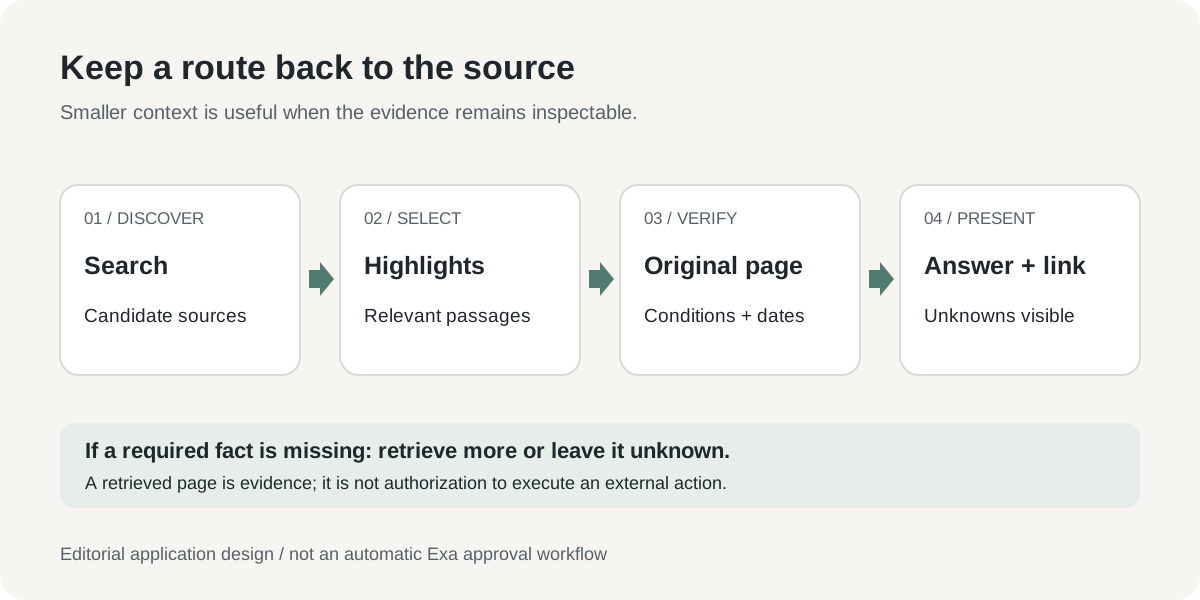
Original editorial infographic. The review gate is an application design recommendation, not a claim that Exa automatically approves decisions.
A related security concern is untrusted source content. A retrieved webpage is evidence about the world, not permission to change an agent's instructions or expose credentials. Applications that combine search with email, purchasing or file tools should preserve that boundary. The source can describe a checkout process without becoming authorized to execute it on the user's behalf.
Developers should also review what their queries disclose. A search about a confidential customer, internal project name or unreleased product sends information outside the application. Appropriate data-handling and retention terms depend on the workload. Smaller returned context does not reduce the sensitivity of the query that was sent.
Better search should make the answer easier to challenge
The strongest expectation for Exa 3.0 is a shorter path from a question to useful evidence. Broader retrieval, shared highlight allocation and two price points give developers concrete options to evaluate. The release makes an interesting commercial argument: selecting less material can be part of improving search quality, rather than simply a cost-cutting measure.
The concern is invisible omission. A concise answer can feel more authoritative precisely because the awkward conditions disappeared upstream. Applications should let readers inspect the supporting source and should reopen it when the decision depends on a detail the excerpt does not contain.
The important outcome is an answer that remains defensible after somebody clicks the link. Search has done its job when the reader can understand the conclusion, locate the supporting passage and recognize what remains uncertain. A smaller context budget earns its place by preserving that ability.
Sources
- Introducing Exa 3.0, October 19, 2026.
- Dynamic Highlights mechanism and vendor evaluations, August 28, 2026; preview status superseded by the October launch.
- Search API reference, checked October 23, 2026.
- Contents API guide, checked October 23, 2026.
- Pricing and charge definitions, checked October 23, 2026.
- Official Exa brand assets and display guidance, checked October 23, 2026.
Keep the answer and the evidence together
For readers who want a separate workspace for source links and their own reviewed research, Telli.sh is one option. Open your notes workspace.