When should an AI phone agent stop talking?
ElevenLabs previewed an engine for taking turns, handling interruptions and routing between models. A changed booking shows how to test the whole conversation.
An automated phone agent starts confirming an appointment for Thursday morning. The caller cuts in. “Sorry, I meant next Thursday.” An agent that speaks fluently can still make this exchange harder if it keeps reading the old confirmation or changes the date before hearing the rest of the request. The question is whether it can yield the floor and return with the right state.
On November 11, 2026, ElevenLabs previewed Interaction Engine at its New York summit. The company says the system handles turn-taking and interruptions and can choose different language models for different parts of an exchange. It described a lower-cost model doing triage and a more capable one stepping in for more complex tasks. The summit announcement described a preview without a general availability date. ElevenLabs summit announcement
That makes a changed reservation a useful example for evaluating the idea. The caller needs to be heard, the new intention needs to replace the old one, and the eventual confirmation has to agree with the booking system. Listening for gaps and overlap is only the first step.
A good pause means the caller can finish
There are at least three reasons someone might speak while an agent is talking. They can correct an important detail, say “okay” to show they are following, or speak to a person nearby. An interruption detector needs to tell those cases apart often enough to feel useful. Stopping on any sound feels responsive once and brittle over a full call. Continuing through a correction can turn a five-second exchange into a repeated explanation.
Listen to two versions of the appointment example. In the first, the caller says “right” as the agent reads the new time. The agent can continue. In the second, the caller says “wait, I meant next Thursday, after lunch.” The old sentence needs to stop and the assistant needs to hold the floor open long enough to hear both the change of week and the new time preference. The success criterion is whether the next response reflects both details.
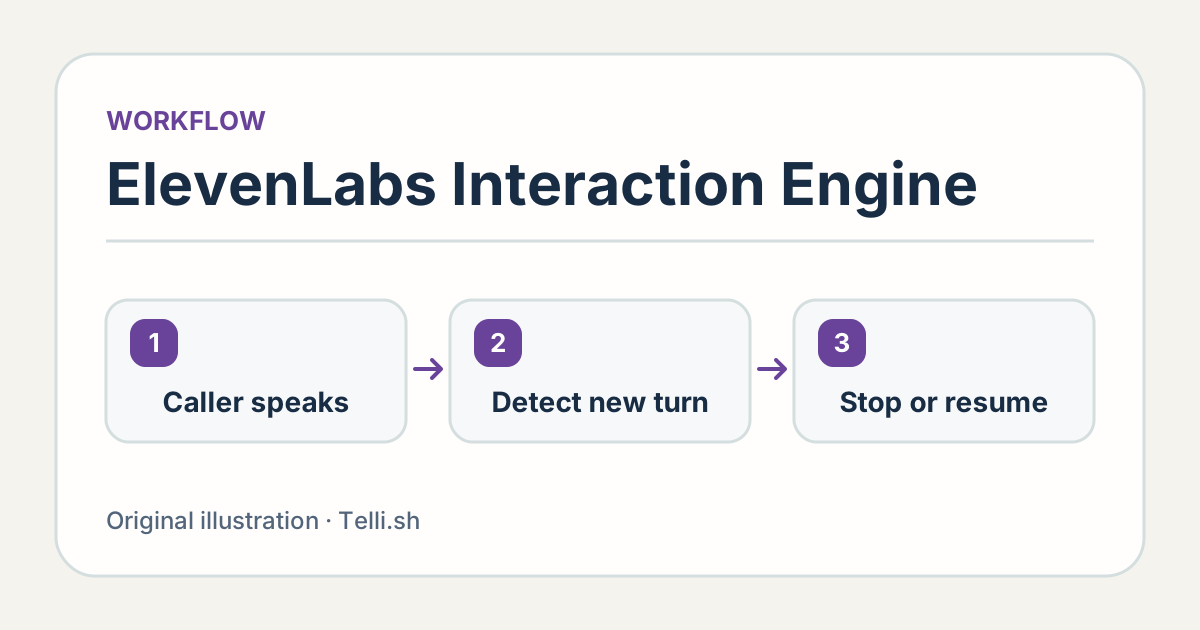
Yielding the floor gives a correction time to become a complete instruction. Original illustration by Telli.sh.
Telephone audio makes the boundary harder to judge. A caller may pause before giving a date, use a filler word, or repeat a phrase while a connection drops. Test the interaction on the channels people actually use and record the audio conditions. A clean demonstration can establish that the design is possible. A set of ordinary noisy calls can show whether your version tolerates the interruptions your callers make.
Measure from audio to audio. For a true correction, record the time from the caller's first meaningful sound to the end of audible agent speech. Include whatever audio was already buffered by the channel. Also measure from the end of the caller's turn to the first useful word of the reply. A quick “one moment” might make a long lookup feel predictable, but count it separately if the next useful answer arrives several seconds later.
The spoken exchange and the booking can get out of step
Suppose the agent had only found a slot for this Thursday when the caller interrupted. It can discard the old proposal, search next Thursday, and offer an available time. Now consider a different system that sends the update as soon as a caller says “Thursday is fine,” before reading the complete date back. By the time the caller corrects the mistake, the previous change may have reached the booking service. Muting the response cannot undo that change.
Make those cases explicit in a test. A reservation in the proposed state needs a fresh readback. A reservation with an update still in progress needs a confirmed backend outcome. If the update succeeded, the agent has to describe the current state and follow the approved correction path. If it failed or timed out, the agent should check the current state before claiming success or attempting another update. The exact repair depends on the booking system's existing rules.
| Caller event | Expected audible behavior | Expected booking outcome |
|---|---|---|
| “Right” during a readback | Continue unless the caller takes the floor | No extra write |
| “Wait, next Thursday” before approval | Stop the old readback and gather the full correction | No update until the new date is confirmed |
| A correction during a pending update | Acknowledge and check the outcome | Report the verified state before any next action |
| A request for a person | Confirm and start the existing handoff flow | Transfer the current status and unresolved request |
To test this, use a sandbox with synthetic appointments. Record both the call timeline and the booking timeline. The timestamps need a shared reference or a clear offset. Then look for moments where speech suggests a successful change that the system did not record, or where a write succeeded after the caller withdrew the instruction. Those are different defects from a slow greeting.
Model choice should follow the work within the turn
ElevenLabs frames its preview as a way to decide which model to use throughout a conversation. An appointment call makes the idea concrete. Recognizing that a person wants to reschedule, looking up a record through an approved tool, interpreting an unusual policy, and deciding whether a transfer is necessary can require different amounts of reasoning. The common date lookup may be easy. A change involving multiple services and conflicting policies may need more attention or a human specialist.
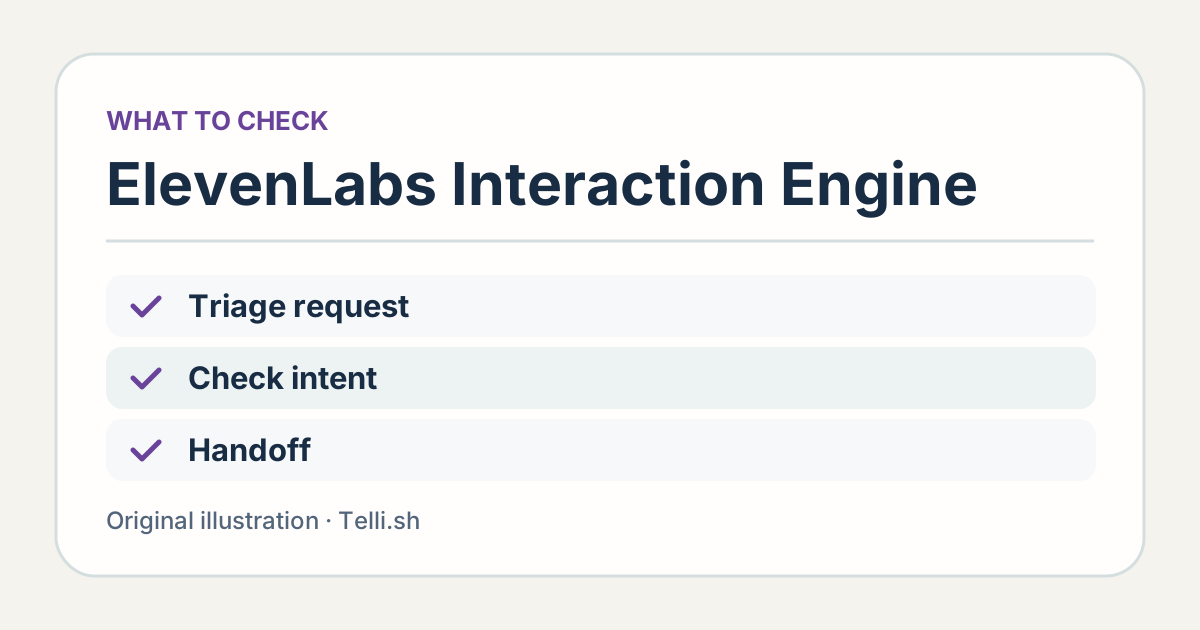
Route the work by its consequence and preserve the conversation state through each handoff. Original illustration by Telli.sh.
The boundaries matter more than a list of model names. When a routine request becomes complex, carry forward verified details such as the booking identifier, the current state, and any remaining uncertainty. For a transfer, provide a short handoff that says what the caller wants and which steps already completed. A helpful escalation saves the caller from repeating information while giving the next person enough room to verify it.
Measure how frequently the router sends cases to the wrong path. For instance, if a caller says “move both appointments,” the request may require a different workflow from changing one date. Check whether the agent notices both bookings before asking for approval. If a complex case starts in triage and promptly escalates with enough context, the recovery may be acceptable. If it leaves the old and new appointments inconsistent, the cheaper routing decision has a real downstream cost.
The preview presents lower token use as a potential benefit of choosing a cheaper model for triage. Actual cost for a contact center will also depend on repeat calls, escalations and abandoned sessions. Compare cost per correctly resolved task, including any human follow-up that the system creates. A call that ends in 40 seconds but forces another call the next day has shifted the cost to a different place.
Design a small test you can repeat
Start with a case that has a known result, such as changing a synthetic Thursday appointment to the following week. Record the expected spoken response and booking-system state. Then add versions with an interruption before confirmation, a mid-sentence correction and a short backchannel. Include an intentional silence. A caller who stops to look at a calendar should be able to resume without being rushed into an unrelated answer.
- Mark when the caller begins and ends each correction, and when agent audio actually stops.
- Check whether the reply preserves every corrected detail. Mark whether the user had to repeat one.
- Compare the conversation to backend state. Look for duplicate writes, wrong dates and unsupported claims about completion.
- Run the same script in quiet and noisier conditions, with a few different speakers and connection conditions.
- Compare completion, time to verified result and routing errors across implementations.
Keep the evaluation broad enough to catch the failures that matter and small enough for a reviewer to listen to individual calls. If two systems differ by a fraction of a second on a clean turn, inspect the more consequential cases before choosing one. A reliable confirmation and a clear transfer can outweigh a small timing gain. If the timing difference changes how often a caller interrupts twice, the same number starts to matter.
Measure the late turns as well as the average
Imagine ten synthetic calls. In nine, the agent hears a correction quickly. In the tenth, the caller talks over a long sentence and repeats the correction before the system yields. The average delay can look reasonable, yet the last call is the one most likely to break the user's confidence. Keep the individual examples and report the slower end of the timing distribution when you have enough calls to support it. On a small pilot, show the actual range and listen to the slowest cases.
A pause can produce a false sense of improvement if the agent stops for sounds unrelated to the turn. Play the same background speech during a short confirmation and a longer explanation. Check the rate of false stops and whether the agent resumes at an intelligible boundary. Then run a matching call with a real correction at the same moment. The pair helps distinguish a responsive detector from an overly sensitive one. Include common forms of disagreement from the callers you serve, since a rehearsed “wait” is only one way to object.
Decide what each outcome costs the user. A mistaken stop on a casual “mm-hmm” may add a short pause. A missed correction can leave a person unsure which date was booked. A routing error can put the caller into a repeat loop. A table that lists both frequency and recovery effort helps a team choose which defects to address first. The trial should include whether the next agent or human operator can explain the current reservation without asking the caller to start again.
Voice timing can also vary with the channel. A browser call in a quiet room and a compressed mobile phone call give different evidence about turn-taking. Keep track of where each recording was captured, whether a speakerphone was involved, and whether the timestamps describe sound at the caller's end or an event inside the service. Use the same method when you compare the old and new stacks. The purpose of the comparison is to explain when a caller will notice a difference.
Before a broad rollout, invite a small set of reviewers to score calls without knowing which system handled each one. Give them the expected booking outcome and ask whether the caller was understood, whether the correction was repeated, and whether the final spoken result was accurate. Combine those checks with the booking audit. That can reveal a gap between natural-sounding speech and a correctly completed task.
ElevenLabs already offers its ElevenAgents platform for configuring and operating voice and chat agents. Its summit article presents Interaction Engine as a separate preview and describes other announced capabilities on their own timelines. The proposed test works with your current voice stack and can be repeated when a preview feature is accessible to you. That lets the comparison start from the same call scripts and expected outcomes. ElevenLabs summit and platform announcement
A correction is a better demo than a flawless script
If a customer can change their mind halfway through a sentence, hear a revised confirmation and find the correct appointment afterward, the whole system has handled an ordinary conversation. That is a stronger target than a sample that makes the voice sound natural while the caller follows a perfect script.
Sources
- ElevenLabs Summit NYC announcement and Interaction Engine preview, November 11, 2026
- ElevenLabs Summit program and demonstrations
To organize notes from customer calls and review sessions in a searchable record, create a Telli.sh account.