Eleven Realtime moves the voice AI contest beyond the voice
ElevenLabs has introduced Mini and Max realtime models. The interesting change is a simpler conversation stack—and a sharper distinction between sounding natural and completing the job.
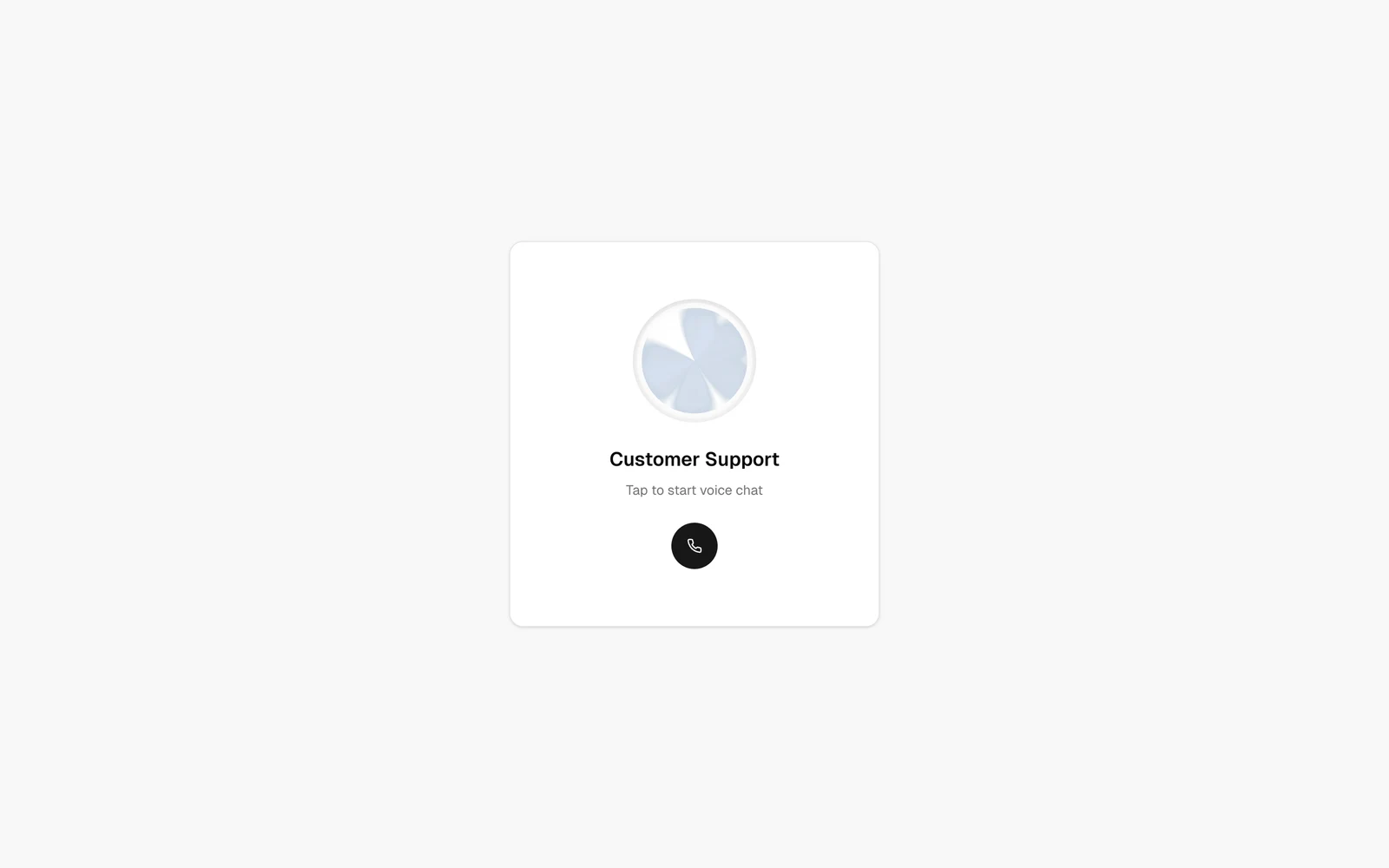
Official ElevenLabs UI voice-chat component preview for customer support. Source: elevenlabs/ui; copyright 2025 Eleven Labs Inc., MIT License. This illustrates a voice interface, not a Realtime model test.

The awkward moment in a voice conversation often arrives before the answer. You pause to remember a date, and the assistant starts talking. You correct a name, and it finishes the sentence it had already prepared. The voice can sound excellent while the exchange feels oddly uncooperative. For anyone building a phone assistant, a tutor or an interactive character, those small failures can matter as much as the quality of the generated speech.
On October 20, ElevenLabs introduced Eleven Realtime v1 Mini and v1 Max, positioning them as complete voice-agent models rather than another component for a developer to assemble. Mini targets everyday conversation at lower cost; Max targets complex instructions and multi-step work. The release matters because it packages more of the conversation as one product decision. It also makes an old question harder to avoid: when a voice sounds capable, how do we know the task was actually done? Official announcement.
Our take: the promising part is less time spent tuning the joins between components. The test of that promise is a conversation that survives corrections and produces a correct outcome. A polished demonstration can show the first impression. An ordinary, messy customer request is where the product earns its place.
ElevenLabs is extending a familiar strength into a larger job
For readers who know ElevenLabs mainly through synthetic voices, the company now describes three platforms: ElevenCreative for content creation, ElevenAgents for deployed conversational agents, and ElevenAPI for developers. Realtime sits within that wider effort to make audio useful inside an application, rather than only as a finished audio file. That background explains why the release combines voice quality with the mechanics of interaction. ElevenLabs press background.
An audio clip has a clear boundary. The text is written, speech is generated, and a listener hears the result. A live agent operates inside a moving situation. The listener can interrupt, change the question, supply missing information or discover that the original request was wrong. The software has to decide whether a pause means “your turn” or “I am still thinking.” It must keep its understanding aligned with the person while also dealing with the systems behind the conversation.
That is a different product problem from making an isolated sentence sound convincing. Consider a booking assistant. It may pronounce the customer's name perfectly and still reserve the wrong day because it missed a correction. A successful voice product needs both the social rhythm and the transactional record to make sense. Improving one while ignoring the other creates a pleasant way to do the wrong thing.
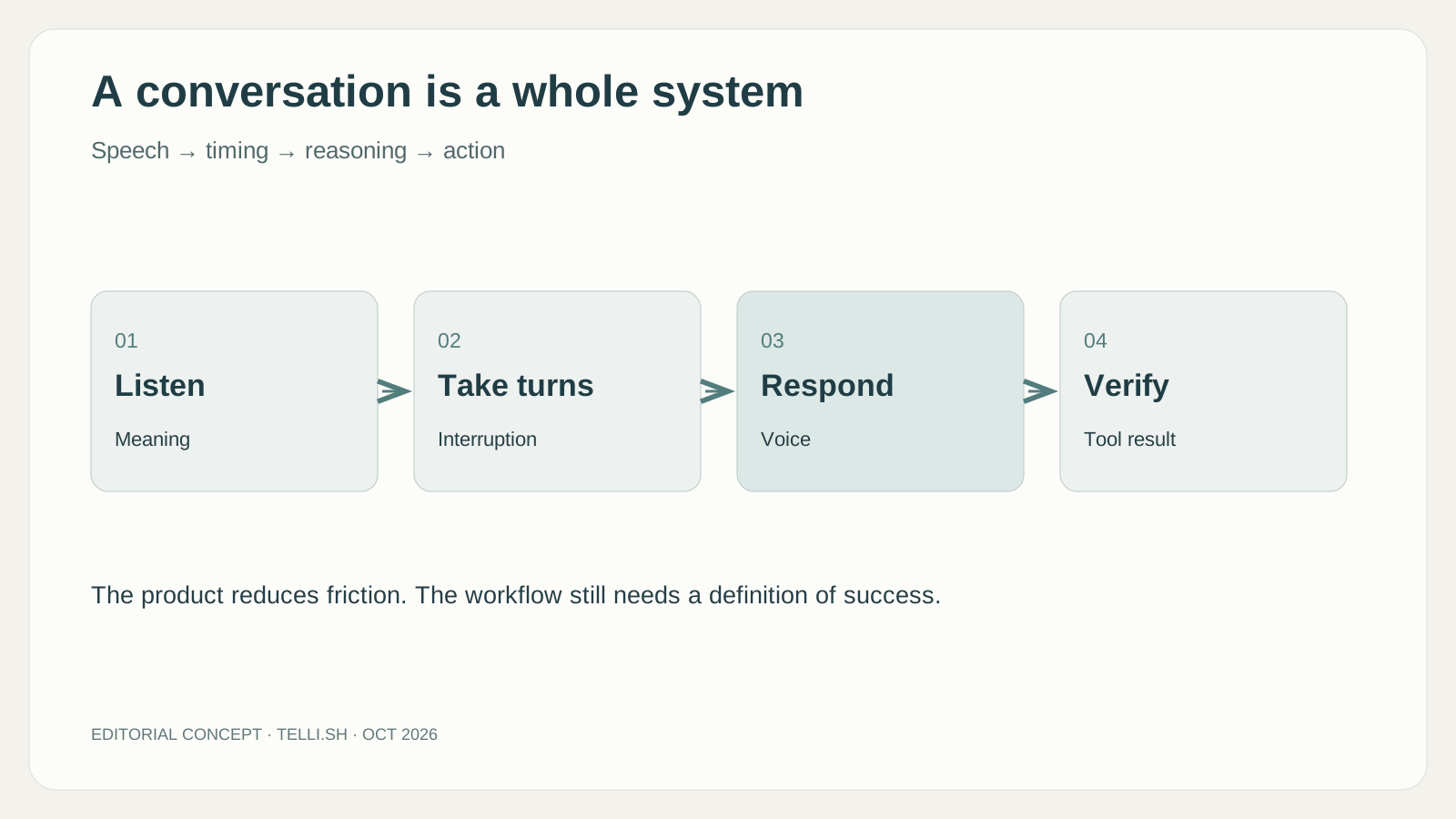
Original editorial infographic. This describes the user experience, not the model's internal architecture.
A managed stack reduces configuration, while changing what you control
The distinction in the documentation is practical. In Custom mode, a builder selects the language model, speech model and recognition settings. Realtime mode hands those choices to ElevenLabs while retaining the agent's instructions, voice, tools and other supported conversation settings. Access is rolling out gradually, so the setting may not yet appear in every workspace. Realtime also has compatibility and regional constraints that an existing agent must satisfy. Realtime model documentation.
That can be a useful exchange. A small team may care much more about whether its assistant handles an interruption than about selecting every underlying component. A managed configuration gives it a coherent starting point and fewer combinations to troubleshoot. It can spend its time on the questions customers ask, the information the business actually has, and the point at which a person should take over.
But fewer settings also mean fewer independent substitutions. If one part of the behavior is unsuitable, the team needs to know whether it can adjust that behavior, change models or return to a custom configuration. The right comparison is the total work of maintaining a usable agent. A configurable stack can be burdensome, while an integrated one can be restrictive. Which cost matters depends on the job and on who will operate the system after the demonstration.
This is especially relevant when a prototype becomes a shared service. The person who assembled the prototype may understand its quirks. The support team, customer and next developer will experience the behavior without that background. A product that makes common choices consistently can be valuable even if it offers fewer choices. Consistency becomes useful when it is visible, testable and compatible with the service's responsibilities.
Other voice stacks put control in different places
ElevenLabs' approach becomes clearer beside the alternatives. OpenAI's voice-agent guide distinguishes realtime speech interaction from a chained workflow that transcribes speech, runs a text agent and generates speech afterward. Its discussion of chained systems emphasizes inspecting intermediate text and replacing individual components. That is an architectural comparison, rather than evidence about the undisclosed internals of Eleven Realtime. The same customer interaction can be assembled around different places to observe and change what happens.
A text stage can be valuable when an organization needs a named checkpoint. A training service might review how an agent interprets a learner's answer; a specialist support desk might apply terminology handling before a response is spoken. The intermediate record gives the team something specific to inspect. It also introduces another component boundary to maintain. For a lively character or an exploratory conversation, the builder may prefer a more integrated interaction and accept a different set of controls.
| Approach | What attracts a builder | What still needs a decision |
|---|---|---|
| Managed realtime mode | Fewer component choices and one supported conversational configuration | Whether the supported settings fit the service |
| Chained speech and text | Inspectable intermediate text and independent component replacement | How the assembled stages preserve timing and corrections |
| Framework-based orchestration | Explicit application behavior around turns, tools and handoffs | Who maintains that behavior as providers change |
The deciding factor is where the team needs a reliable checkpoint: an intermediate transcript, a conversation event or the completed action. That helps explain why a team might reasonably keep a custom system even after a promising integrated release. The commercial opportunity for ElevenLabs is to make the managed option good enough for more jobs, so that detailed assembly becomes a choice rather than the admission price for building a voice service.
A hesitation and an interruption deserve different responses
The framework perspective adds another dimension. LiveKit's turn-handling documentation treats false interruptions as an explicit behavior to handle: voice activity can interrupt an agent even when it produces no user transcript, and speech can resume after a configured timeout. This does not establish that ElevenLabs uses the same mechanism. It shows why a voice product's apparent politeness depends on application behavior as well as the model that supplies its words.
Imagine the difference between someone saying “wait, the other address” and someone coughing while listening. Both can produce sound during the assistant's turn. Only one necessarily changes the request. A service that restarts its explanation after every background sound becomes tiring; one that ignores a genuine correction becomes untrustworthy. The useful comparison is whether the conversation recovers with the right context, rather than whether the audio channel detected activity quickly.
That distinction also broadens who belongs in a pilot. People searching for an unfamiliar word, using a second language or speaking with a slower rhythm may need a different amount of silence. Those are proposed evaluation groups, not claims about measured accessibility or language coverage. Teams should listen for whether users get room to finish and whether recovery requires them to repeat the entire request. An average response-time score can conceal that burden.
The encouraging possibility is that a managed conversation model can improve this experience without every customer implementing its own timing logic. The remaining question is how much a particular application can adjust when the default rhythm is wrong. That is a concrete product question for a demonstration: let a speaker hesitate, correct a detail and resume, then inspect what the agent understood and what the connected tool actually received. It connects conversational comfort with a result the team can verify.
Mini and Max separate conversation from demanding execution
The two names should encourage a workload decision, not a reflex to buy the larger model. A language-practice character and a service agent that follows a refund process face different problems. The first needs to keep a conversation moving and respond appropriately to mistakes. The second may need to retrieve a policy, identify an order, check eligibility and report the result of an external action.
A larger model could be unnecessary for a lightweight exchange, while the cheaper model could become expensive if it repeatedly hands unresolved cases to staff. Cost per minute is useful for estimating a bill. Cost per correctly completed interaction is more useful for deciding whether the system belongs in a workflow. That second number includes recovery, repeated calls and the work people do to repair plausible mistakes.
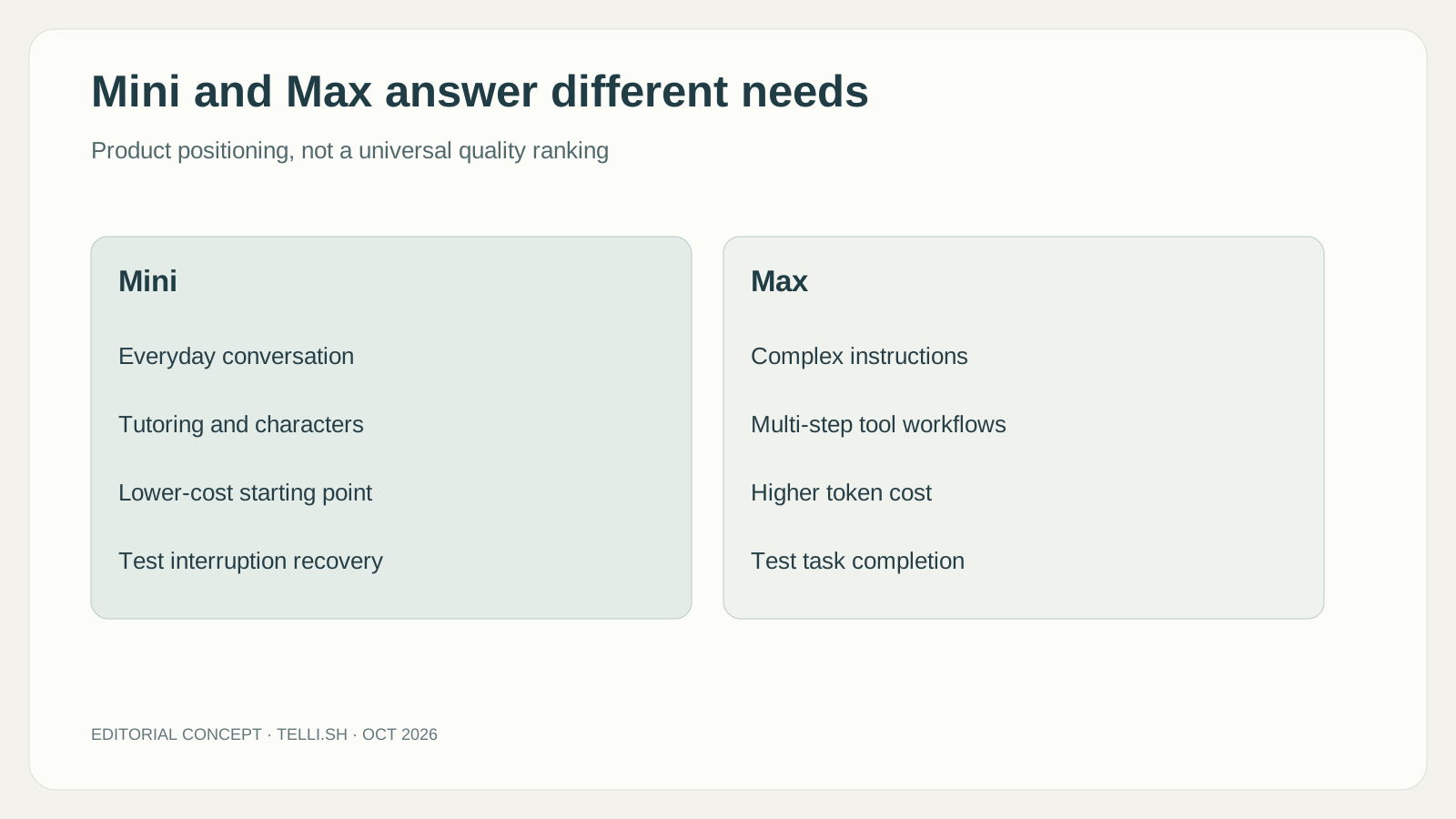
Original infographic based on vendor positioning. This is not a measured ranking across all languages or tasks.
The announcement publishes benchmark results attributed to Artificial Analysis. Its tool-use figures are 87.1% completion for Max and 60.3% for Mini, while the reported conversational-dynamics scores favor Mini slightly. These are vendor-published benchmark results, not our deployment measurements. Their useful message is that conversational fluency and tool completion can diverge; they do not establish a success rate for a particular company's calls. Announcement and benchmark context.
A team should therefore resist compressing all quality into one leaderboard position. If the agent mostly explains a museum exhibit, conversational timing may dominate. If it updates a reservation, the exact final state matters more. The release gives builders two starting points, but the task still supplies the definition of quality.
Three ordinary situations reveal different strengths
Imagine a learner practicing a restaurant conversation in another language. The learner stops halfway through an order, searches for a word and starts again. A useful tutor leaves room for that hesitation and offers help without taking over. The benefit is confidence to keep practicing. The failure is an assistant that mistakes every pause for permission to lecture. This illustrative case is mostly about conversational cooperation, with teaching quality still requiring its own review.
Now consider an appointment service. A caller first asks for Friday, then says, “Actually, next Monday, after lunch.” The assistant should carry the correction into the proposed booking and confirm the relevant details before the consequential step. Once the booking system responds, the spoken confirmation should reflect that response. A friendly “all set” before the system accepts the change would be a failure even if every spoken sentence sounds natural.
An interactive character creates a third balance. It can tolerate an imaginative answer within its fictional setting, but a player still expects the character to remember the current scene and stop when interrupted. Here the business outcome might be an engaging exchange rather than a completed transaction. The same behavior that feels lively in a character could feel evasive in customer support. These are reasons to evaluate distinct jobs, rather than treat “voice agent” as one uniform category.
Compatibility lowers the trial cost, with limits worth reading
ElevenLabs offers access through ElevenAgents and an OpenAI-compatible Realtime API. The announcement's API example changes the destination and model in an existing client, but it also specifies a WebSocket-only connection and separates that API from the managed platform. A WebRTC integration therefore involves more than swapping a model name, and managed channels or knowledge-base features should not be assumed to arrive automatically with the API. API access and migration notes.
The value of compatibility is an easier comparison. A developer can keep more of an existing application while trying a different provider. That makes it more realistic to compare the same task, prompts and tools instead of comparing unrelated demonstrations. It does not remove the need to inspect event behavior, reconnects, tool responses and how the application presents a failure.
Those less glamorous details shape the customer's experience. If the connection drops after a booking request, the application needs to know whether the booking happened before asking the caller to repeat it. If a tool times out, repeating the tool call may have different consequences from repeating the spoken question. A model migration is successful when the complete application behaves correctly through those situations, not simply when the first audio response plays.
A natural voice can make an unfinished action sound complete
Keep the comparison stable when deciding between models. If the larger model receives a cleaner knowledge base, a better prompt and more reliable tools, the trial cannot explain which change helped. Start with the same representative requests and inspect the failures before changing the surrounding workflow. A timing failure may need a conversation adjustment; an incorrect policy answer may need better source material; an incomplete booking may involve the tool integration. Buying a more capable model can help some of those problems, but it should not hide a broken connection that would remain broken with either choice.
The product's strongest advantage can also make errors harder to notice. People use tone, pace and confidence as conversational signals. A fluent assistant can sound as though it has checked something when it has only formed a plausible response. In a text interface, a user may have more opportunity to inspect the answer. During a call, the conversation moves forward and the disputed detail can disappear into the flow.
The design response should be concrete rather than theatrical. Distinguish an explanation from a proposed action and a confirmed result. Let the agent say that it is checking, that a request remains pending or that a person needs to help. Make those states correspond to the application, so they are not merely reassuring language in a prompt. A truthful pause is often a better service experience than an immediate answer that creates repair work later.
Human escalation also needs continuity. A caller who reaches staff after several minutes should not have to reconstruct every detail from memory. The useful handoff contains the current request, relevant corrections and the unresolved step. It should preserve uncertainty where the agent was unsure. Otherwise, automation saves time at the front of the call while moving the same burden to the person who must resolve it.
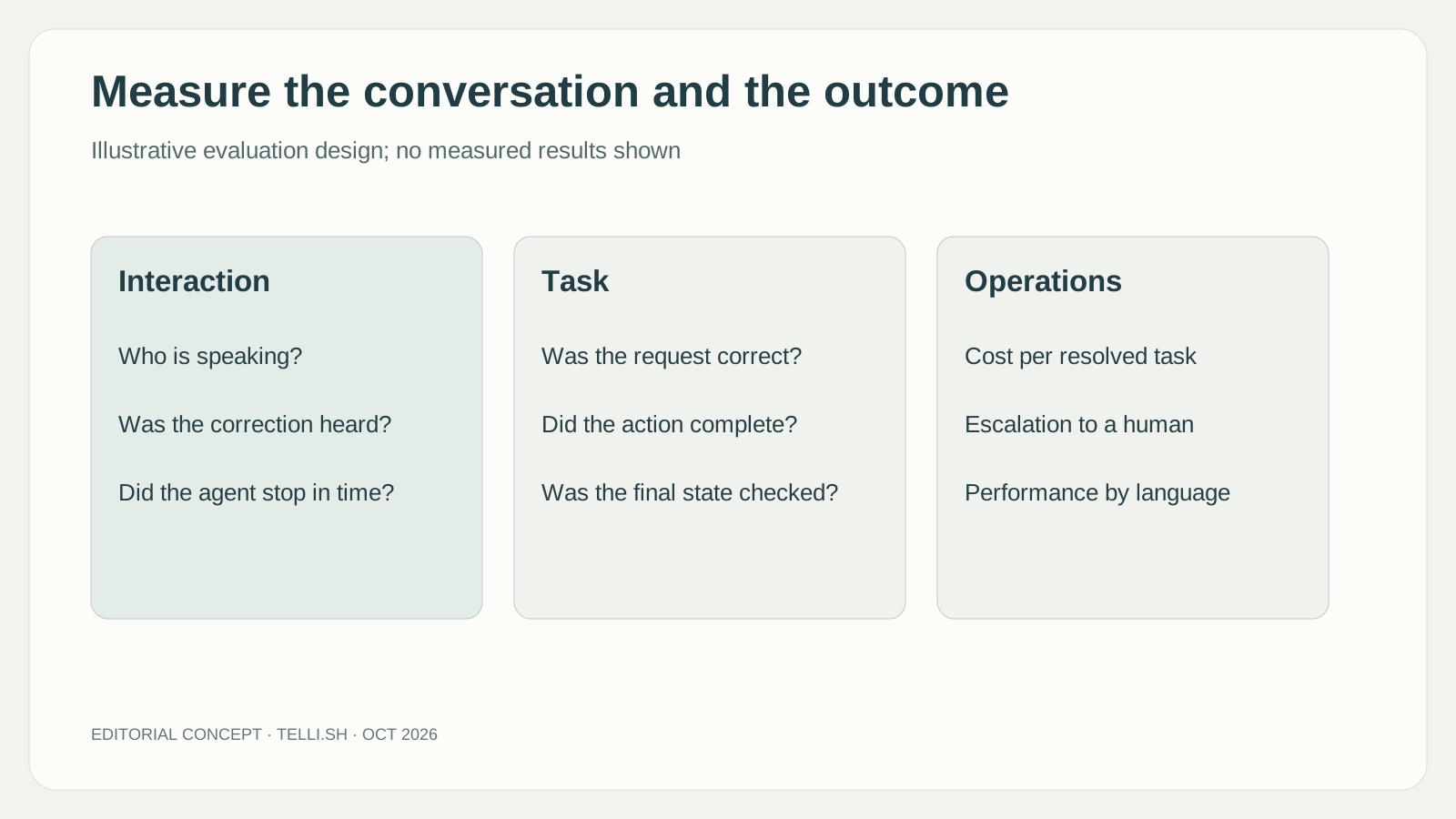
Original editorial evaluation framework. No test results are represented.
The next benchmark is a resolved conversation
A sensible pilot would use representative conversations with permission: short and long requests, interruptions, corrections, different languages and cases requiring escalation. Review whether the intended action happened, how often people had to intervene and what the completed interaction cost. Keep first-audio speed as one measure, but also count a fast answer that later needed correction. These measures describe a proposed evaluation, not tests we have performed on Realtime.
The most promising outcome is an agent that asks fewer unnecessary questions while remaining willing to ask the necessary one. A tutor should let a student finish thinking. A booking assistant should verify the corrected date. A support agent should carry context into a handoff. Those improvements are modest to describe and substantial to experience, because they remove the small frictions that make automated conversations exhausting.
Eleven Realtime gives that direction a concrete product form. It could let more teams build useful voice interactions without becoming experts in every component of the audio stack. Its longer-term significance will depend on whether integrated conversational behavior also produces reliable completed work. The voice gets the user into the conversation. The outcome determines whether they will want to have the next one.
Sources
-
Eleven Realtime announcement and benchmark context, October 20, 2026.
-
Realtime model modes, rollout and limitations, checked October 21, 2026.
-
ElevenLabs platform background, checked October 21, 2026.
-
OpenAI voice-agent architectures, checked October 21, 2026.
-
LiveKit turn handling, checked October 21, 2026.
Keep the conversation available for review
If you want a separate place to retain authorized recordings and your reviewed notes, Telli.sh is one option. Start with an audio note.